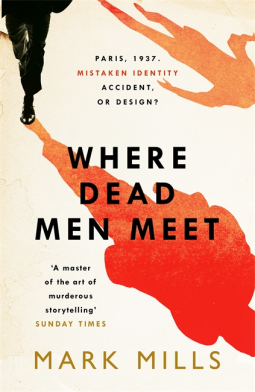
Where Dead Men Meet by Mark Mills

I’ve been reading books so quickly this month that I am now far behind with writing about them, so this is just a short post about an excellent new book by Mark Mills, published on 17 November.

I’ve been meaning to read more of Mark Mills’ books ever since I read The Savage Garden in 2008, a book I enjoyed very much, so I was keen to read his latest book, Where Dead Men Meet. It is historical fiction set in 1937 in pre-Second World War Europe, with a fast-moving plot as Luke Hamilton, an intelligence officer at the British Embassy in Paris, tries to discover why someone wants him dead, why Sister Agnes, the nun who had been his mentor and guide at the orphanage for the first seven years of his life had been bludgeoned to death, and who his real parents were.

Although the war in Europe is imminent it is by no means the main focus of this book, but forms an excellent backdrop as the action moves from Paris across the continent. At first he assumes that the assassin has mistaken him for someone else, but the tension builds as Luke realises that he is not the victim of a mistaken identity, but that someone is determined to kill him. He finds himself on the run, helped by a number of people, including the first man who tried to kill him. It seems the answers lie in his past. It is a complicated story that had me unsure of who Luke could trust and whether he would ever escape, or find out about his real family.

I thoroughly enjoyed this brilliant book with its interesting characters and a convincing plot full of mystery and intrigue. I shall now look out for more books by Mark Mills.

I received a copy of this book from the publisher, via NetGalley, for review.

  • Format: Kindle Edition
  • File Size: 972 KB
  • Print Length: 448 pages
  • Publisher: Review (17 Nov. 2016)

The Spy by Paulo Coelho


The Spy

Synopsis:

When Mata Hari arrived in Paris she was penniless.

Soon she was feted as the most elegant woman in the city.

A dancer who shocked and delighted audiences; a confidant and courtesan who bewitched the era’s richest and most powerful men.

But as paranoia consumed a country at war, Mata Hari’s lifestyle brought her under suspicion. Until, in 1917 she was arrested in her hotel room on the Champs Elysees and accused of espionage.

Told through Mata’s final letter, THE SPY tells the unforgettable story of a woman who dared to break the conventions of her time, and paid the price.

My thoughts:

Before I read this book I didn’t know much about Mata Hari, beyond the facts that she was an exotic dancer and that she was executed as a spy during the First World War, so I was interested to know more.

The Spy is a gripping tale and one I read quickly, fascinated by the story of Mata Hari, whose real name was Margaretha Zella, a name she detested. The book begins with a prologue describing the execution of Mata Hari in Paris on 15 October 1917. It is quite remarkable; she was calm, taking care with dressing herself and with her appearance and choosing to face the firing squad neither bound nor blindfolded.

It continues with her life story told through letters and news clippings and illustrated with photographs. She was accused of being a double agent, but claimed she was innocent and the evidence against her was indeed flimsy. The whole procedure was based on deductions, extrapolations and assumptions. Whatever the truth about her innocence, she comes across as a strong-minded, independent and arrogant woman, who believed she could use her beauty and charm to allure any man to get what she wanted.

I always like to know when I’m reading fictionalised biographies how much is based on fact and what has been fictionalised, so I appreciated the author’s explanatory note at the end of the book. Coelho writes that he had based his novel on facts, but he had created some dialogue, merged certain scenes, changed the order of a few events and left out anything he thought wasn’t relative to the narrative. His opening pages, for example are from a report for the International News Service by Henry G Wales in Paris and dated October 15, 1917 and he has borrowed some verbatim language from the report. He has used various sources such as the British Intelligence Service file on Mata Hari.

  • Format: Kindle Edition
  • File Size: 3598 KB
  • Print Length: 220 pages
  • Page Numbers Source ISBN: 1524732060
  • Publisher: Cornerstone Digital; 01 edition (22 Nov. 2016)

Many thanks to NetGalley for a review copy of this book.

What’s in a Name 2017

whats-in-a-name17

Next year Charlie at The Worm Hole is hosting the tenth ‘“ yes, tenth! ‘“ annual What’s In A Name challenge, originally started by Annie, then handed to Beth Fish Reads and now continued by Charlie. For full details go to the sign-up post. I’ve been doing this challenge since Annie started it in 2007, just missing the one in 2009! So, even though I’m cutting back on challenges for 2017, I really want to take part in this one.

The basics

The challenge runs from January to December. During this time you choose a book to read from each of the following categories. (Charlie’s examples of books you could choose are in brackets ‘“ translations and other languages most definitely count!):

  • A number in numbers (84, Charing Cross Road; 12 Years A Slave; 31 Dream Street)
  • A building (The Old Curiosity Shop; I Capture The Castle; House Of Shadows; The Invisible Library; Jamaica Inn)
  • A title which has an ‘˜X’ somewhere in it (The Girl Next Door; The Running Vixen)
  • A compass direction (North and South; Guardians Of The West; The Shadow In The North; NW)
  • An item/items of cutlery (The Subtle Knife; Our Spoons Came From Woolworths)
  • A title in which at least two words share the same first letter ‘“ alliteration! (The Great Gatsby; The Luminous Life Of Lilly Aphrodite; Gone Girl; The Cuckoo’s Calling)

Charlie is asking for one review per category. Where possible I like to read from my TBRs for my challenges and I’ve found the following books on my shelves (some are e-books) for each category and will choose one from each for this challenge.

A number in numbers

  • 1066: What Fates Impose by G K Holloway
  • 1599: a Year in the life of William Shakespeare by James Shapiro
  • 1946: The Making of the Modern World by Victor Sebestyen
  • 3500: An Autistic Boy’s Ten-Year Romance with Snow White by Ron Miles

A building – lots to choose from

  • Citadel by Kate Mosse
  • The Chapel in the Woods by Susan Louineau
  • Corduroy Mansions by Alexander McCall Smith
  • Framley Parsonage by Anthony Trollope
  • Heather Farm by Dorte Hummelshoj Jakobsen
  • The House by the Churchyard by Joseph Sheridan Le Fanu
  • The House in the Attic by Helen Cardwell
  • House of the Seven Gables by Nathaniel Hawthorne
  • The House of the Spirits by Isabel Allende
  • The House on Fever Street by Celina Grace
  • Last Man in Tower by Aravind Adiga
  • The Murder at Sissingham Hall by Clara Benson
  • The Power House by John Buchan

A title which has an ‘˜X’ somewhere in it

  • Exhume by Danielle Girard
  • The Girl Next Door by Ruth Rendell
  • The Mitfords: Letters Between Six Sisters edited by Charlotte Mosley
  • Notes from an Exhibition by Patrick Gale
  • A Place of Execution by Val McDermid
  • The Sex Life of My Aunt by Mavis Cheek
  • The Taxidermist’s Daughter by Kate Mosse

A compass direction

  • The King in the North by Max Adams
  • North and South – Elizabeth Gaskell
  • South Riding by Winifred Holtby

An item/items of cutlery – I thought I must have some crime fiction in my TBRs with ‘knife/knives’ in the title – but I haven’t! I read Charlie’s suggestion of The Subtle Knife several years ago. The only book I have to read in this category is:

  • The Tiny Fork Diet by Alan Sugar

A title in which at least two words share the same first letter ‘“ alliteration!

  • Break No Bones by Kathy Reichs
  • The Child’s Child by Barbara Vine
  • A Death in the Dales by Frances Brody
  • Deja Dead by Kathy Reichs
  • Dialogues of the Dead by Reginald Hill
  • Gone Girl by Gillian Flynn
  • Hangman’s Holiday by Dorothy Sayers
  • The Pickwick Papers by Charles Dickens
  • The Repentant Rake by Edward Marston
  • The Sacred Stone: The Medieval Murderers
  • Tinker Tailor Soldier Spy by John Le Carre
  • Whitethorn Woods by Maeve Binchy

Another Day Gone by Eliza Graham


Another Day Gone

In 2007 I read Eliza Graham’s debut novel, Playing with the Moon and loved it. I fully intended to read more of her books, but although I have her fifth book, The One I Was, I somehow missed the other three! So when I saw her latest book, Another Day Gone was available I was delighted to receive an advance copy through NetGalley.

I wasn’t disappointed – in fact I think it’s amongst the best books I’ve read this year.

It’s historical fiction, one of my favourite genres, beginning in 1939 just before the outbreak of the Second World War when a bomb went off in Coventry, killing some people and injuring many others. One of those injured was a girl who had seen a man prop a bicycle outside a store just before the bomb exploded. Her description led to his conviction and execution.

The action then moves forward to 1992 with Sara and her older sister Polly living in their family home in Oxfordshire on the banks of the Thames, with their grandfather and housekeeper (formerly their childhood nanny). The sisters’ parents had been killed in a car crash when they were very young. Polly is eighteen and is just about to leave home for university. All is not well and Polly hints that she knows a secret that she is not telling Sara – and then goes away with Michael, Bridie’s nephew, without saying where they are going or for how long.

Years later, in 2005 Sara returns to her family home, taking refuge from the London 7/7 bombings. Polly has now been missing for 13 years, their grandfather has died and Bridie is in a care home. The family secrets are still buried – until Polly returns!

Another Day Gone is a book about families, relationships and realising and living with the consequences of your actions. I loved the structure of this book with its different strands and time periods and all the twists and turns that kept me guessing about the nature of the secret that had remained hidden for so many years. I particularly liked the way it is only revealed drip by drip that meant I had changed my mind about what it was several times until fairly near the end of the book. The characters are so well drawn and sympathetically portrayed that I felt I knew them as people. It’s the type of book that I can get so involved with and whilst wanting to discover its secrets I just don’t want it to end.

  • Format: Kindle Edition
  • File Size: 2182 KB
  • Print Length: 322 pages
  • Page Numbers Source ISBN: 1503940039
  • Publisher: Lake Union Publishing (22 Nov. 2016)
  • Source: review copy via NetGalley

First Chapter, First Paragraph: A Cupboard Full of Coats

First chapter

Every Tuesday Diane at Bibliophile by the Sea hosts First Chapter First Paragraph Tuesday Intros to share the first paragraph sometimes two, of a book that she’s reading or planning to read soon.

My opener this week is from A Cupboard Full of Coats by Yvvette Edwards which was longlisted for The Man Booker Prize in 2011.

A Cupboard Full of Coats

It begins:

It was early spring when Lemon arrived, while the crocuses in the front garden were flowering and before the daffodil buds had opened, the Friday evening of a long, slow February, and I had expected when I opened the front door to find an energy salesperson standing there, or a charity worker selling badges, or any one of a thousand random insignificant people whose existence meant nothing to me or my world.

He just knocked, that was all, knocked the front door and waited, like he’s just come back with the paper from the shop, and the fourteen years since he’d last stood there, the fourteen years since the night I’d killed my mother, hadn’t really happened at all.

Blurb from Amazon:

Crushed by an impossible shame, Jinx’s life has been little more than a shell; estranged from her husband, she is even relieved when he takes her young son with him. When Lemon, an old friend of her mother’s, turns up on her doorstep, Jinx is forced to confront her past, and with the pain of remembrance comes the possibility of redemption. But Lemon has his own secrets to share, and together they unravel an unforgettable family drama, stoked with violence and passion. Rich with voices from East London and the West Indies, Edwards’s narrative is delivered with a unique and uncompromising bite that announces a new talent in British fiction.

I’ve borrowed this book from the library, attracted first of all by the title, wondering why it was called A Cupboard Full of Coats, and then by these opening paragraphs. I want to know more about Jinx, why she killed her mother and how the cupboard full of coats comes into the story.

What do you think and would you read on?

To the Bright Edge of the World by Eowyn Ivey

Blurb:

Lieutenant Colonel Allen Forrester receives the commission of a lifetime when he is charged to navigate Alaska’s hitherto impassable Wolverine River, with only a small group of men. The Wolverine is the key to opening up Alaska and its rich natural resources to the outside world, but previous attempts have ended in tragedy.

Forrester leaves behind his young wife, Sophie, newly pregnant with the child he had never expected to have. Adventurous in spirit, Sophie does not relish the prospect of a year in a military barracks while her husband carves a path through the wilderness. What she does not anticipate is that their year apart will demand every ounce of courage and fortitude of her that it does of her husband.

My thoughts:

I didn’t really know what to expect when I began reading To the Bright Edge of the World as I hadn’t read anything by Eowyn Ivey before (I see she has also written The Snow Child a Sunday Times bestseller and finalist for the Pulitzer Prize). I knew it was fiction but even so at first I wondered if it could be history, because it seemed so real with extracts from the reports, letters and journals of Lieutenant Colonel Allen Forrester, about his journey in 1885 from Perkins Island up the Wolverine River in Alaska. But the Author’s note reveals that the book was inspired by a historical military expedition and that all of the characters and many places in the story are fictionalised including the Wolverine River.

This is a lovely book, narrated through the journals not only of Allen Forrester, but also the diaries of his wife, Sophie. It begins with correspondence between Allen’s great nephew Walt (Walter) Forrester and Joshua Stone, the Exhibits Curator of the Alpine Historical Museum in Alaska about donating the writings and other material and artifacts to the museum. From then on these three strands of the book are interwoven and I was completely absorbed by each one – Allen’s expedition, Sophie’s life, pregnant and left on her own at Vancouver Barracks in Washington Territory and the letters between Walt and Joshua discussing the Forrester family history, the artifacts, and how life in Alaska changed after the expedition had opened up the area.

The facts of their lives make fascinating reading, demonstrating the difficulties and dangers of such a hazardous enterprise through unmapped and hostile territory as Allen travelled along the Wolverine River. Sophie’s story is equally fraught with difficulties left to cope with boredom and loneliness, the dangers of pregnancy and the antagonism of other women when she upset their social conventions. She takes up photography and I loved all the details of the early techniques of taking and developing photographs in the 1880s. As I read of her attempts to capture photos of birds, and especially a humming bird, I thought of the contrast between then and now – how we take digital photos with instant results and of wildlife programmes where the intimate life of birds is captured on film.

I also loved the mystic elements, the supernatural events that both Allen and Sophie experience, such as the raven and the mysterious old Indian man, the connection to folklore and the beautiful descriptions of the landscape. There are almost spiritual events that Ivey records without explanation that left me puzzling over what actually had happened and what they all meant.

And it is a book full of love, the love of Allen and Sophie and the love of the country, the landscape and its people. Although I said there are three strands to the book, as I read I moved between each one effortlessly, enjoying each one equally and from thinking it read like history, I soon realised it was a fictional story of great beauty, complete and whole, backed up by fact and elevated by Eowyn Ivey’s writing. I loved it.

  • Format: Kindle Edition
  • File Size: 6490 KB
  • Print Length: 433 pages
  • Page Numbers Source ISBN: 0316242853
  • Publisher: Tinder Press (2 Aug. 2016)

I received a copy of this book via NetGalley for review.