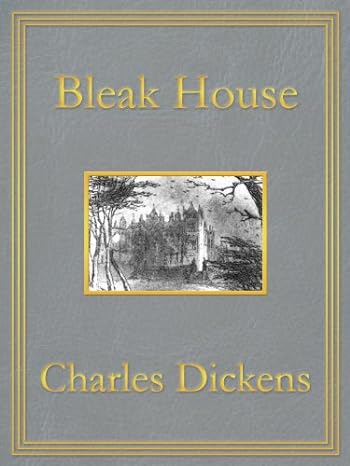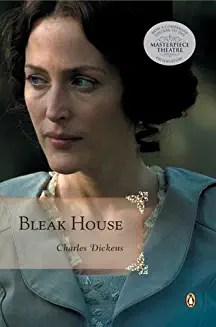
As the interminable case of Jarndyce and Jarndyce grinds its way through the Court of Chancery, it draws together a disparate group of people: Ada and Richard Clare, whose inheritance is gradually being devoured by legal costs; Esther Summerson, a ward of court, whose parentage is a source of deepening mystery; the menacing lawyer Tulkinghorn; the determined sleuth Inspector Bucket; and even Jo, the destitute little crossing-sweeper. A savage, but often comic, indictment of a society that is rotten to the core, Bleak House is one of Dickens’s most ambitious novels, with a range that extends from the drawing rooms of the aristocracy to the poorest of London slums.
I first read Bleak House after watching the 2005 Andrew Davies’ adaptation of the novel on BBC1 with Gillian Anderson as Lady Dedlock and Charles Dance as lawyer, Mr Tulkinghorn, with many more well known actors in the cast. I’ve been meaning to re-read it sometime and so I am pleased to be reading it again.
Did you take part in the Classics Spin? What will you be reading?
It would be an excellent match for he was rich, and she was handsome” Sense & Sensibility, 1811
When Elinor and Marianne Dashwood’s father dies, they with their mother and younger sister are forced to leave their family home Norland Park and take up residence in a small rented cottage. There they experience love, romance, and heartbreak. Marianne falling madly in love with the dashing Mr. Willoughby while Elinor silently hides her own broken heart from those nearest to her. A story of very mixed fortunes in love.
Jane Austen is one of my favourite authors and I’ve read all of her novels, beginning with Pride and Prejudice, which I’ve reread over the years many times, and watched TV and film adaptations. This year is the 250th anniversary of Jane Austen’s birth, so this is an ideal time to reread some of her books and I’m joining Brona at This Reading Life in her Austen 2025 project to reread her books, along with the Classics Club’s Sync Read (or readalong).
I first read Sense and Sensibility when I was at school but have never reread it. This time I read the annotated edition, edited by David M Shapard that gives explanations of historical context, citations from Austen’s life, letters, and other writings, definitions and clarifications, literary comments and analysis. There are multiple maps of England and London, an introduction, a bibliography, and a detailed chronology of events with more than 100 informative illustrations. I found I already knew some of the information given in some of these notes but others enhanced my understanding of the period. I particularly liked all the illustrations and the details about the cultural context, the social customs and conventions of the period.
Sense and Sensibility was Jane Austen’s first published novel. There was an earlier version, called Elinor and Marianne, that Jane Austen wrote in the form of letters probably in 1795 when she was nineteen. She returned to it after she began First Impressions, which later became Pride and Prejudice. Towards the end of 1797 she returned to Elinor and Marianne, modifying it and changing its name to Sense and Sensibility. It wasn’t until 1810 that she finished the book and it was published in 1811.
It focuses on the two Dashwood sisters, Elinor (aged 19) and Marianne (aged 16), who have contrasting temperaments. On the surface Elinor, the older sister represents sense or reason while Marianne represents sensibility or emotion. However as the story develops they both exhibit varying aspects of each characteristic. Marianne comes over at first as a rather silly teenager, emotional and passionate, who openly expresses her likes and dislikes, letting everyone know how much she is grieving for her father and how much she loves her new friend she met whilst living at Barton Cottage, John Willoughby. Elinor, however, is more restrained and discrete, controlling her emotions and reactions, even though she has strong feelings for her sister-in-law’s brother, Edward. Later in the book, however, both sisters display both ‘sense’ and ‘sensibility’, which I think makes them more believable as characters.
I’m not going into any more detail about the plot. A lot happens, there are misunderstandings and many secrets are exposed. I liked the way the story moves between the two sisters switching from one to another. At first I did feel more sympathetic towards Elinor, but Marianne did grow on me by the end of the book. They both grew in complexity as Jane Austen developed their characters. There are many other characters, some foolish or absurd providing comic relief and others who are nasty and selfish and cause both Elinor and Marianne much anguish and heartache.
I thoroughly enjoyed the book!
And now I’m looking forward to re-reading Pride and Prejudice.
Before next Sunday, 16 February 2025 create a post that lists twenty books of your choice that remain “to be read” on your Classics Club list. On that day the Classics Club will post a number from 1 through 20. The challenge is to read whatever book falls under that number on your Spin List by the 11 April 2025
Here’s my list:
The Annotated Pride and Prejudice by Jane Austen (a re-read)
In Cold Blood by Truman Capote
The Case of the Gilded Fly by Edmund Crispin
Bleak House by Charles Dickens
Dombey and Son by Charles Dickens
Nicholas Nickleby by Charles Dickens
The Lost World by Arthur Conan Doyle
Friends and Heroes by Olivia Manning
The Birds and other short stories by Daphne du Maurier
I’ll Never be Young Again by Daphne du Maurier
North and South by Elizabeth Gaskell
Brighton Rock by Graham Greene
The Go Between by L P Hartley
The Great Fire by Shirley Hazzard
Brave New World by Aldous Huxley
Daisy Miller by Henry James
Go Set a Watchman by Harper Lee
Friends and Heroes by Olivia Manning
Down and Out in Paris and London by George Orwell
Fire from Heaven by Mary Renault
I’m happy to get any of these, but it would be great if it’s Pride and Prejudice as that is the book I’ll be (re)reading in March as part of the ReadingAusten25 project.
I read the first Loch Down Murder Mystery, Loch Down Abbey in 2021 and enjoyed it very much, so I was looking forward to reading Only Murders in the Abbey, set in 1930s Scotland . And I’m glad to say that I thought it was even better than the first one.
Description from the publishers:
Mrs MacBain, thank god it’s you.’ Without another word, he grabbed her arm and pulled her into the room, locking the door behind them. Mrs MacBain turned around, clearly offended at being manhandled, but then gasped, ‘Is that blood?’
Loch Down Abbey is full of guests for a Highland Ball. Including several uninvited members of the Inverkillen clan, the Abbey’s former residents. Housekeeper Mrs MacBain thinks her biggest challenge will be finding suitable rooms for everyone and keeping the peace at cocktail hour.
Until the morning after the ball, when one of the guests is discovered inside the Abbey’s library – as dead as a doornail.
Who would have had motive to want them dead? And how did they manage to commit their crime and escape while keeping the door locked from the inside?
With an Abbey full of suspects and secrets, it is down to Mrs MacBain to catch the killer before they strike again…
The Abbey, formerly the ancestral home of the Ogilvy-Sinclair family is now an hotel, owned by several of the long-standing employees and staffed mainly by the former servants, led by Mrs Alice McBain as the Director of Operations. The manager of the hotel is The Honourable Fergus Ogilvy-Sinclair, the youngest grandson of Lady Georgina, the Dowager Countess of Inverkillen. Her eldest grandson is Lord Angus Inverkillen, the current Earl of Inverkillen.
There are so many characters in this book including family members, hotel staff and guests that I found it difficult to keep track of all of them. However the main characters are very clearly defined and there is a list of all the characters at the beginning of the book, which is a great help.
The book begins the morning after a Highland Ball as Hudson, one of the co-owners of the Abbey, is doing his rounds when he finds a dead body in the Small Library, which had been locked for the Ball. The name of the victim is not revealed. The narrative then goes back to the fortnight before the Ball, introducing the characters and their relationships and it is not until the second half of the book that the identity of the victim is revealed.
Detective Inspector Jarvis from the local constabulary is called in to investigate, but as Mrs McBain thinks he is not ‘the sharpest axe in the shed’. And it is mainly down to her to get to the bottom of the mystery – how a murder could take place in a locked room, who had the motive to commit murder and how was the opium trade in Shanghai involved. As the victim had been stabbed to death the number of suspects includes all the men at the ball who were in Highland dress which includes a sgian-dubh, (pronounced ‘skeen doo’), a small single-edged knife, worn as part of Highland dress in the sock of a kilted Scot. So, there are many suspects, making the investigation tremendously complicated and involving many red herrings, and twists and turns as several secrets and scandals are revealed.The Epilogue introduces yet another unexpected turn.
How on earth Beth Cowan-Erskine kept so many strands in play, set in a richly described location and with believable characters is totally beyond me. But she did, with immense skill making this a most enjoyable book. As she describes it it is ‘a lunatic world’ that she has created. I really hope there will be a third Lock Down Murder Mystery.
Many thanks to the publishers for a review copy via NetGalley.
Top 5 Tuesday was created by Shanah at Bionic Book Worm, and it is now being hosted by Meeghan at Meeghan Reads. For details of all of the latest prompts for January to March, see Meeghan’s post here.
Today the topic is Top 5 series I will finish in 2025. Which series are you planning to finish (or finish to most recent publication) in 2025?
I have many series on the go. These five crime fiction novels are just the tip of the iceberg! I’m not saying I’ll finish these series this year, but I’m hoping I’ll make some progress with them this year.
Ian Rankin’s Inspector Rebus series. There are 25 and I’ve read 24 – just one more to read, Midnight and Blue. This is the latest book in the series, so this is the only series that I will finish this year.
Reginald Hill’s Dalziel and Pascoe novels. There are 24 books in the series and I’ve read 16.
Peter Robinson’s Inspector Banks series. There are 28 and I’ve read 20.
Ann Cleeves’ VeraStanhope books. There are 11 and I’ve read 9.
Georges Simenon’s Inspector Maigret books – there are 75 and I’ve read 16. It’ll take me ages to finish this series – if I ever do!
Spell the Month in Books is a linkup hosted by Jana on Reviews From the Stacks on the first Saturday of each month. The goal is to spell the current month with the first letter of book titles, excluding articles such as ‘the’ and ‘a’ as needed. That’s all there is to it! Some months there are optional theme challenges, such as “books with an orange cover” or books of a particular genre, but for the most part, any book you want to use is fair game!
This month I’m not taking the option, which is Valentine’s Day/something sweet on the cover, but instead I’m featuring books from my blog, some from the early days of the blog.
F is for Fair Exchange by Michele Roberts – historical fiction set in England and France in the late 1700s/early 1800s during the French Revolutionary period. While drawing hints and facts from the lives and secret affairs of two of the most famous and passionate figures of the late 18th century – Mary Wollstonecraft and William Wordworth – the intriguing mystery surrounding these two women, is Michèle Roberts own fascinating creation. It’s about William Saygood a fictional friend of Wordsworth’s. Mary Wollstonecraft appears in the novel but Roberts has ‘plundered various aspects of her life’ for the character, Jemima Boote. There is a fair bit in this book about women’s rights and their place in society, and about the question of nurture versus nature in bringing up children.
E is for Elizabeth is Missing by Emma Healey – Maud has dementia – but she knows her friend Elizabeth is missing. I enjoyed the TV adaption with Glenda Jackson as Maud much more than the book. Emma Healey’s depiction of dementia is convincing showing the confusion and bewilderment that Maud must have felt. It’s heart-rending. As Maud continues her search for Elizabeth, she also recalls the search for her sister, Sukey, who disappeared in 1946. And no matter who tells her to stop going on about it, to leave it alone, to shut up, Maud will get to the bottom of it. Because somewhere in Maud’s damaged mind lies the answer to an unsolved seventy-year-old mystery. One everyone has forgotten about.
B is for Bad Science by Ben Goldacre – a splendid rant against the lack of education and knowledge about health with the inevitable result that we are unable to understand and judge for ourselves the effectiveness of the various treatments on offer. He describes how placebos work, just what homeopathy is, the misunderstandings about food and nutrition, and above all how to decide what works and what is quackery, scaremongering or downright dangerous. I found this easy to understand, apart from the statistics, which cause my eyes to glaze over at the mere sight of a graph, tables or columns of figures. Fortunately there’s not a lot of that in this book.
R is for Resurrection Men by Ian Rankin, an Inspector Rebus book. Resurrection Men isn’t about body-snatchers (as I wondered it might be), but about the cops who need re-training, including Rebus. They’re at Tullialian, the Scottish Police College and they are a tough bunch indeed, ‘the lowest of the low‘ as one of them, DI Gray tells a witness he is interrogating. To help them become team players – fat chance of that I thought – they’ve been given on old, unsolved case to work on. But Rebus was involved in the case at the time and begins to get paranoid about why is on the course. It’s a tough, gritty story and as with other Rebus books, there’s more than one investigation on the go, several, in fact, needing concentration to keep tabs on each one. I thought it was excellent.
U is for Ulyssesby James Joyce – I have started this book and given up several times. I’d love to say I’ve finished it, but I haven’t. It deals with the events of one day in Dublin, 16th June 1904, now known as “Bloomsday”. The principal characters are Stephen Dedalus, Leopold Bloom and his wife Molly. Loosely modelled on the wanderings of Homer’s Ulysses as he travelled homewards to Ithaca, Joyce’s novel follows the interwoven paths of Stephen, estranged from his father and Leopold, grieving for his dead infant son. Written over a seven-year period, from 1914 to 1921, Ulysses has survived bowderlization, legal action and bitter controversy.
A is for All Bones and Lies by Anne Fine. I had high hopes I would like this book and that it would be a funny book – Anne Fine has won Awards for her children’s books and the film, Mrs Doubtfire, starring Robin Williams, is based on her book Madame Doubtfire. Although I didn’t enjoy the story, I did find it an indictment of how old age is looked upon by some people – an angry, unsettling and cruel look at our society.
Colin, works for the council and visits his aged mother, Norah. Norah is a grumbler, completely self-absorbed and constantly belittling Colin who can never please her. At times I found it confusing, just what was real and what was in his imagination and how the book hung together. Of course, everything goes wrong as events spiral out of Colin’s control.
R is for The Return of the Native by Thomas Hardy, one of my favourite authors and I thoroughly enjoyed this book. It’s a dramatic and tragic love story. It has a large cast of characters, with lovers who change their affections throughout the novel and it’s full of intrigue with striking moonlit scenes, disputes, heated quarrels and misunderstandings, along with rustic characters and traditional celebrations, for example Guy Fawkes night, May Day and a Mummers’ play at Christmas. It’s not a book to read quickly and it transported me back to a time that ceased to exist before I was born, where time moved more slowly, ruled by the seasons and the weather, and with a clearly defined social hierarchy. And yet, I was surprised to find that youngsters were scribbling graffiti on ‘every gatepost and barn’s doors’, writing ‘some bad word or other’ so that a woman can hardly pass for shame some time.’
Y is for You Talkin’ To Me?: Rhetoric from Aristotle to Obama by Sam Leith a TBR. Sam Leith traces the art of argument from ancient Greece down to its many modern mutations. He introduces verbal villains from Hitler to Donald Trump – and the three musketeers: ethos, pathos and logos. He explains how rhetoric works in speeches from Cicero to Richard Nixon, and pays tribute to the rhetorical brilliance of AC/DC’s “Back In Black”. Before you know it, you’ll be confident in chiasmus and proud of your panegyrics – because rhetoric is useful, relevant and absolutely nothing to be afraid of.
The next link up will be on March 1, 2025 when the theme be Science Fiction