Stacking the Shelves: 12 April 2025

It’s Saturday and time for Stacking the Shelves, hosted by Marlene at Reading Reality and the details are on her blog, as well as a huge amount of book reviews. Why not visit her blog if you haven’t already found it? The gorgeous graphic is also used courtesy of the site.

The idea is to share the books you are adding to your shelves, may they be physical or virtual. This means you can include books you buy in physical stores or online, books you borrow from friends or the library, review books, gifts and of course e-books!

These are e-books I’ve either bought or acquired for free this month:

Underland: A Deep Time Journey by Robert Macfarlane, a 99p offer.

In Underland, Robert Macfarlane takes us on a journey into the worlds beneath our feet. From the ice-blue depths of Greenland’s glaciers, to the underground networks by which trees communicate, from Bronze Age burial chambers to the rock art of remote Arctic sea-caves, this is a deep-time voyage into the planet’s past and future. Global in its geography, gripping in its voice and haunting in its implications, Underland is a work of huge range and power, and a remarkable new chapter in Macfarlane’s long-term exploration of landscape and the human heart.

The One That Got Away by Mike Gayle.This was free – a bonus short story from Amazon Prime this month.

Reuben thought he’d spend the rest of his life with Beth, until she broke his heart six months ago. He’s not even remotely over her, so he’s devastated to hear she’s getting married—this weekend. Now he’s faced with the ultimate question: what should he do on the day of the wedding? Grieve? Disrupt the ceremony? Or do everything in his power to pretend it’s not happening? Enlisting the help of his friends, Reuben is all set to mark the occasion with distraction on a grand scale: Ferraris, champagne, and a VIP box at the races. But on the morning of the Big Day, Reuben gets a phone call that not only derails his elaborate itinerary: it may well change his life completely…

The Boy from Tiger Bay: A True Story of Murder, Betrayal, and a Fight for Justice by Ceri Jackson. A free book from Amazon Prime this month.

A brutal murder. A blighted investigation. The true story of five men damned by a crime they didn’t commit.

On Valentine’s Day 1988, twenty-year-old Lynette White was brutally murdered in a dark corner of Cardiff’s world-famous, and infamous, Tiger Bay. Stigmatised by a bad reputation, the area was on the brink of major redevelopment which would change the historic community forever.

South Wales Police launched its biggest murder hunt to date, and within weeks detectives released a photofit of a prime suspect seen outside the murder scene, his hands covered in blood. A white man. But as the months passed by and no arrest was made, the police came under inevitable pressure.

Everyone knew John Actie. But he didn’t know Lynette White. Yet, almost a year after her death, he and four other innocent men were charged with killing her. None matched the description, and none were white. But they became the scapegoats in what some saw as a desperate attempt to close the case.

Told predominantly through John Actie’s eyes, The Boy from Tiger Bay is an explosive true-crime narrative that exposes one of the UK’s most infamous murder investigations—a story of racial injustice and the enduring fight to bring the truth to light.

I’ve received one ARC this week from NetGalley

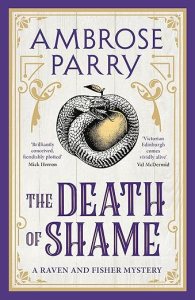
The Death of Shame (A Raven and Fisher Mystery Book 5) by Ambrose Parry, publication date, 5 June 2025.

1854, Edinburgh.
Respectable faces hide private sins.

Apprentice Sarah Fisher is helping to fund Dr Will Raven’s emerging medical practice in exchange for being secretly trained as a medic, should the rules barring women ever change. Sarah needs no instruction in the inequalities that beset her gender, but even she has her eyes opened to a darker reality when a relative seeks her help in searching for her missing daughter. Annabel Banks was promised a situation in a prestigious household, but there has been no word from her since she left home, and the agency that arranged her position says she never appeared.

Sarah’s inquiries lead her to reforming campaigners trying to publicise the plight of the hundreds of girls ensnared in Edinburgh’s houses of assignation. Sarah learns how young women are lured, deceived, trafficked and raped, leaving them ruined in the eyes of a society obsessed with moral purity, and where virginity is prized as a lucrative commodity.

Drawing upon real historical events, The Death of Shame takes Raven and Sarah into a treacherous labyrinth of exploitation, corruption, and immorality.

The 1952 Club

 Simon and Karen are holding the next bi-annual even from 21st to 27th April 2025, when we’ll be reading books from 1952! They are asking readers across the internet to join together to build up a picture of the year 1952 in books – you can read, share, review and comment on any book from the year in question; you can get involved as much or as little as you like. You could read one book or several; it’s low pressure and you have a wide choice of reading matter! There will be a dedicated page for the club where Karen will share links to other people’s posts and reviews.

I’ve previously read and reviewed read these books published in 1952:

Mrs McGinty’s Dead (Poirot and  Mrs Ariadne Oliver)

They Do It With Mirrors (Miss Marple)

The Old Man and the Sea by Ernest Hemingway

East of Eden by John Steinbeck

Excellent Women by Barbara Pym

Tiger in the Smoke by Margery Allingham

Murder in the Mill Race by E C R Lorac

The Man on a Donkey by H F M Prescott

I have other books published in 1952 to read in my TBRs, so I’ll read one or more of the following books:

Sword of Honour – the first book in the Men at Arms series by Evelyn Waugh

Five Have a Wonderful Time by Enid Blyton

The Singing Sands by Josephine Tey – this was the last of Josephine Tey’s Inspector Grant mysteries, published posthumously by Peter Davies Ltd in 1952

The Birds and other stories by Daphne du Maurier

Top 5 Tuesday:Books set in the Americas

Top 5 Tuesday was created by Shanah at Bionic Book Worm, and it is now being hosted by Meeghan at Meeghan Reads. For details of all of the latest prompts for January to March, see Meeghan’s post here.

Today the topic is Books set in America – North or South, we’re doing the continents. Tell us about all your fave books set in the Americas.

I have too many books to choose from to say these are the top five books set in the Americas that I’ve read. And it’s so hard to decide which ones to feature, because I could pick five different books on another day. But in the end I decided to pick books from Canada, the USA and South America (Brazil and Chile) They are all books I’ve read and loved.

Canada:

A Town Called Solace by Mary Lawson. It’s set in North Ontario in 1972, but looks back to events thirty years earlier when Elizabeth Orchard first met Liam who was then a small boy of 3 when he and his family lived in the house next door. The last time she saw him he was still only 4 years old. It was not a happy time for either of them, and thirty years later, when she is dying she wants to make amends and gives him her house.

Clara lives next door to Elizabeth, who she loves, and she is alarmed when she sees Liam moving into Elizabeth’s house. Elizabeth had given her a key and she goes in every day to feed Moses, Elizabeth’s cat. She has no idea that Elizabeth is dying and is furious when she discovers that Liam is moving Elizabeth’s things and packing them in boxes. Her life is in turmoil in any case as she is devastated that Rose, her 16 year old sister has gone missing.

The narration moves between these three people, seeing events through their eyes. Elizabeth, in hospital looks back over her life, remembering her despair at not having a child of her own, and her love for little Liam that ended badly, despite her good intentions. Clara spends the time before and after school at the window looking out for Rose’s return and Liam, whilst remembering his sad childhood, is trying to rebuild his life after his marriage ended in divorce.

I loved this book. It’s about families, the things that go wrong, about memories and about friendships and the care that people have for each other. It’s moving and sad, but also filled with hope. And it’s beautifully written.

North America:

To Kill a Mockingbird by Harper Lee, set in the Deep South of  America in the 1930s. It’s narrated by Scout (Jean Louise Finch) as she looks back as an adult to the Depression, the years when with her older brother, Jem, and their friend, Dill, she witnessed the trial of Tom Robinson, a black man accused of raping a white girl. Scout’s father, Atticus, a lawyer defends Tom. It’s also the story of Boo Radley, their neighbour, a man who is never seen, who is said to only come out at night. 

Scout is a feisty character, always prepared to stand up for what she thinks is right, but Atticus, who also stands for justice and the moral and ethical ideal, has to reign her in sometimes. The book is full of strong characters and for me the outstanding scenes are those when Atticus sat reading outside the jail to stop the lynch mob attacking Tom and the trial itself at the court-house. 

The Help by Kathryn Stockett. Enter a vanished and unjust world: Jackson, Mississippi, 1962. Where black maids raise white children, but aren’t trusted not to steal the silver…

There’s Aibileen, raising her seventeenth white child and nursing the hurt caused by her own son’s tragic death; Minny, whose cooking is nearly as sassy as her tongue; and white Miss Skeeter, home from college, who wants to know why her beloved maid has disappeared.

Skeeter, Aibileen and Minny. No one would believe they’d be friends; fewer still would tolerate it. But as each woman finds the courage to cross boundaries, they come to depend and rely upon one another. Each is in a search of a truth. And together they have an extraordinary story to tell…

South America:

State of Wonder by Ann Patchett. Among the tangled waterways and giant anacondas of the Brazilian Rio Negro, an enigmatic scientist is developing a drug that could alter the lives of women for ever. Dr Annick Swenson’s work is shrouded in mystery; she refuses to report on her progress, especially to her investors, whose patience is fast running out. Anders Eckman, a mild-mannered lab researcher, is sent to investigate.Dr. Annick Swenson, a research scientist, is developing a drug that could alter the lives of women forever.

A curt letter reporting his untimely death is all that returns. Now Marina Singh, Anders’ colleague and once a student of the mighty Dr Swenson, is their last hope. Compelled by the pleas of Anders’s wife, Marina leaves the snowy plains of Minnesota and retraces her friend’s steps into the heart of the South American darkness, determined to track down Dr. Swenson and uncover the secrets being jealously guarded among the remotest tribes of the rainforest.

The novel raises questions about the morality and ethics of research into the use of extreme fertility treatments and drug studies in general, along with the exploitation of native populations. It is wonderfully descriptive and I could easily imagine that I was there in the jungle, experiencing the oppressive heat and humidity. I found it all fascinating and I was totally absorbed in the story.

Portrait in Sepia by Isabel Allende, part of a trilogy, with The House of the Spirits and Daughter of Fortune. Aurora is the narrator and this is the story of her family and after giving details of her birth, Aurora goes back to 1862 beginning her story with details about her grandparents. There is a lot of detail, a lot of 19th century history of Chile, its mix of nationalities, politics and wars.

It’s a book about love, loss, identity, betrayal and about family relationships. It’s a portrayal of the strengths and weaknesses of the characters and their struggle to survive. Aurora tells her family’s story through looking at photographs, snapshots in time, through her own disjointed, incomplete and vague memories of her childhood and through conversations with her family members. Whilst she was still very young her two grandmothers decided her future, thinking that time would erase the memory of the traumatic events she had seen, never realising that the scenes would live forever in her nightmares.

Spell the Month in Books – April 2025

Spell the Month in Books is a linkup hosted by Jana on Reviews From the Stacks on the first Saturday of each month. The goal is to spell the current month with the first letter of book titles, excluding articles such as ‘the’ and ‘a’ as needed. That’s all there is to it! Some months there are optional theme challenges, such as “books with an orange cover” or books of a particular genre, but for the most part, any book you want to use is fair game!

This option this month is Animal on the Cover or in the Title, which I found much easier to do than some of the previous options. These are all books I’ve read, apart from Inchworm.

A is for Animal Farm by George Orwell is an allegorical novella, of the Russian Revolution and the rise of the Soviet Union. It tells the story of a farm where the animals rebel against the farmer, Mr Jones, and throw him off the land. They hope to create a society where they are all equal, free and happy. Ultimately, the farm ends up in a state that is as bad, if not worse than it was before, under the dictatorship of a pig named Napoleon. It begins as the old boar Major tells the animals about his dream of overthrowing the human race when the produce of their labour would then be their own and he incites them to rebel. In the story that follows the Major is based on Marx, Farmer Jones on the Tsar, the pigs Napoleon and Snowball are based on Stalin and Trotsky respectively. Their revolution began by declaring that all animals are equal and ended with the added phrase but some animals are more equal than others.

P is for The Pale Horse by Agatha Christie. Neither Hercule Poirot, nor Miss Marple feature in this novel and Mrs Ariadne Oliver has only a small part. Detective Inspector Lejeune is in charge of the investigation into the murder of Father Gorman who was killed one night on his way home. A list of names is found on Father Gorman’s body, seemingly unconnected in any way. The title,  a reference from the Book of Revelation  to a pale horse ridden by Death suggested to me from the beginning that what they had in common was death.

The Pale Horse is an old house  which was formerly an inn in the village and is now the home of three weird women, thought by the locals to be witches. The Pale Horse is also the name of a sinister organisation that arranges murders based on black magic. It’s a fascinating book conveying a feeling of real menace.

R is for The Raven’s Head by Karen Maitland. Set in 1224 in France and England this is a dark book. I found parts of it very uncomfortable and disturbing to read and yet also very compelling. Life in the medieval world was cruel and brutal and The Raven’s Head describes that world in minute detail, evoking the superstitious fear of the period.

The story is told from the three main characters point of view – Vincent, Wilky, a young boy taken from his family to live in a monastery in Norfolk where unspeakable terrors await him and the other young boys, and Gisa also living in Norfolk, working in her uncle’s apothecary’s shop. Their lives are connected through Lord Sylvain who is trying to find a way to bring the dead back to life and the abbot, trying to find the elixir of life – both experimenting with alchemy.

I is for Inchworm by Ann Kelly. Gussie is a twelve year old girl from St. Ives in Cornwall. She is passionate about learning, wildlife, poetry, literature, and she wants to be a photographer when she grows up. But her dreams were put on hold as she struggled with a serious heart condition. Now she has got what she needed: a heart and lung transplant. But it isn’t working out quite the way she thought. Firstly she has to leave her beloved Cornwall to live in London and in the months following her operation she is unable to do very much except read and adopt a stray kitten, but she could do that when she was sick. She craves adventure and experience beyond her four walls, until, that is, she hits upon a plan – she is going to get her divorced parents to fall in love again. It’s not going to be easy, her mum is still dating her doctor boyfriend and despises Gussie’s father, who happens to be living with his new girlfriend – the Snow Queen. But Gussie is a determined girl and there is only one thing that could stop her now.

L is for Lion by Conn Iggluden. This is the first book in Conn Iggulden’s Golden Age series set in Amcient Greece in the 5th century BCE. I thoroughly enjoyed it which surprised me as generally speaking I’m not keen on reading battle scenes and the book starts and ends with battles. But I had no problem with following the action of the battles between the Greeks and the Persians, and was able to visualise what was going on without any difficulty. The characters’ names took me a little while to get clear in my mind but I soon got used to them. The two main characters are both young men, Cimon the older of the two has more authority than Pericles, the younger man. Lion is the story of their early careers.

The next link up will be on May 3, 2025 when the theme will be: Freebie

Six Degrees of Separation from  Knife by Salman Rushdie to The Likeness

It’s time again for Six Degrees of Separation, a monthly link-up hosted by Kate at Books Are My Favourite and Best. Each month a book is chosen as a starting point and linked to six other books to form a chain. A book doesn’t need to be connected to all the other books on the list, only to the one next to it in the chain.

This month we start with Knife: Meditations After an Attempted Murder by Salman Rushdie, a searing, deeply personal account of enduring—and surviving—an attempt on his life thirty years after the fatwa that was ordered against him.

My first link is The Subtle Knife by Philip Pullman, the second book in the His Dark Materials trilogy. Taken together the books form a grand epic, encompassing parallel universes and their inhabitants. It’s a fabulous story, featuring armoured bears who talk, witches, spectres, angels, and tiny hand sized creatures who fly on the backs of dragonflies.

In The Subtle Knife the action takes place in several universes and Will becomes the bearer of the Subtle Knife, which enables him to cut windows from one universe into a parallel one. In one of these worlds he meets Lyra and they join forces.

My second link is Bring Up the Bodies by Hilary Mantel, the second book in her Wolf Hall trilogy. I didn’t enjoy it as much as the first book Wolf Hall and I had just a little feeling of anti-climax about it, but then the novelty of Wolf Hall for me was the way Hilary Mantel not only brought the Tudor world alive but also how she overturned my ideas of both Thomas Cromwell and Sir Thomas More. As there is no denying that I knew that Anne Boleyn was not going to make a go of her marriage to Henry VIII, there was little drama there for me. I didn’t even want her to escape her fate.

And yet, Bring Up the Bodies is still a brilliant book. It’s beautifully written, full of colour and detail so that there is no doubt that this is 16th century England, with vivid descriptions of the people, buildings, fabrics, and landscapes of both town and countryside.

My third link is a book with just one body, The Body in the Ice by A J MacKenzie, the 2nd Hardcastle and Chaytor Mystery set in Romney Marsh and the surrounding countryside in 1796-7. This is the period after the end of the American War of Independence, so Britain and America are at peace, but Britain and revolutionary France are at war with the constant threat of a French invasion. A J Mackenzie is the pseudonym of Marilyn Livingstone and Morgen Witzel, an Anglo-Canadian husband-and-wife team of writers and historians.

Version 1.0.0

My fourth link is Losing You by Nicci French, a fast paced, take-your-breath-away book about Nina whose teenage daughter, Charlie goes missing. I read it at break-neck speed, switching between being completely engrossed, and desperate for her to find her daughter before it’s too late and being annoyed by her attitude to the police. It’s set on Sandling Island (a fictional place based on Mersea Island, Essex) off the east coast of England and the feelings of isolation and oppression fill the book. ‘Nicci French’ is the pseudonym of wife and husband Nicci Gerard and Sean French.

My fifth link is to another missing teenage daughter in Eyes Like Mine by Sheena Kamal, her debut novel. Everything about this book fascinated me from the characters and in particular the main character, Nora Watts, the gripping storylines that kept me racing through the book, to the atmospheric, gloomy setting in Vancouver and in beautiful British Columbia with its snow, mountains and plush ski resorts.

The plot is intricate, complicated and fast moving, highlighting various issues such as mixed race inheritance and differences in treatment based on skin colour, homelessness, and environmental issues. These never overpower the story, but form part of the book as a whole.

My final link is the word like in the title – The Likeness by Tana French, which I read recently for Reading Ireland Month 2025. It’s a gripping fast paced book, set in Ireland, with well drawn characters, including a group of five friends living in a large house in the countryside. French portrays each of these friends in detail, and as the story progresses their backgrounds and relationships are revealed. The book begins as one of the friends, Lexie Madison is murdered.

Astonished by the fact that Lexie is her double, Detective Cassie Maddox, who played a small role in In the Woods, is persuaded to go undercover at the house, and assume the dead women’s identity, the police having told her friends she wasn’t killed, but was merely wounded. Far-fetched, yes, but it didn’t take me long before I found myself accepting this was feasible. 

My chain goes from Rushdie’s Knife to another book with the word ‘knife‘ in the title, then to two books that are second books in trilogies, two books with a body/bodies in the titles, to two books featuring missing teenagers and finally to two books with ‘like‘ in the titles. It travels from New York, through parallel universities, Tudor England, Romney Marsh, Sandling Island, Vancouver and British Columbia and Ireland.

What is in your chain, I wonder?

Next month (May 3 , 2025), we’ll start with an historical novel longlisted for the 2025 Stella Prize, Rapture by Emily Maguire.

The Singing Sands by Josephine Tey: Book Beginnings on Friday & The Friday 56

Every Friday Book Beginnings on Friday is hosted by Gillion at Rose City Reader where you can share the first sentence (or so) of the book you are reading. You can also share from a book you want to highlight just because it caught your fancy.

I’m featuring The Singing Sands, by Josephine Tey, an Inspector Grant mystery, one of the books I’m currently reading.

It was six o’clock of a March morning, and still dark. The long train came sidling through the scattered lights of the yard, clicking gently over the points.

Also every Friday there is The Friday 56, hosted by Freda at Freda’s Voice, but she is taking a break and Anne at My Head is Full of Books has taken on hosting duties in her absence. You grab a book and turn to page 56 (or 56% of an eBook), find one or more interesting sentences (no spoilers), and post them.

I’ve seen the lighthouse on the point there standing up in the air. Yes. halfway up in the sky. I’ve seen the hill there change shape until it looked like a great mushroom. And as for those rocks by the sea, those great pillars of stone, they can turn light and transparent and move about as if they were walking through a set of the Lancers.

Description:

En route for the Outer Hebrides on sick leave, Inspector Grant literally stumbles upon the body of a young man in a train compartment that reeks of whisky. Grant firmly walks away from the corpse, determined to let nothing interfere with his holiday plans.
But he absentmindedly carries a newspaper away from the scene with him, a newspaper with a cryptic poem scribbled in the margin: The beasts that talk, The streams that stand, The stones that walk The singing sand . . . That guard the way To Paradise.
The memory of the unknown dead man’s face and the strange verse drive Grant into investigating, even though the police are content to call it an accidental death. What are the beasts that talk? Who wrote it? When? It isn’t long before Inspector Grant finds that his holiday is becoming more and more a busman’s holiday. Trail leads to trail: some blind alleys, some red hot. Who was the passenger in compartment B Seven? Was his death accidental or was it murder?

Josephine Tey was a pseudonym for Elizabeth Mackintosh(1896 – 1952). She was a Scottish author who wrote mainly mystery novels. I’ve read four of her books before and enjoyed them, especially The Daughter of Time, a mix of historical research and detective work. Inspector Alan Grant is in hospital and to keep his mind occupied he decides to discover whether Richard III really did murder his nephews – the Princes in the Tower.

This one is looking good, so far. What do you think? Are you tempted to read it? If you have read it would you recommend it? Do let me know.