It’s time for another Classics Club Spin You create a post that lists twenty books of your choice that remain “to be read” on your Classics Club list. This is your Spin List. You have to read one of these twenty books by the end of the spin period. On Sunday 22 November, the Classics Club will post a number from 1 through 20. I’ve just made it as the result hasn’t been posted yet! The challenge is to read whatever book falls under that numb er on your Spin List by 30th January, 2021.
I have just 7 books left on my list, so I’ve repeated the list twice (minus the 7th book for second repeat).
The Riddle of the Third Mile by Colin Dexter
Little Dorrit by Charles Dickens
Parade’s End by Ford Maddox Ford
The Big Sleep by Raymond Challoner
Love in the Time of Cholera by Gabriel Garcia Marquez
Framley Parsonage by Anthony Trollope
Orlando by Virginia Woolf
The Riddle of the Third Mile by Colin Dexter
Little Dorrit by Charles Dickens
Parade’s End by Ford Maddox Ford
The Big Sleep by Raymond Challoner
Love in the Time of Cholera by Gabriel Garcia Marquez
Framley Parsonage by Anthony Trollope
Orlando by Virginia Woolf
The Riddle of the Third Mile by Colin Dexter
Little Dorrit by Charles Dickens
Parade’s End by Ford Maddox Ford
The Big Sleep by Raymond Challoner
Love in the Time of Cholera by Gabriel Garcia Marquez
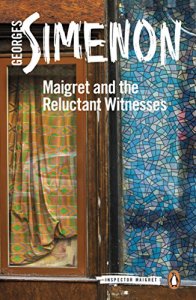
This is the 53rd Inspector Maigret book, originally published in 1955.
It is November and Maigret, nearing retirement, is in a melancholy, nostalgic mood. He has been called out to the home of the Lauchaume family where Léonard, the eldest son has been shot dead. The name Lachaume brings back memories of his childhood in the countryside where the village grocer sold Lachaume Biscuits. But the family is now in dire straits, living in a large house on the Quai de la Gare, Ivry and their biscuit factory is failing. Their house was once an impressive three storey building but is now in a state of decay, cold and damp. The rest of the Lachaume family, his younger brother Armand, Paulette Armand’s wife and his elderly parents, are not only reluctant to talk to the police, they don’t appear to be grieving.
It looks initially that the murder may have been part of a burglary, although only a wallet is missing, but Maigret is suspicious right from the start. His attempts to question the family are held up by their lawyer and also by the Examining Magistrate, Angelot who insists on taking charge of the case. But he makes headway when he visits VéroniqueLachaume, Léonard’s estranged sister and eventually Paulette reluctantly talks to him.
The book as a whole has a nostalgic feel, the sense that the world is changing – the Lachaume family has been left behind. Their business has only been kept afloat by the money from the sons’ wives, but they are still proud and reluctant to face the true facts of their situation. Maigret, too, is beginning to realise that his world is changing. for one thing he is getting older, the new magistrates are the younger generation bringing in new methods and he is aware that he only has two years left before his retirement. However, he solves the case mainly through his own intuition, and so he casts off his melancholy.
I’ve now read several of the Maigret books totally out of order, so now I’ve decided it’s time I read the first book, Pietr the Latvian first published in 1931.
We’re now in Week 3: (Nov. 12 to 16) of Nonfiction November. The topic is – Be The Expert/Ask the Expert/Become the Expert (Rennie @ What’s Nonfiction)
Three ways to join in this week! You can either share three or more books on a single topic that you have read and can recommend (be the expert), you can put the call out for good nonfiction on a specific topic that you have been dying to read (ask the expert), or you can create your own list of books on a topic that you’d like to read (become the expert).
I’ve read a few books on World War 2 and would love to find out more. I have read several novels set during the War, the most recent is V2 by Robert Harris, which has made realise how little I know about it. It is a vast subject and I know there are very many books both fiction and nonfiction about it. My difficulty is where to start!
These are some of the nonfiction books I’ve read/have waiting to be read:
Our Longest Days: a People’s History of the Second World War by the Writers of Mass Observation, which is fascinating.
Wartime Britain 1939 – 1945 by Juliet Gardiner – I’ve only read some of this book.
The Ration Book Diet by Mike Brown, Carol Harris and C J Jackson – social history.
Winston Churchill’s six volume History of the Second World War – these look particularly daunting in the amount of detail involved! I’ve start the first volume.
Band of Brothers by Stephen E Ambrose – I watched the entire HBO series called Band of Brothers. I started to read the book and stalled!
Great Escape Stories by Eric Williams – TBR
How the Girl Guides Won the War by Janie Hampton – TBR
There are so many aspects to the war, so many countries involved, so many battles, people, places, politics, so many events that led up to the war, so many technological details and developments, etc, etc. Any suggestions of where to start will be much appreciated.
The topic this week is Characters I’d Name a Pet After (These could be your own pets (present or future), you could pick 10 different animals and tell us the name and animal type, or you could choose 10 names that would make fun cat names, etc. Put your own spin on this one!)
I struggled to come up with any ideas for this topic. But as I am a cat lover this is my spin – it is Cats in Books.
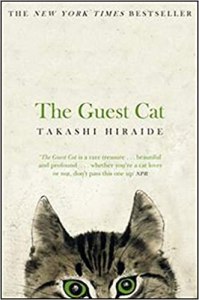
The Guest Cat (my review) is a Japanese Cat called Chibi, who made herself at home with a couple in their thirties who lived in a small rented house in a quiet part of Tokyo. She belonged to their next door neighbour but spent a lot of time with the couple coming and going as she pleased. I was disappointed to discover that the cat on the cover does not look like Chibi, who was a pure white cat whose fur was mottled with several lampblack blotches containing just a bit of light brown.
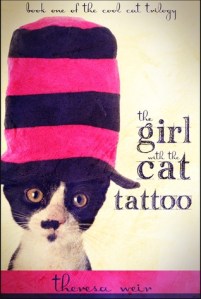
The cat in The Girl with a Cat Tattoo is called Max, a black and white cat with a ‘kitler’ – a cat with a moustache. He lives with Melody, a young widow. Two years after her husband died Max is fed up with the strange men she brings home and decides to do a bit of matchmaking on her behalf. He is a cat of action, but finds it’s more difficult than he expected. It is an entertaining, romantic tale with some dark moments, told from Max’s point of view. I’ve read this but didn’t write a review.
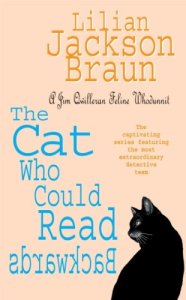
Koko is The Cat Who Could Read Backwards (my review), a beautiful Siamese cat. The cover disappointingly shows a black cat, not the beautiful Siamese with a “voice like an ambulance siren”. The book is about Joe Qwilleran, a newspaper reporter assigned to be an art writer, who together with Koko, investigates the murder of the owner of an art gallery.
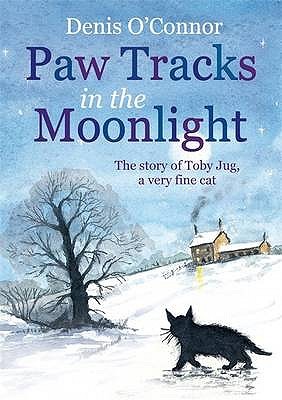
Paw Tracks in the Moonlight (my review) tells the story of how Denis O’Connor rescued a kitten during a snowstorm and how kitten survived, despite the vet’s prediction that he wouldn’t. O’Connor lived at Owl Cottage and as he was out at work all day he put the kitten in a jug to keep him safe and named him Toby Jug. This memoir covers the first year of Toby Jug’s life and it’s a remarkable story because this is no ordinary cat (if such a creature exists, that is). He is a Maine Coon cross.
I must have watched all of the programmes in the TV series All Creatures Great and Small about ‘James Herriot’s’ vet practice in Yorkshire. There are many James Herriot books and I’ve read a few of them in the past. James Herriot’s Cat Stories ( my review) is a collection of ten stories clearly demonstrating his love of cats. In the introduction James writes that cats were one of the main reasons he chose a career as a vet. They have always played a large part in his life and and when he retired they were still there ‘lightening’ his days.
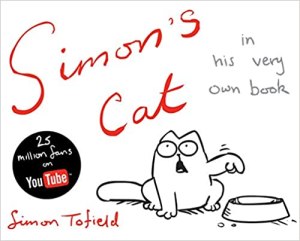
I love watching Simon’s Cat on YouTube. It is brilliant – so funny and just like our cat, Heidi, so I was delighted to find there are several books by Simon Tofield. The first one is Simon’s Cat in His Very Own Words.
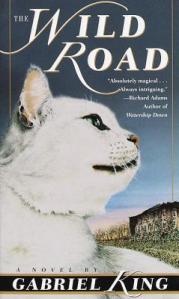
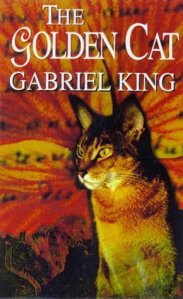
I’ve read but not reviewed The Wild Road and The Golden Cat by Gabriel King. I loved these magical novels, which I read years ago. When a runaway kitten named Tag meets a mysterious black cat named Majicou in his dreams, he learns he is destined for bigger things. Called by Majicou, Tag enters the Wild Road, a magical highway known only to the animals, and learns that he is needed to find the King and Queen of Cats and bring them safely to Tintagel.
The story continues in The Golden Cat. An ancient prophecy speaks of a golden cat whose coming will heal the troubled world. But the Queen of Cats has three golden kittens—and when two are stolen away, the distraught parents turn to Tag, the brave young cat who is the protector of the magical Wild Road.
And finally two cats in children’s books. Rudyard Kipling’s Just So Stories for Little Children are stories he told to his daughter, Effie (Josephine) as bedtime stories – fantastic accounts of how various features of animals came to be. Kipling explained: ‘in the evening there were stories meant to put Effie to sleep, and you were not allowed to alter those by one single little word. They had to be told just so; or Effie would wake up and put back the missing sentence.’
One of the stories is The Cat That Walked by Himself about when the tame animals were all wild. The wildest of all was the Cat and this is Kipling’s explanation of how the cat came to use humans for its own comfort but remained independent, walking in the Wet Wild Woods, ‘waving his tail and walking by his wild lone.’ Kipling’s illustrations in this book are perfect.
And last of all is the Cheshire Cat in Lewis Carroll’s Alice’s Adventures in Wonderland, one of my favourite children’s books. I no longer have the copy I had as a child, so a few years ago I bought The Complete Stories and Poems of Lewis Carroll. The Cheshire Cat sits in a tree and grins. He appears and disappears at will and at one point he vanished slowly beginning with his tail until there was just a grin left which remained for some time after the rest of him had gone.
A N Wilson is the author of over forty books – 20 novels, biographies, a three-part history of the last 100 years, and stories for children.
I’ve read a few of his biographies, the latest one I read was about Queen Victoria. At 656 pages it took me 3 months to read and I learned so much and enjoyed it immensely. In 1990 he wrote a full length biography of C S Lewis (which I haven’t read) and in 2013 he made a BBC 4 documentary about Lewis and his work. I didn’t watch the programme, but that didn’t spoil my enjoyment of The Man Behind Narnia. In only 72 pages he writes briefly about Lewis’s life, his own reflections on Lewis’s works, and describes the making of the documentary.
Clive Staples Lewis (1898–1963) was a Fellow and Tutor in English Literature at Oxford University until 1954, when he was elected to the Chair of Medieval and Renaissance Literature at Cambridge University, a position he held until his retirement. He wrote more than thirty books, including Mere Christianity, Out of the Silent Planet, The Great Divorce, The Screwtape Letters, and The Chronicles of Narnia books.
I first came across Lewis’s books when I was a teenager and a friend lent me The Screwtape Letters and then I read his autobiography, Surprised by Joy – in which he tells the story of his conversion to Christianity and about his childhood in Ireland, his school years and his adolescence – then his time at Oxford University and in 1917 he enlisted and was sent to the front line in France. Since then I’ve read quite a lot of his theological books, including Mere Christianity, as well as The Lion, the Witch and the Wardrobe (the first of his Narnia books) which I read about 15 years ago. I think I’d have enjoyed it more if I’d read it as a child.
I enjoyed Wilson’s book very much, but it really is as much about himself and the effects that Lewis’s writing has had on him as it it is about Lewis. He writes about the places where Lewis lived, Belfast where he was born, Dunluce Castle on the coast where he used to visit with his mother (the castle in the Narnia stories), the places he went to school in England, and Oxford University. I’ve realised in writing this post that Wilson’s book jumps around a lot from place to place whilst covering Lewis’s life at different periods of time, so that it might seem a disjointed book, but it isn’t. As I was reading it, it seemed to flow naturally.
He also writes about Lewis’s relationships with, amongst others his father, and Mrs Moore, his friend’s mother and later his lover (allegedly) and their life together at The Kilns in Headington. He only writes briefly about his marriage to Joy Davidman. Several years ago I remember being enthralled watching Anthony Hopkins, Debra Winger, and Julian Fellowes in Shadowlands (not a dry eye in the cinema). Shadowlands is about Lewis’s meeting with Helen Joy Davidman and about the events that led to their marriage. And earlier this year I read Becoming Mrs Lewis, a novel by Patti Callahan about Joy Davidman and her meeting and subsequent marriage to Lewis, so I was interested to read what Wilson’s view of their relationship was. He too ‘dissolved into tears‘ whilst watching the film, ‘even though [he] knew the circumstances of Lewis’s marriage to Joy Davidman [bore] only the haziest relationship to the story of ‘Shadowlands’. Interesting, I wondered what he based this on. My impression of Joy from reading Becoming Mrs Lewis was that she was stalking Lewis and I couldn’t warm to her.
In Chapter three he writes about the Narnia stories. Like me Wilson didn’t read the Narnia stories as a child. He hadn’t wanted to spoil his admiration for Lewis’s academic books by dipping into Narnia and found Lewis ’embarrassing’ when he got onto the subject of religion. He finally read them when he was on holiday in the Hebrides with his family and as it was raining he read The Lion, the Witch and the Wardrobe aloud to his daughters. The children were enraptured but he found it disturbing and shocking, with the Atonement theology of the story. But even so he found the story absolutely absorbing.
There is so much packed into this novella that I could probably go on writing about it. But this post is too long already, so I’m going to stop. If you’re interested in knowing more I can recommend reading it. I was fascinated and it has made me want to read more of Lewis’s books. I have little pile of them and haven’t read all of them yet.
The only one I’ve written about on this blog is Letters to Malcolm, a book about prayer. I’m also wondering whether to read Wilson’s biography of Lewis, or maybe Alister McGrath’s more recent biography, written in honour of the 50th anniversary of C. S. Lewis’s death, C S Lewis: A Life: Eccentric Genius, Reluctant Prophet.
I’m taking part in Nonfiction November again this year. It runs from Nov2 to Nov 30. Each Monday a link-up for the week’s topic will be posted at the host’s blog for you to link your posts throughout the week. 28 to Nov 30.
Week 2: (November 9-13) – Book Pairing (Julie @ Julz Reads):This week, pair up a nonfiction book with a fiction title. It can be a “If you loved this book, read this!” or just two titles that you think would go well together. Maybe it’s a historical novel and you’d like to get the real history by reading a nonfiction version of the story.
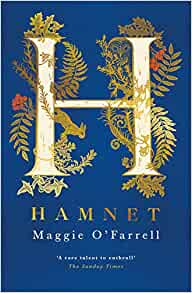
Hamnet by Maggie O’Farrell and Shakespeare’s Wife by Germaine Greer
I’ve recently read Hamnet by Maggie O’Farrell, historical fiction inspired by Hamnet, Shakespeare’s son. It is a story of the bond between him and his twin sister, Judith. Shakespeare isn’t the main character and he is never named in this novel, which really focuses on Ann Hathaway and her children. Little is actually known about her and she comes across to me in this book as a rather wayward, wild young woman when Shakespeare first met her, flouting convention and set on getting her own way, manipulating the people around her.
So, I’d like to know more about Ann Hathaway. Germaine Greer’s book, Shakespeare’s Wife explores what is known but I haven’t read it, so I don’t know how much is supposition and padding. I think it sounds interesting from the description on Goodreads:
Until now, there has been no serious critical scholarship devoted to the life and career of the farmer’s daughter who married England’s greatest poet. Part biography, part history, Shakespeare’s Wife is a fascinating reconstruction of Ann’s life, and an illuminating look at the daily lives of Elizabethan women, from their working routines to the rituals of courtship and the minutiae of married life. In this thoroughly researched and controversial book, Greer steps off the well-trodden paths of orthodoxy, asks new questions, and begins to right the wrongs done to Ann Shakespeare.
If you have read Shakespeare’s Wife I’d love to know what you think about it.







 BooksPlease