Saturday Snapshot

A few weeks ago I posted a photo of my grandfather on Alyce’s Saturday Snapshot. Today I’m posting a photo of his older sister Sarah, known to my grandfather as ‘Our Sal’ and to me as Aunty Sally. She didn’t live near me and my family when I was growing up but came to stay with us for a week each year. I used to love her visits.

This is how she looked when I knew her:

and this is her taken when she was a young woman:

and also:

Aunty Sally was born on 26 August 1878 in Mold, Flintshire, Wales. She died on 15 April 1967 aged 88. For many years she had been Matron and Housekeeper at Wellingborough School, a private school in Northamptonshire. She had worked until she was 78 and until she became ill she had visited the school chapel each week to arrange the flowers.

She had trained as a nurse in a London Hospital and had worked for a while in Chile as a children’s nurse. She first went to Wellingborough in 1940 as a member of the staff of Weymouth College which was evacuated to Wellingborough School.

By the time that I knew her she was an old lady or at least she seemed so to me, but she was great fun with loads of energy and interested in everything we were doing. She and my father used to sit up late at night, talking and sharing cigarettes, long after we’d all gone to bed. She bought us lovely presents, which were always different – not just an Easter Egg but a large Easter Chick, probably made of papier-mâché and decorated with glitter, containing small chocolate eggs. I’d never seen anything like it before and after I’d eaten the eggs I kept the chick for years afterwards until it fell to pieces. I wish I knew more about her.

Book Beginnings

Last week I found another little secondhand bookshop – The Border Reader – a lovely little shop above a tea room near Melrose in the Scottish Borders. I browsed the bookshelves upstairs and had a cup of Earl Grey tea and a slice of Lavender and Lemon Drizzle Madeira cake downstairs – a most pleasurable afternoon.

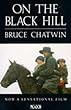
And up the stairs I found in the bookcase to the right of the photo a book I’ve had on my wishlist for a while. It’s On the Black Hill by Bruce Chatwin.

The book begins:

For forty-two years, Lewis and Benjamin Jones slept side by side, in their parents’ bed, at their farm which was known as ‘The Vision’.

The bedstead, an oak four-poster, came from their mother’s home at Bryn-Draenog when she married in 1899. Its faded cretonne hangings, printed with a design of larkspur and roses shut out the mosquitoes of summer, and the draughts in winter. Calloused heels had worn holes in the linen sheets, and parts of the patchwork quilt had frayed. Under the goose-feather mattress, there was a second mattress, of horsehair, and this had sunk into two troughs, leaving a ridge between the sleepers. (page (9)

The Black Hill is not one of the Black Hills of Dakota – known to me only from the song, sung by Doris Day, but it is one of the Black Mountains on the border of England and Wales, although fictionalised in this book. The book was first published in 1982 and won the James Tait Black Memorial Prize that same year. It’s also been made into a film. It looks to be a gentle, richly descriptive book about lonely lives on a farm, largely untouched by the 20th century. A nice change from all the crime fiction I’ve been reading recently.

Book Beginnings on Friday is hosted by Katy, at  A Few More Pages.

Book Beginnings

There came Death hurtling along the Boulevard in waning sepia light.

There came Death flying as a children’s cartoon on a heavy unadorned messenger’s bicycle.

There came Death unerring. Death not to be persuaded. Death-in-a-hurry. Death furiously pedalling. Death carrying a package marked *SPECIAL DELIVERY HANDLE WITH CARE* in a sturdy wire basket behind his seat.

These are the opening lines of the Prologue, ‘Special Delivery’ in Joyce Carol Oates’s novel Blonde. The date is 3 August 1962 – the date of Marilyn Monroe’s death. It doesn’t give anything away – Marilyn’s death has been well documented even if it still remains under suspicion and speculation. Blonde tells the fictionalised story of Norma Jeane Baker, who became the beautiful ‘Fair Princess‘ of the movies.

The only difficulty I have in reading Blonde is the weight and size of the book – not ideal for reading in bed. And it has 738 pages – and I’m only on page 52.

Book Beginnings is hosted by Katy at A Few More Pages, where you can leave a link to your own post on the opening lines of a book you’re currently reading.

Saturday Snapshot: The Birds Have Flown

I’ve posted a few photos and videos of the collared doves’ nest – first the empty nest, then the eggs were laid, the chicks hatched and now we have an empty nest again. On Thursday evening the second young collared dove left the nest and has not returned. I do feel a little sad – empty nest syndrome!

Empty Nest!

Here is a video showing the final moments as the young bird left the confines of the nest behind the satellite dish for the last time and flew off into the wide world beyond. It looks quite big in the video but in reality it is still very small.

To participate in Alyce’s Saturday Snapshot meme post a photo (new or old) that you (or a friend or family member) have taken, but make sure it’s not one that you found online.

‘Young Man at the Window’ by Gustave Caillebotte

Young Man at Window by Caillebotte (1876)

File:G. Caillebotte - Jeune homme à la fenêtre.jpg

(Photo courtesy of Wikimedia Commons.)

I’m quite surprised that Gustave Caillebotte (1848 – 1894) was a member of the French Impressionists as his paintings are much more realistic than the others’ paintings. He painted more modern subjects and his paintings are almost photographic in style.

His painting of a Young Man at Window shows Caillebotte’s brother standing at the window of a new apartment looking out on the scene below. I love the clarity and crispness of this painting, the detail of the stone balustrade, the back view of the young man – a ‘flaneur’ or man about town – and the contrast between the dark interior and bright view outside the window. In the 1870s Paris was being transformed into a modern metropolis under Napoleon III, with Baron Haussmann’s new boulevards and apartements and the rise of the bourgeoisie. The urban setting of this painting shows the tree-lined boulevard and horse drawn carriages.

Is the young man looking at the woman outside? Does he know her? What is the story behind the painting?

An ABC Wednesday post.