Book Beginnings

Some books sit unread on my bookshelves for quite a long time before I read them. Then when I do pick them up I wonder why on earth I’ve left them so long – they look so good.
The Meaning of Night by Michael Cox is one of these many unread books of mine. I am shocked to see from my LibraryThing catalogue that I’ve had this book since August 2007, not long after I started writing this blog – no doubt I’d read about it on another book blog.

It begins:

After killing the red-haired man, I took myself off to Quinn’s for an oyster supper.

It had been surprisingly – almost laughably – easy.

The first chapter is called Exordium and a footnote explains that this means ‘an introduction to a treatise or discourse’. A second footnote tells me that ‘Quinn’s’ is a shell fishmonger and supper house at 40, Haymarket. So, not only is this a dramatic opening the first few lines tell me this is an historical murder mystery set in London, most likely to be in the Victorian period, all of which makes me want to read on.

Reading the back cover it seems that this book is following on in the tradition of Wilkie Collins and Charles Dickens, described as a ‘tale of obsession, love and revenge, played out amid London’s swirling smog’, an ‘extraordinary story of Edward Glyver, book lover, scholar and murderer.’

I think one of the reasons I haven’t read it before now is that not only is it nearly 600 pages long, my copy is printed in a small font!

Book Beginnings ButtonSee more Book Beginnings on Friday at Gilion’s blog Rose City Reader.

 

Book Beginnings: Ninepins by Rosy Thornton

I’m a fan of Rosy Thornton’s books and so I’m pleased she has a new book Ninepins due out in a few days. Rosy has kindly set me a copy and I’ve just started to read it – it promises to be just as good as her earlier books. See my reviews of The Tapestry of Love, (my post here) and Hearts and Minds, (my post here).

Ninepins is an old tollhouse, deep in the Cambridgeshire fens where single mother Laura lives with her 12 year old daughter, Beth. She rents out the pumphouse, once a fen drainage station, to students but this time she is persuaded to let it to Willow, a seventeen-year-old care leaver with a mysterious past, by Vince Willow’s social worker. But, is Willow dangerous or vulnerable, or maybe a little of both? And what effect will this have on Beth, already causing her mother concern?

Ninepins begins:

Half past two: she was certain she’d said half past two. Oh dear – why was there already a car in front of the house when it was only 2:17?

From the back cover:

With the tension of a thriller, Ninepins, explores the idea of family, and the volatile and changing relationships between mothers and daughter, in a landscape that is beautiful but – as they all discover – perilous.

Book Beginnings on Friday is hosted by Gilion at Rose City Reader.

Wondrous Words

Reading Agatha Christie’s books I often come across words or phrases that I’m either not sure what they mean but can get the gist of the meaning from the context, or have never come across before.

I found an example of each type whilst reading The Murder on the Links, an early Poirot mystery first published in 1923:

Traps as in this sentence: ‘I had made a somewhat hurried departure from the hotel and was busy assuring myself that I had duly collected all my traps, when the train started.(page 5)

Captain Hastings is the narrator and is returning to London on the Calais train, so I thought he couldn’t be taking animal traps with him on the train and it was more likely to be his luggage. According to the Chambers Dictionary that is the meaning of the word: ‘personal luggage or belongings’. 

I didn’t know what the Bertillon system was. Poirot referred to it when talking about the lack of fingerprints on the murder weapon and remarked that ‘The veriest amateur of an English Mees knows it – thanks to the publicity the Bertillon system has been given in Paris.’ (page 35)

The Bertillon system is described in Wikipedia in the article on Anthropometry. Simple put it is a system for identifying criminals based on a series of their physical measurements introduced by Alphonse Bertillon in 1883. In 1894 England had adopted the system and had added the partial use of fingerprints. By 1900 England relied on finger prints alone.

(Click on the image to enlarge)

Wondrous Words Wednesday is hosted by Kathy at Bermuda Onion.

Saturday Snapshot: Dewars Lane

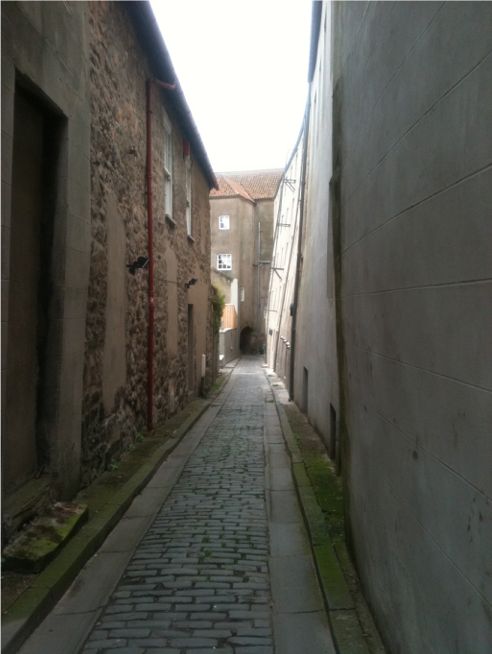
Berwick-upon-Tweed is an interesting English town near the border with Scotland, with three bridges crossing the Tweed. There are the Elizabethan Town Walls, Ramparts, Barracks, a ruined castle and quaint passageways like Dewars Lane, which dates back to medieval times. This is what it looks like today.

Dewars Lane, Berwick

The white building on the right at the end of the passageway is now a Youth Hostel, Art Gallery and Bistro. It was built in 1769 and was originally a granary. Its fantastic tilted walls are the result of a fire in 1815, after which it was propped up rather than being rebuilt. It was used for storing grain up until 1985 and was then left unoccupied, gradually becoming derelict. It has recently been restored by the Berwick Preservation Trust.

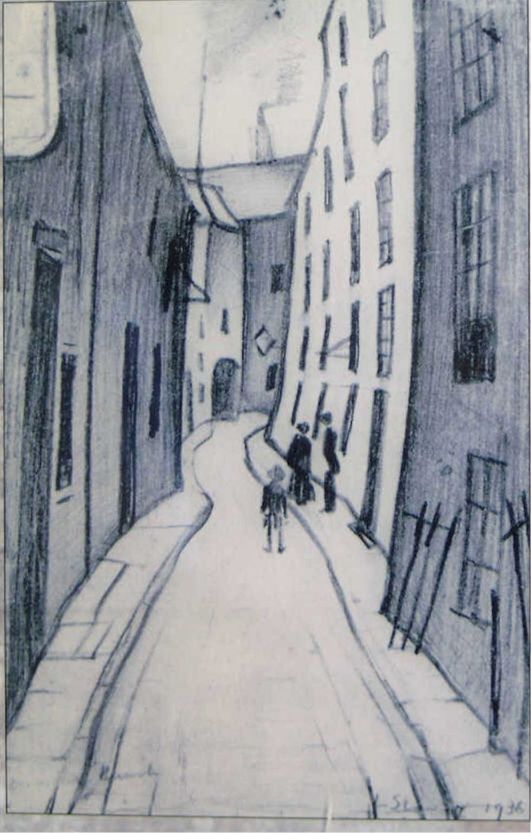
The artist L S Lowry sketched it in 1936  on one of his many visits to the town and it is now part of the town’s Lowry Trail. Below is Lowry’s pencil drawing of the Lane.

Lowry Dewars Lane

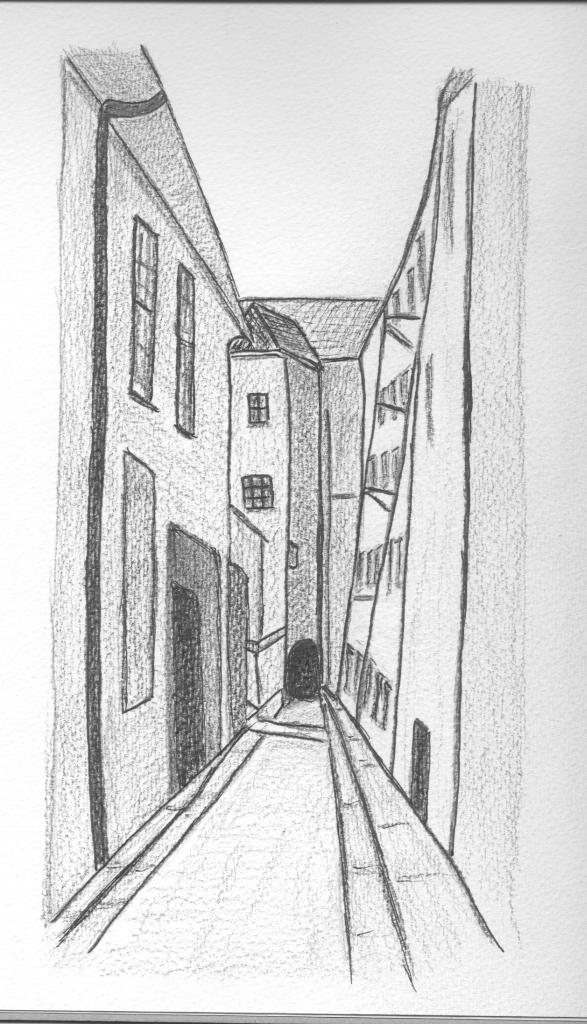
And here is my sketch:

Dewars Lane 001

See more Saturday Snapshots on Alyce’s blog At Home With Books.


Teaser Tuesdays

The book I’m currently reading is A Place of Greater Safety by Hilary Mantel, a huge book of 872 pages. I’m only on page 136, so it’s early days. In fact so far it’s been setting the scene of pre-Revolutionary France as seen through the key characters of Georges-Jacques Danton, Maximilien Robespierre and Camille Desmoulins. I’m liking it and it brings back to my mind history lessons at school when we listed the causes of the French Revolution.

This extract summarises, I think, the mood of the times in 1788:

Nothing changes. Nothing new. The same old dreary crisis atmosphere. The feeling that it can’t get much worse without something giving way. but nothing does. Ruin, collapse, the sinking ship of state: the point of no return, the shifting balance, the crumbling edifice and the sands of time. Only the cliche flourishes. (page 130)

Not long afterwards everything changed!

Book Beginnings on Friday

This is the opening sentence of the book I’m going to read next:

The night the war ended, both Mrs Trevor and Mrs Wilson went on duty at the Red Cross post as usual.

from The Village by Marghanita Laski. As this sentence indicates the setting is at the end of World War Two – in fact, the very day it ended. It seems to me as though Mrs Trevor and Mrs Wilson don’t want to give up the routine they had during the war and I’m keen to see what effect the end of the war will have on them.

This opening reminds me a bit of One Fine Day by Mollie Panter-Downes, also set in 1946 and chronicles the changes the Marshall family encountered, a book which I loved.

Book Beginnings on Friday is now hosted by Gilion at Rose City Reader.