Saturday Snapshot: Duddo Stone Circle

Stone circles fascinate me. They have done ever since I was a young teenager and went to Stonehenge. It was dawn as we were travelling to the New Forest for our annual Girl Guide camp there. The coach driver stopped so we could get out and see the sun rising over the stones. This was in the days when the stones were open and we ran across so we could be in the circle when the sun came up – it was magical. These days Stonehenge is fenced off and going there is just not the same experience.

There is a small stone circle not very far from where we live and we went to see it last Saturday. Duddo Stone Circle is a group of five Neolithic/Bronze Age stones – radiocarbon dating indicates they were erected around 2000BC. Originally there were seven stones. Excavations in the 1890s revealed the socket holes of the missing stones and also the cremated human remains in the central pit.

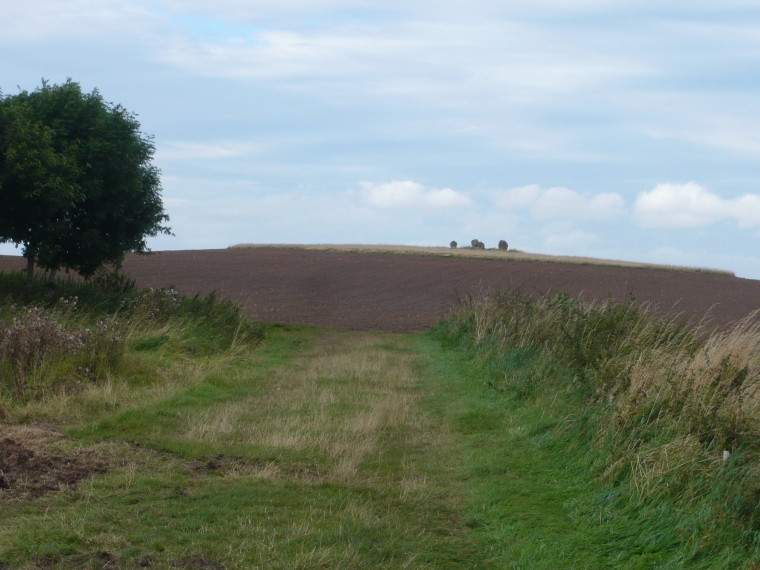
This is the view of the stone circle standing proud on a low hill next to the small Northumberland village of Duddo as you approach the stones along a permissive path:
P1060985

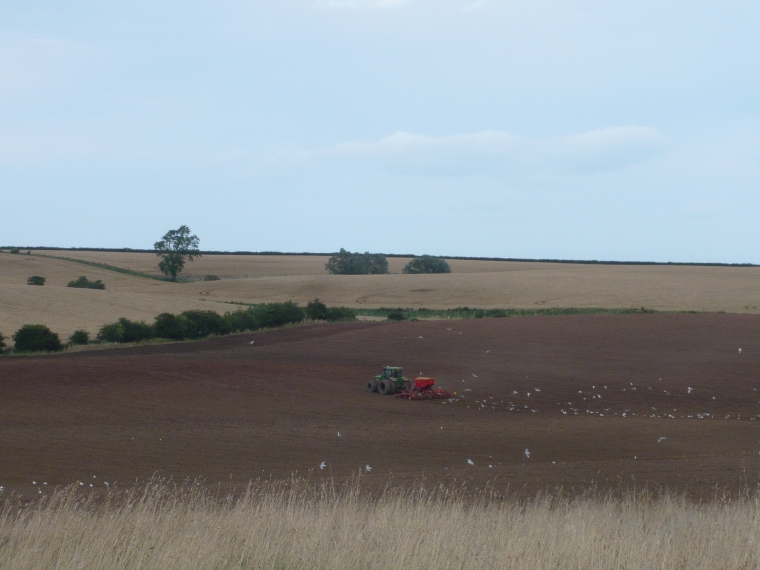
Farmers used to plough across the inside of the circle.These days they don’t, but farm all around the circle:
P1060992

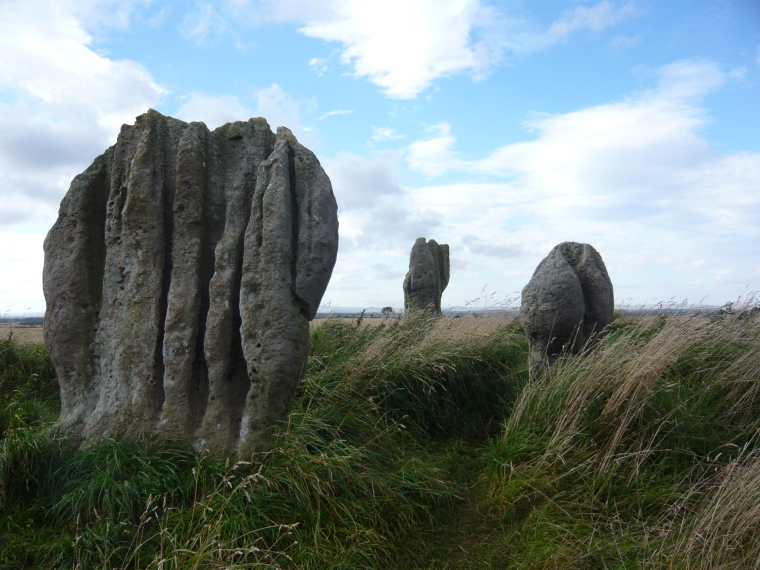
It’s fantastic up inside the stone circle. Unlike Stonehenge (which is of course much bigger) you can walk right up to the stones and go inside the circle. The stones are sandstone, varying in height from 1.3 metres to 2.3 metres. The site is listed on the Schedule of Ancient Monuments – No. 1006622.

It was very windy last Saturday and I found it hard to keep my camera steady, but I did manage to get some close ups of the stones. Stones that have been sculpted by the wind into weird shapes.
P1060995

We had the stones to ourselves and it was easy to imagine what it must have been like up there on the hill all those years ago, with views all round to the Cheviots and the Eildon Hills in Scotland and to wonder just why the stones were there and what they had meant to the people who erected them. The Defra information board below the stones indicated that the fragments of human bones found in the central pit dated from 1740 – 1660 BC suggesting that the use of the site for burial was a later event. Its original purpose remains a mystery – I like that.

Also in Duddo are the remains of a medieval tower house. We didn’t have time to look at it last Saturday, but we’ll go there another day.

For more Saturday Snapshots see Alyce’s blog At Home With Books.
Opening Lines: The Distant Hours

I  thought I’d read – The Distant Hours by Kate Morton, at least I thought from the title that I had read it. But when I read some reviews of it on LibraryThing  it didn’t sound at all familiar.  Then I couldn’t find the book on my fiction bookshelves and I thought maybe I’d given it away, thinking I’d read it, when I haven’t – panic! Eventually, I found it in a bookcase full of non-fiction – apart from this and a few other novels that I’d put there whilst tidying up one day.

Looking at it it seems ideal for R.I.P.VII – ‘A dilapidated castle, aristocratic twins, a troubled sister and a series of dark secrets cast a whispery spell in Morton’s third book.’ (Quoted on the back cover from Marie Claire)

It begins:

Hush … Can you hear him?

The trees can. They are the first to know that he is coming.

Listen! The trees of the deep, dark wood, shivering and jittering their leaves like papery hulls of beaten silver; the sly wind, snaking through their tops, whispering that it will soon begin.

The trees know, for they are old and have seen it all before.

I can hardly wait to read it, but I have to because I’m only halfway into Death of a Red Heroine by Qiu Xiaolong and that is really good – I have to finish that first!

Diane at Bibliophile By the Sea hosts this weekly meme. The idea is that you post the opening paragraph (sometimes maybe a few ) of a book you decided to read based on the opening paragraph (s).

Saturday Snapshot

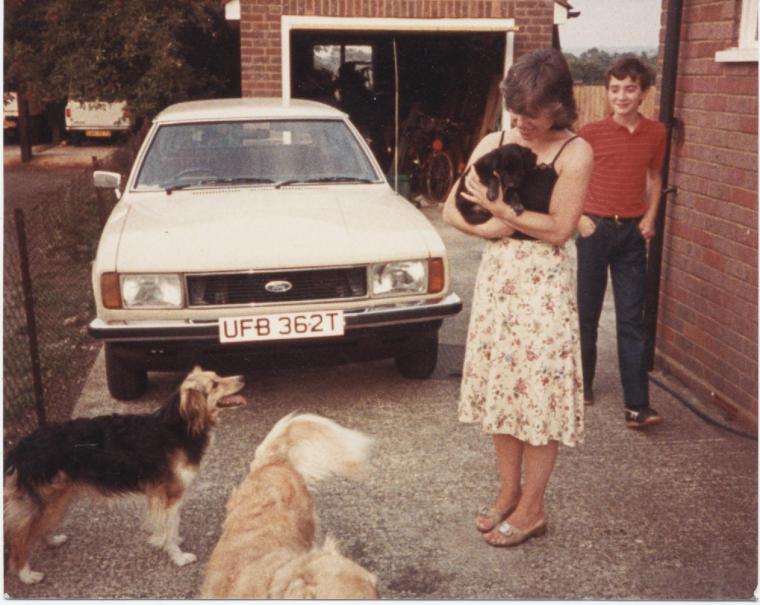
Another photo from the family snapshots. I actually quite like this one of me, taken years ago.  I’m not sure of the date but it must have been a hot day, or I wouldn’t have been wearing a little strappy top. And it must have been a long time ago because our son is all grown up now, with three children of his own! I think he must have been about 12 years old (is that right P?).Click on the photo to enlarge.

I like it too because it’s not a posed photo – I’m smiling naturally – and you can see our son casually walking into the picture. I’m holding our next-door neighbour’s new puppy, introducing it to our two dogs. Ben, our black, tan and white border collie/cross is interested and wants to play, but Zoe, our golden retriever isn’t bothered about it and instead wants to go to the photographer – my husband – so you can only see the top of her head. And I do like my Scholls. I used to wear them all the time, so comfortable. That reminds me I need to get another pair.

For more Saturday Snapshots see Alyce’s blog At Home With Books.

Saturday Snapshot

I’ve been going through family photos again:

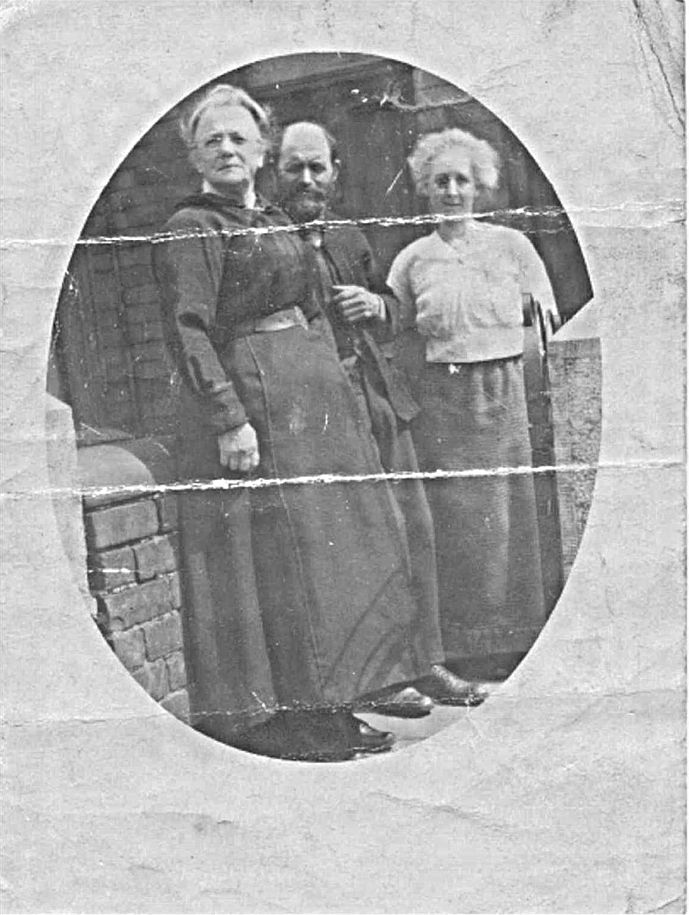
When I was a child of five (living in Cheshire) my grandparents came from Wales to live with us. They had the front room in our house and on the mantelpiece were two miniature framed photos of my Taid’s (grandfather’s) parents. He was immensely proud of them and it’s a great shame that those photos have gone missing, so I was delighted to find this one of my great grandparents. It shows my great grandfather, Isaac Owens and my great grandmother, Elizabeth Owens, the lady wearing glasses. I have no idea who the other lady was (the one wearing the white blouse). Nor do I know when or where it was taken.

I know very little about them.

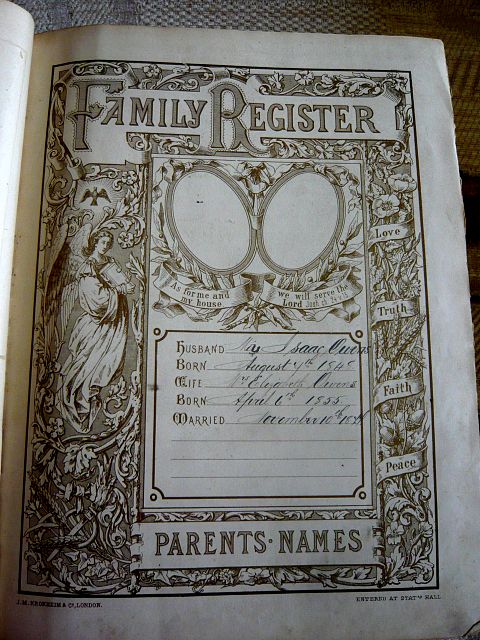
Isaac was born on 7 August 1848 (August 7 is also my birthday) in Bryn-y-Baal, a small hamlet near Mold in Flintshire, Wales. His father, George was a coal miner. Isaac’s occupation is described in the census returns as a Brickworks Labourer, an Agricultural Labourer and a Tin Plate Worker.  He married Elizabeth Hughes in 1877 and they had five children, my Taid was their second child. Two of their children died, aged 17 months and 11 months, with a third, John dying when he was 19.

I have the family Bible in which he recorded the family births, marriages and deaths.

From the census returns I’ve discovered that he moved around the local area, presumably to get work and on some of the censuses he is not living with the rest of the family. He and Elizabeth spoke both Welsh and English. Isaac died aged 79 in 1928 at my grandparents’ home.

I’ve posted photos previously of my great grandmother, Elizabeth and also of the sampler that she stitched in 1867, when she was twelve.

For more Saturday Snapshots see Alyce’s blog At Home With Books.
Book Beginnings: Before the Fact

I went to Barter Books yesterday and came home with several crime fiction books, plus a book on painting with pastels and a book on Northumberland’s coastal castles.

The book I’m writing about today is one of the crime fiction books, that I was quite excited to find, because I’ve never read anything by Francis Iles, the pseudonym of Anthony Berkeley Cox (1893-1970), a journalist and mystery writer from the Golden Age of crime fiction.

The book is his second novel written as Francis Iles, Before the Fact and it is a psychological study of a potential murderer as seen through the eyes of his intended victim. It begins:

Some women give birth to murderers, some go to bed with them, and some marry them. Lina Aygarth had lived with her husband for nearly eight years before she realized that she was married to a murderer.

I’m eager to read on …

For more Book Beginnings on Friday see Gilion’s blog Rose City Reader.

Wondrous Words Wednesday

I’m currently reading Our Mutual Friend by Charles Dickens. It’s taking me quite a while as it’s a long book of just over 800 pages and there are many characters and sub-plots. There are also many new-to-me words!

I’m reading it in bed on Kindle, a free edition without any notes, but, of course Kindle has its own built in dictionary, which I’m constantly using. During the day I’m reading the Wordsworth Classic edition, which does have notes, and illustrations and an introduction, all of which help with understanding the literary references as well as words that are no longer in current use.

For today I’m just going to pick out one word: hippedEugene Wrayburn has been telling Mortimer Lightwood, his friend and fellow lawyer about how he enjoys goading the schoolmaster, Bradley Headstone, by walking all over London knowing that he is being followed by Headstone. He describes this as enjoying the ‘pleasures of the chase’. Lightwood says he doesn’t like it. Eugene then says:

‘You are a little hipped, dear fellow’, said Eugene; ‘you have been too sedentary. Come and enjoy the pleasures of the chase.’

I wasn’t at all sure I knew what that meant – was Lightwood getting a bit broad in the hips, sitting down too much, a bit too fat, maybe and needing the exercise?

One of the Kindle dictionary defines it as ‘having hips of a specified kind: a thin-hipped girl, so maybe that’s what Dickens meant – Lightwood has fat hips! Another definition given on Kindle is ‘obsessed or infatuated with‘, which seems to fit better.

The Wordsworth Classics edition has a more appropriate definition, I think. Hipped meaning ‘depressed‘. Lightwood needs more exercise to lift his mood.

Then I wondered how my Chambers Dictionary defined hipped. It has several to choose from, including the more modern use of ‘hip‘, meaning ‘following the latest trends in music, fashion, political ideas, etc’, ‘ the fruit of the dog-rose or other rose‘, and so on. But the one that fits is:

hipped: melancholy; peevish, offended, annoyed; obsessed.

No wonder, it’s taking me longer than usual to read this book, when just one little word takes up so much thought. :)

Wondrous Words Wednesday is a weekly meme created by Kathy at BermudaOnion, where you can share new words that you’ve encountered or spotlight words you love.