Top Ten Tuesday is a weekly meme created by The Broke and the Bookish and now hosted by Jana at That Artsy Reader Girl. For the rules see her blog.
The topic this week is Books on My Winter 2021 To-Read List. I don’t plan what to read in advance, so these are books on my shelves that I want to read – maybe this winter, or sometime next year. They’re a mix of NetGalley books that will be published next year and books that I’ve had on my bookshelves or on Kindle for some time.
NetGalley books:
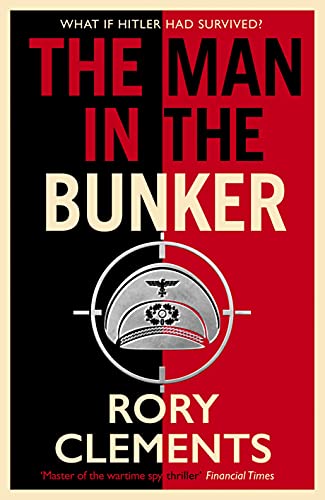
The Man in the Bunker by Rory Clements (pub 20 January 2022) – a Cambridge spy must find the truth behind Hitler’s death. But exactly who is the man in the bunker?
The Second Cut by Louise Welsh (pub 27 January 2022) – this delves into the dark side of twenty-first century Glasgow. Twenty years on from his appearance in The Cutting Room, Rilke is still walking a moral tightrope between good and bad, saint and sinner.
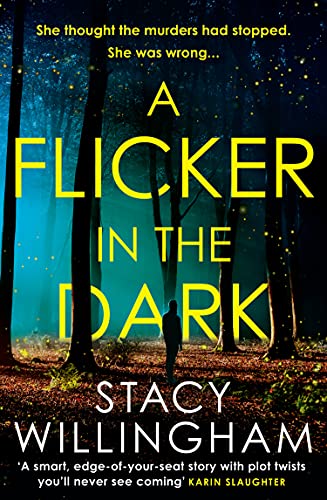
A Flicker in the Dark by Stacy Willingham (pub 3 February 2022) – Chloe Davis’ father is a serial killer. He was convicted and jailed when she was twelve but the bodies of the girls were never found, seemingly lost in the surrounding Louisiana swamps. The case became notorious and Chloe’s family was destroyed.
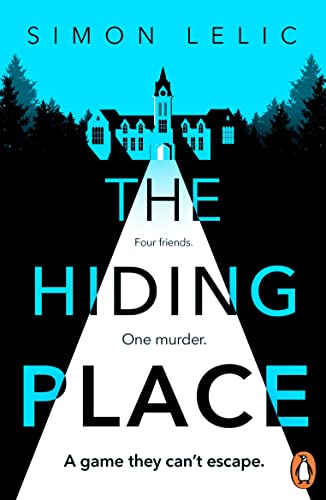
The Hiding Place by Simon Lelic (pub 5 May 2022) – DI Rob Fleet investigates a cold case when the body of a boy, who went missing over twenty years earlier whilst playing a game of hide and seek, is found.
The Second Sight of Zachery Cloudesley by Sean Lusk (pub 2 June 2022) – Set in the 18th century Zachary Cloudesley has grown up surrounded by strange and enchanting clockwork automata. But most extraordinary of all are the things Zachary can see in other people. At the touch of a hand, he can see the secret desires, regrets and inner workings of the people he meets. When his father disappears in Constantinople he sets out to find him.
Books from my TBRs:
Fire from Heaven: a novel of Alexander the Great by Mary Renault – Alexander the Great died at the age of thirty-three, leaving behind an empire that stretched from Greece to India. Fire From Heaven tells the story of the years that shaped him.
Love in the Time of Cholera by Gabriel Garcia Marquez – Set on the Caribbean coast of South America, this love story brings together Fermina Daza, her distinguished husband, and a man who has secretly loved her for more than fifty years.
State of Wonder by Ann Patchett – Among the tangled waterways and giant anacondas of the Brazilian Rio Negro, an enigmatic scientist is developing a drug that could alter the lives of women for ever.
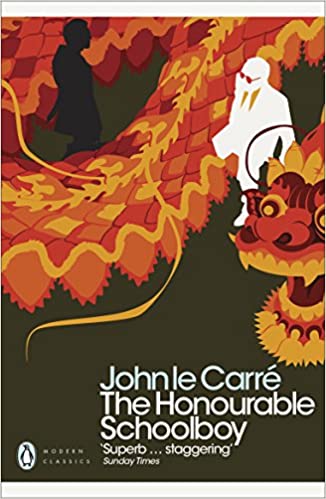
The Honourable Schoolboy by John Le Carré – George Smiley launches a risky operation uncovering a Russian money-laundering scheme in the Far East. His aim: revenge on Karla, head of Moscow Centre and the architect of all his troubles.
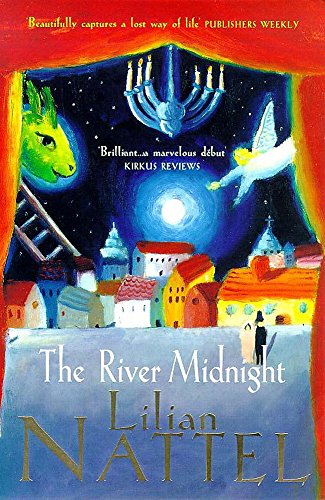
The River Midnight by Lilian Nattel – this is set in the fictional village of Blaszka in Poland at the end of the 19th century. Myth meets history and characters come to life through the stories of women’s lives and prayers, their secrets, and the intimate details of everyday life.
Top Ten Tuesday is a weekly meme created by The Broke and the Bookish and now hosted by Jana at That Artsy Reader Girl. For the rules see her blog.
This week’s topic is Books to Read If You Love/Loved X (X can be a genre, specific book, author, movie/TV show, etc.). TheWolf Hall Trilogy by Hilary Mantel tells the story of the rise and fall of Thomas Cromwell in the court of Henry VIII.
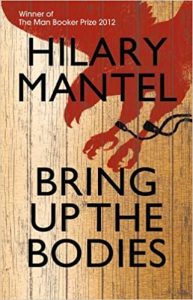
Wolf Hall – England in the 1520s as Henry VIII is seeking a divorce from Katherine of Aragon in order to marry Anne Boleyn. It tells of the rise to power of Thomas Cromwell. Bring Up the Bodies, by 1535, Anne has failed to bear a son and Henry gas fallen in love with Jane Seymour – Anne has to go. This is mainly about Cromwell’s scheming to bring about Anne’s downfall. The Mirror and the Light, the final part, which I’m still reading, set in 1536 – 1540, about Cromwell’s final years.
Here are 10 other historical fiction trilogies/series that I’ve read and loved. I’ve given brief descriptions of the first books for each with links to Goodreads for the details of the rest of the series..
Mathew Shardlake Series by C J Sansom – Mathew Shardlake is a lawyer-detective in the court of Henry VIII. Seven books – I’ve read all of them. The first one Dissolution is closest in time to the third book of Mantel’s trilogy set at the time of the dissolution of the monasteries in 1537. Thomas Cromwell’s Comissioner is found dead, his head severed from his body. Dr Shardlake is sent to uncover the truth behind what has happened.
Marwood and Lovett Seriesby Andrew Taylor – 17th century London during Charles II reign, who was restored to the throne in 1660 Five books – the first, The Ashes of London is set in 1666 just after the Great Fire. The fathers of both James Marwood and Cat Lovett has fought against Charles and so they are both disgraced. they become involved in investigating the murder of a man is found in the ruins of St Paul’s Cathedral.
Christopher Redmayne Seriesby Edward Marston – Christopher Redmayne, an architect, and Jonathan Bale, a constable in 1600s London, England. The first book, The King’s Evil is also set in 1666 just after the Great Fire and is also a murder mystery. Redmayne is an architect, working to restore London after the Fire, when he becomes involved in investigating the murder of Sir Ambrose Northcott. whose body was found in the cellars of his partly built new house.
Damian Seeker Series by S G MacLean – historical thrillers set in Oliver Cromwell’s London. Five books – the first is The Seeker, set in 1654. Damian Seeker, Captain of Cromwell’s Guard, works for John Thurloe, Cromwell’s Chief Secretary and spy master. England in 1654 is a Republic in name only, Parliament had been dissolved in 1653 and Cromwell was appointed as Lord Protector – King in all but name.
Raven, Fisher, and Simpson Mystery Series by Ambrose Parry – murder and medical experiments set in 19th century Edinburgh. Three books – the first one is The Way of All Flesh, set in 1847. It begins with the death of Evie, a prostitute in Edinburgh’s Old Town, found by Will Raven, a young medical student about to start his apprenticeship with Dr Simpson. a professor of midwifery, who discovered the anaesthetic properties of chloroform. Sarah Fisher, Dr Simpson’s housemaid is an ambitious and enterprising young woman who would love to have a career in medicine. She and Will join forces to uncover the killer in the depths of Edinburgh’s dark underworld.
MunroScottish Saga Series by Margaret Skea – set 16th century Scotland. Three books, the first is Turn of the Tide which begins in 1586 in the Scottish Borders in the middle of the centuries-old feud between the Cunninghames and the Montgomeries, with all the drama of their battles, ambushes and schemes to further their standing with the young King James VI. It’s a tale of love, loyalty, tragedy and betrayal.
The Burning Chambers Series by Kate Mosse – 2 books, with a third book in progress. The first is The Burning Chambers, set in Languedoc in the south-west of France in 1562 during the French Wars of Religion. It’s centred on the Joubert family, Catholics living in Carcassonne and Piet Reydon, one of the Huguenot leaders. Bernard Joubert, a bookseller had been imprisoned accused of being a traitor and a heretic after he had let slip information about a secret will. It’s a complicated story of war, conspiracies, love, betrayal, forgery, torture and family secrets.
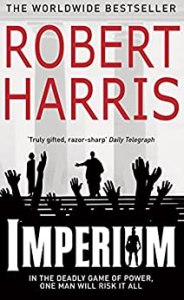
Cicero Series by Robert Harris- set in Ancient Rome – three books. The first is Imperium. Beginning in 79 BC, this book set in the Republican era is a fictional biography of Marcus Tullius Cicero by Tiro, his slave secretary. It is basically a political history, a story filled with intrigue, scheming and treachery in the search for political power as Cicero, a senator, works his way to power as one of Rome’s two consuls.
Theseus Series by Mary Renault – Two books, The King Must Die and The Bull from the Sea. I remember being captivated by these books when I first read them years ago and would so like to re-read them. They retell the life of the mythological Greek hero Theseus, following his adventures from Troizen to Eleusis, where the death in the book’s title is to take place, and from Athens to Crete, where he learns to jump bulls and is named king of the victims. In the second book Theseus defies the Gods’ and claims the throne of Athens a move that culminates in the terrible, fateful destruction of the house of Minos where he slays the Minotaur.
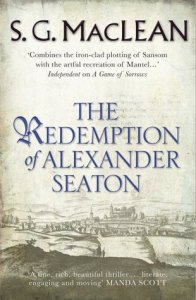
Alexander Seaton Seriesby Shona MacLean, set in 17th century Scotland. Four books, the first is The Redemption of Alexander Seaton. It is set in the town of Banff, Scotland in the 1620s. One stormy night Patrick Davidson, the local apothecary’s assistant collapses in the street. The next morning he is found dead in the school house of Alexander Seaton, a failed minister, now a schoolteacher. When one of Alexander’s few friends in the town is arrested for the murder, he sets out to prove his innocence.
Top Ten Tuesday is a weekly meme created by The Broke and the Bookish and now hosted by Jana at That Artsy Reader Girl. For the rules see her blog.
This week’s topic is a Hallowe’en Freebie. I’m a reluctant reader of scary stories but I have read these books, some are more scary than others.
Dracula by Bram Stoker. knew the story of Dracula from film and TV versions – with most notably Christopher Lee and later Louis Jourdan as Dracula, but steered clear of reading Bram Stoker’s book – well, it’s not like the film versions I’ve seen. The opening surprised me a little, so matter-of-fact and such attention to detail. And the narrative continues composed of letters, journal entries, newspaper articles and transcripts of phonograph diary entries, from several characters, so the story is told from several different viewpoints It’s a very scenic novel, and I could easily imagine the locations and it’s also a very sensual and melodramatic novel, full of religious references; plus it’s an adventure story with a final chase scene and a love story – and not a bit like I expected from the film versions!
Frankensteinby Mary Shelley is not like the film version with Boris Karloff as the monster created by Victor Frankenstein. It’s not scary, but it is an improbable story with some interesting ideas about what it is to be human. It is a gothic tale about a scientist whose laboratory experiments produced fantastical results. The ‘monster’ learns by observation what it is to be human, but because of the reactions of the people he meets he is spurred on to take revenge on his creator.
The Strange Case of Dr Jekyll and Mr Hydeby Robert Louis Stevenson – a novella together with Other Tales of Terror. The case of Jekyll and Hyde is well known through film and TV versions, but I think the book is much scarier. It reads at first like a mystery story as Dr Jekyll is trying to discover the identity of the evil Mr Hyde – it is only later than he discovers the truth.
The Turn of the Screw by Henry James, a dark and melodramatic tale about good and evil. There’s a story within a story, told as a ghost story to a group of people as they sit gathered round a fire in an old house. It tells of two children and their governess. She has been employed by their uncle who wants nothing to do with them. Their previous governess had died under mysterious circumstances (was it in childbirth?). There’s a dark foreboding of menace within the house where creepy, disturbing things are going on. in this dark and melodramatic tale.
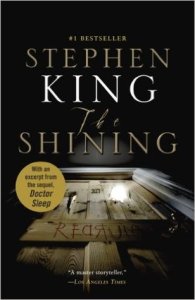
The Shining by Stephen King. I saw the film with Jack Nicolson, which is terrifying before I read the book. I remember his crazed face as he rampaged through the hotel, the sense of evil and terror, and I decided that was enough – I wouldn’t read the book. But later on I did – I don’t know why. It tells the story of Jack Torrance and his family as they move into the Overlook Hotel in the Colorada Rockies. The Overlook is closed for the winter and Jack, a recovering alcoholic is the caretaker. Just what impels him towards murder is horrifyingly revealed as the winter weather closes in on the hotel and they are cut off from the rest of the world. Having read the book there is no way I’ll ever watch the film again,
As you can see from the cover of The Shining it contains an except from the sequel,Dr Sleep. It tells what happened to Danny Torrance (Jack’s son) later on in his life, when he worked in a hospice. He was known as “Doctor Sleep” by secretly using his special abilities to comfort the dying and prepare them for the afterlife. Truly terrifying, even the cover is enough to give me nightmares – that demonic looking cat!
By the Pricking of My Thumbs by Agatha Christie, a Tommy and Tuppence story. As you would imagine from the title of the book (taken from Shakespeare’s Macbeth), ‘something wicked’ is afoot, there is evil about and Tuppence’s life is in danger. A dark and sinister tale.
The Hunger by Alma Katsu, a story about the Donner Party, comprising pioneers, people who were looking for a better life in the American West. Interwoven with hints of the supernatural and Indian myths it becomes a thrilling, spine tingling horrific tale. Many of them died of starvation, and some of them resorted to eating their animals and it is supposed, the deceased members of the group. It is a tense, menacing tale full of hope and also of desperation.
The Chalk Pit by Elly Griffiths. Something evil is waiting in the dark tunnels under Norwich, where boiled human bones have been found. The boiling might have been just a medieval curiosity – now it suggests a much more sinister purpose. The bones are found during the excavations when an underground restaurant in one of the tunnels is proposed. A homeless women, Barbara, disappears and there are rumours that she has ‘gone underground‘. Just what is the gruesome secret lurking in the tunnels?
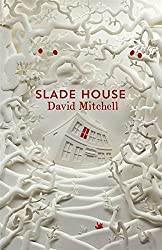
Slade House by David Mitchell, a mixture of a ghost story, science fiction and horror. Something nasty happens every nine years at the end of October at Slade House. It’s down Slade Alley, which doesn’t normally exist and it only appears to those who have been invited, or are drawn to it. There is a door set into the right hand wall of the alley, a small black iron door with no handle or keyhole, that opens if you’re meant to enter. There you meet a stranger, are invited into the House, and find yourself in a strange and dangerous situation, and there is no way out – eventually you find yourself in a long attic at the top of the stairs – where something terrible happens to you.
Top Ten Tuesday is a weekly meme created by The Broke and the Bookish and now hosted by Jana at That Artsy Reader Girl. For the rules see her blog.
This week’s topic is a Freebie and I have chosen a past TTT topic from October 2013 which was before I took part in TTT – Top Ten Books I was ‘Forced’ to Read. The definition of this topic was described thus: ‘Obviously, in most cases, you weren’t LITERALLY forced to read it but you know what we are getting at here. Those required reading books, book club picks, books for your job or those books that it simply feels like other readers were going to tie you down until you read it!!’
I’ve chosen books that were ones I read at my local book group. They are all books I would probably never have read if they hadn’t been for the book club – some of them I loved, some I disliked and some that I thought were OK, neither very good or very bad.
First the ones I loved:
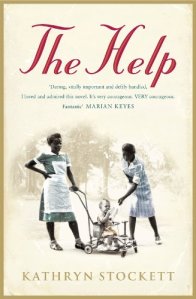
The Help by Kathryn Stockett, which I loved even more than the film. It takes place in Jackson, Mississippi in 1962 during the Civil Rights Movement. Aibileen, Minny and Skeeter are the three narrators and it is through their eyes that the book comes to life as they take turns telling their stories. It’s touching, poignant, funny, compelling and definitely thought-provoking. I loved the film too.
Little Boy Lostby Marghanita Laski – the story of Hilary Wainwright, who is searching for his son, lost five years earlier in the Second World War. Hilary had left France just after his wife, Lisa, had given birth to John. Lisa, unable to leave France, worked for the Resistance, but was killed by the Gestapo and her son disappeared. It is emotional, heart-wrenching and nerve-wracking, full of tension, but never sentimental.
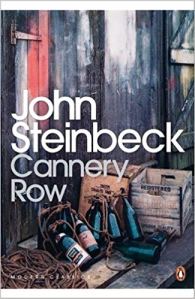
Cannery Rowby John Steinbeck – it has everything I like, rich descriptions of locations, wonderful characters and a storyline, that grabs my attention and makes me want to know more. There is humour and tragedy, meanness and generosity, life and death all within Cannery Row‘s 148 pages. After reading this I went on to read more of Steinbeck’s books, The Grapes of Wrath, East of Eden, Of Mice and Men and Sweet Thursday.
The Long Song by Andrea Levy. It’s brutal, savage, and unrelenting in depicting the lives of the slaves in Jamaica just as slavery was coming to an end and both the slaves and their former owners were adjusting to their freedom. The narrator is July, at the beginning a spirited young woman, born in a sugar-cane field, telling her story at her son’s suggestion. It’s beautifully written too.
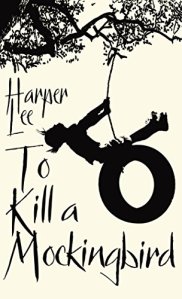
To Kill a Mockingbird by Harper Lee set in the Deep South of America in the 1930s. Scout (Jean Louise Finch) is the narrator, as she looks back as an adult to the Depression, the years when with her older brother, Jem, and their friend, Dill, she witnessed the trial of Tom Robinson, a black man accused of raping a white girl. Scout’s father, Atticus, a lawyer defends Tom. It’s also the story of Boo Radley, their neighbour, a man who is never seen, who is said to only come out at night.
Salmon Fishing in the Yemen by Paul Torday by Paul Torday. The conditions in the Yemen are completely wrong for salmon fishing and that is the conundrum that Dr Alfred Jones has to solve when Sheikh Muhammad wants scientific advice on how best to introduce it into the Yemen. The sheikh has an estate in Scotland where he pursues his great love of fly fishing. This a light comic novel, much of it complete but enjoyable nonsense and I was actually hoping the project would be successful and that salmon would run up the waters of the Wadi Aleyn in the heart of the mountains of Heraz. I haven’t seen the film of the book.
Then the books I enjoyed, although I didn’t actually love them:
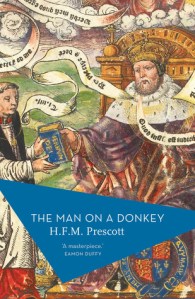
The Man on a Donkey by H F M Prescott, written in the form of a chronicle, from the various characters’ viewpoints. It’s as much about the ordinary people as the rich and powerful, and based on documentary evidence relating to the Pilgrimage of Grace in 1536 led by Robert Aske, a lawyer. It was a protest against Henry VIII‘s break with the Roman Catholic Church, the Dissolution of the Monasteries, and the policies of the King’s chief minister, Thomas Cromwell. It transported me back to that time, with lyrical descriptions of the settings, both of the countryside and of the towns, of Marrick Priory and of the king’s court, of the people, and the mood of the times, both religious and political.
I found Westwood by Stella Gibbons a slightly disappointing book. I liked it, but didn’t love it, as I’d hoped I would. I do enjoy descriptive writing, and there are some beautiful descriptive passages, particularly of London just after the Blitz. Margaret Steggles, a plain young woman finds a ration book on Hampstead Heath which provides her with an introduction into the lives of Gerard Challis and his family, his beautiful wife, Seraphina, his self-absorbed daughter Hebe and her spoilt children and Zita the family’s maid. Margaret idolises Gerard, who is a playwright. He in turn falls under the spell of her best friend, Hilda.
Full Tilt: Dunkirk to Delhi on a Bicycle, by Dervla Murphy, first published in 1965, this is an account of her journey in 1963, which took her through Europe, Persia (Iran), Afghanistan, over the Himalayas to Pakistan and into India. She travelled on her own, with a revolver in her saddle bag. It’s very much a personal account, but not so much about the actual cycling. I enjoyed it as much for her descriptions of the places she visited as for her thoughts along the way. I’m not sure that I would find her easy company though!
And finally a book that I disliked:
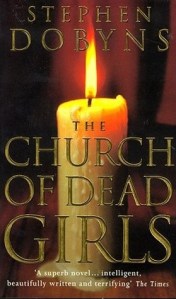
The Church of Dead Girls by Stephen Dobyns about the disappearance and murders of three young teenage girls. It’s far too detailed and drawn out. I had trouble with the narrator, wondering how he could possibly know all the detail of what other characters were thinking and doing. Described on Amazon thus ‘One after another, three girls disappear from a small American town. As the sleepy town awakens to a horrific nightmare, no one is safe from the rising epidemic of suspicion. Dobyn’s chilling novel is superbly written portrait of a little place seemingly at home with itself. The suspense builds to a magnificent climax.’ I did not like it at all.
Top Ten Tuesday is a weekly meme created by The Broke and the Bookish and now hosted by Jana at That Artsy Reader Girl. For the rules see her blog. This week’s topic is Books on My Fall 2021 To-read List.
Not easy when I have so many books I want to read. These are the first ten that came to mind, but this is not a reading plan and I could just as easily read other books this autumn:
First two novellas:
Another Part of the Woodby Beryl Bainbridge – 159 pages -literary fiction set In a remote cottage in Wales where two urban couples are spending their holiday with the idealistic owner and his protege. The beginning is idyllic but catastrophe lurks behind every tree.
Picnic at Hanging Rockby Joan Lindsay 189 pages – a novel for the reader to decide if it’s fact or fiction. On St Valentine’s Day in 1900, nineteen girls and two schoolmistresses visit Hanging Rock. Some were never to return.
Two books from my NetGalley shelf:
Just Like the Other Girlsby Claire Douglas – standalone psychological thriller. Una Richardson’s heart is broken after the death of her mother. Seeking a place to heal, she responds to an advertisement and steps into the rich, comforting world of Elspeth McKenzie. But Elspeth’s home is not as safe as it seems.
The Girl Who Died by Ragnar Jónasson, a standalone novel. After the loss of her father, Una sees a chance to escape Reykjavík to tutor two girls in the tiny village of Skálar – population just ten – on Iceland’s storm-battered north coast. The creaky old house where they live is playing on her already fragile mind when she’s convinced she hears the ghostly sound of singing. Then, at midwinter, a young girl is found dead.
Two books from my TBR list:
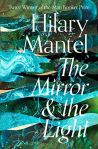
The Mirror and the Light by Hilary Mantel, the final novel in her Wolf Hall trilogy about Thomas Cromwell, tracing his final years. I wanted to read this so much when I bought it (in 2020) and it has sat around the house ever since, but it’s a hardback copy and I keep putting off reading it. If I don’t read this soon it will be 2022 before I get round to it.
The Unlikely Pilgrimage of Harold Fry by Rachel Joyce, which I bought in 2013! It’s about Harold’s journey on foot from one end of the country to the other – from South Devon to Berwick-upon-Tweed and I was intrigued. I wondered which places he went through. It’s definitely time I read this.
And finally two more recent acquisitions:
Another Journey Through Britain by Mark Gregory Probert. He follows the route taken by John Hillaby in his 1960s book Journey through Britain. The ride starts from rugged Land’s End in south-west England and ends up at the wild north-east coast of Scotland at John o’Groats. Buying this book is what made me remember I haven’t read Rachel Joyce’s novel, also about a journey through Britain.
The Bass Rock by Evie Wyld, a novel that weaves together the lives of three women in three different eras, linked by the Bass Rock, an island in the Firth of Forth, north-east of North Berwick. There’s Sarah in the 1700s accused of being a witch, Ruth, newly married in 1955 to a widower, Peter, and Viv, Peter’s granddaughter, in the present day.
Top Ten Tuesday is a weekly meme created by The Broke and the Bookish and now hosted by Jana at That Artsy Reader Girl. For the rules see her blog. This week’s topic is Books with Numbers in the Titles.
I did a top ten post in October 2019 on Book Titles with Numbers in Them, using the numbers 1 – 10, so for this week’s topic I decided to use different numbers. These are all books I’ve read.
The numbers are 0, 4.50, 11, 12.30, 13, 17, 39, 70, 100 and 1,000.
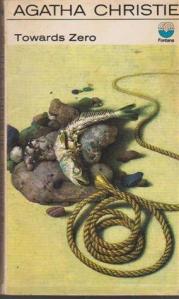
Towards Zero by Agatha Christie – an intricately plotted murder mystery featuring Superintendent Battle, in which a group of lawyers discuss a recent case at the Old Bailey. One of them puts forward the idea that murder is not the beginning of a detective story, but the end, that murder is the culmination of causes and events that bring together certain people, converging towards a certain place and time, towards the Zero Hour – ‘towards zero’. A thoroughly puzzling murder mystery.
4.50 from Paddington by Agatha Christie, another murder mystery, this time featuring Miss Marple. It’s an intriguing puzzle about a murder on a train, because you know there has been a murder, and that the victim was a woman but her identity is not known, until much later in the book. You also know that the murderer is a man and there are plenty of male suspects to consider.
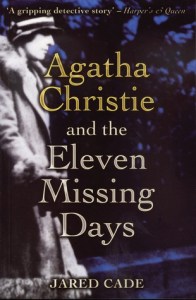
Agatha Christie and the Eleven Missing Days by Jared Cade. In December 1926 Agatha Christie disappeared from her home, Styles, in Berkshire. She was found eleven days later in a hotel in Harrogate, Yorkshire apparently suffering from amnesia. Jared Cade delves into the mystery of her disappearance and reveals how those eleven days and the events that led up to her disappearance influenced the rest of her life.
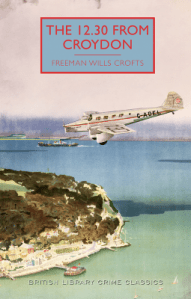
The 12.30 from Croydon by Freeman Wills Croft begins with a murder but the identity of the murderer is known before he even thought of committing the crime. Set in the early 1930s when the country is suffering the effects of the ‘slump’, unlike the 4.50 from Paddington, the 12.30 from Croydon is not a train, but a plane. Charles Swinburne is on the edge of bankruptcy, and he is unable to raise the money to keep his business going, so he sets about murdering his uncle, Andrew Crowther, in order to inherit his fortune.
Thirteen Hours by Deon Meyer. Moving at a fast pace this book follows the events during the thirteen hours from 05:36 when Rachel, a young American girl is running for her life up the steep slope of Lion’s Head in Capetown. DI Benny Griessel is mentoring two inexperienced detectives who are investigating these crimes. With a strong sense of location it reflects the racial tension in the ‘new South Africa’ with its mix of white, coloured and black South Africans.It’s tense, taut and utterly enthralling.
The Verneys: A True Story of Love, War and Madness in Seventeenth Century England by Adrian Tinniswood is set in a period of political and social upheaval, revolution, war, plague, famine and fire. The book starts with the death of Sir Francis Verney at Messina in 1615 and moves through the seventeenth century to the death of Sir Ralph Verney at Claydon House in 1696. The Verney family history is told through from the family archives and tens of thousands of their letters and placing it within the national context.
The Thirty Nine Steps by John Buchan, a fast moving action-story, beginning with an international conspiracy, involving anarchists, financiers and German spies. Richard Hannay, having found Scudder, murdered in his London flat, fears for his life and goes on the run, chased by villains in a series of exciting episodes, culminating in the discovery of the location of the ‘thirty-nine steps’.
When the Lights went out: Britain in the Seventies by Andy Beckett, a journalist, a very detailed book, using original material such as diaries, letters, personal memoirs as well as books written about the period. I particularly liked the personal, face-to-face interviews with some of the key figures such as Ted Heath, and Beckett’s assessments of politicians such as Margaret Thatcher in 1975 when she was a contender for the leadership of the Conservative Party. He described the crises Britain faced then – the economic crises, the floods, food shortages, terrorism, and the destruction of the environment. So, what has changed?
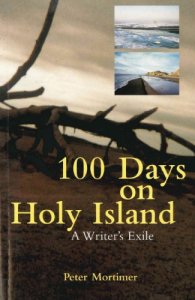
100 Days on Holy Island: a Writer’s Exile by Peter Mortimer, a playwright and a poet. He went to Holy Island with the intention of seeing how he coped with living there for one hundred days and writing about it. His time on Holy Island was from January to April 2001, when foot and mouth disease swept through the UK, and although it never got to Holy Island it was affected by the closure of the countryside. The islanders were hit by the threat to the tourist trade. It was freezing cold, blasted by snow storms and afflicted by power cuts.
A Thousand Moons by Sebastian Barry, a sequel to Days Without End this continues the story of Thomas McNulty and John Cole, and Winona, the young Indian girl they had adopted. It’s set in the 1870s, some years after the end of the Civil War in Tennessee, about seven miles from a little town called Paris. The town was still full of rough Union soldiers and vagabonds on every little byway. Dark skin and black hair were enough to get you beaten up – and it wasn’t a crime to beat an Indian. After Winona was brutally attacked she set out for revenge. And in so doing she began to remember more about her early life and about her mother, a strong Lakota woman, full of courage and pride.



























 BooksPlease