The question this month is:

- Have you ever read a biography on a classic author? If so, tell us about it. If you had already read works by this author, did reading a biography of his/her life change your perspective on the author’s writing? Why or why not? // Or, if you’ve never read a biography of a classic author, would you? Why or why not?
This question came at just the right time for me because I’ve just finished reading Shakespeare: The Biography by Peter Ackroyd. It’s taken me a long time to read because I began it in March and have been reading it almost daily a few short chapters each day.
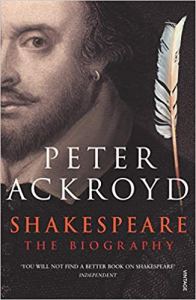
I bought the book in Stratford-upon-Avon some years ago after going to the theatre there. I first came across Shakespeare’s plays at school – doesn’t everyone? Years later I took an Open University course and studied more plays and managed to see productions of each one, either at the Barbican in London or at the Stratford.
So, I’m familiar with several plays, which helps enormously with reading Ackoyd’s biography as he has structured it mainly around the plays. But above all, he has placed Shakespeare within his own time and place, whether it is Stratford or London or travelling around the countryside with the touring companies of players. Shakespeare spans the reigns of two monarchs, which saw great changes and Ackroyd conjures up vividly the social, religious and cultural scene. It’s a very readable book, full of detail. My only reservation about it is one I often have when reading biographies – there are inevitably assumptions, those phrases such as ‘must have’ ‘would have’, ‘most likely’, ‘could have’, ‘there is also a possibility that’ and so on that biographers use.
I learnt a lot that I hadn’t known before as my study of Shakespeare hadn’t gone much beyond the plays, and studying them as entities in themselves is not the same as seeing them in their contemporary settings, or as a part of his whole work. I knew very little (or if I did learn anything years ago, I’ve forgotten) for example of the theatrical world, of how the actors worked, their patrons and managers, nor about how Shakespeare interacted with other writers, or of how his work was received by the public and the monarchy. I particularly liked the sections on religion and the religious conflicts of the late 16th and early 17th centuries and his discussion about Shakespeare’s own beliefs and practices:
This raises the vexed question of his religion, endlessly debated through the centuries. It is true that he used the language and the structure of the old faith in his drama, but that does not imply that he espoused Catholicism. His parents are likely to have been of the old faith, but he did not necessarily take it with him into his adulthood. The old religion was part of the landscape of his imagination, not of his belief.
…
His own adult beliefs are much more difficult to estimate. It is possible that he was, in the language of the period, a ‘church papist’; he outwardly conformed, as in the ceremony of christening, but secretly remained a Catholic. This was a perfectly conventional stance at the time. (pages 446 – 7)
Ackroyd’s account of the language of the plays is also fascinating. Understanding the plays can be demanding. I’ve found that when I’ve seen a play acted it makes much more sense to me than when I’ve only read it and I’ve often wondered how the plays were understood by their 16th century audiences. Ackroyd considers that
Some of Shakespeare’s more recondite phrases would have passed over them, as they baffle even the most highly educated contemporary audience, but the Elizabethans understood the plots and were able to appreciate the contemporary allusions. Of course scholars of a later age have detected in Shakespeare’s plays a subtlety of theme and intention that may well have escaped Elizabethan audiences. But it may be asked whether these are the inventions of scholars rather than the dramatist. (page 349)
In a book of over 500 pages there is much more to be said about it than I’ve attempted in this post – I’ve only just touched the surface!
My overall view of this biography is that it is well researched, with an extensive bibliography, notes and index. Ackroyd acknowledges that he ‘came to this study as a Shakespearian enthusiast‘ rather than as an expert and lists other biographies that he found ‘most illuminating’.
In answer to the Classics Club question on whether reading a biography has changed my perspective on an author’s writing I think the answer has to be that it hasn’t really changed it but it has enhanced my understanding of the world in which Shakespeare lived and wrote and emphasised the fact that the plays are/were made for an audience:
Shakespeare relied upon the audience and, with such devices as the soliloquy, extended the play towards it; the drama did not comprehend a completely independent world, but needed to be authenticated by the various responses of the crowd. (page 349)
 It’s time for another Classics Spin. I didn’t manage to read the book from the last Spin but as we have until 5th January to read the selected book, I’m hoping to do better this time.
 For years I’ve thought I’d read all of Jane Austen’s books, apart from Lady Susan/The Watsons/Sanditon, but then last year I wondered about Mansfield Park, and I realised I couldn’t remember much about it. At first I thought it was one of those books I must have read years ago and forgotten the detail. So, I thought I’d have a look at it again to refresh my memory, but when I looked for my copy I couldn’t find it and slowly I began to think I hadn’t read it at all and bought one. And, lo and behold it was totally new to me – I hadn’t even watched the TV version!

