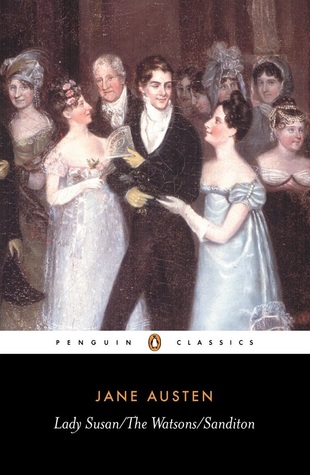
Lady Susan, The Watsons and Sanditon by Jane Austen

Adam at Roof Beam Reader’s Austen in August event reminded me to read Lady Susan, The Watsons and Sanditon.

Jane Austen has long been one of my favourite authors, ever since I read my mother’s copy of Pride and Prejudice and since then I have re-read it several times and her other full length novels too. But I’ve never read Lady Susan, The Watsons and Sanditon before. In fact it was only reading Carol Shields’ biography of Jane Austen quite some years ago now that I discovered that she had written these books, none of which were published in her lifetime. Lady Susan is a finished novella, whereas The Watsons and Sanditon are two unfinished fragments. Lady Susan and The Watsons were first published in 1871 by her nephew, James Edward Austen-Leigh in his Memoir of Jane Austen, including an account of  Sanditon . The full text of Sanditon wasn’t published until 1925.
Lady Susan

According to Margaret Drabble’s introduction to my Penguin Classics edition there is some evidence that Lady Susan was probably written between 1793-4, when Jane Austen was about 20 years old. Drabble thinks this is the least satisfactory of the three stories, but I can’t agree with her view. I was completely taken with it.

Told in a series of letters, Lady Susan is the  story of an unscrupulous widow who plans to force her daughter into a marriage against her wishes. Lady Susan is an attractive and entertaining and totally wicked character, who nevertheless almost manages to fool people for some of the time at least. She is also trying to captivate her sister-in-law’s brother, whilst still holding on to the affections of a previous lover.

As I was reading Lady Susan it reminded of Laclos’s Les Liaisons Dangereuses, not just because both are epistolary but also the content – manipulative and evil characters without any moral scruples, who delight in their power to seduce others. I wondered if it was possible that Jane Austen had known of this book. It was published in 1782, so it is possible that she knew of it, even if she had not actually read it.

To my mind Lady Susan is unique in Jane Austen’s works and I was delighted to read it. It’s written with style, confidence and humour convincingly illustrating 18th century morals and manners.

The Watsons

Jane Austen began writing this in 1804, her father died in 1805 and she never finished it. Its main character is Emma Watson who after fourteen years of absence returns to her father’s house after being brought up by a wealthy aunt. She had grown up in an affluent household and until her aunt had remarried she’d had expectations of an inheritance. She joins her three unmarried sisters, living with their invalid father  and looking for husbands whilst struggling for money. Mr Watson is a clergyman, so on his death they will lose their home. Maybe it was the parallel with Jane and Cassandra Austen’s own situation that caused Jane to abandon the novel when her own father died.

In some ways it is a little like Pride and Prejudice with its account of a ball and Emma Watson has a spirited nature similar to Elizabeth Bennet’s.  Women without money were often obliged to marry for money, but Emma doesn’t want to. Her sister Elizabeth points out that it is ‘very bad to grow old and be poor and laughed at‘, whereas Emma thinks she would ‘rather be a teacher at a school (and I can think of nothing worse) than marry a man I did not like.’

I liked The Watsons but with just this fragment to go off it is a bit basic and does seem rather similar to Pride and Prejudice. I wished she had finished it.

Sanditon

I thoroughly enjoyed Sanditon, even in its unfinished state. It’s the last fiction that Jane Austen wrote, beginning it in January 1817, the year she died. She was ill and the subject of health is one of its themes, but not in a serious or gloomy way. It has a lively, bright and humorous tone, with three of the characters being hypochondriacs, wonderfully satirised by Jane Austen.

The other theme is change in the form of the development of a seaside resort at Sanditon. It conveys the spirit of change of the times as  Sanditon is developed by two of the landowners, Mr Parker and Lady Denham from ‘a quiet village of no pretensions‘ into ‘a fashionable bathing place‘. The two of them, realising its potential of becoming profitable ‘had engaged in it, and planned and built, and praised and puffed, and raised it to a something of young renown – and Mr Parker could think of nothing else.‘

It extols the benefits of sea air and sea bathing, Lady Denham decries the need for a doctor saying it would only encourage the servants and the poor to imagine they were ill – and pronouncing that  if her husband had never seen a doctor he would still have been alive, ‘Ten fees, one after the other, did the man take who sent him out of the world. – I beseech you Mr Parker, no doctors here.‘

Sanditon contrasts the old world with the new upcoming world. Mr Parker has moved from his old comfortable family house set in a sheltered dip two miles from the sea to a new elegant house, which he has named Trafalgar House, not far from a cliff  from which there is a descent to the sea and the bathing machines. Granted it has all the ‘grandeur of storms’, which rocked their bed whilst the wind rages around the house.

…

There is so much more in these stories than I can write about here (this post is far too long anyway).  I shall enjoy re-reading them in the future. They are so different from each other, probably reflecting the different periods of her life when they were written. And I can’t decide between Lady Susan and Sanditon which one I like best.

The Classics Spin: My List

The Classics ClubThe Classics Club has been so quiet for a while now that I was beginning to think it had folded – but no!

It’s time for another Classics Spin for any who are interested. By next Monday, August 24, list your choice of any twenty books you’ve left to read from your Classics Club list ‘” in a separate post. Next Monday morning, The Classics Club will announce a number and that is the book for you to read by October 23.

This is my list:

  1. Moll Flanders by Daniel Defoe
  2. Nicholas Nickleby by Charles Dickens
  3. Little Dorrit by Charles Dickens
  4. Martin Chuzzlewit by Charles Dickens
  5. The Old Curiosity Shop by Charles Dickens
  6. Oliver Twist by Charles Dickens
  7. The Mill on the Floss by George Eliot
  8. Romola by George Eliot
  9. Parade’s End by Ford Maddox Ford
  10. Mary Barton by Elizabeth Gaskell
  11. North and South by Elizabeth Gaskell
  12. Wives and Daughters by Elizabeth Gaskell
  13. Far from the Madding Crowd by Thomas Hardy
  14. The Return of the Native by Thomas Hardy
  15. Love in the Time of Cholera by Gabriel Garcia Marquez
  16. One Hundred Years of Solitude by Gabriel Garcia Marquez
  17. Doctor Thorne  (Barsetshire Chronicles, #3) by Anthony Trollope
  18. The Color Purple by Alice Walker
  19. The Age of Innocence by Edith Wharton
  20. The Voyage Out by Virginia Woolf

I don’t mind which one of these comes up in the Spin, but I’m half hoping it will be one of the Hardy books and I’m not sure about reading The Voyage Out as I’ve started this in the past and put it back on the shelf unfinished.

The Classics Club Spin Result …

… it’s NUMBER 2

Out of Africa by Karen Blixen

This is the book for me to read by 15 May.

Well, it’s not one of the Dickens’ books I listed but it’s still a book I’ve been looking forward to reading, ever since I saw the film starring Meryl Streep and Robert Redford. It’s Karen Blixen’s memoir of life in Kenya on a coffee plantation in the early years of the 20th century.

Classics Club Spin

The Classics ClubIt’s time for another Classics Spin.

  • List any twenty books you have left to read from your Classics Club list.
  • Number them from 1 to 20.
  • Next Monday the Classics Club will announce a number.
  • This is the book you need to read by 15th May.

I decided to list all the books by Charles Dickens, George Eliot, Elizabeth Gaskell and Gabriel Garcia Marquez that are on my list and then added Moby Dick because it will fit in well with a book I’m planning to read soon, In the Heart of the Sea by Nathaniel Philbrick, which was inspired by Moby Dick.  I added the other books randomly.

  1. Lorna Doone: A Romance of Exmoor by R D Blackmore
  2. Out of Africa by Karen Blixen
  3. No Name by Wilkie Collins
  4. Nicholas Nickleby by Charles Dickens
  5. Little Dorrit by Charles Dickens
  6. Martin Chuzzlewit by Charles Dickens
  7. The Old Curiosity Shop by Charles Dickens
  8. Oliver Twist by Charles Dickens
  9. Adam Bede by George Eliot
  10. The Mill on the Floss by George Eliot
  11. Romola by George Eliot
  12. Silas Marner by George Eliot
  13. Parade’s End by Ford Maddox Ford
  14. Mary Barton by Elizabeth Gaskell
  15. North and South by Elizabeth Gaskell
  16. Wives and Daughters by Elizabeth Gaskell
  17. Three Men in a Boat by Jerome K Jerome
  18. Love in the Time of Cholera by Gabriel Garcia Marquez
  19. One Hundred Years of Solitude by Gabriel Garcia Marquez
  20. Moby Dick by Herman Melville

I quite fancy reading Dickens soon, so hope one of his is the spin book.

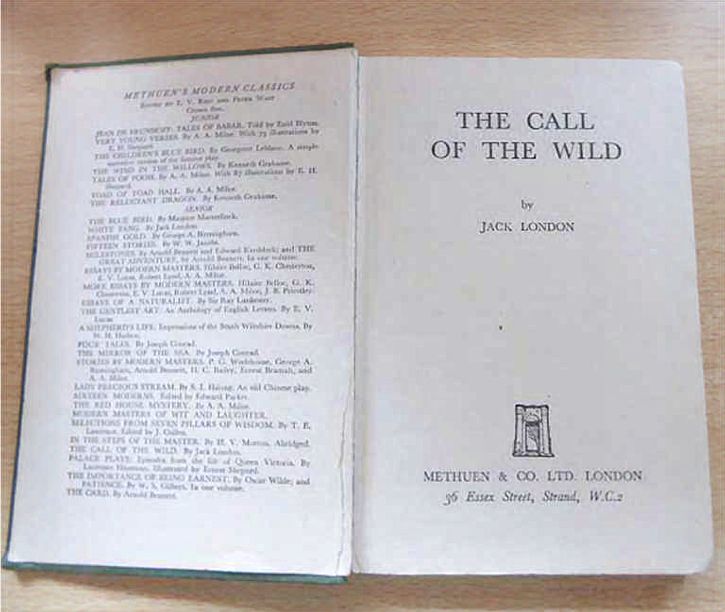
The Call of the Wild by Jack London

The Call of the Wild and White Fang by Jack London are books that I’ve known about as long as I can remember – they were books my parents owned – but I’ve never read them, until now.  So, I was pleased when The Call of the Wild, Jack London’s first book came out as my Classics Club Spin book.  I would have read it one day anyway but the Spin gave me the nudge to read it now. I wasn’t expecting to find it such a beautiful, moving and poignant book, but it is. And it has so much packed into its 106 pages in my little hardback copy.

It begins in 1897 when Buck, a cross between a St Bernard and a Scotch Shepherd (Collie) was stolen from his home in the Santa Clara Valley in California and taken to the Yukon where strong sled dogs were needed during the Klondike Gold Rush. It’s a shock to Buck (what an understatement) as he moves from his pampered life on a California ranch where he had free rein, swimming, hunting and playing to the harsh realities and cruelty of the life of a working dog in the wastes of Alaska, where the ‘law of club and fang‘ predominated. The book is told from Buck’s point of view, but this is no cutesy, sentimental animal story. Buck has to fight for existence and as he learnt by experience, instincts that were long dead came alive in him:

The domesticated generations fell from him. In vague ways he remembered back to the youth of the breed, to the time the wild dogs ranged in packs through the primeval forest and killed their meet as they tracked it down. It was no task for him to learn to fight with cut and slash and the quick wolf snap.

…  And when, on the still cold nights, he pointed his nose at a star and howled long and wolflike, it was his ancestors, dead and dust, pointing nose at star and howling down through the centuries and through him. … the ancient song surged through him and he came into his own again (page 24)

After changing owners several times, each worse than the one before he is eventually saved from death by John Thornton who nurses him back to health and for a while it is the love between man and dog that keeps Buck with him. Eventually however, the call of the wild is too strong!

Apart from the story which kept me turning the pages to find out what happened next it’s the quality of London’s writing, the vivid descriptions and the haunting mystical sense of the wild that captivated me – this passage for example:

There is an ecstasy that marks the summit of life, and beyond which life cannot rise. And such is the paradox of living, this ecstasy comes when one is most alive, and it comes as a complete forgetfulness that one is alive. This ecstasy, this forgetfulness of living, comes to the artist, caught up and out of himself in a sheet of flame; it comes to the soldier, war-mad in a stricken field and refusing quarter; and it came to Buck, leading the pack, sounding the old wolf-cry, straining after the food that was alive and that fled swiftly before him through the moonlight. (pages 37-38)

I’ll be reading White Fang soon.

The Spin Result is …

… Number 13 in the Classics Club Spin.

For me that is The Call of the Wild by Jack London, the story of the dog, Buck and his adventures in the Klondike.

Call of the wild

I am delighted with this choice. That’s not so surprising as I want to read all the books on my Classics Club list, but I’m particularly pleased with this one because I’ve been meaning to read it for years! Both this and White Fang are books that belonged to my mother and I just cannot imagine why I’ve never read either of them before – it seems I need this push from the Spin to get round to it. As The Call of the Wild is so short I’m going to read White Fang as well.