The Call of the Wild by Jack London

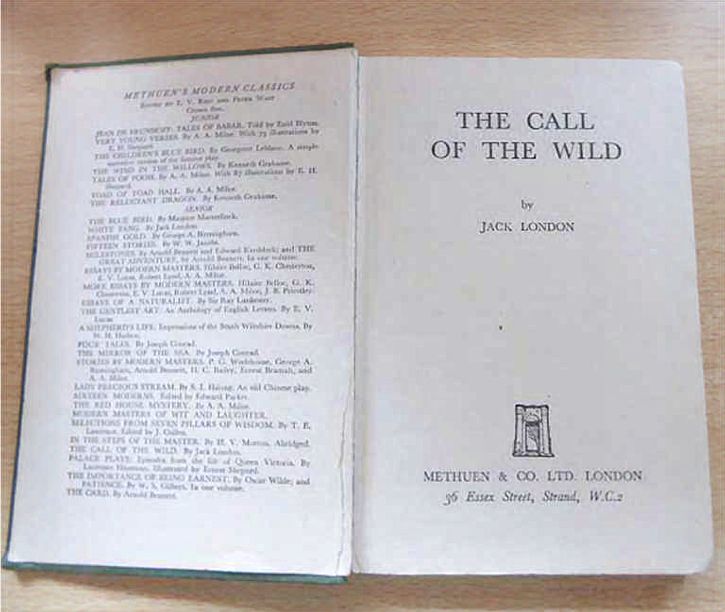
The Call of the Wild and White Fang by Jack London are books that I’ve known about as long as I can remember – they were books my parents owned – but I’ve never read them, until now.  So, I was pleased when The Call of the Wild, Jack London’s first book came out as my Classics Club Spin book.  I would have read it one day anyway but the Spin gave me the nudge to read it now. I wasn’t expecting to find it such a beautiful, moving and poignant book, but it is. And it has so much packed into its 106 pages in my little hardback copy.

It begins in 1897 when Buck, a cross between a St Bernard and a Scotch Shepherd (Collie) was stolen from his home in the Santa Clara Valley in California and taken to the Yukon where strong sled dogs were needed during the Klondike Gold Rush. It’s a shock to Buck (what an understatement) as he moves from his pampered life on a California ranch where he had free rein, swimming, hunting and playing to the harsh realities and cruelty of the life of a working dog in the wastes of Alaska, where the ‘law of club and fang‘ predominated. The book is told from Buck’s point of view, but this is no cutesy, sentimental animal story. Buck has to fight for existence and as he learnt by experience, instincts that were long dead came alive in him:

The domesticated generations fell from him. In vague ways he remembered back to the youth of the breed, to the time the wild dogs ranged in packs through the primeval forest and killed their meet as they tracked it down. It was no task for him to learn to fight with cut and slash and the quick wolf snap.

…  And when, on the still cold nights, he pointed his nose at a star and howled long and wolflike, it was his ancestors, dead and dust, pointing nose at star and howling down through the centuries and through him. … the ancient song surged through him and he came into his own again (page 24)

After changing owners several times, each worse than the one before he is eventually saved from death by John Thornton who nurses him back to health and for a while it is the love between man and dog that keeps Buck with him. Eventually however, the call of the wild is too strong!

Apart from the story which kept me turning the pages to find out what happened next it’s the quality of London’s writing, the vivid descriptions and the haunting mystical sense of the wild that captivated me – this passage for example:

There is an ecstasy that marks the summit of life, and beyond which life cannot rise. And such is the paradox of living, this ecstasy comes when one is most alive, and it comes as a complete forgetfulness that one is alive. This ecstasy, this forgetfulness of living, comes to the artist, caught up and out of himself in a sheet of flame; it comes to the soldier, war-mad in a stricken field and refusing quarter; and it came to Buck, leading the pack, sounding the old wolf-cry, straining after the food that was alive and that fled swiftly before him through the moonlight. (pages 37-38)

I’ll be reading White Fang soon.

The Spin Result is …

… Number 13 in the Classics Club Spin.

For me that is The Call of the Wild by Jack London, the story of the dog, Buck and his adventures in the Klondike.

Call of the wild

I am delighted with this choice. That’s not so surprising as I want to read all the books on my Classics Club list, but I’m particularly pleased with this one because I’ve been meaning to read it for years! Both this and White Fang are books that belonged to my mother and I just cannot imagine why I’ve never read either of them before – it seems I need this push from the Spin to get round to it. As The Call of the Wild is so short I’m going to read White Fang as well.

The Classics Spin

The Classics ClubIt’s time for another Classics Spin. I didn’t manage to read the book from the last Spin but as we have until 5th January to read the selected book, I’m hoping to do better this time.

The rules are the same as always:

  • Pick twenty unread books from your list.
  • Number them from one to twenty.
  • On Monday a number will be drawn.
  • That’s your book, to read by 5th January.

Here’s my list:

  1. Lady Susan/The Watsons/Sanditon by Jane Austen
  2. Lorna Doone: A Romance of Exmoor by R D Blackmore
  3. Out of Africa by Karen Blixen
  4. No Name by Wilkie Collins
  5. Little Dorrit by Charles Dickens
  6. Martin Chuzzlewit by Charles Dickens
  7. Nicholas Nickleby by Charles Dickens
  8. Oliver Twist by Charles Dickens
  9. The Mill on the Floss by George Eliot
  10. Parade’s End by Ford Maddox Ford
  11. Where Angels Fear to Tread by E M Forster
  12. The Man Who Would Be King by Rudyard Kipling
  13. The Call of the Wild by Jack London
  14. Love in the Time of Cholera by Gabriel Garcia Marquez
  15. One Hundred Years of Solitude by Gabriel Garcia Marquez
  16. Of Human Bondage by W. Somerset Maugham
  17. Black Beauty by Anna Sewell
  18. Barchester Towers (Barsetshire Chronicles, #2) by Anthony Trollope
  19. The Age of Innocence by Edith Wharton
  20. The Voyage Out by Virginia Woolf

These are all books from my TBR books which will help me reduce the numbers – books I’ve had for years in some cases!

It's Spin Time!

The Classics Club Spin, that is. I don’t mind which book comes up in the Spin as they are all books I’d like to read. I quite fancy reading one of Dickens’ books this summer and can’t decide which one! And that is why I’ve included five of his books in the list.

Here are the rules:

* List any twenty books you have left to read from your Classics Club list.The Classics Club
* Number them from 1 to 20.
* Next Monday (August 11th) the Classics Club will announce a number.
* This is the book you need to read by October 6th.

Here’s my list:

  1. Lady Susan/The Watsons/Sanditon by Jane Austen – her first full-length novel
  2. Lorna Doone: A Romance of Exmoor by R D Blackmore
  3. Out of Africa by Karen Blixen – I’ve been meaning to read this ever since I saw the film, which is only loosely based on the book.
  4. No Name by Wilkie Collins – because I liked The Moonstone and The Woman in White
  5. Little Dorrit by Charles Dickens
  6. Martin Chuzzlewit by Charles Dickens
  7. Nicholas Nickleby by Charles Dickens
  8. Oliver Twist by Charles Dickens
  9. Pickwick Papers by Charles Dickens
  10. Parade’s End by Ford Maddox Ford – I liked the TV series with Benedict Cumberbatch so much, I hope I like the book!
  11. Where Angels Fear to Tread by E M Forster
  12. The Man Who Would Be King by Rudyard Kipling
  13. The Call of the Wild by Jack London
  14. One Hundred Years of Solitude by Gabriel Garcia Marquez
  15. Of Human Bondage by W. Somerset Maugham
  16. Travels with a Donkey in the Cevennes by Robert Louis Stevenson
  17. Gulliver’s Travels by Jonathan Swift
  18. Barchester Towers (Barsetshire Chronicles, #2) by Anthony Trollope
  19. The Age of Innocence by Edith Wharton
  20. The Voyage Out by Virginia Woolf – her first novel

Shakespeare and The Classics Club’s July question

The question this month is:

Have you ever read a biography on a classic author? If so, tell us about it. If you had already read works by this author, did reading a biography of his/her life change your perspective on the author’s writing? Why or why not? // Or, if you’ve never read a biography of a classic author, would you? Why or why not?

This question came at just the right time for me because I’ve just finished reading Shakespeare: The Biography by Peter Ackroyd. It’s taken me a long time to read because I began it in March and have been reading it almost daily a few short chapters each day.

Shakespeare biography

I bought the book in Stratford-upon-Avon some years ago after going to the theatre there. I first came across Shakespeare’s plays at school – doesn’t everyone? Years later I took an Open University course and studied more plays and managed to see productions of each one, either at the Barbican in London or at the Stratford.

So, I’m familiar with several plays, which helps enormously with reading Ackoyd’s biography as he has structured it mainly around the plays.  But above all, he has placed Shakespeare within his own time and place, whether it is Stratford or London or travelling around the countryside with the touring companies of players. Shakespeare spans the reigns of two monarchs, which saw great changes and Ackroyd conjures up vividly the social, religious and cultural scene. It’s a very readable book, full of detail. My only reservation about it is one I often have when reading biographies – there are inevitably assumptions, those phrases such as ‘must have’  ‘would have’, ‘most likely’, ‘could have’, ‘there is also a possibility that’ and so on that biographers use.

I learnt a lot that I hadn’t known before as my study of Shakespeare hadn’t gone much beyond the plays, and studying them as entities in themselves is not the same as seeing them in their contemporary settings, or as a part of his whole work. I knew very little (or if I did learn anything years ago, I’ve forgotten) for example of the theatrical world, of how the actors worked, their patrons and managers, nor about how Shakespeare interacted with other writers, or of how his work was received by the public and the monarchy. I particularly liked the sections on religion and the religious conflicts of the late 16th and early 17th centuries and his discussion about Shakespeare’s own beliefs and practices:

This raises the vexed question of his religion, endlessly debated through the centuries. It is true that he used the language and the structure of the old faith in his drama, but that does not imply that he espoused Catholicism. His parents are likely to have been of the old faith, but he did not necessarily take it with him into his adulthood. The old religion was part of the landscape of his imagination, not of his belief.

His own adult beliefs are much more difficult to estimate. It is possible that he was, in the language of the period, a ‘church papist’; he outwardly conformed, as in the ceremony of christening, but secretly remained a Catholic. This was a perfectly conventional stance at the time. (pages 446 – 7)

Ackroyd’s account of the language of the plays is also fascinating. Understanding the plays can be demanding. I’ve found that when I’ve seen a play acted it makes much more sense to me than when I’ve only read it and I’ve often wondered how the plays were understood by their 16th century audiences. Ackroyd considers that

Some of Shakespeare’s more recondite phrases would have passed over them, as they baffle even the most highly educated contemporary audience, but the Elizabethans understood the plots and were able to appreciate the contemporary allusions. Of course scholars of a later age have detected in Shakespeare’s plays a subtlety of theme and intention that may well have escaped Elizabethan audiences. But it may be asked whether these are the inventions of scholars rather than the dramatist. (page 349)

In a book of over 500 pages there is much more to be said about it than I’ve attempted in this post – I’ve only just touched the surface!

My overall view of this biography is that it is well researched, with an extensive bibliography, notes and index. Ackroyd acknowledges that he ‘came to this study as a Shakespearian enthusiast‘ rather than as an expert and lists other biographies that he found ‘most illuminating’.

In answer to the Classics Club question on whether reading a biography has changed my perspective on an author’s writing I think the answer has to be that it hasn’t really changed it but it has enhanced my understanding of the world in which Shakespeare lived and wrote and emphasised the fact that the plays are/were made for an audience:

Shakespeare relied upon the audience and, with such devices as the soliloquy, extended the play towards it; the drama did not comprehend a completely independent world, but needed to be authenticated by the various responses of the crowd. (page 349)

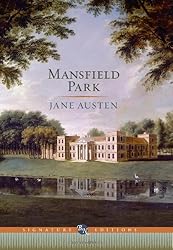
Mansfield Park by Jane Austen

For years I’ve thought I’d read all of Jane Austen’s books, apart from Lady Susan/The Watsons/Sanditon, but then last year I wondered about Mansfield Park, and I realised I couldn’t remember much about it. At first I thought it was one of those books I must have read years ago and forgotten the detail. So, I thought I’d have a look at it again to refresh my memory, but when I looked for my copy I couldn’t find it and slowly I began to think I hadn’t read it at all and bought one. And, lo and behold it was totally new to me – I hadn’t even watched the TV version!

On the surface Mansfield Park is a simple story about a family and their relationships. Fanny Price, as a child of 10 goes to live with her wealthy aunt and uncle, Sir Thomas and Lady Bertram at Mansfield Park, where as the poor relation she is not treated badly, but not as cared for or as kindly as her cousins, but more as an unpaid servant dependent on the family for her welfare – a sort of Cinderella story.

But through the story, Jane Austen reveals the complicated interaction of society, shows the development of Fanny’s character and the depiction of a heroine who is good and gentle who matures throughout the novel. Fanny is an unassuming character who at first appears to be too self-effacing and timed, but who grows in strength of character. I think it’s a very clever portrayal because the reader sees things through Fanny’s eyes. Whilst at first I wanted to give her a shake and say pull yourself together, you’re being a doormat, I realised that Jane Austen was drawing a realistic portrait and waited to see how she would develop.

Like the other novels, Mansfield Park is full of detail of everyday life, its boredom as well as its entertainments and pleasures, the  balls and dinners. There is much in it about the houses and gardens, not only of the wealthy but also of the lower classes, such as Fanny’s parents home in Portsmouth – but they have servants themselves, so it is only comparative poverty. Seen mainly through Fanny’s eyes, it’s a study of morals, the damage caused by being unwanted and unloved.

There is, of course, so much more to say about this book – Mrs Norris’s snobbery, her obsession with  penny-pinching and her nasty, spiteful behaviour; the opinion of clergymen, seen through Mary Crawford’s mercenary eyes as she thinks about Edmund Bertram’s position; the flirty behaviour of the ‘charming’ Henry Crawford; the apparent coldness of Sir Thomas and his family’s distance from him; Lady Bertram’s languid life from her sofa; the disruption caused by the play and so on. There is also a gentle strain of humour and satirical observations about contemporary values, and even, with Mary Crawford’s pun on ‘Rears and Vices‘, a bawdy note.

Yes, I definitely like Mansfield Park and pleased it came up for me in the Classics Club Spin, which gave me the necessary push to read it in June.