The Mill on the Floss by George Eliot

I was pleased when the Classics Club Spin number came up as 8, because for me that was The Mill on the Floss, a book I’ve had for years, so it was time I read it. I think one of the reasons I hadn’t read it is the size of the font – it’s small. But then I realised that there is a free e-book, so I read it on my Kindle as I could increase the font size.
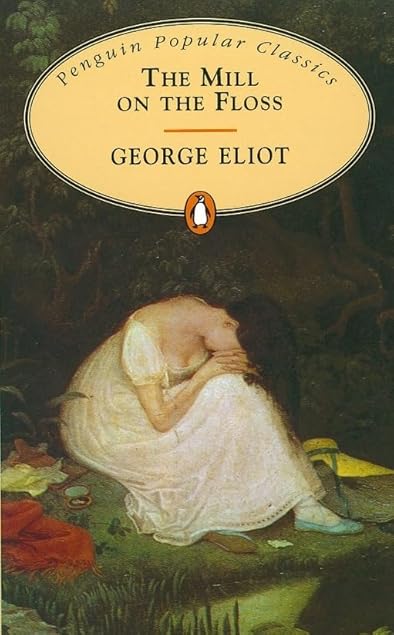
Description (from my paperback copy of the Penguin Popular Classics 1994 edition, shown above):

George Eliot drew on her own anguished childhood when she depicted the stormy relationship between Maggie and Tom Tulliver. Maggie’s often tormented battle to do her duty and belong on the one hand, and to be  herself, wild and natural, on the other, propels her from one crisis to another. As the Tulliver fortunes decline and fall, the rift between Maggie and her family becomes almost irreconcilable. But Maggie’s biggest mistake of all is to fall in love with Stephen Guest who is engaged to another woman.

Both a sharp and observant picture of English rural life and a profoundly convincing analysis of a woman’s psychology, The Mill on the Floss is a novel that tackles the complexities of morality versus desire.

My thoughts:

The Mill on the Floss was first published in 1860. The story begins in the late 1820s, when Maggie, who is ‘big for her age, gone nine‘ and her brother, Tom aged about twelve are living at Dorlcote Mill on the banks of the river Floss near the town of St Oggs. Their father is anxious that Tom should have a good education so that he can go into business – he does not want him to be a miller. But it is Maggie who is the keen reader, enjoying books like The History of the Devil by Daniel Defoe, Aesop’s Fables and the Pilgrim’s Progress.

I enjoyed parts of the book more than other parts. The first part of this book, covering Maggie and Tom’s childhood for example is fascinating and a study of early 19th century rural life and education. Tom goes away from home to study under a tutor, Mr Stelling and meets Philip Wakem, whose father is a lawyer, Mr Tulliver’s opponent in a lawsuit. Maggie and Tom’s relationship is difficult, although she professes she ‘loves him better than anyone else in the world’, even when he rebukes her. Meanwhile Maggie becomes more friendly with Philip than Tom and her family like.

There are some lovely scenes, for example Maggie’s escapade when she leaves home to live with the gypsies. And I liked all the scenes with Mrs Tulliver’s sisters, who look down on her for marrying a miller and criticise Maggie’s appearance and behaviour, for Maggie is full of high spirits and energy. The sisters also provide comic relief, at times being miserly and self-centred, with a strong sense of their own importance. But things go from bad to worse for the Tullivers, when Mr Tulliver loses the lawsuit and eventually loses the mill.

In other places, between scenes there are long, rambling passages, that I found too wordy and philosophical and I waited impatiently to get back to the story. But overall I liked the book, more than I liked Adam Bede, but not as much as I remember liking Middlemarch, which I read long before I began this blog.

The Mill on the Floss is an epic novel encompassing various themes such as love, marriage, family loyalty, the social conventions of the times, and the struggle to survive. Feminism, education, and the role of women in society are to the fore, as Maggie is torn between two men who love her and is judged harshly for her behaviour.

It is a character driven plot; the river Floss plays a major part in the story, running through a wide plain, hurrying on to the sea, laden with ships. It’s a noisy place with Dorlcote Mill is on its banks near a stone bridge and the rush of the water is deafening, along with the ‘thunder of the huge covered wagon coming home with sacks of grain‘.

And it is the Floss that provides the huge climax which took me by surprise. It’s a dramatic ending and yet I found it rather unsatisfactory, not sure that I could believe what I had read, and shocked by such a sad ending. Looking back after I finished the book I realised that it had been foreshadowed almost from the start and I had missed it.

Reading Challenges: Mount TBR 2016 and The Classics Club.

Classics Club Check-In April 2016

Classics Club check inIt’s time for a Classics Club Check-In. Three years ago (next week) I joined The Classics Club, signing up to read and write about at least 50 classic books in at most five years. This is the first time I’ve taken part in a Check-In, although I have joined in with the Classics Club Spins, which I enjoy.

The list is not a fixed list and I have changed it since I started in 2013.This is my current list. I’ve listed the books in a-z author order. I’ve read 18 books, shown in bold, so I’m behind if I’m going to meet my target in the next two years. Currently I’m reading The Mill on the Floss by George Eliot (my current Spin book).

It’s hard to pick a favourite. These books stand out in my mind – Ethan Frome by Edith Wharton, To Kill a Mockingbird by Harper Lee and The Old Curiosity Shop by Charles Dickens.

  1. Lady Susan, The Watsons, Sanditon by Jane Austen ‘“ finished 24 August 2015
  2. Mansfield Park by Jane Austen ‘“ finished 29 June 2014
  3. The Old Wives Tale by Arnold Bennett
  4. Lorna Doone: A Romance of Exmoor by R D Blackmore
  5. Jane Eyre by Charlotte Bronte (a re-read) ‘“ read in November 2014
  6. The Thirty Nine Steps by John Buchan ‘“ finished 21 February 2014
  7. My Antonia by Willa Cather ‘“ finished 26 September 2013
  8. Don Quixote by Miguel de Cervantes Saavedra
  9. The Dead Secret by Wilkie Collins ‘“ finished 30 September 2015
  10. No Name by Wilkie Collins
  11. Lord Jim by Joseph Conrad
  12. Moll Flanders by Daniel Defoe
  13. Barnaby Rudge by Charles Dickens ‘“ finished 29 June 2013
  14. Nicholas Nickleby by Charles Dickens
  15. Little Dorrit by Charles Dickens
  16. Martin Chuzzlewit by Charles Dickens
  17. The Old Curiosity Shop by Charles Dickens ‘“ finished 10 October 2015
  18. Oliver Twist by Charles Dickens
  19. The Adventures of Sherlock Holmes by Arthur Conan Doyle
  20. The Count of Monte Cristo by Alexandre Dumas
  21. Adam Bede by George Eliot ‘“ finished 18 September 2015
  22. The Mill on the Floss by George Eliot
  23. Romola by George Eliot
  24. Silas Marner by George Eliot
  25. Parade’s End by Ford Maddox Ford
  26. The Forsyte Saga (1-3) by John Galsworthy
  27. Mary Barton by Elizabeth Gaskell
  28. North and South by Elizabeth Gaskell
  29. Wives and Daughters by Elizabeth Gaskell
  30. Far from the Madding Crowd by Thomas Hardy
  31. The Return of the Native by Thomas Hardy
  32. Washington Square by Henry James ‘“ finished 17 December 2013
  33. The Man Who Would Be King by Rudyard Kipling
  34. To Kill a Mockingbird by Harper Lee ‘“ finished 16 July 2013
  35. The Call of the Wild by Jack London ‘“ finished 10 December 2014
  36. Love in the Time of Cholera by Gabriel Garcia Marquez
  37. One Hundred Years of Solitude by Gabriel Garcia Marquez
  38. Gone with the Wind by Margaret Mitchell ‘“ finished 20 November 2013
  39. Of Mice and Men by John Steinbeck ‘“ finished 20 September 2015
  40. Travels with a Donkey in the Cevennes by Robert Louis Stevenson
  41. Gulliver’s Travels by Jonathan Swift
  42. Barchester Towers (Barsetshire Chronicles, #2) by Anthony Trollope ‘“ finished 22 February 2015
  43. Doctor Thorne (Barsetshire Chronicles, #3) by Anthony Trollope ‘“ finished 3 March 2016
  44. Framley Parsonage (Barsetshire Chronicles, #4) by Anthony Trollope
  45.  The Small House at Allington (Barsetshire Chronicles, #5) by Anthony Trollope
  46. The Last Chronicle of Barset (Barsetshire Chronicles, #6) by Anthony Trollope
  47. The Time Machine by H G Wells ‘“ finished 29 March 2014
  48. The Age of Innocence by Edith Wharton
  49. Ethan Frome by Edith Wharton ‘“ finished 22 February 2014
  50. The Voyage Out by Virginia Woolf

Classics Club Spin: Result

The Spin number is 8, which for me is The Mill on the Floss by George Eliot ‘“ to be read by 2 May 2016.

I’ve had this book for years, keen to read it after I’d enjoyed Middlemarch, and it has sat unread ever since. I was hoping for Framley Parsonage and have started to read it, so I probably won’t finish The Mill on the Floss by 2 May especially as it is quite long (535 pages in a small font – I think I’ll get a copy to read on my Kindle).

Doctor Thorne by Anthony Trollope

I’ve recently read Anthony Trollope’s Doctor Thorne, which I’d meant to read about a year ago after I finished Barchester Towers! I enjoyed it, although I think it’s a bit too drawn out – I could see where the plot was going very early in the book. The conclusion is predictable.
But that didn’t matter as it’s a book about mid nineteenth-century prosperous country life and the traditional attitudes towards the accepted codes of conduct, of the importance of birth, of wealth and above all about money, class and power. It’s about human relationships and the strength of the novel is in the portraits of its characters and their responses to matters of principle in the face of upper class idiocy and snobbishness. Trollope uses gentle satire in this novel, emphasising the absurdities of the class divisions in society and poking fun at the professions, with the names of doctors, such as Dr Fillgrave, whose name wouldn’t inspire me with confidence, parliamentary agents such as Mr Nearthewind and Mr Closerstil and lawyers called Messrs Slow and Bideawhile.

Doctor Thorne is the third in Trollope’s Barchester Towers books – the first one not set in Barchester, but in Greshambury in East Barsetshire, where the Gresham family and Doctor Thorne and his niece Mary live. As the novel opens nothing is going well for the Gresham family, they are in financial difficulties, the estate is mortgaged and they are heavily in debt. It is imperative that Frank, the son and heir to Greshambury Park and its estate, should marry money – indeed, his mother, Lady Arabella, the sister of the Earl de Courcy insists ‘He must marry money‘, a refrain that is repeated throughout the novel. But Frank has fallen in love with Mary, who has neither money or rank, and is illegitimate and as the story proceeds she is increasingly ostracised by the Gresham family, egged on by their rich relations the De Courcys.

Although the book is called Doctor Thorne, the main character to my mind is Mary Thorne, who shows great strength of character throughout. Mary had been adopted by Doctor Thorne, after her father, his brother had been murdered by her mother’s brother. Her mother had left England for America, where she had married and had a family. The brother, meanwhile had done well for himself after he left prison and made a fortune. Mary knows nothing of her background.

I particularly liked Miss Dunstable, the daughter of ‘the ointment of Lebanon man‘, who had inherited £200,000 when he had died recently. The Gresham family, or rather Lady Arabella, instruct Frank that he is to ask her to marry him – her wealth over-riding the fact that her father was a tradesman.

My only criticism of this book is that the discussions about whether Frank and Mary should or should not be allowed to marry are too drawn out and slowed down the plot too much for my liking. Apart from that I thought it was good, Trollope’s authorial comments were interesting, the dialogue was realistic and lively and the main characters came over as real people. An entertaining novel and now I’m keen to read the next Barchester Towers book, Framley Parsonage; Doctor Thorne also appears in this book!

In his Autobiography Trollope wrote that he had been trying to think up a new plot and he asked his brother to sketch one for him, which he did! He thought it was a good plot and the book was, he believed, the most popular book he had written. He was surprised by its success.

After I finished reading Doctor Thorne I realised that it was a perfect choice for the What’s in a Name? Challenge in the category of a book with a profession in the title. It’s a book I’ve had since before 1 January 2016 and fits into the Mount TRB Reading Challenge too and it’s also a book I identified for the Classics Club Challenge.

I wanted to read Doctor Thorne before the three-part adaptation of the book that starts tonight on ITV at 9 pm, so that my reaction to it wouldn’t be influenced. Now that I have read it I’m not at all sure I’ll watch the adaptation. If there are too many changes I know it will irritate me.

Classics Club Spin

The Classics ClubIt’s time for another Classics Club Spin.

The Spin rules:

  •  List any twenty books you have left to read from your Classics Club list.
  • Number them from 1 to 20.
  • On Monday the Classics Club will announce a number.
  • This is the book to read by 2nd May 2016.

My List

  1. Lorna Doone: A Romance of Exmoor by R D Blackmore
  2. Nicholas Nickleby by Charles Dickens
  3. Little Dorrit by Charles Dickens
  4. Martin Chuzzlewit by Charles Dickens
  5. Oliver Twist by Charles Dickens
  6. The Adventures of Sherlock Holmes by Arthur Conan Doyle
  7. The Count of Monte Cristo by Alexandre Dumas
  8. The Mill on the Floss by George Eliot
  9. Romola by George Eliot
  10. Parade’s End by Ford Maddox Ford
  11. The Forsyte Saga (1) by John Galsworthy
  12. Mary Barton by Elizabeth Gaskell
  13. North and South by Elizabeth Gaskell
  14. Wives and Daughters by Elizabeth Gaskell
  15. Far from the Madding Crowd by Thomas Hardy
  16. The Man Who Would Be King by Rudyard Kipling
  17. Love in the Time of Cholera by Gabriel Garcia Marquez
  18. One Hundred Years of Solitude by Gabriel Garcia Marquez
  19. Framley Parsonage by Anthony Trollope
  20. The Voyage Out by Virginia Woolf

I’d like no.19 to come out as the spin number, as I’ve recently finished reading Anthony Trollope’s Doctor Thorne, or no. 20 as that would fit in with Heavenali’s Virginia Woolf read-along, or maybe no. 15 as it’s been ages since I read anything by Thomas Hardy. But actually I’m happy to read any of these books.

Classics Club Spin Result

The Spin number is 19, which for me is The Color Purple by Alice Walker – to be read by 1 February 2016.

‘One of the most haunting books you could ever wish to read … it is stunning – moving, exciting, and wonderful’, Lenny Henry.

I’m looking forward to reading it. I watched the film starring Whoopi Goldberg many years ago, which I thought was an excellent film.

Did you take part in the Classics Spin? What will you be reading?