Hamlet, Revenge! by Michael Innes

A Golden Age Mystery

Hamlet, Revenge! by Michael Innes has been languishing on my TBR shelves for 9 years, mainly because it is in such a small font making it difficult for me to read. It was first published in 1937. My copy was published in 1961 in paperback with the cover shown in the photo above.

Synopsis:

A Scotland Yard detective probes a high-society house party for someone rotten when a government official is murdered in this classic British mystery.

Preparations are underway for a grand party at Scamnum Court, the sweeping English country estate of the fabulously wealthy Duke of Horton. Some of the nation’s elite are invited for dinner, and some are even set to star in a semi-amateur production of Hamlet on an authentic Elizabethan stage in the banqueting hall. No expense is spared, but one guest soon pays with his life. Before the play ends, a shot is fired, and the actor playing Polonius―Lord Auldearn, the Lord Chancellor of England―is dead.

With war looming on the horizon, suspicions arise over the possibility of espionage. Therefore, the prime minister sends Insp. John Appleby not only to investigate, but to also find a confidential government document. Appleby is lucky there’s a mystery novelist eager to lend a hand with the extensive guest list at Scamnum Court. He will need all the help he can get if he hopes to prevent the killer from making an encore performance . . .

My thoughts

This is the second Inspector John Appleby book. And like the first, Death at the President’s Lodging (my review) it is a most complex mystery. When Lord Auldearn, Lord Chancellor of England is murdered on stage during an amateur production of Hamlet at Scamnum Court the Prime Minister asks Appleby to investigate. Because there’s a possibility that espionage is involved, the PM tells Appleby not to trust anybody. It’s all very vague. The PM tells him there’s a document concerning

… the organization of large industrial interests on an international basis, in the event of a certain international situation. The general drift towards the matter such a document embodies cannot, you realize, well be secret; nothing big can be secret. But the details may be. And this document might be useful in two ways: the detailed information might be useful to one powerful interest or another: and accurate possession of the details, as circumstantial evidence of something already known in general terms, might be useful to an unfriendly government.

…War? said Appleby … (pages 83,84)

The book begins with a Prologue.which is is longer than most prologues. It sets the scene, describing Scamnum Court in detail. It’s the family seat of the Crispin family, described as ‘a big place: two counties away it has a sort of little brother in Blenheim Palace.’ All the characters are introduced, including Giles Gott, who was also in Death at the President’s Lodging. An eminent Elizabethan scholar, he is the director of the play. The other characters are also introduced; Lord Auldearn, the Lord Chancellor of England, who plays Polonius, and numerous other family members, guests and members of the Scamnum Court staff.

There are thirty people involved in the play, actors and those behind the scenes, plus twenty seven in the audience. I found this section too long (74 pages in my copy) and it took me more than a while to identify who was who! My attention was drooping as I read pages of long meandering, descriptive paragraphs and I wondered when there would be a murder. And there is a lot of information about the staging of the play and numerous Shakespearean references. Before the performance the murderer delivered a number of warning messages about revenge, so everybody is on edge.

Appleby doesn’t appear until the second section and then the pace picks up considerably as he and Gott question the suspects. It gets more complicated when a second murder, that of Mr Bose, the prompter who was on stage and who could possibly have seen who shot Lord Auldearn. I was puzzled for much of the time as I read – it’s a book that you can’t read quickly and it requires concentration. I had no idea who the culprit was as Appleby and Gott tried to eliminate the suspects and answer numerous questions, such as why was Lord Auldearn shot and not stabbed as Polonius the character he played was, why did the murderer come onto the stage to shoot him and risk being seen by Bose, why did he send the mysterious messages about revenge – what revenge was being sought, and was the possible espionage plot the reason behind the shooting? Or was the reason a personal one?

From being confused and overwhelmed by the puzzle I became thoroughly absorbed by the mystery and was eagerly turning the pages to find out all the answers. It’s a book I really need to re-read to get to grips with it – I’m sure I missed so much. My post falls far short of doing justice to the book!

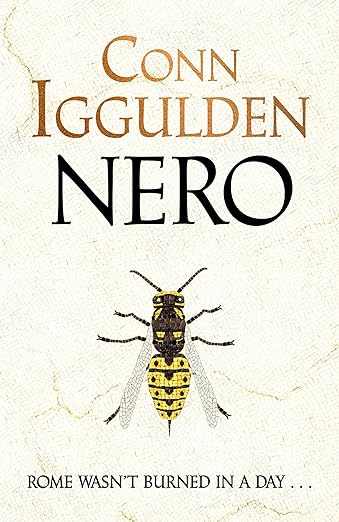
Nero by Conn Iggulden

Penguin 23 May 2024 | 392 pages|e-book |Review copy| 5*

Synopsis

ANCIENT ROME, AD 37

It begins with a man’s hand curled around another’s throat.

Emperor Tiberius first dispatches a traitor. Then his whole family.Next all his friends. It is as if he never existed.

THIS IS ROMAN JUSTICE.

Into this fevered forum, a child is born. His mother is Agrippina, granddaughter of Emperor Augustus. But their imperial blood is no protection. The closer you are to the heart of the empire, the closer you are to power, intrigue, and danger. She faces soldiers, senators, rivals, silver-tongued pretenders, each vying for position. One mistake risks exile, incarceration, execution. Or, worst of all, the loss of her infant son. For Agrippina knows that opportunity waits, even in your darkest moments. Her son is everything. She can make this boy, shape him into Rome itself – the one all must kneel before.

BUT FIRST, THEY MUST SURVIVE . . .

This then is the story of Nero’s birth and raising under the watchful and scheming eye of his mother Agrippina – a woman every man crossed at his peril.

My thoughts:

I’ve enjoyed three books by Conn Iggulden and Nero is no exception. It is excellent. It’s the first in a new trilogy and having read it I’m eagerly looking forward to reading the next two books about Nero. This is the story of his birth and early years up to his 10th year. But it’s more about his mother, Agrippina than about him. She was ruthless, scheming and ambitious for her son, allowing no one to stand in her way.

My interest in historical fiction about the Romans really began in 1976 when I watched the BBC adaptation of I, Claudius and Claudius the God by Robert Graves, starring  Derek Jacobi as Claudius. Later on I read the books, which I loved (I’m tempted to re-read them). Nero brought it back to me as it covers the reigns of Tiberius (the end of his reign), Nero’s uncle, Caligula, and then his great-uncle, Claudius.

Iggulden writes well, bringing life during this period vividly to life. He doesn’t hold back on describing the cruelty and brutality of the times. – he states in his Historical Note: ‘Tiberius was a horror of ancient Rome, who tainted or destroyed anything he touched. … Details of Tiberius’ parties on Capri are too grim to relate …’ There are episodes where, if I’d been watching on TV I would have been covering my eyes, and peeping through my fingers – but I am rather squeamish!

The Historical Note at the end of the book gives further details about the characters, their lives and relationships; and about the ad 43 invasion of Britain, about trade between the empire and Britain before the invasion, and the battle of Medway that took place in Kent.

Despite the gory and bloody scenes I thoroughly enjoyed Nero. Iggulden is a great storyteller.

My thanks to Michael Joseph / Penguin Random House, the publishers for a review copy via NetGalley.

The Road to Wigan Pier by George Orwell

Synopsis:

In the 1930s, commissioned by a left-wing book club, Orwell went to the industrial areas of northern England to investigate and record the real situation of the working class. Orwell did more than just investigate; he went down to the deepest part of the mine, lived in dilapidated and filthy workers’ houses, and used the tip of his pen to vividly reveal every aspect of the coal miners’ lives. Reading today, 80 years later, Still shockingly true. The despair and poverty conveyed by this picture have a terrifying power that transcends time and national boundaries. At the same time, the Road to Wigan Pier is also Orwell’s road to socialism as he examines his own inner self. Born in the British middle class, he recalled how he gradually began to doubt and then hate the strict class barriers that divided British society at that time. Because in his mind, socialism ultimately means only one concept: “justice and freedom.” (Goodreads)

The Road to Wigan Pier, written in 1936 and published in 1937, is a book of two halves. Orwell’s graphically unforgettable descriptions of social injustice, cramped slum housing, dangerous mining conditions, squalor, hunger and growing unemployment remains a powerful portrait of poverty, injustice and class divisions in Britain. I loved Part One, Part Two less so. I was much more interested in the social and economic conditions than in Orwell’s political views on socialism and fascism.

I knew very little about the 1930s, so I was fascinated and appalled by Orwell’s descriptions in Part One of the working conditions in the coal mines in three towns in the industrial north of England in 1936. His experience of working in a coal mine convinced him that could never have been a coal miner:

I am not a manual labourer and please God I shall never be one, but there are some kinds of manual work that i could do if I had to. At a pinch I could be a tolerable road-sweeper or an inefficient gardener or even a tenth-rate farm hand. But by no conceivable amount of effort or training could I become a coal-miner; the work would kill me in a few weeks.

Yet as bad as the conditions in the mines were in 1936, Orwell stated that it was not long since conditions had been even worse, and he went on to describe how women used to have to work underground, crawling on all fours with a harness round their waists and a chain that passed between their legs dragging tubs of coal even when they were pregnant.

The slag heaps were just ‘dumped on the earth like the emptying of a giant’s dust-bin’ on the outskirts of the mining towns and often they were on fire. At night they could be seen as ‘rivulets of fire winding this way and that, and also the slow-moving blue flames of sulphur’.

Orwell states that

… the majority of these houses are old, fifty or sixty years old at least, and great numbers of them are by any ordinary standard not fit for human habitation. They go on being tenanted simply because there are no others to be had. And that is the central fact about housing in the industrial areas: not that the houses are poky and ugly, and insanitary and comfortless, or that they are distributed in incredibly filthy slums round belching foundries and stinking canals and slag heaps that deluge them with sulphurous smoke – though all this is perfectly true – but simply that there are not enough houses to go round.

Given that the living and working conditions were so appalling it was no surprise to read Orwell’s descriptions of the miners’ health – the most distinctive thing about them were the blue scars on their noses. The coal dust entered every cut and then their skin grew over it and formed the blue stain like tattooing. Only the largest pits had pithead baths, so the miners could only wash when they got home, where it was impossible to wash all over but they could only wash in a bowl of water – and that was only the top half of their bodies. This was because none of the miners’ houses had hot water and at the time they were built no one had imagined that the miners wanted baths!

Before he’d looked into the real situation of the working class, Orwell had thought that the miners were comparatively well paid having heard that a miner was paid ten or eleven shillings a shift, concluding that every one was earning round about £2 a week or £150 a year. However the actual average earnings were only £115 11s 6d. He included a list of weekly stoppages that were given to him as typical in one Lancashire district and also a comprehensive account of their expenses, all of which reduced their earnings considerably.

He then went on to describe the rate of accidents and of those miners killed and injured – if a miner’s working life was forty years the chances were nearly seven to one against his escaping injury and not much more that twenty to one of his being killed outright, giving horrifying accounts of being buried by rock falls when a roof came down. The most understandable cause of accidents was gas explosions, but there were also ‘pot-holes’, circular holes that shot out lumps of stone big enough to kill a man and large stretches of roof were left unpropped because of the increased speed at which the coal was extracted. No other trade was this dangerous.

I struggled to keep my attention focused whilst reading Part Two. He wrote about class divisions, class prejudice and the struggle towards a liberation from the constrictions of class. He pondered whether he had been born into the lower-upper middle class or the upper middle class, or whether it was better to define the class division in terms of money – that is, a layer of society lying between £2000 ad £300 a year. In any case he thought it was not entirely explicable in terms of money as there was also a sort of shadowy caste-system involved. But a lot of Part Two just went over my head.

I was curious about the title, because there is no ‘road to Wigan Pier’ in Orwell’s book and also because I’d grown up knowing that ‘Wigan Pier’ was not a pleasure pier at the seaside – Wigan is not near the sea. It’s inland and part of Greater Manchester!

In a broadcast radio interview of 1943 Orwell elaborated on the name Wigan Pier:

Wigan is in the middle of the mining areas. The landscape is mostly slag-heaps – Wigan has always been picked on as a symbol of the ugliness of the industrial areas. At one time, on one of the muddy little canals that run round the town, there used to be a tumble-down wooden jetty; and by way of a joke some nicknamed this Wigan Pier. The joke caught on locally, and then the music-hall comedians got hold of it, and they are the ones who have succeeded in keeping Wigan Pier alive as a byword.” (Wikipedia)

For more information about the current ‘Wigan Pier’ area see this article about a proposal to redevelop the disused 18th century industrial buildings that is being led by Step Places, The Old Courts, Wigan Council and the Canal and River Trust with the aim of creating a new cultural destination.

I read this book as part of The 1936 Club hosted by Karen at Kaggsy’s Bookish Ramblings and Simon from Stuck in a Book blogs, but was too late to enter my post with the other bloggers’ links during the club event.

The Classics Club Spin Result

The spin number in The Classics Club Spin is number …

8

which for me is The Black Tulip by Alexandre Dumas. The rules of the Spin are that this is the book for me to read by 2 June 2024.

Synopsis from Goodreads:

Set at the height of the “tulipomania” that gripped Holland in 17th century, this is the story of Cornelius van Baerle, a humble grower whose sole desire is to grow the perfect specimen of the tulip negra.

When his godfather is murdered, Cornelius finds himself caught up in the deadly politics of the time, imprisoned and facing a death sentence. His jailor’s daughter Rosa, holds both the key to his survival and his chance to produce the ultimate tulip.


I loved The Count of Monte Cristo by Alexandre Dumas so I’m hoping to love this one too.

Did you take part in the Classics Spin? What will you be reading?

Reading Wales 2024

The sixth Reading Wales celebration (aka Dewithon 24), a month-long event during which book lovers from all parts of the world are encouraged to read, discuss and review literature from and about Wales, began on Saint David’s Day, 1 March, and ends today.

I’ve finished reading two books one , I let You Go, set mostly in Wales and Maiden Voyages by Siân Evans, a Welsh historian, which I’ll write about in a later post.

I Let You Go by Clare Mackintosh

Rating: 5 out of 5.

Synopsis

A tragic accident. It all happened so quickly. She couldn’t have prevented it. Could she?

In a split second, Jenna Gray’s world descends into a nightmare. Her only hope of moving on is to walk away from everything she knows to start afresh. Desperate to escape, Jenna moves to a remote cottage on the Welsh coast, but she is haunted by her fears, her grief and her memories of a cruel November night that changed her life forever.

Slowly, Jenna begins to glimpse the potential for happiness in her future. But her past is about to catch up with her, and the consequences will be devastating . . .

My thoughts:

I loved I Let You Go, Clare Mackintosh’s debut novel, part psychological thriller and part police procedural. It won Theakston’s Old Peculier Crime Novel of the Year Award in 2016, beating J K Rowling writing as Robert Galbraith. I’ve had this book since 2017 and I started to read it then but it begins with a tragedy, as five year old Jacob is killed by a hit-and-run driver, and I didn’t feel up to reading it at that time and put it back on the shelf for a while. Clare Mackintosh, a former police officer, is a member of Crime Cymru, a consortium of Welsh crime writers who promote Welsh crime fiction.

This is a difficult book to review without giving away spoilers so I’m not going into detail about the plot. It is set partly in Bristol, England where Jacob is killed, and then moves into a small coastal village in Wales where Jenna is trying to make a new life for herself. It’s heart-wrenching reading as Jenna tries to put the past behind her and at times I thought this was a romantic novel. But it’s not, as it becomes clear that there are secrets in her past that haunt her. It’s almost a book of two parts and the second half is dark and violent, full of suspense and menace, and really shocking twists and turns. The characters are fully rounded, extremely well-drawn and realistic. The settings are vividly described, especially of the beautiful Welsh coast line. I could picture it so well and it made me long to be there.

After a slow start this became a book I didn’t want to stop reading. It’s a powerful novel that kept me glued to its pages and it’s one of the best books I’ve read this year. I’ll certainly be reading more by Clare Mackintosh.

The Hunter by Tana French

A short review

Penguin UK| 7 March 2024| 409 pages| E-book review copy| 4*

Synopsis

It’s a blazing summer when two men arrive in the village. They’re coming for gold. What they bring is trouble.

Cal Hooper was a Chicago detective, till he moved to the West of Ireland looking for peace. He’s found it, more or less – in his relationship with local woman Lena, and the bond he’s formed with half-wild teenager Trey. So when two men turn up with a money-making scheme to find gold in the townland, Cal gets ready to do whatever it takes to protect Trey. Because one of the men is no stranger: he’s Trey’s father.

But Trey doesn’t want protecting. What she wants is revenge.

Crackling with tension and slow-burn suspense, The Hunter explores what we’ll do for our loved ones, what we’ll do for revenge, and what we sacrifice when the two collide, from the Sunday Times and New York Times bestseller Tana French

I’ve loved several books by Tana French, especially The Searcher, the first Cal Hooper mystery, so I was really looking forward to reading the second, The Hunter. I wasn’t disappointed and enjoyed this one almost as much. Like The Searcher this is a slow-burner, a book to savour, not one to rush through.

Two years have gone by since the events told in The Searcher. Ex-Chicago detective Cal Hooper is now settled in Ardnakelty, a remote Irish village and Trey Reddy is now fifteen. Trey’s father, Johnny who has been absent from the village for four years suddenly returns. But Trey is suspicious of her father’s true motives and doesn’t trust him, or the rich Londoner, Cillian Rushborough, Johnny met in London. The two of them are out to fleece the villagers, claiming there is gold on their land. But just who is scamming who?

I liked the slow build up to the mystery – there is a murder, but the body is only discovered later on in in the book. And it is the characters not the murder that are the focal point. I loved Tana French’s beautiful descriptions of the Irish rural landscape. It’s the sort of book I find so easy to read and lose myself in, able to visualise the landscape and feel as if I’m actually there with the characters, watching what is happening.

Many thanks to Penguin for a review copy via NetGalley.