More New-to-Me Books

A visit to Barter Books  at Alnwick this week has added 4 books to my TBRs.

 I usually steer clear of books about kidnapped or missing babies/children, so I’m not sure about the first two books shown below. But I’ve read books by both authors before and enjoyed them so I’m hoping they’ll be OK – or at least not too heart-wrenching:
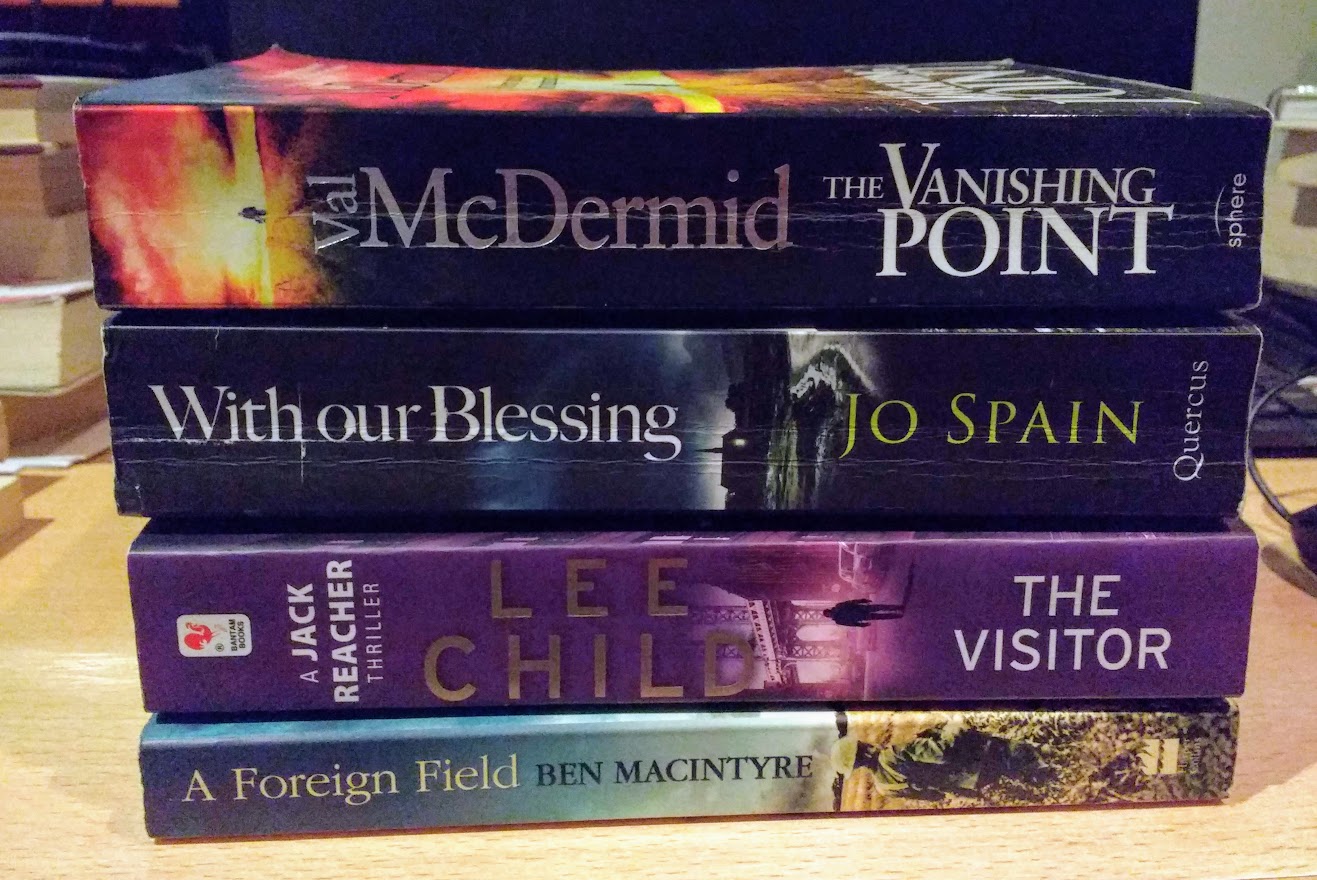
The Vanishing Point by Val McDermid – a standalone psychological thriller beginning with a nightmare scenario: a parent who loses her child in a bustling international airport.

Blurb

Stephanie Harker is travelling through security at O’Hare airport with five-year-old Jimmy. But in a moment, everything changes. In disbelief, Stephanie watches as a uniformed agent leads her boy away – and she’s stuck the other side of the gates, hysterical with worry.

The authorities, unaware of Jimmy’s existence, just see a woman behaving erratically; Stephanie is wrestled to the ground and blasted with a taser gun. By the time she can tell them what has happened, Jimmy is long gone.

But as Stephanie tells her story to the FBI, it becomes clear that everything is not as it seems. There are many potential suspects for this abduction. With time rapidly running out, how can Stephanie get him back?

A breathtakingly rich and gripping psychological thriller, The Vanishing Point is Val McDermid’s most accomplished standalone novel to date, a work of haunting brilliance.

With Our Blessing by Jo Spain – a murder mystery and another book about mothers and babies in the Magdalene Laundries in Ireland, also known as Magdalene asylums.

Blurb

1975
A baby, minutes old, is forcibly taken from its devastated mother.

2010
The body of an elderly woman is found in a Dublin public park in the depths of winter.

Detective Inspector Tom Reynolds is on the case. He’s convinced the murder is linked to historical events that took place in the notorious Magdalene Laundries. Reynolds and his team follow the trail to an isolated convent in the Irish countryside. But once inside, it becomes disturbingly clear that the killer is amongst them . . . and is determined to exact further vengeance for the sins of the past.

The Visitor by Lee Child – a Jack Reacher – I’ve read one of the Jack Reacher books and did enjoy it but looking at the reviews of this book it seems a lot of readers weren’t keen on it whilst many others were. A marmite book, maybe. 

Blurb

Sergeant Amy Callan and Lieutenant Caroline Cook have a lot in common. High-flying army career women, both are victims of sexual harassment from their superiors; both are force to resign from the service.

And now they’re both dead.

Their unmarked bodies are discovered in their homes, naked, in baths filled with army-issue camouflage paint. Expert FBI psychological profilers start to hunt for a serial murderer, a smart guy with a score to settle, a loner, an army man, a ruthless vigilante known to them both.

Jack Reacher, a former US military cop, is a smart guy, a loner and a drifter, as tough as they come. He knew both victims. For Agent-in-Charge Nelson Blake and his team, he’s the perfect match. They’re sure only Reacher has the answers to their burning questions: how did these women die? And why?

A Foreign Field: a True Story of Love and Betrayal in the Great War by Ben Macintyre – nonfiction – because I’m interested in reading about World War One in both fiction and nonfiction. I enjoyed reading his book Operation Mincemeat so I’m hoping I’ll like this one too.  

Blurb

A wartime romance, survival saga and murder mystery set in rural France during the First World War, from the bestselling author of ‘Operation Mincemeat’ and ‘Agent Zig-Zag’.

Four young British soldiers find themselves trapped behind enemy lines at the height of the fighting on the Western Front in August 1914. Unable to get back to their units, they shelter in the tiny French village of Villeret, where they are fed, clothed and protected by the villagers, including the local matriarch Madame Dessenne, the baker and his wife.

The self-styled leader of the band of fugitives, Private Robert Digby, falls in love with the 20-year-old-daughter of one of his protectors, and in November 1915 she gives birth to a baby girl. The child is just six months old when someone betrays the men to the Germans. They are captured, tried as spies and summarily condemned to death.

Using the testimonies of the daughter, the villagers, detailed town hall records and, most movingly, the soldiers’ last letters, Ben Macintyre reconstructs an extraordinary story of love, duplicity and shame – ultimately seeking to discover through decades of village rumour the answer to the question, ‘Who betrayed Private Digby and his men?’ In this new updated edition the mystery is finally solved.

Which one would you recommend I read first?

Top Ten Tuesday: Backlist Books I Want to Read

Top Ten Tuesday new

Top Ten Tuesday is a weekly meme created by The Broke and the Bookish and now hosted by Jana at That Artsy Reader Girl.

The rules are simple:

  • Each Tuesday, Jana assigns a new topic. Create your own Top Ten list that fits that topic – putting your unique spin on it if you want.
  • Everyone is welcome to join but please link back to The Artsy Reader Girl in your own Top Ten Tuesday post.
  • Add your name to the Linky widget on that day’s post so that everyone can check out other bloggers’ lists.
  • Or if you don’t have a blog, just post your answers as a comment.

This week’s topic is: Backlist Books I Want to Read.

It’s hard to limit this to just 10 – this is just a snapshot of some of the books I own and still haven’t read. They’re all fiction.

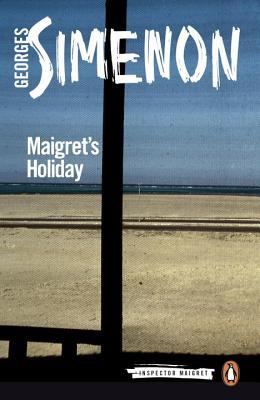
An Advancement Of Learning (Dalziel & Pascoe, #2)Maigret's Holiday (Maigret, #28)The Song of TroyFall of Giants (The Century Trilogy #1)Wednesday's Child (Inspector Banks, #6)

Family AlbumSea of Poppies (Ibis Trilogy, #1)The DryThe IslandThe Lady and the Unicorn

  • Family Album by Penelope Lively, a novel of family intrigue
  • Sea of Poppies by Amitav Ghosh – historical fiction, Ibis Trilogy Book 1 set in the 1830’s just before the opium wars in China
  • The Dry by Jane Harper, crime fiction set in the Australian outback
  • The Island by Victoria Hislop, historical fiction inspired by a visit to Spinalonga, the abandoned Greek leprosy colony
  • The Lady and the Unicorn by Tracy Chevalier, historical fiction, weaving together fact and fiction about the medieval tapestries

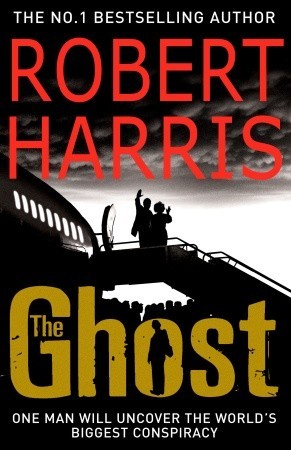
The Ghost by Robert Harris

The Ghost

4*

I have enjoyed all of Robert Harris’s books that I’ve read and The Ghost is no exceptionThe ‘ghost’ in this novel is a professional  ghostwriter employed to finish writing the memoirs of recently retired prime minister of Great Britain, Adam Peter Benet Lang. McAra, Lang’s long-term assistant, had nearly completed Lang’s memoir when he was found dead, drowned. He had gone overboard during the ferry crossing to Martha’s Vineyard, where Lang and his wife, Ruth are staying.

The setting of Martha’s Vineyard in winter reflects Lang’s mood, it is out-of-season, closed down, practically empty – as isolated as Lang himself, disconnected from the world of power he once dominated and stuck on this bleak island with his volatile wife and his aide, the beautiful Amelia Bly, who Ruth suspects is having an affair with Lang. The ghostwriter soon discovers that Lang has secrets in his past that are returning to haunt him – secrets with the power to kill. And he suspects that McAra’s death was neither an accident nor a suicide.

This is fiction, but Adam and Ruth, do have similarities to Tony and Cherie Blair. Lang is charming, personable, full of restless energy, with an engaging smile and thick wavy hair. The narrator, an unnamed writer, who Adam calls ‘man’, is a likeable character more used to ghostwriting the memoirs of footballers than politicians, who has just one month to complete Lang’s memoirs. But soon after he arrives this is reduced to two weeks when news breaks that Lang is accused of war crimes. The International Criminal Court in The Hague are investigating the allegations of Richard Rycart, the former British Foreign Secretary, that Lang had ordered the illegal handover of suspects for torture by the CIA.

I liked the details about ghostwriting from the quotes heading each chapter taken from Andrew Crofts handbook, Ghostwriting. But what I liked most about The Ghost is that it is fast- paced, full of tension and written in a straightforward linear narrative – no flashbacks or fly forwards, or multiple narrators. As in his other books  I’ve read it’s written in such a way that I feel as though I’m there with the characters taking part in the action. And his characters are distinct people, easily distinguishable from each other. In so many books I’ve read recently I’ve come across a character and have been unable to place them and have had to backtrack to find out who they are and how they fit into the plot, or the characters have similar sounding names or all begin with the same letter. Not so with The Ghost the characters have depth, the structure is clear, and there is a twist at the end that revealed the menace implied through the whole novel. Harris is a great storyteller.

My copy:

  • Paperback: 416 pages
  • Publisher: Arrow; Reprint edition (3 July 2008)
  • Language: English
  • ISBN-13: 978-009952749
  • Source: I bought the book
  • My rating: 4*


A-Z of TBRs: E-Books: D, E and F

Earlier this year I looked through my TBRs – the ‘real’ books – and as it prompted me to read more of them, I’ve decided to take a fresh look at some of the TBRs on my Kindle. I have a bad habit of downloading books and then forgetting all about them – it’s as though they’ve gone into a black hole.

This is the second instalment of my A – Z of my e-book TBRs – with a little ‘taster’ from each. These are all fiction.

Daisy in Chains

D is for Daisy in Chains by Sharon Bolton (on my Kindle since November 2014.)  I can’t quite believe I haven’t read this book as Sharon Bolton is one of my favourite authors, but there it is – I can see I started it as I’m on page 22. It’s about a convicted murderer, Hamish Wolfe who tries to convince, defence barrister Maggie Rose that he is innocent.

The Times Online, Monday, 8 September 2014

CONTROVERSY IN COURT AS WOLFE TRIAL OPENS

Accused surgeon, Hamish Wolfe, refused to enter a plea on the first day of his trial at the Old Bailey today. In accordance with English law, he will now be tried as if he had pleaded not guilty.

Dressed in a dark grey suit, white shirt and blue tie, Wolfe appeared to be paying close attention to proceedings, but when asked to speak he remained silent, in spite of the judge, Mr Justice Peters, on three occasions, advising him that it was not in his interests to do so. (page 13)

There are letters, emails, and court transcripts as well as newspaper reports and the story is told from multiple viewpoints, told mainly as far as I can see from the little I’ve read, in the present tense, as in the following extract where Sandra, Hamish’s mother is talking to Maggie as she drives her home from the beach:

I came here today to talk to you,’ she says. I didn’t want to come to your house, I didn’t want to intrude, so I thought I’d wait for you at the beach. And then Daisy ran off just before you arrived. It all nearly went so horribly wrong.’

… ‘I drove over this morning,’ Sandra says before she’s even changed gear. ‘And yesterday morning too. I watched your car pull out of your drive. I guessed you were coming here. And that you come at high tide. (page 9)

Exposure

E is for Exposure by Helen Dunmore, on my Kindle since July 2017. It’s set in London in 1960 when the Cold War is at its height, and a spy may be a friend or neighbour, colleague or lover. At the end of a suburban garden, in the pouring rain, a woman buries a briefcase deep in the earth. She believes that she is protecting her family. What she will learn is that no one is immune from betrayal or the devastating consequences of exposure.

Another book written in the present tense, which again might be the reason I stopped reading this book at page 56:

It starts with a whistle of a train, shearing through the cold, thick dust of a November afternoon. Lily Callington hears it as she digs over her vegetable patch at the bottom of her garden in Muswell Hill. For a second she’s startled, because the whistle sounds so close, as if a rain is rushing towards her along the disused railway line at the bottom of the garden. She straightens and listens intently, frowning. the whistle goes through her, touching nerves so deep that Lily doesn’t even know where they are. The children! They aren’t here. She can’t see them, touch them, keep them safe.

Stop it you fool. They are not babies any more. Paul is ten, Sally almost nine. Even Bridget is five. They’re at school. What could be safer than a primary school in Muswell Hill?

(pages 4-5)

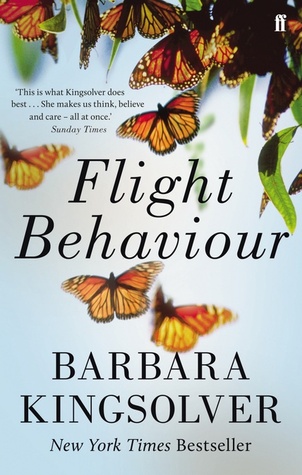
Flight Behaviour

F is for Flight Behaviour by Barbara Kingsolver, on my Kindle since February 2014. On the Appalachian Mountains above her home, a young mother discovers a beautiful and terrible marvel of nature: the monarch butterflies have not migrated south for the winter this year. Is this a miraculous message from God, or a spectacular sign of climate change? Entomology expert, Ovid Byron, certainly believes it is the latter. He ropes in Dellarobia to help him decode the mystery of the monarch butterflies.

Dellarobia is a restless farm wife who gave up her own plans when she accidentally became pregnant at seventeen. Now, after a decade of domestic disharmony on a failing farm, she has settled for permanent disappointment but seeks momentary escape through an obsessive flirtation with a younger man. As she hikes up a mountain road behind her house to a secret tryst, she encounters a shocking sight: a silent, forested valley filled with what looks like a lake of fire.

The flame now appeared to lift from the individual treetops in showers of orange sparks, exploding the way a pine log does in a camp fire when it’s poked. The sparks spiralled upwards in swirls like funnel clouds. Twisters of brightness against gray sky. In broad daylight with no comprehension she watched. From the tops of the funnels the sparks lifted high and sailed out undirected above the dark forest.

A forest fire, if that’s what it was, would roar. This consternation swept the mountain in perfect silence. The air remained cold and clear. No smoke, no crackling howl. she stopped breathing for a second and closed her eyes to listen, but heard nothing. Only a faint patter like rain on leaves. (page 19)

If you’ve read any of these please let me know what you think?

Timekeepers: How the World Became Obsessed with Time by Simon Garfield

Timekeepers: How the World Became Obsessed With Time

3*

Synopsis:

Time flies like an arrow, but fruit flies like a banana. The Beatles learn to be brilliant in an hour and a half. An Englishman arrives back from Calcutta but refuses to adjust his watch. Beethoven has his symphonic wishes ignored. A US Senator begins a speech that will last for 25 hours. The horrors of war are frozen at the click of a camera. A woman designs a ten-hour clock and reinvents the calendar. Roger Bannister lives out the same four minutes over a lifetime. And a prince attempts to stop time in its tracks.

Timekeepers is a book about our obsession with time and our desire to measure it, control it, sell it, film it, perform it, immortalise it and make it meaningful. It has two simple intentions: to tell some illuminating stories, and to ask whether we have all gone completely nuts.

My thoughts:

Timekeepers fulfils Simon Garfield’s intentions – to tell some illuminating stories, and to ask whether we have all gone completely nuts. It covers a wide variety of topics, all in one way or another about time – how it’s been recorded, the development of the calendar, the standardisation of time to aid with railway timetables, and aspects of time management, for example.

The chapters vary in length and some are more interesting than others. The one that interested me most was Movie Time, with an account of how the silent film, Safety Last! was made in 1923.

File:Safetylast-1.jpg
Harold Lloyd dangling from the clock in Safety Last! (1923)

Harold Lloyd climbs the outside of a department store, obstacles falling on him as he does so, until he reaches the giant clock at the top, grabs hold of it, and dangles above the street below. Garfield recalls that for the first audiences time just froze, some went into hysterics and others fainted. Garfield’s focus is on the concept of time that the movies portrayed and goes on to explain how films were originally produced and shown when the timing depended on the cranking skills of the cameraman during filming and the projectionist during showing.

I was also interested in the chapter on performances of Beethoven’s Ninth Symphony, a long and complex piece of music involving a large orchestra, solo singers and a chorus, where Garfield’s focus is on the tempo of the music and the differences made by different composers’ interpretations; and also in the chapter on Nic Ut’s photograph of children fleeing after a napalm bomb had been dropped on a village in Trảng Bàng, Vietnam. Garfield’s focus here is on the fraction of a second when the photograph was captured that brought the story home to its viewers.

Several other chapters also interested me but I wasn’t taken with those on the technicalities of time measurement, time management,or the production of clocks and watches, that Garfield describes in great detail. The book jumps about from topic to topic with, as far as I can make out, no chronological order. But it is full of facts, and going off the Further Reading and Acknowledgement section it is well researched. A book to dip into rather than read straight through.

  • Format: Kindle Edition
  • File Size: 4503 KB
  • Print Length: 369 pages
  • Publisher: Canongate Books; Main edition (29 Sept. 2016)
  • Source: Canongate Books via NetGalley
  • My Rating: 3 stars

Thanks to Canongate Books and NetGalley for my copy of this book for review.

New-To-Me Books

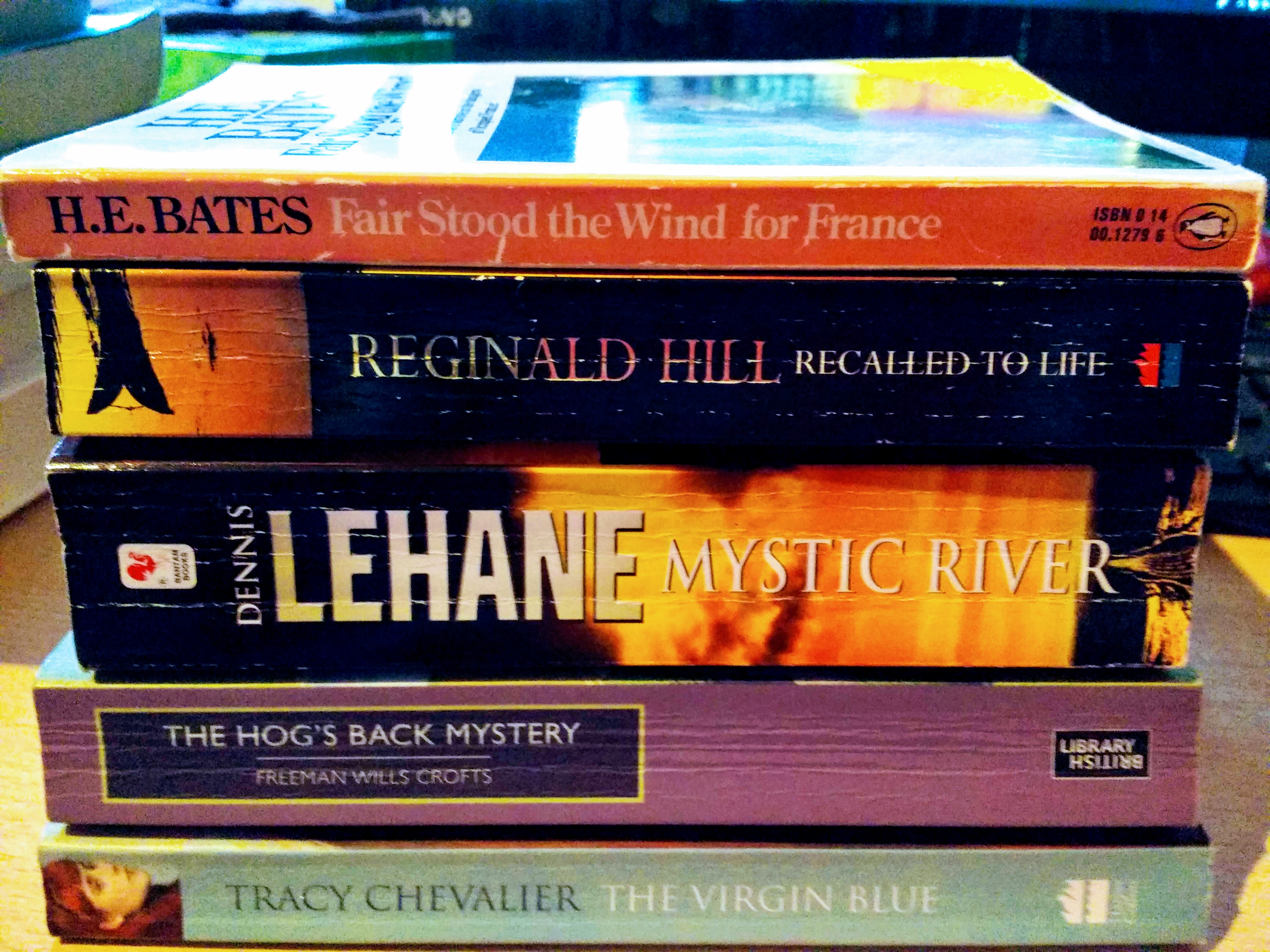
Another visit to  Barter Books in Alnwick means I’ve added 5 more books to my TBRs.

img_20181011_073308703

From top to bottom they are:

Fair Stood the Wind for France by H E Bates – a Penguin modern classic. It was first published in 1944 and is about a British pilot, John Franklin, whose plane was shot down in occupied France, and Francoise, the daughter of a French farmer who hid Franklin and his crew from the Germans. I haven’t read any other books by Bates (1905 – 1974) – he was a prolific writer.

Recalled to Life by Reginald Hill, the 13th Dalziel and Pascoe book.  Dalziel reopens the investigation into a murder that took place in 1963 – the year of the Profumo Scandal, the Great Train Robbery and the Kennedy Assassination. I should be on safe ground with this book as I’ve enjoyed all the other Dalziel and Pascoe books I’ve read.

Mystic River by Dennis Lehane. Three boys’ lives were changed for ever when one of them got into a stranger’s car and something terrible happened. Twenty five years later they have to face the nightmares of their past. I’m not sure what to expect from this book, not having read any of Lehane’s books before, but a reviewer in the Guardian described it as one of the finest novels he’d read in ages.

The Hog’s Back Mystery by Freeman Willis Crofts, first published in 1933 during the Golden Age of detective fiction between the two world wars. It’s an Inspector French murder mystery set in Surrey, where first one person then others disappear. Have they been murdered? I’ve read just one of Crofts’ books before, Mystery in the Channel, which completely baffled me – will this be just as complicated?

The Virgin Blue by Tracy Chevalier, the story of two women, born centuries apart and the ancestral legacy that binds them. This was Tracy Chevalier’s first novel. I’ve read and enjoyed some of her later books, including The Girl with a Pearl Earring and Falling Angels, so I’m looking forward to reading this book.

Please let me know if you’ve read any of these books and whether you enjoyed them – or not.