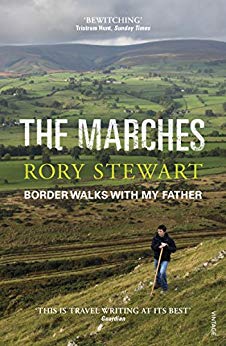
The Marches by Rory Stewart

Marches

Vintage|September 2017|368 pages|Paperback|4*

I enjoyed reading The Marches: Border Walks With My Father by Rory Stewart. He’s been in the news here recently, having stood for leadership of the Conservative Party, and has now formally stood down from Parliament to run as an independent candidate for Mayor of London.

But none of that has anything to do with why I wanted to read his book. It’s because of the subject – walking in the borderlands between England and Scotland, in the place where I live. And it’s not just about walking – he also muses on history, memory and landscape, all topics that interest me immensely.

Blurb:

His father Brian taught Rory Stewart how to walk, and walked with him on journeys from Iran to Malaysia. Now they have chosen to do their final walk together along ‘the Marches’ – the frontier that divides their two countries, Scotland and England.

On their six-hundred-mile, thirty-day journey – with Rory on foot, and his father ‘ambushing’ him by car – the pair relive Scottish dances, reflect on Burmese honey-bears, and on the loss of human presence in the British landscape.
Travelling across mountain ridges and through housing estates they uncover a forgotten country crushed between England and Scotland: the Middleland. They discover unsettling modern lives, lodged in an ancient place, as their odyssey develops into a history of the British nationhood, a chronicle of contemporary Britain and an exuberant encounter between a father and a son.

And as the journey deepens, and the end approaches, Brian and Rory fight to match, step by step, modern voices, nationalisms and contemporary settlements to the natural beauty of the Marches, and a fierce absorption in tradition in their own unconventional lives.

My thoughts:

This is a book of three parts – Book One: The Wall about Rory Stewart’s walk along Hadrian’s Wall in 2011, with his father, then aged 89 – his father walking for the first hour or so each day. They had intended to walk the full length of the Wall, from east to west, but after they reached the fort at Bewcastle they decided to abandon their plan (his father having reached his limits) and drive back to his father’s house, Broich, near Crieff in Perthshire. He writes about the Wall, the Roman occupation of the area, his father’s career, about nationality and clans, and reminisces about his childhood and his time in Afghanistan.

Book Two: Middleland, in which he describes his walk from coast to coast, a distance of about 400 miles, taking him 26 days, walking alone from his cottage in Cumbria to the Solway Firth, then crossing and re-crossing the modern border (established in the 13th century) to Berwick-upon-Tweed and then back to Broich.

I got a bit lost in his descriptions of the route, not knowing some the places along the way. But there are maps of his route that helped me follow where he went. He describes the landscape, the geology, sheep farming and land use, the people he met, their history  and language and much, much more.

Book Three: The General Danced on the Lawn about his father, who died at the age of 93, before this book was finished. The whole book is permeated with his love and respect for his father, but this last section is all about Brian Stewart.

At the end of the Marches is a Chronology which I found very interesting, defining The Middleland before AD100 up to the present days. The Middleland is a term invented by Brian Stewart:

The geographical centre of the island of Britain. An upland landscape, whose core is the Lake District, the Peninnes, the Cheviots and the Scottish Borders, but whose fringes extend to the Humber in the south and the firths of Forth and Clyde in the north. A land naturally unified by geography and culture for two thousand years, but repeatedly divided by political frontiers. (page 339)
My Friday Post: Boris by Andrew Gimson

Book Beginnings Button

Every Friday Book Beginnings on Friday is hosted by Gillion at Rose City Reader where you can share the first sentence (or so) of the book you are reading, along with your initial thoughts about the sentence, impressions of the book, or anything else the opener inspires.

Boris

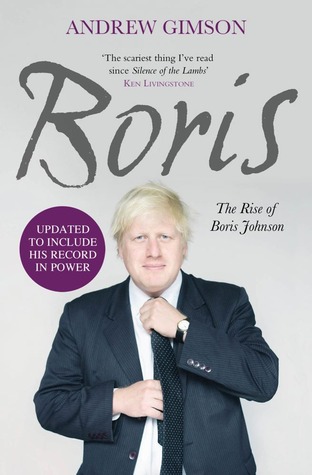
I’ve been thinking for a while of reading Boris: the Rise of Boris Johnson by Andrew Gimson, published in 2012. I bought it secondhand several years ago after Boris had been elected as Mayor of London and it is an updated version of his earlier biography to include Boris’s record in power as the Mayor of London.  I see that Gimson has since brought out  another updated edition, subtitled The Adventures of Boris Johnson, after the Brexit Referendum in 2016.  

It begins with an Introduction explaining why Gimson thought of writing a life of Boris Johnson.

In the summer of 2004, Boris’s star shone with amazing brightness. Reputable judges predicted he would be the next Conservative Prime Minister, and that June morning he was all over the newspapers, which were enthralled by a scoop he had gathered while waiting on his bike at a traffic light.

Well, he wasn’t the next Prime Minister – for that he had to wait until this year.

Then Chapter I begins:

Boris was born to British parents in New York City on 19 June 1964. His mother Charlotte, who was only twenty-two years old, relates that at his birth he had the thick yellow hair for which he was later to become so celebrated: ‘We didn’t cut it, so it turned into ringlets.

And in the photos there is one of Boris, aged one with his mother celebrating at the end of her Oxford exams and Boris is determined to have some of her champagne – his hair a mop of curls.

Also every Friday there is The Friday 56, hosted by Freda at Freda’s Voice.

30879-friday2b56These are the rules:

  1. Grab a book, any book.
  2. Turn to page 56, or 56% on your eReader. If you have to improvise, that is okay.
  3. Find any sentence (or a few, just don’t spoil it) that grabs you.
  4. Post it.
  5. Add the URL to your post in the link on Freda’s most recent Friday 56 post.

Pages 57:

At a time when many of us are still in a state of utter confusion, Boris knew where he wanted to go. A close friend said of him: ‘At the age of eighteen he set himself the target that he was going to be in the Cabinet by the age of thirty-five.’

He didn’t make that target until later in his life – and he went on to become Prime Minister in July.  But will he still be PM by the end of this year … ?

Who knows??

My Friday Post: Maigret’s Holiday by Georges Simenon

Book Beginnings Button

Every Friday Book Beginnings on Friday is hosted by Gillion at Rose City Reader where you can share the first sentence (or so) of the book you are reading, along with your initial thoughts about the sentence, impressions of the book, or anything else the opener inspires.

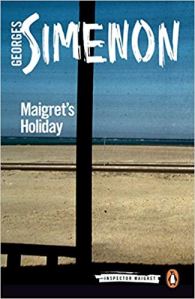
Maigret’s Holiday by Georges Simenon is one of my TBRs, the 28th Inspector Maigret novel in which Maigret’s wife falls ill whilst on their seaside holiday at Les Sables d’Olonne and  a visit to the hospital sends him on an unexpected quest to find justice for a young girl.

Maigret's Holiday


The street was narrow, like all the streets in the old quarter of Les Sables d’Olonne, with uneven cobblestones and pavements so narrow that you had to step off to let another person pass.

Also every Friday there is The Friday 56, hosted by Freda at Freda’s Voice.

30879-friday2b56These are the rules:

  1. Grab a book, any book.
  2. Turn to page 56, or 56% on your eReader. If you have to improvise, that is okay.
  3. Find any sentence (or a few, just don’t spoil it) that grabs you.
  4. Post it.
  5. Add the URL to your post in the link on Freda’s most recent Friday 56 post.

Page 56:

‘I was very fond of that girl, but I repeat that my feelings for her were purely fraternal. I am aware that things are often otherwise. A man can easily be in love with two sisters, especially if they are both living under his roof. That is not the case  and besides, Lili was not in love with me. I’ll go further. I was the exactly the opposite of what she loved. She found me cold and cynical. She often said I had no heart.’

I’ve been reading the Maigret books as I come across them – so, totally out of order of publication. It doesn’t seem to matter. Maigret’s Holiday was originally published in 1948

Have read this book? What did you think about it? And if you haven’t, would you keep on reading?

Ruling Passion by Reginald Hill

Ruling passion

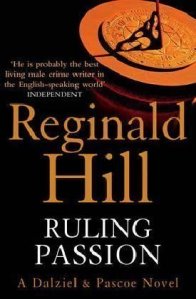
HarperCollins|1993|388 pages|Paperback\ my own copy| 3.5* (rounded up to 4*)

Ruling Passion is Reginald Hill’s third Dalziel and Pascoe novel, first published in 1973, in which Pascoe finds his social life and work uncomfortably brought together by a terrible triple murder. Meanwhile, Dalziel is pressuring him about a string of unsolved burglaries, and as events unfold the two cases keep getting jumbled in his mind.

Peter Pascoe is the main character with Dalziel, his boss playing a minor role. Moving on from the second book where Pascoe had renewed his relationship with Ellie Soper, they are now a couple and friends from their university days, Colin and Rose Hopkins have invited them to stay for a weekend in the country at their cottage in the village of Thornton Lacey. They hadn’t seen them for more than five years and the other guests were also old friends, Timothy Mansfield and Charles Rushworth. (References here to Jane Austen’s Mansfield Park)

However, Peter and Ellie didn’t arrive until the Saturday morning when they found a terrible scene – Timothy and Charles lying on the dining room floor in a pool of blood, dead from wounds caused by a shotgun fired at close range, and Rose was in the back garden lying dead at the base of a sundial in the centre of the lawn, her face pressed into the grass. Colin was nowhere to be seen – and the police, headed by Superintendent Backhouse, immediately assume he is the murderer. Peter for once is faced with being a witness rather than a detective and he doesn’t find it easy. He and Ellie are both convinced that Colin didn’t commit the murders – it’s a matter of finding him and proving Backhouse wrong.

As in the previous book, An Advancement of Learning, the plot is by no means straight forward and I found it rather confusing for a while, trying to remember who was who and where they fitted into the mystery. It’s not helped by the fact that the action moves between Thornton Lacey, Yorkshire and Scotland. It wasn’t only Peter who muddled the murder mystery with his unsolved burglaries – I did too. But it all became much clearer towards the end of the book as the connections between the storylines were made.

It’s the main characters though that interested me most and the development of their characters – Peter and Ellie in particular. Their relationship has moved on and during the course of the book they realise how deep their feelings for each other are – leading them into considering getting married. Peter recognises that he can be a very solitary man:

Solitariness was not far from loneliness and this he feared. He believed he could recognize similar characteristics in Ellie, but how good a basis for marriage this common area would be he could not speculate. Equally far from contemplation, however, was a life without Ellie. Which is as good a definition of love as I’m likely to get in a police station, he told himself. Motives for marriage are at least as varied and unexpected as motives for murder. That sounded like the kind of cold comfort Dalziel would doubtless offer! (page 325)

Whereas Peter and Ellie have now become more developed characters Dalziel still remains more of a caricature, rude, coarse and insensitive. But as Ellie gets to know him more so he becomes more human – and more likeable, with more understanding than she had previously thought. By the end of the book Peter, having passed his exams, is promoted to Inspector.

Reginald Hill wrote 24 Dalziel and Pascoe novels. I’ve now read the first and the last and some in between. Currently I’m reading my way through the rest of them – so book 4 is next on my list – An April Shroud.

Life After Life by Kate Atkinson

Life After Life 1

Transworld Digital|March 2013|Print length 477 pages| e-book|5*

I am delighted to say that I loved Life After Life. I wasn’t at all sure that I would as I began reading it soon after I bought it (in 2013) and didn’t get very far before I decided to put it to one side for a while. A ‘while’ became years – and then at the end of 2016 I read A God in Ruins about Ursula’s brother Teddy, and loved it and decided to try Life After Life again. But, even so it has taken me until this September to get round to reading it. I can’t imagine what my problem with it was in 2013, because this time round once I’d started it I just knew I had to read it and I was immediately engrossed in the story.

Ursula Todd was born on 11 February 1910 at Fox Corner during a wild snowstorm. In the first version she was born before the doctor and the midwife arrived and she died, strangled by the umbilical cord around her neck. But in the second version the doctor had got there in time and saved her life, using a pair of small surgical scissors to snip the cord

During the book Ursula dies many deaths and there are several different versions that her life takes over the course of the twentieth century – through both World Wars and beyond. Each time as she approaches death she experiences a vague unease, before the darkness falls. As she grows older she experiences different outcomes to the events that lead up to that feeling of unease, and finds that sometimes she can prevent the darkness from falling. By the end of the book I had a complete picture of a life lived to the full. I loved the way she experiences the same circumstances but because one little thing is changed it completely changes the whole sequence of events.

There is a constant thread throughout the book – the Todd family, Ursula’s mother, Sylvie, her father, Hugh, her aunt, Izzie, and her brothers and sisters, plus the family servants and friends. They all play more or less significant roles throughout Ursula’s life. It’s a large cast of characters but I had no difficulty in distinguishing them – they all felt ‘real’, partly I think because Atkinson is so good at depicting family life and relationships.

I would love to know more about several of the characters – Izzie, for one – Hugh’s wild bohemian sister, who Sylvie called a ‘cuckoo’ and Mrs Glover described as a ‘Flibbertigibbet’. Then there is Sylvie herself, who I found quite a mysterious character – in particular one of the chapters describing Ursula’s birth very near the end of the book set my imagination working overtime- what had Sylvie known and how? There is more about Ursula’s youngest brother, Teddy in A God In Ruins and I think I’ll have to re-read it soon to see what further light it throws on all the characters.

In some ways it is a tragic book – particularly the parts set during the war years. They are brilliantly written bringing the full of horror of war into focus; some of the standout scenes  are those in London during the Blitz. And it’s interesting to speculate how different the history of the twentieth century could have been if Hitler had been assassinated in 1930. The whole book is full of ‘what ifs’ – what if this character had behaved differently, what if that had not happened, what if you’d made a different choice of subject to study or a different career, or married a different person?  

In fact I think the whole book is excellent, well researched and with such a different structure so well done that it kept me glued to the pages. I wish I’d read it earlier – but it obviously wasn’t the right time for me to read it then.

Reading challenges: Mount TBR

The Seagull by Ann Cleeves

Seagull

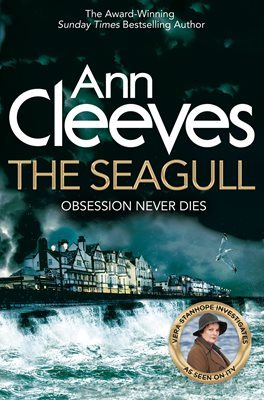
Macmillan| September 2017|print length 416 pages|e-book| 5*

The Seagull is Ann Cleeves’ eighth novel in her Vera Stanhope series, set in Northumberland. It begins as Vera visits the prison where ex-Superintendent John Brace is serving time for corruption and his involvement in the death of a gamekeeper. He had been one of the so-called ‘Gang of Four’ – Brace, Robbie Marshall, a man known simply as ‘The Prof’, and Vera’s father, Hector Stanhope. Brace tells Vera that Robbie, who had disappeared years ago, is dead and that he will tell her where his body is buried if she will visit his daughter Pattie, who has mental health problems.  She does so, but when the police investigate the location Brace gave her they find not one skeleton, but two. 

Opening up this cold case brings back memories for Vera of her past when she was living at home in a remote cottage in the Northumberland countryside, with Hector, after her mother had died.  The Gang of Four had met at Hector’s cottage when Vera was a teenager. They had traded in rare birds’ eggs and sold raptors from the wild for considerable sums. They were regulars at the (fictional) classy Seagull night club, a sleek Art Deco building built in the thirties in Whitley Bay,  during the town’s glory days. Brace and Marshall had also run a recruitment service providing muscle for hire. And Vera wonders just how much Hector had been involved in the Gang of Four’s illegal activities. 

And just as Vera and her team, Joe, Charlie and Holly – Vera’s own ‘gang of four’ – investigate Robbie’s murder they are faced with a present day murder that looks very much as though it links in with their cold case.

I enjoy watching Vera on TV, but I enjoy the books even more. Brenda Blethyn is very good in the role of Vera, but the Vera in the books is not the same as the TV Verashe is more down to earth, a large woman who wears tent-shaped dresses, has bare legs, wears size seven sandals with rubber soles and Velcro straps and she is none too fussy if her feet are dirty. She is a big woman with a big personality and she knows she is a brilliant detective:

‘Oh, I’m interested in everything, Joe. That’s why I’m a bloody brilliant detective’. She gave him her widest smile, ‘That’s why I’m in charge and you’re sitting there, doing as you’re told.’ (page 45)

She still lives in the cottage in the hills (not on Lindisfarne as in the TV series), which she had inherited from Hector along with a freezer full of animal corpses (Hector had done a bit of taxidermy), but most of the action takes place in Whitley Bay and at St Mary’s Island, a small rocky tidal island, linked to the mainland by a short, narrow causeway which is submerged at high tide.

I thoroughly enjoyed The Seagull and loved the way it reveals Vera’s past and her relationship with her father. At the same time the plot kept me guessing almost to the end and the location, well known to Ann Cleeves as it used to be her home town, is superbly described.

I see on Ann Cleeves’ website that ITV have confirmed that there will be a tenth series of VERA, based on Ann’s characters and settings and starring multi-award-winning Brenda Blethyn. The cast have been filming in the North East through the summer. Four new episodes will be broadcast in 2020.

And she has recently published a new  book, The Long Call, the first in a new series, Two Rivers. It is set in North Devon, where Ann grew up, and introduces the reserved and complex Detective Inspector Matthew Venn, estranged from the strict evangelical community in which he grew up, and from his own family, but drawn back by murder into the community he thought he had left behind.

The Long Call was published in Australia on 27th August, in the US on Tuesday 3rd September and in the UK on Thursday 5th September 2019.

Reading challenges: Mount TBR, Calendar of Crime