A Z of TBRs: E-Books – J, K and L

It’s been a long time since I last looked at the forgotten e-books on my Kindle, so it’s time to dip into it again. I have a bad habit of downloading books and then forgetting all about them – it’s as though they’ve gone into a black hole.

Today I’m looking at books with titles beginning with the letters J, K and L, with a little ‘taster’ from each. The summaries are from Goodreads.

Jeremy Hutchinson’s Case Histories by Thomas Grant – I bought this in February 2020 after watching the BBC series,The Trial of Christine Keeler, the story of the Profumo affair in 1962 as seen from her perspective. Hutchinson was Keeler’s defence barrister.

Summary: Born in 1915 into the fringes of the Bloomsbury Group, Jeremy Hutchinson went on to become the greatest criminal barrister of the 1960s, ’70s and ’80s. The cases of that period changed society for ever and Hutchinson’s role in them was second to none. In Case Histories, Jeremy Hutchinson’s most remarkable trials are examined, each one providing a fascinating look into Britain’s post-war social, political and cultural history.

A cartoon by Cummings appeared in the Daily Express on 10 July 1963 headed ‘The adventures of James Macbond’. It showed the beleaguered figure of Harold Mavmillan fleeing from three assailants. Kim Philby and his fellow spy John Vassall are both dressed as shady hoodlums, one wielding a knife, the other a pistol both aimed at Macmillan. Christine Keeler is the third, incarnated on the page as a sort of vampiric harpy, her long-nailed hand outstretched trying to clutch the Prime Minister’s coat tails.

That year was a kind of horror show for Macmillan, and he was not to see out 1963 as Prime Minister. His resignation was accepted by the Queen in October.(page 95)

The Keeper of Lost Things by Ruth Hogan – I bought this in May 2017 and can’t remember how I first came across it.

Summary: Anthony Peardew is the keeper of lost things. Forty years ago, he carelessly lost a keepsake from his beloved fiancée, Therese. That very same day, she died unexpectedly. Brokenhearted, Anthony sought consolation in rescuing lost objects—the things others have dropped, misplaced, or accidentally left behind—and writing stories about them.

He took a sip from his drink and lovingly kissed the cold glass of the photograph before replacing it on the table next to his chair. She was not a classic beauty; a young woman with wavy hair and large dark eyes that shone, even in an old black and white photograph. But she was wonderfully striking, with a preserve that still reached out from all those years ago and captivated him. She had been dead for forty years, but she was still his life, and her death had given him his purpose. It had made Andrew Peardew the Keeper of Lost Things. (page 4)

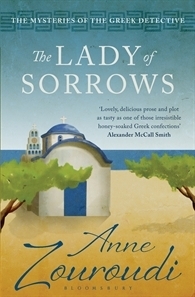
The Lady of Sorrows by Anne Zouroudi – I bought this in April 2013! It is the fourth in Anne Zouroudi’s Mysteries of the  Greek Detective series featuring Hermes Diaktoros. Hermes is a detective with a difference. Just who he is and who he works for is never explained. I have read three of the books in the series. Each one features one of the Seven Deadly Sins.

Summary: A painter is found dead at sea off the coast of a remote Greek island. For our enigmatic detective Hermes Diaktoros, the plot can only thicken: the painter’s work, an icon of the Virgin long famed for its miraculous powers, has just been uncovered as a fake. But has the painter died of natural causes or by a wrathful hand? What secret is a dishonest gypsy keeping? And what haunts the ancient catacombs beneath the bishop’s house?

‘Allow me to introduce myself. I am Hermes Diaktoros, of Athens. Diaktoros being, as you may know, an ancient word for messenger. My father has a strange idea of humour. He’s something of a scholar of the classical world.’

Politely, the priest took the fat man’s hand, which was, in spite of the day’s heat was quite cool to touch.

‘Father Linos Egiotis,’ said the priest.

‘A pleasure,’ said the fat man. ‘Now, I know you must be anxious to close up for siesta, and I won’t keep you.’ He turned back to the icon. ‘She’s very lovely, isn’t she?’ he said. ‘I have been wanting to make her acquaintance for many years. Quite by chance we were passing within a few miles, and had time enough before my next engagement to make the detour. She has quite a reputation, I believe, for performing magic tricks. Magic tricks are a paerticular interest of mine.’

‘Magic tricks?’ queried the priest, with annoyance. ‘The Lady occasionally sees fit to grant miracles. They are acts of divine grace, not magic tricks.’ (page 31)

So, three very different books from the depths of my Kindle. I’m not sure which one to read first. If you’ve read any of these books please let me know what you think. Or if you haven’t read them do they tempt you?

Book Beginnings & The Friday 56: This Poison Will Remain by Fred Vargas

Every Friday Book Beginnings on Friday is hosted by Gillion at Rose City Reader where you can share the first sentence (or so) of the book you are reading. You can also share from a book you want to highlight just because it caught your fancy.

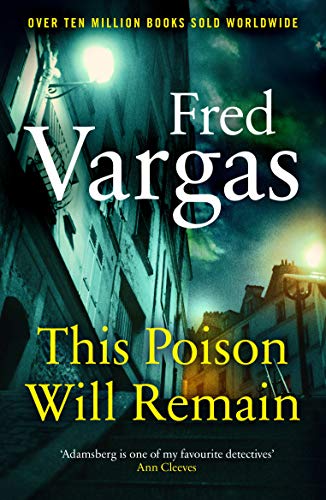
This week’s extracts are from This Poison Will Remain by Fred Vargas. This is the 9th in the Commissaire Adamsberg series. When three elderly men are poisoned by spider venom, everyone assumes that the deaths are tragic accidents. But at police headquarters in Paris, Inspector Adamsberg begins to suspect that the case is far more complex than first appears.

Jean-Baptiste Adamsberg, sitting on a rock at the quayside, watched the Grimsey fishermen return with their daily catch, as they moored their boats and hauled up their nests. Here, on this tiny island off the coast of Iceland, people called him simply ‘Berg’.

Also every Friday there is The Friday 56, hosted by Freda at Freda’s Voice. *Grab a book, any book. *Turn to Page 56 or 56% on your  ereader . If you have to improvise, that is okay. *Find a snippet, short and sweet, but no spoilers!

These are the rules:

  1. Grab a book, any book.
  2. Turn to page 56, or 56% on your eReader. If you have to improvise, that is okay.
  3. Find any sentence (or a few, just don’t spoil it) that grabs you.
  4. Post it.
  5. Add the URL to your post in the link on Freda’s most recent Friday 56 post.

Page 56:

And that very day, a local newspaper reported that a woman, Jeanne Beaujeu, who had just returned from three weeks’ holiday and heard about the deaths, had gone to hospital in Nimes, asking to have her own wound, now healing, to be examined. She stated that she had been bitten by a spider on 8 May, but since the bite had not spread beyond a slight irritation, she had merely taken the medicine prescribed by her doctor. She was forty-five.

Adamsberg stood up and went to gaze at the lime tree outside his window. So it wasn’t just old people.

I’ve read 5 of Fred Vargas’ books. They’re quirky and original and I like Adamsberg, an expert at untangling mysteries, a thinker, who doesn’t like to express his feelings, but mulls things over. I bought this book a couple of years ago and fully intended to read it at that time – but it got buried in my Kindle!

Book Beginnings & The Friday 56: The Lantern Men by Elly Griffiths

Every Friday Book Beginnings on Friday is hosted by Gillion at Rose City Reader where you can share the first sentence (or so) of the book you are reading. You can also share from a book you want to highlight just because it caught your fancy.

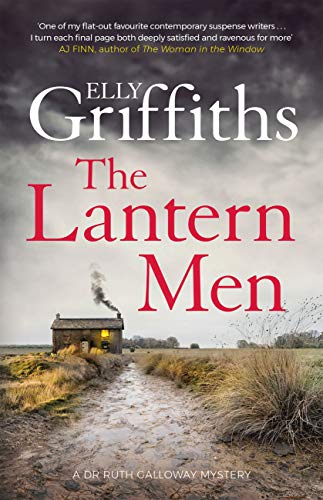
I’ve been looking through my TBR books on my Kindle and came across The Lantern Men by Elly Griffiths, the 12th in her Ruth Galloway series. I’ve read most of the series, so, I think I’ll read this next.

It begins with a Prologue:

10 July 2007

She has been walking for a long time. It’s funny but she hadn’t thought that there was so much space in England.

Also every Friday there is The Friday 56, hosted by Freda at Freda’s Voice. *Grab a book, any book. *Turn to Page 56 or 56% on your  ereader . If you have to improvise, that is okay. *Find a snippet, short and sweet, but no spoilers!

These are the rules:

  1. Grab a book, any book.
  2. Turn to page 56, or 56% on your eReader. If you have to improvise, that is okay.
  3. Find any sentence (or a few, just don’t spoil it) that grabs you.
  4. Post it.
  5. Add the URL to your post in the link on Freda’s most recent Friday 56 post.

Page 56:

It’s a note, scrawled on a folded piece of lined A4 paper.

‘If you want to know more about Ivor March meet me at The Hanged Man on Newnham Rd tonite at 7.30. Ask for John.’

Blurb:

Everything has changed for Dr Ruth Galloway.

She has a new job, home and partner, and is no longer North Norfolk police’s resident forensic archaeologist. That is, until convicted murderer Ivor March offers to make DCI Nelson a deal. Nelson was always sure that March killed more women than he was charged with. Now March confirms this, and offers to show Nelson where the other bodies are buried – but only if Ruth will do the digging.

Curious, but wary, Ruth agrees. March tells Ruth that he killed four more women and that their bodies are buried near a village bordering the fens, said to be haunted by the Lantern Men, mysterious figures holding lights that lure travellers to their deaths.

Is Ivor March himself a lantern man, luring Ruth back to Norfolk? What is his plan, and why is she so crucial to it? And are the killings really over?

Of course, now I want to know more. Do you?

Six Queens: Katheryn Howard the Tainted Queen by Alison Weir

Headline Review| 20 August 2020| 479 pages| Review copy| 2*

I wanted to read this book because I knew very little about Henry VIII’s 5th wife, except that she was beheaded on the grounds that she had committed adultery and treason.

Description

A NAIVE YOUNG WOMAN AT THE MERCY OF HER AMBITIOUS FAMILY.

At just nineteen, Katheryn Howard is quick to trust and fall in love.

She comes to court. She sings, she dances. She captures the heart of the King.

But Henry knows nothing of Katheryn’s past – one that comes back increasingly to haunt her. For those who share her secrets are waiting in the shadows, whispering words of love… and blackmail.

Having read it, I don’t think I know much more, except that Katheryn Howard comes across as a very shallow character, obsessed with sex, with luxury in all its forms, naive and easily manipulated. Alison Weir excels in her descriptive writing, bringing the Tudor court to life in all of its settings, locations, clothes and jewellery.

It has glowing reviews on Amazon full of praise and it is based on extensive research. Clearly other people love this book, but I didn’t. For me it came across as a romance novel, primarily focused on Katheryn’s imagined thoughts, emotions, and sexual encounters. It is simply written, but with too many cliches and modernised text.

Alison Weir’s Author’s Note is much more interesting than her novel, in which she acknowledges her sources, including Dr. Nicola Tallis’ unpublished DPhil thesis, All the Queen’s Jewels, 1445 – 1548, and a number of biographies of Katheryn Howard. She refers to original sources she used as the basis of the book – contemporary writers and wills, portraits showing her rich clothes and jewellery – jewels that have been tentatively identified in Katheryn Howard’s inventory.

She used these sources for the narrative of the book, weaving them into the dialogue and modernising the speech ‘where Tudor English looks out of place in a modern text.’ She states that ‘apart from fictionalising the historical record’ she has invented very little.’ There is also a Dramatis Personae, usefully indicating which characters are fictional and a Timeline, which is also very useful.

I think the Author’s Note is the best part of the book. There is rather too much of ‘fictionalising the historical record’ for me in the novel. I don’t like writing about a book I didn’t enjoy when I know so much work has gone into it and clearly other people have loved it. But this is just my opinion, for what it is worth.

With thanks to NetGalley and to the publishers for my review copy.

The Paris Library by Janet Skeslien Charles

Two Roads| 9th February 2021| 369 pages| Review copy| 3*

Before I read the summary of the book the title led me to think this was about the Bibliothèque Nationale de France, located in Paris. It’s not, it’s about the American Library in Paris.

PARIS, 1939
Odile Souchet is obsessed with books, and her new job at the American Library in Paris – with its thriving community of students, writers and book lovers – is a dream come true. When war is declared, the Library is determined to remain open. But then the Nazis invade Paris, and everything changes.
In Occupied Paris, choices as black and white as the words on a page become a murky shade of grey – choices that will put many on the wrong side of history, and the consequences of which will echo for decades to come.

MONTANA, 1983
Lily is a lonely teenager desperate to escape small-town Montana. She grows close to her neighbour Odile, discovering they share the same love of language, the same longings. But as Lily uncovers more about Odile’s mysterious past, she discovers a dark secret, closely guarded and long hidden.

As an ex-librarian I had high hopes that I would love The Paris Library. It’s historical fiction, based on the true Second World War story of the librarians at the American Library in Paris. It was established in 1920 by the American Library Association with books and periodicals donated by American libraries to US soldiers serving their allies in World War I. Since then it has developed into the largest English language lending library in Europe.

I liked the details about the Library, and about the work the library staff did during the War, including delivering books by hand to their Jewish subscribers in Paris after they were not allowed to enter the Library.

Charles’ helpful Author’s Note gives a fascinating insight into the background to the novel and explains that she had spent several years researching it. She had worked in the American Library in 2010 and her colleagues had told her the story of the Library during the Second World War and had given her access to documents, correspondence and contacts. She met with some of the staff who had worked there and was able to bring their stories up to date. Odile and Lily are both fictional characters.

Although I enjoyed the factual elements of the novel and the wartime storyline, I didn’t enjoy it as much as I had hoped. I was disappointed with the fictional stories, in particular Lily’s story in Montana in the 1980s. I really didn’t see the point of introducing her character simply to show what happened to Odile after the end of the War. Her story took the novel into the genres of YA and romantic fiction, neither of which hold much appeal for me. Overall I thought it was slow going and towards the end of the book my interest flagged making it a struggle to finish it.

With thanks to NetGalley and to the publishers, Two Roads for my review copy.

Coming Up For Air by Sarah Leipciger

A remarkable true story richly re-imagined

On the banks of the River Seine in 1899, a young woman takes her final breath before plunging into the icy water. Although she does not know it, her decision will set in motion an astonishing chain of events. It will lead to 1950s Norway, where a grieving toy-maker is on the cusp of a transformative invention, all the way to present-day Canada where a journalist, battling a terrible disease, risks everything for one last chance to live.

Taking inspiration from a remarkable true story, Coming Up for Air is a bold, richly imagined novel about the transcendent power of storytelling and the immeasurable impact of every human life.

Coming Up For Air is Sarah Leipciger’s second novel. It is a beautiful novel, a story of three people living in different countries and in different times. How their stories connect is gradually revealed as the novel progresses. As the author explains at the end of the novel is is a mix of fact and fiction and has its basis in truth. There is grief and loss and despair in each story, but above all, it is about love, and the desire to live.

Each story was compelling and, for once in a book that alternates between the characters, I thought the changes were just at the right moment in each one.

It begins with the unknown young woman in Paris, L’Inconnue, telling the story of her life that led to her suicide. Her death in the Seine is vividly described. As she fell in the cold water, initially she discovered the desire to live, as her body thrashed about not wanting to drown, her lungs fighting for air, for oxygen. It’s poignant and moving, set at the end of the 19th century bringing the city to life, where she lives as a lady’s companion to an old friend of her grandmother’s.

The second story is that of Norwegian, Pieter Akkrehamn, beginning in 1921, when he used to spend his summers with his grandparents on Karmoy Island. He went swimming in the North Sea, diving down several metres, holding his breath for over a minute in the freezing cold water, as the cold reached his chest, squeezing his lungs. His story is revealed, as he grieves for his little son. He is a toymaker, bored with making wooden toys, who turned to soft plastics and began making dolls with soft faces and bendable knees. What he eventually developed was truly remarkable.

The vital importance of being able to breathe comes to the fore in the third story – that of Anouk, a journalist in Canada. Anouk has cystic fibrosis and is on the list for a lung transplant. Her story is one of how she and her parents dealt with her illness, enabling her to combine her love for water and swimming with managing her cystic fibrosis, all the time struggling to breathe.

I think Sarah Leipciger is a great storyteller. It is an inspiring book, beautifully written, which emphasises the importance of the air we breathe and the desire to live. I loved it so much that I hope to read her first novel, The Mountain Can Wait.

With my thanks to NetGalley and to Random House for my review copy.

  • Publisher ‏ : ‎ Random House UK Transworld Digital (19 Mar. 2020)
  • Language ‏ : ‎ English
  • Print length ‏ : ‎ 320 pages