Six Degrees of Separation: from Eats Shoots and Leaves by Lynne Truss to Talk to the Hand

It’s time again for Six Degrees of Separation, a monthly link-up hosted by Kate at Books Are My Favourite and Best. Each month a book is chosen as a starting point and linked to six other books to form a chain. A book doesn’t need to be connected to all the other books on the list, only to the one next to it in the chain.
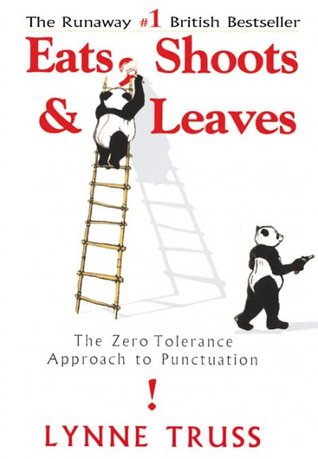
This month the Six Degrees chain begins with Eats Shoots & Leaves by Lynne Truss. I like books on grammar and punctuation! I love her examples and the wrong use of the apostrophe in “its/it’s” infuriates me, although not quite as as much as it does her:

No matter if you have a PhD and have read all of Henry James twice. If you still persist in writing, “Good food at it’s best”, you deserve to be struck by lightning, hacked up on the spot and buried in an unmarked grave.
My first link is Henry JamesWashington Square. It’s all about will /won’t Catherine Sloper and Morris Townsend get married. Catherine lives at home in Washington Square with her father, the wealthy Dr Sloper. I found it rather tedious and repetitive as Catherine grew older, constantly in conflict with her father over whether she should marry Morris. Her father describes her as ‘ about as intelligent as the bundle of shawls.’

Thinking of shawls provides my next link – is The Kashmir Shawl by Rosie Thomas, a dual time-line romantic novel about a beautiful handmade shawl. It’s set in Wales in the present day and in the Himalayas and Kashmir in the 1940s . The story switches between Mair’s journey and that of Nerys Watkins, her grandmother, a missionary’s wife, living in India during the Second World War.
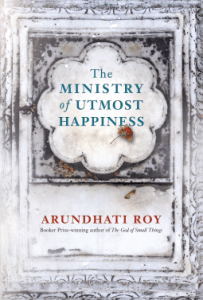
Kashmir is my third link, with The Ministry of Utmost Happiness by Arundhati Roy. The novel begins in Old Delhi then moves into the new metropolis and beyond, to the Valley of Kashmir and the forests of Central India. After a good beginning I struggled with this book because there is so much description, so little plot and such a large cast of characters. It’s a book about love and loss, death and survival, grief, pain and poverty. It made the 2017 Booker Prize longlist.
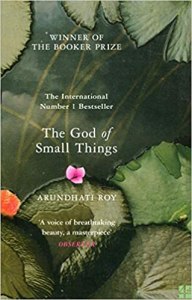
My fourth link is to Arundhati Roy‘s first book, The God of Small Things, which won the Booker Prize in 1997. Set in Kerala this is the story of Rahel and Estha, twins growing up among the banana vats and peppercorns of their blind grandmother’s factory, and amid scenes of political turbulence. I loved this book, but as I read it before I began my blog I haven’t reviewed it.

Small is also in the title of Susan Hill’s novella, The Small Hand, a sad and mournful ghost story about Adam Snow, a dealer in antiquarian books and manuscripts who got lost on his way home from visiting a client when he came across a derelict Edwardian house. It was there in the garden that he had a strange experience in which he felt a small hand creep into his right one.

So that brings me to the end of my chain linking back to the opening book with another book by Lynne Truss – Talk to the Hand. I haven’t reviewed this book as it’s another one I read before I began my blog. It’s about the rudeness of modern society, or as she describes it ‘unashamedly, a big long moan about modern life including automated switchboards, customer service, mobile phone abuse, littering, and telling strangers to Eff off.‘ You can see more about why she wrote the book on her website.

My chain begins with a book about punctuation and ends with one about rudeness by the same author. It’s a circle which came about quite by chance as I moved from one link to the next, not knowing where it would end! The links are Henry James, shawls, Kashmir, books by Arundhati Roy, books with ‘small’ in the title and also ‘hand’, moving from the UK, travelling through the US, Kashmir and India and then back to the UK.

They are all books I’ve read – and, for a change, my chain does not include any crime fiction!

Next month, on the 7 August 2021 (my birthday), we’ll start with  Postcards From the Edge by Carrie Fisher.

Six Degrees of Separation: from The Bass Rock by Evie Wyld to Harbour Street

It’s time again for Six Degrees of Separation, a monthly link-up hosted by Kate at Books Are My Favourite and Best. Each month a book is chosen as a starting point and linked to six other books to form a chain. A book doesn’t need to be connected to all the other books on the list, only to the one next to it in the chain.

This month the Six Degrees chain begins with The Bass Rock by Evie Wyld, set on an island in the Firth of Forth. I haven’t read it, but it does appeal to me, so I think I’d like to read it. It’s a novel that weaves together the lives of three women across four centuries.

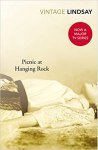
My first link is to a book about another rockPicnic at Hanging Rock by Joan Lindsay, an Australian thriller, set in 1900 about a group of girls who went missing after an outing to the Hanging Rock, a spectacular volcanic mass.

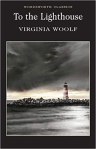
The beginning of Picnic at Hanging Rock when it was agreed that the warm summer’s day was just right for the expedition to the Rock, reminded me of the beginning of To the Lighthouse by Virginia Woolf in which Mrs Ramsay announces that if the next day is fine they could go to the lighthouse, an expedition that her son had looked forward to for years.

As I wondered which book to link to next it struck me that Virginia Woolf’s name begins with two consecutive letters of the alphabet. Another author’s name also begins with consecutive letters – Charles Dickens. So my next link is to A Tale of Two Cities, a novel set in Paris and London about the French Revolution.

Paris is my fourth link with The Shadow Puppet by Georges Simenon. A man is shot dead in his office in the Place des Vosges in Paris and Maigret uncovers a tragedy involving desperate lives, unhappy people, addiction and an all-consuming greed. Maigret notices shadowy figures in the lighted windows of the building opposite.

Staying with Shadows my next link is The Shadows in the Street by Susan Hill, one of her Serrailler novels. Whilst being crime fiction, it also concerns moral and social issues.There are two major themes in this book. One concerns the murders of local prostitutes, found strangled. The other is mental illness, with Ruth Webber, who suffers from manic depression. She goes missing there are fears she may become one of the murder victims.

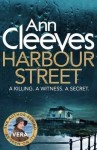
Murder and the word street in the title are my links to the final book in the chain – Harbour Street by Ann Cleeves – one of the best Vera Stanhope murder mysteries. It’s about the murder of an old lady, Margaret Krukowski, who was stabbed to death on the Newcastle Metro ten days before Christmas.

My chain begins with a novel about the Bass Rock and ends with one of my favourite murder mysteries.

Next month (3 July 2021), we’ll start with Eats, Shoots and Leaves by Lynne Truss.

Six Degrees of Separation: from Beezus and Ramona by Beverly Cleary to The ABC Murders

It’s time again for Six Degrees of Separation, a monthly link-up hosted by Kate at Books Are My Favourite and Best. Each month a book is chosen as a starting point and linked to six other books to form a chain. A book doesn’t need to be connected to all the other books on the list, only to the one next to it in the chain.

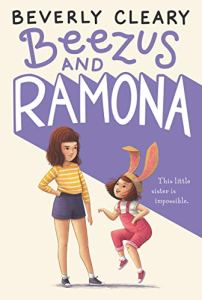
This month the Six Degrees chain begins with Beezus and Ramona by Beverly Cleary, a book I haven’t read. Four-year-old Ramona makes it hard for her big sister Beezus to be the responsible older sister she knows she ought to be, especially when Ramona threatens to ruin Beezus’s birthday party. Will she find the patience to handle her little sister before Ramona turns her big day into a complete disaster? 

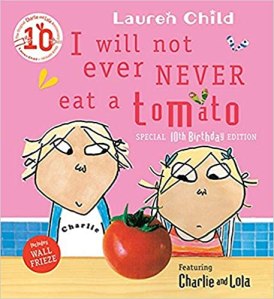
My first link is the first Charlie and Lola book – I Will Not Ever NEVER Eat a Tomato  by Lauren Child as it is about another little sister, Lola, who is also four years old. I first came across the TV version of the books on children’s television and loved it.

I thought of continuing with links to more books about sisters but that didn’t work out so instead my next link is to a book about another character called Charlie in A Good Thief’s Guide to Amsterdam by Chris Ewan. Charlie Howard is a thief. It’s set in Amsterdam where he is asked by an American to steal two little monkey figurines to make up the set, ‘See no evil, hear no evil, speak no evil‘.

I’m staying in Amsterdam for my third link, with Tulip Fever by Deborah Moggach, set in the 1630s, when tulipomania has seized the populace. Everywhere men are seduced by the fantastic exotic flower. Sophia’s husband Cornelis is one of the lucky ones grown rich from this exotic new flower. To celebrate, he commissions a talented young artist to paint him with his beautiful bride.

My fourth link is to another artist in Portrait of an Unknown Woman by Vanora Bennett. Hans Holbein was commissioned to paint Sir Thomas More’s family portrait. The book tells the story of More’s adopted daughter, Meg Giggs and her love for two men – John Clements, the family’s former tutor, and Hans Holbein.

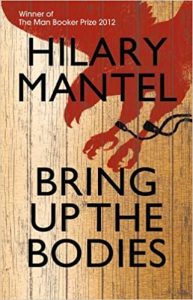
Hans Holbein also appears in Bring Up the Bodies by Hilary Mantel, the second book in her Wolf Hall trilogy. He has painted Thomas Cromwell’s portrait, which he had on the wall at his house at Austin Friars. When he saw it, Cromwell said, ‘Christ I look like a murderer‘.

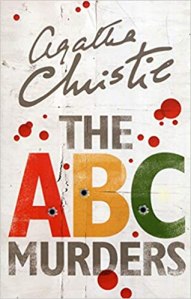
So that brings me to my final link – a murderer. Bodies – dead bodies – appear in many of the books I read and one of my favourite Agatha Christie mysteries has several. It’s The ABC Murders in which Poirot investigates a series of murders that are advertised in advance by letters sent to him, and signed by an anonymous ‘ABC’. An ABC Railway is left next to each of the bodies.

My chain begins with two sisters and ends with a on of my favourite murder mysteries, linking together siblings, characters called Charlie, Amsterdam, Hans Holbein and murder. It travels from the USA to the UK, crosses over to the Netherlands then returns to the UK, beginning and ending in the 20th century and visiting the 16th and 17th centuries on the way

Next month (June 5 2021), we’ll start with the winner of the 2021 Stella Prize, The Bass Rock by Evie Wyld.

Six Degrees of Separation: from Phosphorescence by Julia Baird to The Burry Man’s Day

It’s time again for Six Degrees of Separation, a monthly link-up hosted by Kate at Books Are My Favourite and Best. Each month a book is chosen as a starting point and linked to six other books to form a chain. A book doesn’t need to be connected to all the other books on the list, only to the one next to it in the chain.

This month the Six Degrees chain begins with Phosphorescence by Julia Baird, who is an Australian author. The book won’t be published here in the UK until 27 May. Julia Baird reflects on her encounters with phosphorescence, a luminescent phenomenon found in the natural world, and how she was able to cultivate her own ‘inner light’ in the face of suffering and illness. I think I’d like to read it.

I didn’t know where to start my chain, so I used my Search Box to see if I had used the word phosphorescence previously on my blog – and I had, just once. It’s in a passage I quoted from D H Lawrence’s Sons and Lovers, when he described Paul Morel’s grief and sadness after his mother’s death, and yet also his hope for the future:

Turning sharply, he walked towards the city’s gold phosphorescence. His fists were shut, his mouth set fast. He would not take that direction, to the darkness, to follow her. He walked towards the faintly humming, glowing town, quickly.

I read Sons and Lovers in 2007 and another book I read then is The Moon and Sixpence by W Somerset Maugham, a novel about Charles Strickland, who was a stockbroker; a boring, man. He left his wife and family after seventeen years of marriage and fled to Paris, because he wanted to paint. It is roughly based on the life of Gauguin, which reminded me I have Gauguin By Himself, a massive book that contains copies of his paintings, drawings, ceramic, sculpture and prints together with his written words.

Gaugin’s relationship with Vincent Van Gogh described in his book leads me on to Van Gogh and A S Byatt’s book, Still Life in which Alexander Wedderburn struggles to make a play about Van Gogh. The cover painting on my copy is Van Gogh’s Still Life with Coffeepot.

Another book called Still Life is Val McDermid’s latest Karen Pirie mystery. It combines a cold case investigation into the identity of a skeleton found in a campervan and a current case into the discovery of a body in the Firth of Forth.

The Burry Man’s Day is the second in Catriona McPherson’s Dandy Gilver series. It is set in South Queensferry, on the south shore of the Firth of Forth, where there is an annual Ferry Fair and the Burry Man Parade. A local man is covered from head to ankles in burrs and walks round the town, taking a nip of whisky at every stop. When Dandy visits the Parade, the Burry Man drops down dead at the end of the Parade, apparently poisoned. The list of suspects includes all those who gave him a nip of whisky.

My chain begins with awe and wonder and ends in murder, linking together sons and lovers, artists, and detectives.

Next month (April 3, 2021), we’ll start with the 2020 Booker Prize winner, Shuggie Bain by Douglas Stuart – a book I haven’t read.

Six Degrees of Separation from Redhead by the Side of the Road to Hercule Poirot’s Christmas

It’s time again for Six Degrees of Separation, a monthly link-up hosted by Kate at Books Are My Favourite and Best. Each month a book is chosen as a starting point and linked to six other books to form a chain. A book doesn’t need to be connected to all the other books on the list, only to the one next to it in the chain.

This month the chain begins with Redhead by the Side of the Road by Anne Tyler.

I haven’t read this book, although reading the description it does appeal to me. It’s about Micah Mortimer, who lives in a basement flat in Baltimore, and runs his own tech business. His steady life is upset when his partner Cassia tells him she’s facing eviction because of a cat and a teenager arrives at his door claiming to be his son. And his eyesight isn’t too good.

The first link is to another book by Anne Tyler – Digging to America, also set in Baltimore. It’s about two contrasting families who adopted two Korean babies. They met at Baltimore airport, waiting for the babies to arrive.

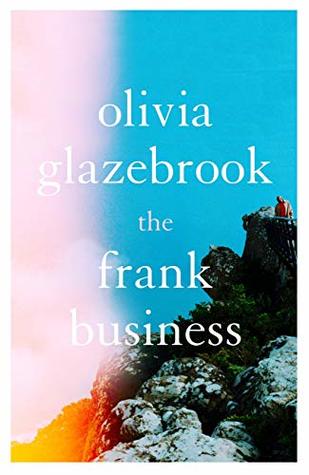
The second link is to The Frank Business by Olivia Glazebrook. The link is an airport – in this book Frank dropped down dead at London Heathrow airport, having travelled from his home in France. He died of a congenital heart defect.

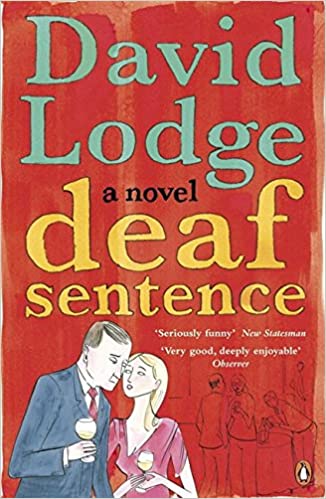
The third link is to Deaf Sentence by David Lodge in which a character has a different type of defect – Desmond Bates has defective hearing. He is having to come to terms with his increasing deafness and also with his retirement from the academic world. He still hankers after his position as a Professor of Linguistics. 

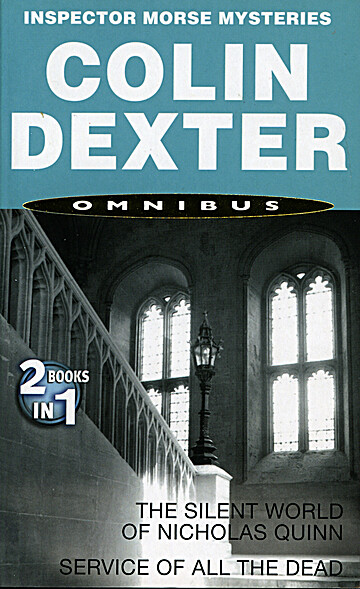
In The Silent World of Nicholas Quinn by Colin Dexter, Quinn was deaf. He was a member of the Oxford Examinations Syndicate and was found dead in his north Oxford home. Chief Inspector Morse tracks down the killer through the insular and bitchy world of the Oxford Colleges.

The Case of the Gilded Fly by Edmund Crispin, a locked room mystery is also set in Oxford with Gervase Fen, an Oxford Professor of English Language and Literature at the fictional St Christopher College. First published in 1944 this is one of the Golden Age mysteries.

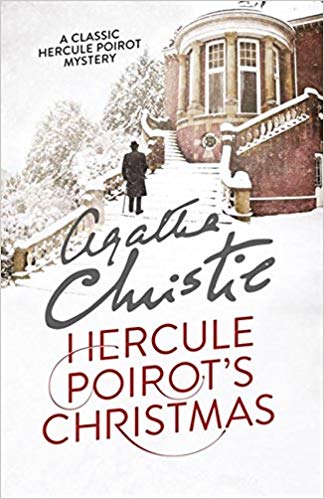
My final link is to Hercule Poirot’s Christmas by Agatha Christie, another locked room mystery. Poirot investigates the death of Simeon Lee, the head of the Lee family. None of his family like him, in fact most of them hate him and there are plenty of suspects for his murder. He is found dead with his throat cut in a locked room – locked from the inside.

Well, I ended up with crime fiction again! Where will your chain end up?

Six Degrees of Separation: From Hamnet to Macbeth

It’s time again for Six Degrees of Separation, a monthly link-up hosted by Kate at Books Are My Favourite and Best. Each month a book is chosen as a starting point and linked to six other books to form a chain. A book doesn’t need to be connected to all the other books on the list, only to the one next to it in the chain.

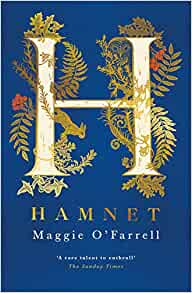
This month’s chain begins with Hamnet by Maggie O’Farrell, the winner of the 2020 Women’s Prize for Fiction. Set mainly in Stratford-on-Avon, it is historical fiction inspired by Hamnet, Shakespeare’s son. The central theme, though is the grief – the overwhelming and all consuming grief, that the whole family and in particular, Agnes, Hamnet’s mother suffered when he died at the age of eleven in 1596. It’s not my favourite book by O’Farrell but I did find it fascinating.

The first five books that form the links in my chain are shown in the photo below:

The first link:

Hilary Mantel’s third book in her Wolf Hall trilogy, The Mirror and the Light, which was also on the shortlist for the Women’s Prize for Fiction in 2020. I was very keen to read this book when it was first published in February, and began reading it, but for a variety of reasons I still haven’t finished it. It’s the final book in the Wolf Hall trilogy, tracing Thomas Cromwell‘s final years as he fell from power.

The second link:

A biography of Thomas Cromwell and a another book I haven’t read – Thomas Cromwell: the Untold Story of Henry VIII’s Faithful Servant by Tracy Borman. I’d like to read this and The Mirror and the Light this year, but that could easily mean another year could slip by leaving them still on the TBR piles.

The third link:

Thinking about historical figures in fiction and also books I haven’t read yet but have owned for a while (years), the next book in my chain is another of my TBRs . It is Now is the Time by Melvyn Bragg, a novel about the Peasants’ Revolt that took place during just a few weeks in May and June of 1381. The boy king Richard II was faced with a revolt led by former soldier Wat Tyler and John Ball, a preacher.

The fourth link:

is to another book by Melvyn Bragg and also with the word ‘time‘ in the title – In Our Time: a Companion to the Radio 4 series. I have read this book, which contains transcripts of 26 programmes, a selection from hundreds of programmes broadcast over eleven years, including one about the Peasant’s Revolt, and also one on witchcraft.

The fifth link:

Another book featuring witchcraft is Season of the Witch by Natasha Mostert. It’s a modern day gothic epic, mixing computer technology with witchcraft, alchemy and the power of the human mind, in the search for enlightenment.

The final link completes the chain making it into a circle by returning to the opening book – a reworking of one of Shakespeare’s plays:

It is Macbeth by Jo Nesbo, a retelling of Shakespeare’s Macbeth. Witches in different forms appear in both the book and the play. Inspector Macbeth, an ex-drug addict is the head of the SWAT team, ruled by his passions, violent and paranoid. He is manipulated by Hecate, Shakespeare’s chief witch, here one of the drug lords, a man with a friendly smile and cold eyes.

The links in my chain are the Women’s Prize for Fiction, Thomas Cromwell, TBRs, books with the word ‘time’ in the title and witchcraft/witches.

Next month (February 6, 2021), we’ll start with Anne Tyler’s latest novel, Redhead By the Side of the Road.