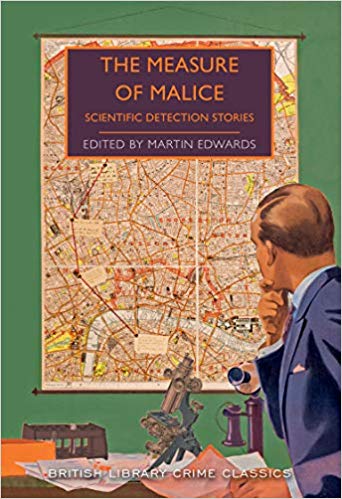
Measure of Malice: Scientific Detection Stories edited by Martin Edwards

The Measure of Malice edited by Martin Edwards is one of the more enjoyable short story collections that I’ve read. It contains 14 stories in which scientific/technological methods are used in the detection of crime. There is an excellent introduction by Martin Edwards with information about the authors, five of whom were doctors, two were engineers and one was an academic chemist.

As always with short story collections some stories are better than others. I’m highlighting a few of the better ones here:

The Boscombe Valley Mystery by A Conan Doyle was originally published in the Strand Magazine in October 1891, and is the first short story to feature Inspector Lestrade. It’s a solid story, solved by Sherlock Holmes by inspecting and analysing the footprints and signs at the scene of the crime.

The Horror of Studley Grange by L T Meade and Clifford Halifax (1894), from Stories for the Diary of a Doctor, originally published in the Strand Magazine. I enjoyed this one although it was pretty easy to predict. Ostensibly a ghost story, the solution involves the use of a laryngoscope.

After Death the Doctor by J J Connington, a Scottish professor of chemistry. This one was first published in 1934, involving a contemporary scientific gadget. The doctor in question is Doctor Shefford who together with Sergeant Longridge, investigate the murder of old Barnaby Leadburn, found dead with his throat cut.

The next two are the ones I enjoyed the most:

The Broken Toad by H C Bailey, first published in 1934, featuring the surgeon and Home Office Consultant, Reggie Fortune as he considers the death of a police constable from poisoning. I enjoyed all the detailed complications and Bailey’s literary mannered style of storytelling.

In the Teeth of the Evidence by Dorothy L Sayers, first published in 1939, about forensic dentistry, which starts as Lord Peter Wimsey is sitting in his dentist’s chair. The police had just visited the surgery, wanting to see his predecessor’s records to identify the victim of a burnt out garage. An upper right incisor crown and the filling in a molar provided the clues to his death. Gory if you actually visualise what is involved!

  • Publisher : Poisoned Pen Press (4 Feb. 2020)
  • Language: : English
  • Paperback : 336 pages
  • ISBN-10 : 1492699624
  • ISBN-13 : 978-1492699620
  • Source: The Poisoned Pen Press via NetGalley
  • My Rating: 3.5*

Short Stories on Sunday

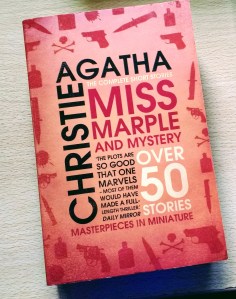
Over several years I’ve been reading my way through Agatha Christie’s books and short stories. I’ve read all her detective/mystery novels and some of her short story collections. In an attempt to read more of the short stories I’ve decided to read some each Sunday, beginning with the stories collected in Miss Marple and Mystery.

IMG_20180513_095855842.jpgThis collection contains 55 stories, 20 of them featuring Miss Marple. There is an Short Story Chronology in the Appendix with a table aiming to present all Agatha Christie’s short stories published between 1923 and 1971, listed in order of traced first publication date. Counting how many there are in total is a difficult task – some stories that first appeared in weekly or monthly magazines were later  re-worked and became chapters in a larger work, some in Partners in Crime were sub-divided into smaller chapters, 13 were re-worked into the episodic novel, The Big Four, and some were rewritten so substantially that they appear separately in different books!
I’ve read some of these in other short story collections but there are still many I haven’t read.

The Girl in the Train is one I haven’t read before. It was first published in Grand Magazine in February 1924 and was adapted as one of the Agatha Christie Hour drama series for by Thames Television in 1982 as part of their ten-part programme. It’s a very short story that also appears in The Listerdale Mystery collection of short stories.

George Rowland is the heir to his Uncle William’s wealth but is left without a job or a home when William throws him out on his heel. On a whim George Rowland decides to catch a train down to Rowland’s Castle, a village which happens to bear his name. A beautiful girl bursts into his compartment, frantically begging to be hidden.  She gives him a package saying it is the key to everything and he is to guard it with his life. Jumping out of the train at the first stop she tells him to follow the little man with a small dark beard getting on the train. His life changes dramatically as he follows her instructions.

It’s a bit of nonsense really, in the same vein as Christie’s Tommy and Tuppence stories. A quick easy read, but entertaining nevertheless and possibly the first of books entitled The Girl … 

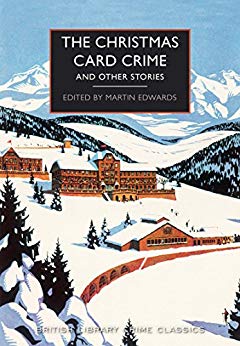
The Christmas Card Crime and Other Stories edited by Martin Edwards (British Library Crime Classics)

Here is another collection of short stories from the Golden Age of Murder edited by Martin Edwards: The Christmas Card Crime and Other Stories.

Christmas Card Crime

Poisoned Pen Press, in association with the British Library|1 October 2019|Print length 240 pages|e-book |Review copy|4*

There are eleven stories all set during the Christmas season in this collection and an introduction by Martin Edwards. In it he points out the differences between a short story and a novel. It’s not just the length, but it is also the fact that in a short story there is little space to develop the characters in depth or for lengthy descriptions, so ‘every word must be made to earn its keep‘. He has also prefaced each story with a biographical note, which I found useful as some of the authors were new to me.

The mysteries range in date of publication from 1909 up to 1965. I’ve read stories by some of the authors before, such as Baroness Orczy, John Dixon Carr, Ronald Knox, E C R Lorac, John Bude and Julian Symons, but others were new to me. The ones I enjoyed the most are:

The Motive  Ronald Knox. This story first appeared in The London Illustrated News in November 1937 and is about an attempted murder in a smart hotel on the English Riviera, by a character named ‘Westmacott’ (a pen name used by Agatha Christie).. On Christmas Day after a party the guests decided to play a version of ‘blind man’s buff’ in the swimming pool, which didn’t go as planned.

Another version of ‘blind man’s buff‘, this time called ‘blind man’s bluff‘, is played in the next story also with disastrous consequences.

Blind Man’s Hood by John Dickson Carr writing as Carter Dickson. This first appeared in the Christmas edition of The Sketch in 1937 and is a story inspired by the unsolved Peasonhall murder case of 1902. It is a strange tale about a young couple arriving to spend Christmas with friends, only to find the house empty – except that is for a young woman carrying a white bag, who tells them about a game of ‘Blind Man’s Bluff’ that went very wrong, years ago. It’s a variation on a locked room mystery, with a touch of the supernatural.

Crime at Lark Cottage by John Bingham – this first appeared in the 1954 Christmas Number of The London Illustrated News. Bingham was the 7th Earl of Clanmorris, a journalist who was recruited into MI5, where he worked with David Cornwell, who later wrote spy novels under the name of John Le Carré. This story and the next are my two favourites in the book. It is the story of an escaped convict and an isolated country cottage occupied by a young woman and her little daughter one snowy Christmas. Very atmospheric and tense with an unexpected ending. I’d like to read more of John Bingham’s work.

‘Twixt the Cup and the Lip by Julian Symons – this first appeared in Ellery Queen’s Mystery Magazine in January 1965). Longer than the other stories in this collection it is the tale of Mr Rossiter Payne, a meticulous bookseller who plans a perfect robbery – to steal the jewels, that had once belonged to the Russian royal family, on display in a London department store at Christmas. But Mr Payne had made an uncharacteristic error …

Overall, I enjoyed reading this collection, with a mix of excellent short stories and some that I thought  were too short and had disappointing or predictable endings.

My thanks to the publishers for my review copy via NetGalley.

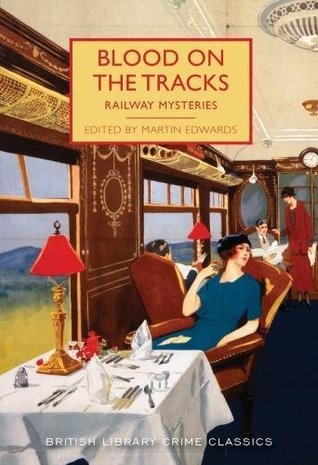
Blood on the Tracks: Railway Mysteries edited by Martin Edwards (British Library Crime Classics)

I’ve said before that I’m not a big fan of short stories, often finding them disappointing. So I’m glad to say that I enjoyed this anthology edited by Martin Edwards: Blood on the Tracks: Railway Mysteries. Some stories, of course, are better than others.

Blood on the tracks

There are fifteen railway themed stories in the collection and an introduction on classic railway mysteries by Martin Edwards. He has also prefaced each story with a brief biographical note, which I found useful as some of the authors were new to me. I read the collection slowly over a few months, which I find is the best way to approach a short story collection.

Train travel provides several scenarios for a mystery – the restriction of space on trains, with or without a corridor, means that there are a limited number of suspects and they can also provide an ideal place for a ‘locked room’ crime or an ‘impossible crime’ story. This collection also includes a couple of crimes with a supernatural element.

The mysteries are presented in roughly chronological order from 1898 up to  the 1950s. The ones I enjoyed the most are by R Austin Freeman, Roy Vickers, Dorothy L Sayers, F Tennyson Jesse and Freeman Crofts Willis.

  1. The Man with the Watches by Arthur Conan Doyle featuring an un-named sleuth, ‘a well-known criminal investigator’, about a man shot through his heart on the London to Manchester train. He had no ticket on him but had six valuable gold watches in his possession. This was first published in The Strand Magazine in 1898.
  2. The Mystery of Felwyn Tunnel by L T Meade and Robert Eustace. This was also first published in 1898 in which a signalman is found dead at the mouth of the tunnel. When another man dies in in the same place it looks as though something very strange is the cause of their deaths.
  3. How He Cut His Stick by Matthias McDonnell Bodkin. In this story Lady Detective Dora Myrl investigates the theft of £5,000 in gold and notes from a locked railway carriage.
  4. The Mysterious Death on the Underground Railway (1901) by Baroness Orczy, featuring the Old Man in the Corner, an ‘armchair detective’ as he sits in a teashop and tells journalist Polly Burton the solution to the murder of a young woman on the Underground, whilst he fiddles with a piece of string.
  5. The Affair of the Corridor Express by Victor L Whitechurch featuring the railway detective Thorpe Hazell. He investigates the kidnapping of the son of a millionaire.
  6. The Case of Oscar Brodski by R Austin Freeman, an ‘inverted’ detective story, in which the reader knows everything, whereas the detective knows nothing and it all hinges on the significance of trivial details, including fragments of glass, biscuit crumbs, a piece of string and threads of fabric.
  7. The Eighth Lamp by Roy Vickers – an underground mystery about switching off the station lamps after the last train had gone down the line, with a rather spooky supernatural ending.
  8. The Knight’s Cross Signal Problem by Ernest Bramah, in a steam engine crashes into a light train, killing twenty seven people and injuring forty plus. The cause of the accident is a mix up with the signals. I think this is one of the less successful stories for me.
  9. The Unsolved Puzzle of the Man with No Face (1928) by Dorothy L Sayers (a Lord Peter Wimsey story), . The body of a man is found on a lonely beach, his face slashed, and with no means of identification. Wimsey’s discussion of the crime with his fellow passengers as they travel into London, helps D I Winterbottom to solve the mystery – a most intriguing story.
  10. The Railway Carriage by F Tennyson Jesse (1931) – this is possibly my favourite story in the collection. It’s a supernatural mystery in which Solange Fontaine, a female sleuth with a ‘feeling for evil’ features meets two passengers on a train. Both the elderly woman, dressed in shabby black and the insignificant-looking man in a grey felt hat seem to be locked in their own thoughts and she feels very ill at ease. Then the train crashes. An excellent story.
  11. Mystery of the Slip-Coach by Sapper (1933), the creator of ‘Bulldog’ Drummond – an example of an ‘impossible crime’ in which the clue of a raw egg supplies the solution to the murder – I wasn’t convinced by this story.
  12. The Level Crossing by Freeman Crofts Willis ( 1933) in which a man is found dead, lying near an unmanned railway crossing. A mystery that shows the effects of unforeseen circumstances even on a well planned murder.
  13. The Adventure of the First-class Carriage by Ronald Knox (1947) a Sherlock Holmes pastiche with an ‘impossible crime’ scenario.
  14. Murder on the 7.16 by Michael Innes, a John Appleby mystery in which he investigates a murder in a railway carriage on trestles, not on wheels, as it is part of a film set.
  15. The Coulman Handicap by Michael Gilbert (1950s). I found this rather confusing as the police follow a woman passing on stolen goods as she uses the Underground to give them the slip. I think this is possibly the one story in the collection that failed to hold my interest.

My thanks to the publishers for my review copy via NetGalley.

  • Paperback: 358 pages
  • Publisher: Poisoned Pen Press (3 July 2018) in association with the British Library
  • Language: English
  • ISBN-10: 1464209693
  • ISBN-13: 978-1464209697
  • My rating: 3*

Library Loans

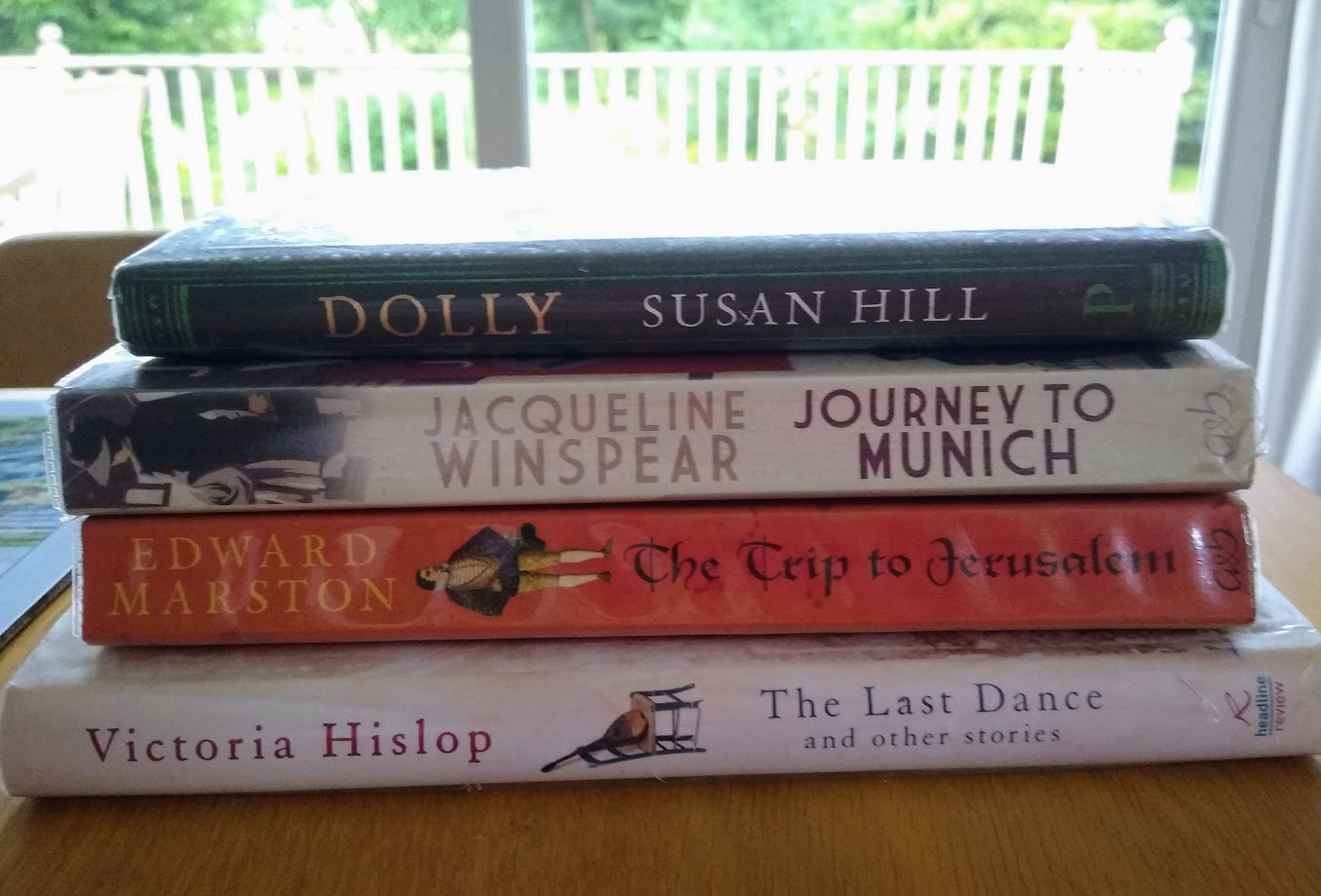
Here are some of my current library books

Lib bks July 2019

  • Dolly by Susan Hill, sub-titled ‘A Ghost Story’, a novella set in the Fens where two young cousins, Leonora and Edward spend a summer at Iyot Lock, a large decaying house, with their ageing aunt.  I’ll be writing more about this book soon.
  • Journey to Munich by Jacqueline Winspear, a Maisie Dobbs novel. This is no. 12 in the series (I’m not reading them in order). This one is set in 1938 when Molly travels into the heart of Nazi Germany.
  • The Trip to Jerusalem: an Elizabethan Mystery by Edward Marston, the 3rd book in the Nicholas Bracewell series about a troupe of players travelling England – not  to Jerusalem but to an ancient inn called The Trip to Jerusalem – whilst the Black Plague rages.
  • The Last Dance and other stories by Victoria Hislop. Ten stories set in Greece, described on the book cover as ‘bittersweet tales of love and loyalty, of separation and reconciliation’. I’ve recently enjoyed reading her latest book, Those Who Are Loved, also set in Greece, so my eye was drawn to this book.

The library van used to visit here once a fortnight, but now it only comes once a month. I hope it continues coming, but I fear that its days are numbered, so I make sure I use it whilst I still can.

Breakfast at Tiffany’s by Truman Capote

Breakfast at Tiffany's

Blurb:

Immortalised by Audrey Hepburn’s sparkling performance in the 1961 film of the same name, Breakfast at Tiffany’s is Truman Capote’s timeless portrait of tragicomic cultural icon Holly Golightly, published in Penguin Modern Classics.

It’s New York in the 1940s, where the martinis flow from cocktail hour till breakfast at Tiffany’s. And nice girls don’t, except, of course, for Holly Golightly: glittering socialite traveller, generally upwards, sometimes sideways and once in a while – down. Pursued by to Salvatore ‘Sally’ Tomato, the Mafia sugar-daddy doing life in Sing Sing and ‘Rusty’ Trawler, the blue-chinned, cuff-shooting millionaire man about women about town, Holly is a fragile eyeful of tawny hair and turned-up nose, a heart-breaker, a perplexer, a traveller, a tease. She is irrepressibly ‘top banana in the shock department’, and one of the shining flowers of American fiction.

My thoughts:

I’ve never seen the film Breakfast at Tiffany’s starring Audrey Hepburn as Holly Golightly, a high-priced escort looking for a rich man to marry, but I understand that it’s only loosely based on the novella and is set in the 1960s rather than the 1940s.

Breakfast at Tiffany’s is a quick read and very entertaining. The narrator is not named, although Holly Golightly calls him ‘Fred’ after her brother. He’s a writer and at the beginning of the book he is reminiscing about Holly with Joe Bell, who ran a bar around the corner on Lexington Avenue. They hadn’t seen or heard from Holly  for over two years. She used to live in the apartment below Fred’s in a brownstone in the East Seventies in New York. Her past is almost as unknown as her present whereabouts.

She’s a free spirit, charming and carefree, but craves attention. She has a cat, plays the guitar and likes to live as though she’s about to leave – all her belongings still in suitcases and crates – and has a great many friends who she entertains with numerous parties. She gets the ‘mean reds’, days when she’s afraid, expecting something bad is going to happen, but she doesn’t know what. On days like that she gets in a taxi and goes to Tiffany’s which calms her down and where nothing bad could happen to her, but not for the diamonds. She doesn’t ‘give a hoot’ about diamonds and thinks it’s ‘tacky to wear them before you’re forty’.

Her life is a mass of contradictions, one character describes her as a ‘phony,’ but a ‘real phony’ with crazy ideas and always on the move. She’s involved with a Mafia gangster, Sally Tomato, who she visits in jail every Thursday. But her life is really a mystery and not all is as it appears on the surface, longing for something wonderful to happen.

There’s a lot packed into this novella of 100 pages. There are also three short stories at the end of the book in the remaining pages – and these are a delight. I think these are among the best short stories that I’ve read!

There’s House of Flowers about a young woman called Ottilie, who makes the best of her life, first as a prostitute and then as the wife of Royal, a young man who takes her to live in a house in the mountains, a house of flowers with wisteria on the roof, vines over the windows and lilies blooming at the door. But all is not as idyllic as it seems in this beautiful and exotic setting.

A Diamond Guitar is set in a prison farm, a story of unrequited love when a new prisoner arrives bringing with him a guitar studded with glass diamonds. The third story is maybe my favourite, A Christmas Memory, about a young boy, Buddy and his cousin who is sixty or so years older than him. It’s a heart-warming story with a poignant ending.

I loved Capote’s writing – it’s lively, richly descriptive with sparkling dialogue, and his ability to conjure up characters with depth in a few paragraphs is impressive, to say the least.

  • Paperback: 160 pages
  • Publisher: Penguin Classics; New Ed edition (27 April 2000) – originally published in 1958
  • Source: Library Book
  • My Rating: 5*

Challenges: The Virtual Mount TBR Challenge