The Brimstone Wedding by Barbara Vine

I’ve had The Brimstone Wedding by Barbara Vine sitting on my unread shelves for a while and when the R.I.P. IX Challenge came up I thought it would be a good book to include in the challenge, because the cover blurbs describe it as a ‘horrifying mystery’, ‘chilling’ and with a ‘horrible climax’.
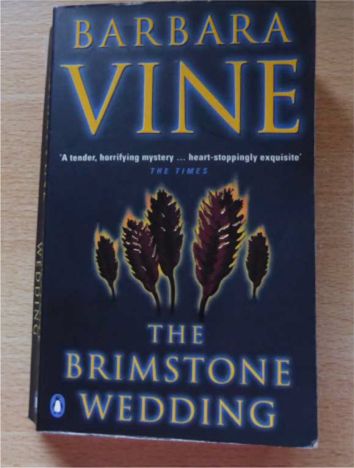
Brimstone wedding

My copy is a second-hand paperback, which is no longer in print, but The Brimstone Wedding is available as an e-book.

Jenny Warner is a carer at a retirement home, Middleton Hall where she meets Stella Newland, who is dying of lung cancer. At first Stella never mentions her husband or her past life, but gradually she confides in Jenny, telling her things she has never said to her son and daughter – things about her life she doesn’t want them to know. 

Their stories intertwine, some narrated by Jenny and some by Stella as she records events in her life on a tape recorder which she leaves to Jenny.  They have more in common than Jenny initially thought and as Stella slowly reveals her past the tension in the book begins to mount.

The atmosphere is mysterious, a house isolated in the fens, seems to hold the key to the past. The description of the house is superb, set in an overgrown garden, with clothes still hanging in the wardrobe, food and champagne still sitting in the fridge and a red Ford Anglia locked in the garage. It’s all very subtle at first with tantalising hints about what had really happened in Stella’s past, but the full horror is left to the end, which by that time I was itching to find out if it was what I suspected it was. I was not disappointed; it’s not horrific in the overblown graphic sense, but in a sinister, psychological way that really is ‘chilling’ and inexpressibly sad.

Ruth Rendell, writing as Barbara Vine, writes beautifully and powerfully yet in a controlled manner, nothing is left out but there are no superfluous characters or sub-plots. Everything ties in well and the subtle horror of what I was reading gripped me. It is indeed a ‘chilling’ book. It’s about love, hate and indifference, about relationships between couples and families, and about obsession, deceit and betrayal.

Here are just a few quotations that I noted as I read. The opening sentences, set the scene and illustrate Jenny’s superstitious nature. Throughout the book there are numerous examples of her beliefs:

The clothes of the dead don’t wear long. They fret for the person who owned them. Stella laughed when I said that. She threw back her head and laughed in the surprisingly girlish way she had. I was telling her Edith Webster had died in the night and left cupboards full of clothes behind her, and she laughed and said she’d never known anyone as superstitious as me. (page 3)

and

When you deceive people you make fools of them. You make them act stupidly, act as if things which are aren’t and things which aren’t are. And that’s what fools do or people who are mentally disturbed and we look down on them for it or if we’re unkind we laugh at them. (page 17)

She is also aware of ill omens – a bird dying in your hand means your hands will shake for ever, it also means a death in the family and red and white flowers mixed are the worst possible omen at a funeral meaning there will be another death. I was wondering what significance the title has: Jenny has been married for thirteen years, which according to her mother is a ‘Brimstone Wedding’ anniversary. Jenny thinks:

Maybe because it’s explosive or because it’s hard and dark like a burning stone, which is what brimstone means. (page 231)

I think The Brimstone Wedding is one of the best of Barbara Vine’s books that I’ve read – nearly as good as A Dark-Adapted Eye and writing under her real name, Ruth Rendell, A Judgement in Stone. It certainly qualifies not only for the R.I.P. Challenge, but also for the Mount TBR Challenge 2014 and the My Kind of Mystery Challenge.
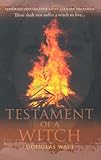
Testament of a Witch by Douglas Watt

Testament of a Witch by Douglas Watt is the second book of his that I’ve read. The first one Death of a Chief I read 5 years ago! Both books are set in late 17th century Scotland (1686 and 1687) and feature a Gaelic speaking, Edinburgh lawyer John MacKenzie and his clerk Davie Scougall. I like the way Douglas Watt incorporates the historical background into the narrative without detracting from the story.

In Testament of a Witch MacKenzie investigates the death of Grissell Hay, Lady Lammersheugh accused of witchcraft in a village overwhelmed by superstition, resentment and puritanical religion. Then the same accusations are made against the Euphame, Grissell’s daughter.  I wasn’t too keen on the horrifying and explicit descriptions of how the witch hunter identified and dealt with women accused of being witches, which involved torture and sleep deprivation, but apart from that I enjoyed this book.

I liked the interaction between Mackenzie, a Highlander and Scougall, a Lowland Scot. Scougall is convinced of the reality of witchcraft, whereas Mackenzie has ‘grave doubts about the crime of witchcraft‘, believing ‘it is nothing more than superstition‘. The religious fervour and political unrest are clearly demonstrated in this book, setting the frenzied persecution of those suspected of witchcraft in context. Watts’ Historical Note on The Scottish Witch-hunt at the end of the book gives the background, when Scottish society was in a state of flux.

Change caused anxiety and fear, unleashing frenzies of witch-hunting . … It has been estimated that the Scottish witch-hunt was ten times more deadly than the English one in terms of executions per head of population. Probably more than a thousand men and women were executed for witchcraft in Scotland during the sixteenth and seventeenth centuries.

The witch-hunt could not have occurred without a widespread belief in magic, charming and divination, and the acceptance of Satan as a real presence in the life of the people.

Witch-hunting declined when the revolutionary zeal of the Scottish Reformation ran out of steam in the late seventeenth century. Scotland began to turn its back on persecution and look towards the more tolerant and commercial age of the Enlightenment.

Testament of a Witch is well-researched and although it gets off to a slow start and I didn’t enjoy it quite as much as Death of a Chief, I was immersed into the fascinating and terifying world of the witch-hunt in 17th century Scotland as I was reading. It’s a book that qualifies both for the Read Scotland 2014 Challenge and this year’s R.I.P. Challenge, as well as the Historical Fiction Challenge and the My Kind of Mystery Challenge.

Douglas Watt is a Scottish historian, poet and novelist, who lives in Linlithgow. He has a PhD in Scottish History from Edinburgh University and is the author of The Price of Scotland, a history of Scotland’s Darien Disaster, which won the Hume Brown Senior Prize in Scottish History in 2008. 

Two R.I.P. IX Books

So far I’ve read five books that fit into the R.I.P. Challenge categories of Mystery, Suspense, Thriller, Dark Fantasy, Gothic, Horror, or Supernatural. As I’m behind with writing about these books here are just a few notes on two of them:

Wycliffe and the House of Fear by W J Burley. Like the other Wycliffe books this is set in Cornwall. Detective Superintendent Wycliffe is on holiday recuperating from an illness when he meets the intriguing Kemp family and visits Kellycoryk, their decaying ancestral home.  The Kemps’ behaviour is odd to say the least and when Roger Kemp’s second wife, Bridget disappears people remember  that his first wife had also disappeared in what had been assumed was a boating accident. Wycliffe is inevitably drawn into the investigation.

I have yet to read a Wycliffe book and be disappointed and this one is no exception. It’s a complex story with sinister undercurrents and good depiction of a dysfunctional family. It kept me guessing almost to the end. This fits into the ‘Mystery’ category.

The next one I read is the short story (just 27 pages), The Yellow Wallpaper by Charlotte Perkins Gilman, which is definitely a suspense story of a young woman slowly but surely losing her mind – or is it a case of a woman suffering from post-natal depression most cruelly treated by her doctor husband? Her husband believes she has just a ‘slight hysterical tendency‘ and prescribes rest and sleep, scoffing at what he considers are her fantasies.
The un-named woman has just had a baby, which she is unable to bear to be near her. She spends most of her time in an attic bedroom, with barred windows and a bed fixed to the floor. The walls are covered in a hideous yellow wallpaper which has been torn off in places. It’s not a beautiful yellow like buttercups but it makes her think of old, foul bad yellow things – and it smells.  The pattern is tortuous and she sees a woman trapped behind the wallpaper as though behind bars, crawling and shaking the pattern attempting to escape. Definitely a creepy and disturbing story!

It reminded me of Marghanita Laski’s The Victorian Chaise-Longue with a similar sense of claustrophobia and helplessness. But The Yellow Wallpaper is much more horrific and by the end I began to question just what was real and what was imagination – it’s psychologically scary!

These two are both books from my to-be-read piles.

Catching Up

Half of September has gone! I’ve read 5 books and haven’t written about any of them (except for one and that’s for the Shiny New Books blog – more about that book later). The other four books are:

  1. The Goldfinch by Donna Tartt (on Kindle)
  2. Wycliffe and the House of Fear by W J Burley
  3. Testament of a Witch by Douglas Watt (on Kindle)
  4. The Moving Finger by Agatha Christie

It’s much easier to write about a book straight after I’ve read it, so today’s post is about the last book I’ve finished, which is The Moving Finger by Agatha Christie. I’ll try to nudge my brain into writing about the other books as soon as I can.

The Moving Finger is a book I’ve had for a few years now, so it’s one off my to-be-read shelves. It is described as a Miss Marple mystery, but as she doesn’t appear in the book until three-quarters of the way through and after there have been two deaths, she doesn’t have a big part, although she is instrumental in unveiling the murderer.

The story is narrated by Jerry Burton, who has recently moved into the market town of Lymstock with his sister, Joanna. His doctor had instructed him to move to the country where he can take things slowly and easily whilst he recovers from a flying accident. Lymstock seems to be a ‘peaceful backwater where nothing happens‘, but soon after the Burtons have moved in Joanna receives a very nasty anonymous poison-pen letter. They discover that other people have also received them, and soon afterwards Mrs Symmington apparently commits suicide followed by the death of her maid, Agnes, which is without doubt murder.

I liked The Moving Finger. As usual with Agatha Christie’s novels there are plenty of suspects, including Mrs Cleat, well-known as the ‘local witch’, and there are plenty of clues, with a good deal of misdirection throwing me into confusion about who could possibly be the culprit. She captures the nastiness of the anonymous letters well with their accusations of illicit sexual activities. I always think Agatha Christie excels with her dialogue. It’s all so natural and I have no difficulty following who is speaking. I was also convinced about the characters, especially Megan Hunter, Mrs Symmington’s twenty-year old daughter and her relationship with her step-father. Lymstock, itself is a place about fifty years behind the times, but by no means the ‘peaceful backwater where nothing happens‘ that Jerry Burton was seeking.

The police are eventually called in, in the person of Superintendent Nash who then requests help from an expert from London on anonymous letters – Inspector Graves. But the vicar’s wife, Mrs Dane Calthrop isn’t satisfied and brings in an expert of her own, an expert who ‘knows people‘, ‘someone who knows a great deal about wickedness‘ and that person is of course, Miss Marple.

The Moving Finger was first published in 1942 in New York and then in the United Kingdom in the spring of 1943. Along with the puzzle, Agatha Christie, speaking through her characters. makes several comments that interested me – on work/idleness for example. The local doctor’s sister, Miss Griffith, who is a Girl Guide leader, states that idleness is an unforgivable sin, and in response Jerry Burton says:

Sir Edward Grey … afterwards our foreign minister was sent down from Oxford for incorrigible idleness. The Duke of Wellington, I’ve heard, was both dull and inattentive to his books. And has it ever occurred to you, Miss Griffith, that you would probably not be able to take a good express train to London if little Georgie Stephenson had been out with his youth movement instead of lolling about, bored, in his mother’s kitchen until the curious behaviour of the kettle lid attracted the attention of his idle mind?

Another example – considering whether Providence/the Almighty/God would permit dreadful things to happen ‘to awaken us to a sense of our own shortcomings‘, Jerry Burton responds:

There’s too much tendency to attribute to God the evils that man does of his own free will. I might concede you the Devil. God doesn’t really need to punish us, Miss Barton. We’re so very busy punishing ourselves.

Re-reading at her detective novels, Agatha Christie wrote in her Autobiography:

I find that one I am really pleased with is The Moving Finger. It is a great test to re-read what one has written some seventeen or eighteen years later. One’s views change. Some do not stand the test of time, others do.

It's Time for R.I.P. IX

Can you believe it? September 1st is right around the corner. And it is time to begin the 9th R.I. P. challenge hosted by Carl at Stainless Steel Droppings. It runs from 1 September right through to 31 October and involves reading from the following categories:

Mystery.
Suspense.
Thriller.
Dark Fantasy.
Gothic.
Horror.
Supernatural.

Or anything sufficiently moody that shares a kinship with the above.

And you can start today!!!

I’m going to participate in just one:

ripnineperilfirst

Peril the First:

Read four books, any length, that you feel fit (the very broad definitions) of R.I.P. literature. It could be King or Conan Doyle, Penny or Poe, Chandler or Collins, Lovecraft or Leroux€¦or anyone in between.

Here are some of the books I’m thinking of reading. I’m sure I have more that fit into the categories, both on the bookshelves and on my Kindle, but these came to mind first:

  • The Wasp Factory by Iain Banks
  • A Song of Stone by Iain Banks
  • The Haunted Hotel by Wilkie Collins
  • Cauldstane by Linda Gillard
  • The Yellow Wallpaper by Charlotte Perkins Gilman
  • The Brimstone Wedding by Barbara Vine
  • Testament of a Witch by Douglas Watt

Thank you so much to Carl for doing this, once more. I won’t be starting today as I’m still reading a few books and one in particular – The Goldfinch – is too long!!! But I’ll get going very soon.

R.I.P.VIII wrap-up

We’re into November now and Carl’s R.I.P. book challenge is over. This year I completed the course. I did Peril the First, to read four books of mysteries, detective stories, horror stories, dark fantasies, and everything in between. I read 6!

  1. Waiting for Mr Right and other Sinister Stories by Andrew Taylor
  2. The Death Maze by Ariana Franklin
  3. Relics of the Dead by Ariana Franklin
  4. Not the End of the World by Christopher Brookmyre
  5. The Shining by Stephen King
  6. Ten Little Niggers/And Then There Were None by Agatha Christie

Well, some of them were very good and some were just OK, and some were scarier than others. Three of the six were books from my to-be-read shelves, books I’d been meaning to read for ages.

The scariest of all was The Shining!

The Shining by Stephen King

But I don’t know if I’m up to reading its sequel, Dr Sleep! It sounds even more scary, because according to the description it’s about quasi-immortals, living off the ‘steam’ that children with the ‘shining’ produce when they are slowly tortured to death.  That is most definitely not my cup of tea, but I have reserved a copy from the library …. just to have a look. The cover is enough to give me nightmares – that demonic looking cat has a resemblance to our cat! Oh no!