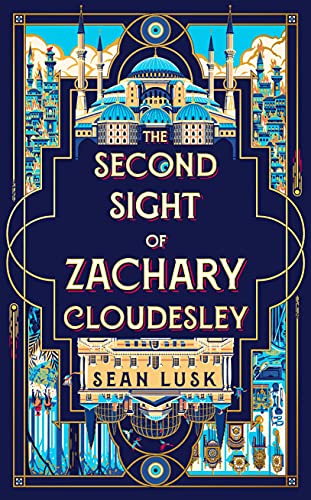
The Second Sight of Zachary Cloudesley by Sean Lusk

Random House UK, Transworld| 9 June 2022| e-book, print length 355 pages| Review copy| 4*

Synopsis from Amazon

In 1754, renowned maker of clocks and automata Abel Cloudesley must raise his new-born son Zachary when his wife dies in childbirth.

Growing up amongst the cogs and springs of his father’s workshop, Zachary is intensely curious, ferociously intelligent, unwittingly funny and always honest—perhaps too honest. But when a fateful accident leaves six-year-old Zachary nearly blinded, Abel is convinced that the safest place for his son is in the care of his eccentric Aunt Frances and her menagerie of weird and wonderful animals.

So when a precarious job in Constantinople is offered to him, Abel has no reason to say no. A job presented to him by a politician with dubious intentions, Abel leaves his son, his workshop and London behind. The decision will change the course of his life forever.

Since his accident, Zachary is plagued by visions that reveal the hearts and minds of those around him. A gift at times and a curse at others, it is nonetheless these visions that will help him complete a journey that he was always destined to make—to travel across Europe to Constantinople and find out what happened to his father all those years ago.

With a Dickensian cast of characters that are brilliantly bonkers one moment and poignant the next, Sean Lusk’s debut will take listeners on an immersive journey into the wonders of the world of Zachary Cloudesley.

I’ve enjoyed novels about clockwork and automata inventions before, so I was hoping Sean Lusk’s debut novel, The Second Sight of Zachary Cloudesley would be just as enjoyable – and it is. It’s a mixture of historical fact and fantasy set in the 18th century, in London and in Constantinople.

It follows the events in Zachary’s life from his birth in London, brought up two strong-minded women, surrounded by the clocks and clockwork automata in his father’s workshop, to his teenage years, when he travelled to Constantinople in search of his father, Abel. Zachary, an intelligent and gifted child, who had visions of future events, had an unusual most unusual life – as indeed, did Abel.

For me this book was as much about Abel as about Zachary and I loved the rich descriptions and all the detail that Lusk packed into his book. It did slow the action down at times, but it didn’t spoil my enjoyment at all. The characters are fabulous, the settings are beautifully described and the historical background is fascinating.

Lusk begins his book with an extensive note about Ottoman heirachy in the mid eighteenth century and ends it with a section of Historical and Other Notes explaining that his inspiration to write his novel came when he discovered an eighteenth century Ottoman clock made in England, in a shop in Istanbul. He finally produced his book after several years of research into clockmaking, Anglo-Ottoman relations and other 18th century matters, and having spent numerous hours in the British Library. He also includes a list of books for further reading. It is a remarkable book on a grand scale that entertained me enormously. I’m looking forward to reading more books by Sean Lusk.

About Sean Lusk

Sean Lusk is an award-winning short story writer, winner of the Manchester Fiction Prize, the Fish Short Story Prize and runner-up in the Bridport and Tom-Gallon Trust prizes. He has lived in Greece, Pakistan and Egypt, working variously as a gardener, speechwriter and diplomatic official. He now lives near Forres on the Moray Firth. The Second Sight of Zachary Cloudesley is his debut novel.

My thanks to Random House, UK for a review copy via NetGalley.

The Key in the Lock by Beth Underdown

Penguin UK| 13 January 2022| 283 pages| e-book| Review copy/4*

Rating: 5 out of 5.

Synopsis:

I still dream, every night, of Polneath on fire. Smoke unravelling from an upper window, and the terrace bathed in a hectic orange light…. Now I see that the decision I made at Polneath was the only decision of my life. Everything marred in that one dark minute.

By day, Ivy Boscawen mourns the loss of her son Tim in the Great War. But by night she mourns another boy – one whose death decades ago haunts her still.

For Ivy is sure that there is more to what happened all those years ago: the fire at the Great House, and the terrible events that came after. A truth she must uncover, if she is ever to be free.


From the award-winning author of The Witchfinder’s Sister comes a captivating story of burning secrets and buried shame, and of the loyalty and love that rises from the ashes.

My thoughts:

The Key in the Lock is Beth Underdown’s second book. I read her first book The Witchfinder’s Sister (my review) and enjoyed it immensely, so I had high expectations that I’d enjoy this book too – and it fully met my expectations. It is historical fiction set between two periods 1888 and 1918 in Cornwall.

It captures both time periods, reflecting the society both before and after the First World War showing the changes that the war had made. I loved the slow pace of this book as the secrets surrounding the death of William, the seven year old son of Edward Tremain in 1888 in a fire at Polneath, and that of Ivy’s son, Tim, on the battlefields of France are gradually revealed.

Both stories are shrouded in mystery as the circumstances of how William and Tim died are by no means clear. Ivy is devastated by Tim’s death and is determined to discover what actually happened to him, the letter informing them of his death was not phrased in the normal form of words. She wondered why.

It brought back painful memories of little William’s death. The fire at Polneath had started at night when everyone had gone to bed. William had been in the maid’s room, not his own bedroom when he had died. The postmortem revealed that he had died from asphyxiation by inhaling the smoke. Found under the bed, with paint from the door under William’s fingernails and bruised hands, it appeared that he must have been locked in and yet when he was found the door was standing open. The conclusion was that at some point the door had been locked – and later unlocked by a person or persons unknown.

The events surrounding each death are gradually revealed and there are plenty of secrets that come to light. It is described as a ‘gothic’ novel, but apart from the setting in an old isolated house, that had once been an ancient manor house, I didn’t find it gothic at all. It is a complicated story and at times I had to go back to make sure I’d got the facts right. I really liked Ivy and I liked the way her character is shown to develop with the passage of time. I loved the details about the attitudes to the First World War and the change from the earlier period. This is a novel full of grief and the circumstances surrounding both deaths provide an element of mystery. I loved the way the two time periods were interlocked as the novel progressed. I was fully engaged in it and I’ll be looking out for Beth Underdown’s next book.

The Hiding Place by Simon Lelic

Penguin UK| 22 May 2022| 340 pages| e-book| Review copy/5*

Rating: 5 out of 5.

Synopsis:

Four friends. One murder. A game they can’t escape . . .

It was only a game.’ Until a boy went missing. ‘No one was meant to get hurt.’ But a body has been found. ‘Just some innocent fun.’ Except one of them is a killer. Ready or not, here I come.

It’s time to play hide and seek again.

My thoughts:

I’ve read two of Simon Lelic’s books previously and enjoyed both of them, but I think The Hiding Place is the best. It’s the second book featuring D I Robin Fleet and D S Nicola Collins, first seen in The Search Party.

It’s set across two timelines – 1997 when Ben Draper, a 14 year-old teenager with a troubled background, and a history of absconding from school, started at Beaconsfield, a prestigious boarding school. He is bullied, disliked and feels shunned and despised, but he does make three friends, Callum, Lance and Melissa. Longing to be accepted, he thinks they are his friends, but then he is drawn unwillingly into their plot to damage the school. After playing a game of Hide and Seek with them, that ended in terror, he went missing and his body was never found. Until, that is, in the present day, when his skeleton was found in an abandoned crypt in the school grounds – Fleet and Collins are assigned to investigate the case.

I was soon thoroughly gripped by this book as it moves between the two time periods. The detectives interview the headmaster, who seems to be more concerned about the school’s reputation than about finding out what had happened to Ben. The investigation is made more difficult as Callum is now a well-known TV celebrity and aspiring politician, which means the case is potentially a political scandal and that Fleet’s hands are tied. The detectives efforts to trace the other two pupils, Lance and Melissa are also hampered.

What emerges is a fantastic story, with many complications, red herrings and plot twists. Lelic is a terrific storyteller and writes a really compelling story that moves along at a fast pace. It is full of tension and suspense that kept me enthralled.The characterisation and the school setting, surrounded by thick woodland full of ancient trees and a graveyard, are excellent. I really like Fleet, and the way he stands up to his boss, Superintendent Burton, a yes man whose main concern is to keep the politicians happy. It examines the problems caused by loneliness and feelings of being a misfit in an unfeeling elitist education system where bullying and manipulation is largely unchecked. I was never sure how it would end, or who was responsible for Ben’s death until the final dramatic conclusion. I think it is one of the best books I’ve read so far this year.

Many thanks to Penguin UK for a review copy via NetGalley.

The Chapel in the Woods by Dolores Gordon-Smith

Severn House| 1 March 2022| 256 pages| e-book| Review copy| 3*

The Chapel in the Woods is the 11th Jack Haldean Murder Mystery, set in the 1920s.

Major Jack Haldean, a former World War I pilot, is a detective story writer. He and his wife Betty are visiting his cousin Isabelle and her husband Arthur in the hamlet of Croxton Abbas in Sussex. The neighbouring estate, Birchen Bower, had recently been bought by Canadian Tom Jago and his wife Rosalind. A fortnight earlier he had sent Derek Martin and his wife, Jean, in advance to open up the house and unpack their belongings, but when the Jagos arrive they discover the house open and that most of their things including Rosalind’s diamonds had been stolen. And the Martins have disappeared. But Jago can’t believe that Martin is the thief, maintaining he is perfectly honest. Jack has formerly helped his friend Detective Superintendent Ashley of the Sussex Police with a number of cases and as he is staying locally he gets involved in the police investigations.

Jago is renovating the 17th century house, built around 1620, by William Cayden, set in woodland. The chapel in the woods contains the tomb of Anna, Cayden’s wife who was a native of Peru. Her tomb, a box tomb, is decorated with an elaborately carved leaping jaguar – hence the legend of the Jaguar Princess who haunts the chapel and grounds taking the form of a jaguar.

It gets more and more complicated. In the Victorian period Josiah Cayden, an explorer and big game hunter had imported wild animals from South America, wanting to recreate a piece of the Amazon in the grounds. And now the locals are convinced that there is something in the woods that shouldn’t be there. There have been stories about dead and mutilated animals being found around Birchen Bower woods, and every so often dogs and ponies go missing. So, when Jago hosts the village fete, the local residents throng to the estate, some keen to follow the path into the woods to visit the chapel, only to find a dead body, apparently mauled by a jaguar.

And then there is another body … Is there really a jaguar roaming the woods, or is something supernatural going on? And who stole the diamonds, was it Derek Martin or someone else? Where is Derek Martin? What is the truth about the legend of the Jaguar Princess?

It is entertaining, with a mysterious, even supernatural atmosphere in parts, but it all seems to me too unlikely and fanciful and too convoluted. I liked the setting, the scenes in the woodlands and the historical aspects. But, there is too much repetition of the events and too much discussion about the various possibilities. I lost interest and just wanted to know how the mystery was resolved. It all gets sorted out and ends as Jack explains how he uncovered what had really happened.

My thanks to Severn House for a review copy via NetGalley.

Traitor in the Ice by K J Maitland

Headline Review| 31 March 2022| 461 pages| e-book| Review copy| 2*

I don’t have very much to say about Traitor in the Ice, the second Daniel Pursglove book, by K J Maitland. It is set during the Great Frost of 1607-8 in England, when the Thames and many other rivers were frozen solid, but the countryside was the hardest hit. I preferred the first Daniel Pursglove book, The Drowned City.

It is a dark historical novel, describing life in England under the new king, James I of England and VI of Scotland. Daniel is continuing his search for the mysterious Spero Pettingar, suspected of plotting another conspiracy to kill James and reinstate a Catholic monarch and is sent by the Secretary of State, Robert Cecil, Lord Salisbury, to Battle Abbey, near Hastings, in Sussex, a Catholic household, suspected of sheltering Catholic priests.

Daniel is an interesting character, needing all his determination and courage to discover what has been going on at Battle Abbey. It’s made even more difficult as it seems that everyone has something to hide, not just their politics and religious dissent, but also murder. A little bit more of his background is revealed in this second book, but he still remains a mysterious figure. And Spero Pettingar is an even more mysterious character, who is he – is he hiding at Battle Abbey? And will Daniel uncover all the secrets concealed within the Abbey?

But I enjoyed K J Maitland’s Author’s Note and information she gives in ‘Behind the Scenes of this Novel’ more than the novel. The details of her historical research are fascinating, with information about the real people behind her characters, such as Lady Magdalen, Viscountess Montague who did live at Battle Abbey. And the Glossary at the end of the book is also most helpful explaining a lot of the terms in the book I hadn’t come across before.

However, the book failed to hold my interest throughout as the wealth of detail she has put into the novel slows the action down and took away much of the suspense and tension – I felt like I was drowning in description. And at times I wasn’t really sure what was happening, especially at the end of the book – the Epilogue is mystifying.

My thanks to Headline Review for a review copy via NetGalley

Moonlight and the Pearler’s Daughter by Lizzie Pook

Mantle| 3 March 2022| 304 pages| e-book| Review copy| 3*

1886, BANNIN BAY, AUSTRALIA.

The Brightwell family has sailed from England to make their new home in Western Australia. Ten-year-old Eliza knows little of what awaits them on these shores beyond shining pearls and shells like soup plates – the things her father has promised will make their fortune.

~~~

Ten years later and Charles Brightwell, now the bay’s most prolific pearler, goes missing from his ship while out at sea. Whispers from the townsfolk suggest mutiny and murder, but headstrong Eliza, convinced there is more to the story, refuses to believe her father is dead, and it falls to her to ask the questions no one else dares consider.

But in a town teeming with corruption, prejudice and blackmail, Eliza soon learns that the truth can cost more than pearls, and she must decide just how much she is willing to pay – and how far she is willing to go – to find it . . .

My thoughts:

I knew about diving for pearls, but I knew nothing about pearlers – the pearl divers/the people who trade in pearls – so I thought Moonlight and the Pearler’s Daughter would be a good way to find out more about it. And it is – I learned a lot. It has a great sense of both time and place. Although Bannin Bay is a fictional town in Western Australia its geography is modelled on parts of the north-west Kimberley coast. Lizzie Pook’s research, which she details in her Historical and Cultural Note at the end of the book, is fascinating. Her descriptive writing is very good and I felt that I was transported back to 19th century Australia experiencing the sights and smells of the coastal town and witnessing the appalling abuse and violence dealt out to the aboriginals who were forced to become pearl divers.

And I was also convinced by the main characters, Eliza in particular who comes across as a determined young woman, not cowed into conforming with the behaviour expected of women in the local community. She does everything she can to find out what happened to Charles, her father when he doesn’t return with his ship, the White Starling. It seems he just disappeared and no one can tell her what happened to him. She finds his diary and realises that there must be a reason why he didn’t take it with him as he always did. It contains detailed information about shell-beds, stars, storms, sharks and life at sea, but she also finds a sheet of paper between its pages with a cryptic clue she is convinced will help her find him. The police assume he went overboard and arrest one of the aboriginal divers for his murder. But Eliza is convinced that he is not dead and helped by Axel Kramer, a German and a newcomer to Bannin Bay, she sets sail on his lugger, Moonlight to search for him.

The book starts slowly, building up a picture of the town, its inhabitants, and landscape, and builds to a crescendo as Eliza’s search takes a dramatic turn when the Moonlight is caught up in a terrible storm putting their lives in danger. I enjoyed the book, just as much for its historical detail and vivid descriptions of the landscape and wildlife, as for the mystery of Charles’ disappearance.