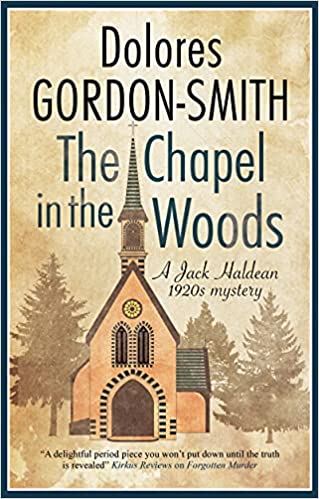
The Chapel in the Woods by Dolores Gordon-Smith

Severn House| 1 March 2022| 256 pages| e-book| Review copy| 3*

The Chapel in the Woods is the 11th Jack Haldean Murder Mystery, set in the 1920s.

Major Jack Haldean, a former World War I pilot, is a detective story writer. He and his wife Betty are visiting his cousin Isabelle and her husband Arthur in the hamlet of Croxton Abbas in Sussex. The neighbouring estate, Birchen Bower, had recently been bought by Canadian Tom Jago and his wife Rosalind. A fortnight earlier he had sent Derek Martin and his wife, Jean, in advance to open up the house and unpack their belongings, but when the Jagos arrive they discover the house open and that most of their things including Rosalind’s diamonds had been stolen. And the Martins have disappeared. But Jago can’t believe that Martin is the thief, maintaining he is perfectly honest. Jack has formerly helped his friend Detective Superintendent Ashley of the Sussex Police with a number of cases and as he is staying locally he gets involved in the police investigations.

Jago is renovating the 17th century house, built around 1620, by William Cayden, set in woodland. The chapel in the woods contains the tomb of Anna, Cayden’s wife who was a native of Peru. Her tomb, a box tomb, is decorated with an elaborately carved leaping jaguar – hence the legend of the Jaguar Princess who haunts the chapel and grounds taking the form of a jaguar.

It gets more and more complicated. In the Victorian period Josiah Cayden, an explorer and big game hunter had imported wild animals from South America, wanting to recreate a piece of the Amazon in the grounds. And now the locals are convinced that there is something in the woods that shouldn’t be there. There have been stories about dead and mutilated animals being found around Birchen Bower woods, and every so often dogs and ponies go missing. So, when Jago hosts the village fete, the local residents throng to the estate, some keen to follow the path into the woods to visit the chapel, only to find a dead body, apparently mauled by a jaguar.

And then there is another body … Is there really a jaguar roaming the woods, or is something supernatural going on? And who stole the diamonds, was it Derek Martin or someone else? Where is Derek Martin? What is the truth about the legend of the Jaguar Princess?

It is entertaining, with a mysterious, even supernatural atmosphere in parts, but it all seems to me too unlikely and fanciful and too convoluted. I liked the setting, the scenes in the woodlands and the historical aspects. But, there is too much repetition of the events and too much discussion about the various possibilities. I lost interest and just wanted to know how the mystery was resolved. It all gets sorted out and ends as Jack explains how he uncovered what had really happened.

My thanks to Severn House for a review copy via NetGalley.

Traitor in the Ice by K J Maitland

Headline Review| 31 March 2022| 461 pages| e-book| Review copy| 2*

I don’t have very much to say about Traitor in the Ice, the second Daniel Pursglove book, by K J Maitland. It is set during the Great Frost of 1607-8 in England, when the Thames and many other rivers were frozen solid, but the countryside was the hardest hit. I preferred the first Daniel Pursglove book, The Drowned City.

It is a dark historical novel, describing life in England under the new king, James I of England and VI of Scotland. Daniel is continuing his search for the mysterious Spero Pettingar, suspected of plotting another conspiracy to kill James and reinstate a Catholic monarch and is sent by the Secretary of State, Robert Cecil, Lord Salisbury, to Battle Abbey, near Hastings, in Sussex, a Catholic household, suspected of sheltering Catholic priests.

Daniel is an interesting character, needing all his determination and courage to discover what has been going on at Battle Abbey. It’s made even more difficult as it seems that everyone has something to hide, not just their politics and religious dissent, but also murder. A little bit more of his background is revealed in this second book, but he still remains a mysterious figure. And Spero Pettingar is an even more mysterious character, who is he – is he hiding at Battle Abbey? And will Daniel uncover all the secrets concealed within the Abbey?

But I enjoyed K J Maitland’s Author’s Note and information she gives in ‘Behind the Scenes of this Novel’ more than the novel. The details of her historical research are fascinating, with information about the real people behind her characters, such as Lady Magdalen, Viscountess Montague who did live at Battle Abbey. And the Glossary at the end of the book is also most helpful explaining a lot of the terms in the book I hadn’t come across before.

However, the book failed to hold my interest throughout as the wealth of detail she has put into the novel slows the action down and took away much of the suspense and tension – I felt like I was drowning in description. And at times I wasn’t really sure what was happening, especially at the end of the book – the Epilogue is mystifying.

My thanks to Headline Review for a review copy via NetGalley

Moonlight and the Pearler’s Daughter by Lizzie Pook

Mantle| 3 March 2022| 304 pages| e-book| Review copy| 3*

1886, BANNIN BAY, AUSTRALIA.

The Brightwell family has sailed from England to make their new home in Western Australia. Ten-year-old Eliza knows little of what awaits them on these shores beyond shining pearls and shells like soup plates – the things her father has promised will make their fortune.

~~~

Ten years later and Charles Brightwell, now the bay’s most prolific pearler, goes missing from his ship while out at sea. Whispers from the townsfolk suggest mutiny and murder, but headstrong Eliza, convinced there is more to the story, refuses to believe her father is dead, and it falls to her to ask the questions no one else dares consider.

But in a town teeming with corruption, prejudice and blackmail, Eliza soon learns that the truth can cost more than pearls, and she must decide just how much she is willing to pay – and how far she is willing to go – to find it . . .

My thoughts:

I knew about diving for pearls, but I knew nothing about pearlers – the pearl divers/the people who trade in pearls – so I thought Moonlight and the Pearler’s Daughter would be a good way to find out more about it. And it is – I learned a lot. It has a great sense of both time and place. Although Bannin Bay is a fictional town in Western Australia its geography is modelled on parts of the north-west Kimberley coast. Lizzie Pook’s research, which she details in her Historical and Cultural Note at the end of the book, is fascinating. Her descriptive writing is very good and I felt that I was transported back to 19th century Australia experiencing the sights and smells of the coastal town and witnessing the appalling abuse and violence dealt out to the aboriginals who were forced to become pearl divers.

And I was also convinced by the main characters, Eliza in particular who comes across as a determined young woman, not cowed into conforming with the behaviour expected of women in the local community. She does everything she can to find out what happened to Charles, her father when he doesn’t return with his ship, the White Starling. It seems he just disappeared and no one can tell her what happened to him. She finds his diary and realises that there must be a reason why he didn’t take it with him as he always did. It contains detailed information about shell-beds, stars, storms, sharks and life at sea, but she also finds a sheet of paper between its pages with a cryptic clue she is convinced will help her find him. The police assume he went overboard and arrest one of the aboriginal divers for his murder. But Eliza is convinced that he is not dead and helped by Axel Kramer, a German and a newcomer to Bannin Bay, she sets sail on his lugger, Moonlight to search for him.

The book starts slowly, building up a picture of the town, its inhabitants, and landscape, and builds to a crescendo as Eliza’s search takes a dramatic turn when the Moonlight is caught up in a terrible storm putting their lives in danger. I enjoyed the book, just as much for its historical detail and vivid descriptions of the landscape and wildlife, as for the mystery of Charles’ disappearance.


The Drowned City by K J Maitland

Headline Review| 1 April 2021| 495 pages| e-book| Review copy| 3*

1606. England stands divided in the wake of the failed Gunpowder Plot. As a devastating tidal wave sweeps the Bristol Channel, rumours of new treachery reach the King.

In Newgate prison, Daniel Pursglove receives an unexpected – and dangerous – offer. Charles FitzAlan, close confidant of King James, will grant his freedom – if Daniel can infiltrate the underground Catholic network in Bristol and unmask the one conspirator still at large.

Where better to hide a traitor than in the chaos of a drowned city? Daniel goes to Bristol to investigate, but soon finds himself at the heart of a dark Jesuit conspiracy – and in pursuit of a killer.

My thoughts:

I didn’t realise when I began reading The Drowned City that K J Maitland is Karen Maitland, an author whose books I’ve enjoyed in the past. It is the first book of a new series featuring Daniel Pursglove, set in Jacobean England under the reign of James I of England and VI of Scotland. It is an historical thriller set in 1606, a year after the Gunpowder Plot failed.

It begins dramatically as a huge wave surges up the Bristol Channel, flooding the surrounding countryside in south-west England and parts of South Wales causing devastation and loss of life. The drama continues with Daniel Pursglove’s arrival in Bristol sent on the orders of King James to find Spero Pettingar, one of the conspirators of the Gunpowder Plot. King James is fearful of his life as there are rumours of more Catholic uprisings and plots to assassinate him, especially if the flood is taken as a sign of God’s anger, revenge for the executions of the conspirators.

Daniel is an interesting character, but there is a mystery about him. He was in Newgate prison at the start of the book, but no details are given about what crime he had committed, and little is given about his family background. He is offered his freedom if he finds Spero, or torture and death if he doesn’t. King James is an expert on witchcraft and also fears the flood was caused by enchantments, by witches and sorcerers paid by Jesuits to wreck the King’s ports and open the country to an invading army.

Daniel’s real name is not Pursglove. He’s skilled at opening locks, described as a ‘crossbiter’ meaning a trickster, and hints are given about his origins – we know he had been educated as a nobleman and brought up to act the lord, but without money, title of position, raised in Lord Fairfax’s Catholic household. He is also a most determined and courageous investigator and he needs all his skills during his visit to Bristol, as his life is in danger more than once.

I like description in a novel but it is excessive in the this book, so much so, that it slowed down the narrative almost to a standstill in places and I had to really concentrate to keep track of who was who and even what was actually going on. The detailed description makes it a long book.

There is an extensive Glossary at the end of the book that explains many of the terms that puzzled me and was unable to find in a dictionary – I wish I’d discovered it when I began the book, rather than in the middle. Maitland’s historical research is impressive but at times I felt I was reading a history book rather than a novel. However, overall I enjoyed reading it and I’m looking forward to reading the second book in the series, The Traitor in the Ice.

The Red Monarch by Bella Ellis

Hodder and Stoughton| 18 November 2021| 326 pages| e-book| Review copy| 3*

Blurb

The Brontë sisters’ first poetry collection has just been published, potentially marking an end to their careers as amateur detectors, when Anne receives a letter from her former pupil Lydia Robinson.

Lydia has eloped with a young actor, Harry Roxby, and following her disinheritance, the couple been living in poverty in London. Harry has become embroiled with a criminal gang and is in terrible danger after allegedly losing something very valuable that he was meant to deliver to their leader. The desperate and heavily pregnant Lydia has a week to return what her husband supposedly stole, or he will be killed. She knows there are few people who she can turn to in this time of need, but the sisters agree to help Lydia, beginning a race against time to save Harry’s life.

In doing so, our intrepid sisters come face to face with a terrifying adversary whom even the toughest of the slum-dwellers are afraid of . . . The Red Monarch.


The Red Monarch is the third Brontë Mystery book in which the main characters are the three Brontë sisters, Charlotte, Emily and Anne and their brother Branwell. I’ve read the first two and enjoyed them. But when I came across the first book I wasn’t at all sure I wanted to read it, as I’m never very keen on books that use real people as fictional characters. So, I was delighted to find that I thoroughly enjoyed the books even though, of course, the stories about the Brontës being ‘detectors’, or amateur sleuths, are pure imagination. The setting in the Yorkshire Moors is superb, the characters came across as ‘real’ and the books are well plotted.

And so, I was looking forward to reading The Red Monarch and it began well in Haworth in August 1852 as Charlotte is trying to write Villette. She is in despair after the deaths of her siblings – Emily and Branwell in 1848, and Anne in 1849. Instead of writing she reads a little notebook containing Emily’s poems and one particular poem brought back to her the dreadful events that had taken place and the terrors and cruelties they had seen, on their excursion to London. It had all taken place just after the Brontë sisters’ first poetry collection had been published – in 1846.

It was at this point, right at the beginning of the story about their time in London, that I thought I was reading a completely different type of mystery from the earlier books – not only is in not set in Yorkshire this book is a gothic melodrama. In a terrifying attack on Lydia and her husband Harry, a gang of thieves and murderers, led by Noose, had burst into Harry and Lydia’s bedroom. They had seized Harry and threatened to kill him unless Lydia brought them the jewel that Harry had been ordered to collect. Lydia, who was pregnant, had seven days to save their lives. But it is the Red Monarch, who was in control of the gang, and who held them all under his control – a most villainous and fearsome gangster. In desperation Lydia wrote to Anne for help.

The story is melodramatic, sensational and fast-paced. It is told through each of the sisters’ eyes, each one clearly distinctive, whilst Emily (once more) is the standout character. They are all independent women, strong-willed and determined and as Victorian women, vastly underestimated by the men. But, I had a hard time accepting the Brontë sisters in this story. Whereas in the two previous books I could believe that the Brontë family were just as Bella Ellis has described them, in this book I couldn’t.

The descriptions of mid 19th century London are vivid, clearly depicting the filthy living conditions of the poor, the sights and foul smells. The details of the Brontës’ search for Harry and the missing jewel test their strength, courage and skill in detection.

There are a few other real people who play a minor role, notably Charles Dickens, who is dismissive when Charlotte, somewhat in awe of him, asks for his advice as a writer, telling her to abandon any ideas of being a novelist and to marry, or teach. His companion, Mrs Catherine Crowe, another real author who wrote supernatural tales, was much more approachable and friendly, contacting her spirit friends to help with Charlotte’s search as well as giving her useful advice as a writer. Another character, with a larger role, is Louis Parensell, who develops a passion for Emily. He was not a real person, but Virginia Moore, a Brontë biographer, misread the handwritten title of Emily’s poem ‘Love’s Farewell’ as ‘Louis Parensell’, and developed the theory that Louis was Emily’s secret lover.

As the novel reached its dramatic climax, Emily in particular is in danger of losing her life as she dared to challenge the Red Monarch. I was most interested in the identity of The Red Monarch – was he in fact a real person, or totally fictitious? There various references to him throughout the novel, what was the origin of his name, and what was the meaning of his insignia? It seemed to be two capital Rs back to back topped with a crown and contained within a five-pointed star of pentagram. Anne had first discovered them and she felt sure they carried a secret meaning to those in know. When the identity of the Red Monarch is finally revealed I was surprised – but it is appropriate in that the real person has been described as a maniacal, controlling man.

I enjoyed this book, but I think the two previous books are much better and seem more authentic, aided by being set in the Brontës’ Yorkshire. They were out of place in London. It all seems to me to be over dramatic and unbelievable. The fictional element far outweighs the historical.

~~~

‘Bella Ellis’ is the Brontë-inspired pen name for the author Rowan Coleman, who has been a Brontë devotee for most of her life. As well as writing the Brontë Mysteries she is the .author of sixteen novels including the Richard and Judy pick The Memory Book and the Zoe Ball bookclub choice, The Summer of Impossible Things.

My thanks to Hodder Stoughton for a review copy via NetGalley

The Second Cut by Louise Welsh

Canongate Books| 27 January 2022| 372 pages| e-book| review copy via NetGalley| 3.5*

Synopsis:

Auctioneer Rilke has been trying to stay out of trouble, keeping his life more or less respectable. Business has been slow at Bowery Auctions, so when an old friend, Jojo, gives Rilke a tip-off for a house clearance, life seems to be looking up. The next day Jojo washes up dead.

Jojo liked Grindr hook-ups and recreational drugs – is that the reason the police won’t investigate? And if Rilke doesn’t find out what happened to Jojo, who will?

Thrilling and atmospheric, The Second Cut delves into the dark side of twenty-first century Glasgow. Twenty years on from his appearance in The Cutting Room, Rilke is still walking a moral tightrope between good and bad, saint and sinner.(Amazon UK)

I enjoyed reading Louise Welsh’s debut novel, The Cutting Room back in 2005, even though it was not the usual type of book that I read, and was way out of my comfort zone. I remember that its dark, edgy atmosphere made it compelling reading about Rilke an auctioneer who discovered a collection of violent and highly disturbing photographs. So when I saw that she’d written another novel, about, Rilke, The Second Cut I was keen to read it. I had forgotten most of the detail in The Cutting Room, but that didn’t matter as this book reads well as a standalone.

Twenty years have passed since the first book was published and much has changed in the world, but Rilke at forty seven years old, is now only four years older in this second book, still an auctioneer at Glasgow’s Bowery Auctions and ‘too tall, too thin and too cadaverous to look like anything other than a vampire on the make’. I found this somewhat confusing as The Second Cut is clearly set in the present day, with all the changes that have taken place in the last twenty years regarding the rights of LBGTQ+ people, and the references to Covid.

Just like The Cutting Room, I found this compelling reading, but not always comfortable reading, particularly about the darker side of Glasgow’s violent underworld and gay scene. The characters are vividly drawn and from start to end the pace is fast, and the details about the auction house are fascinating. There are two main threads – the first is Rilke’s determination to find out how and why his old acquaintance Jojo turned up dead on a doorstep.

Aand the second follows his suspicions about the truth behind the house clearance of Ballantyne House, a neglected Georgian house in Galloway, less than two hours from Glasgow. It was crammed with many valuable items along with the dross. It was owned by Mrs Forrest, an old lady who had been a concert pianist but was now suffering from dementia, so her son and nephew were dealing with the sale of the property and its contents. I read a lot of crime fiction, so I soon guessed what had happened to Mrs Forrest, and similarly I was immediately suspicious about what was going on in the polytunnels.

But it’s the gay scene that is the main focus of the book and in her Afterword Louise Welsh explains that she had written The Cutting Room twenty years ago in a white-hot rage about the intensity of the hostile environment against LBGTQ+ people. Although much has changed since then with equal marriages, increased visibility, access to hate laws, improved awareness of queer and trans rights, with a general consensus that violence and prejudice against LBGTQ+ people is wrong, outrages still occur. She writes that the Glasgow she inhabits is largely better, in terms of sexuality, than it was twenty years ago. I have to say that some of the scenes in The Second Cut seem to be stuck in the past – or have I got that wrong?

Many thanks to Canongate Books for a review copy via NetGalley