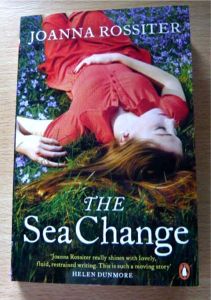
The Sea Change by Joanna Rossiter

Set in lost landscapes, The Sea Change is Joanna Rossiter’s debut novel revolving around a mother and daughter caught up in catastrophic events. The lost landscapes are the village of Imber, a Wiltshire village that was requisitioned by the army during World War Two, where Violet had grown up, and the coastal village of Kanyakumari in Southern India, where her daughter Alice was caught up in the tsunami that devastated the area in 1971.

It’s about lost lives too, wrecked relationships, the isolation of people through their inability to communicate with each other, about love, loss and grief and above all about the relationship between mothers and daughters and sisters.

I enjoyed reading this beautifully written book; I could easily visualise the different landscapes as I read. It begins with drama in the ‘present’ (1971) as the tsunami sweeps through Kanyakumari, separating Alice from her new husband, James and she is in danger of drowning. The story is a dual time novel told alternately by Alice and Violet. After the dramatic opening scenes it then moves immediately to Imber in 1971 as Violet returns to Imber and recalls how they were forced to leave, clinging to Imber ‘as if it were a lost soul.

There are parallels between their stories, both caught up in events outside their control. I was more interested in Violet’s story as she and her mother and sister try to carry on with their lives during the war, mourning the death of her father. And yet Alice’s story is also moving as she desperately searches for James.  Alice and Violet had not parted on good terms when Alice had left home to go on the hippy trail and I liked the way the two stories gradually came together and details of their lives became clearer.

I wrote about the opening paragraphs of this book in this earlier post.

Thanks to Penguin for providing a review copy of this book. I’m sorry to say that it has sat unread apart from the opening pages on my bookshelves since last year when I received it. This is one reason I’m reluctant sometimes to accept review copies – there are so many books clamouring to be read!

Joanna Rossiter has her own website where you can see a YouTube video of her reading from the beginning of the book and talking about her book. I hope she writes more books!

No Stranger to Death by Janet O'Kane

No Stranger to DeathMy thanks to Janet O’Kane for sending me a copy of her book,  No Stranger to Death, which I really enjoyed reading.  Once I’d started it I just wanted to keep on reading. I was surprised by how intricate and complex the plot is, with several sub-plots and a crowd of characters, all of whom are clearly defined. Set in the Scottish Borders, it also has a strong sense of location and it was refreshing to read a Scottish crime novel that is not set in Edinburgh, Glasgow or even in Shetland. It’s a fast-paced novel that kept me on the edge wanting to find out more.

No Stranger to Death begins with recently widowed Dr Zoe Moreland’s discovery of a body in the remains of a Guy Fawkes bonfire. Westerlea, a fictional village, is a place where everybody knows everyone, but even so it seems everyone has something to hide.  Zoe is new to the village, having moved from there from England to join the Health Centre as a GP and with the help of her new friend, Kate Mackenzie, she soon finds herself in the middle of a murder investigation. This is not a police procedural, although Detective Erskine Mather of Police Scotland is in charge of the investigation.

It’s not only the villagers who have secrets, as there is something in Zoe’s background that she wants to keep to herself and getting involved in a murder investigation is the last thing she wanted:

She had gone back to using her maiden name when she came to Scotland, but would that protect her against people whose job it was to dig up the past of anyone remotely connected with a sensational crime? (page 29)

As Zoe and Kate dig deeper quite a few nasty secrets come to light with almost disastrous consequences and Zoe is in fear of her own life. No Stranger to Death touches on some quite dark themes with an ending that took me by surprise.

Janet O’Kane lives in the Scottish Borders and she is currently writing a follow up to No Stranger to Death, again featuring Zoe Moreland. For more information see her blog – Janet O’Kane: Crime Fiction with a Heart and her Facebook page.

As well as being a really good book in its own right, No Stranger to Death meets the criteria for both the Read Scotland 2014 challenge and the My Kind of Mystery challenge.

Knavesborough Stories by Dorte Hummelshoj Jakobsen

Recently Dorte Hummelshoj Jakobsen kindly made two of her short stories available to me (e-books) for review. They are both about the Gershwin family in Knavesborough, a fictional village in Yorkshire, namely Ding Dong Bell, the Kitten in the Well and Green Acres. I often find short stories lack the necessary depth to be convincing – either weak plots and/or characterisation, but these short stories are both convincing and satisfying. Maybe it helps that they are continuations of other stories, or in the case of Ding Dong Bell, the Kitten in the Well, a prequel.

Ding Dong Bell, the Kitten in the Well goes back in time to Rhapsody Gershwin’s childhood in the early 1990s. Rhapsody is the vicar’s daughter first featured in The Cosy Knave. In this short story Rhapsody and her sisters are worried about the disappearance of the black kitten they have called Black Pete. The last time they had seen him was when they had played in old Ursula Abbot’s garden and they wondered if he had he got locked in her cottage. Ursula had died but as she was nearly ninety it wasn’t entirely an unexpected death … but she had been in good health. Is Ursula’s death connected to Black Pete’s disappearance?Rhapsody helps to solve the mystery.
Green Acres* takes us to the latest in the Gershwin and Penrose Mysteries series. Green Acres, once a country mansion, has been converted into a home for the elderly. Rhapsody visits Rowan Dougal, a farmer who has broken his hip and is currently living at Green Acres. Lavinia Banbury staying in the room next to Rowan dies in her sleep. Nothing unusual in an old people’s home, but is her death really a natural one?

Green Acres* was originally published in the anthology The Red Shoes. This is a new and longer version.

I like these stories. They’re humorous crime fiction, with colourful characters all with quirky names. There’s no blood and gore and each story has an unexpected twist at the end. In other words, they are cosy crimes (if any crime could really be considered as ‘cosy’, that is).

Dorte Hummelshoj Jakobsen is Danish. After many years as a teacher she is now concentrating on a writing career, publishing in both Danish and English. As well as writing her cosy mysteries she has also written a full length psychological murder mystery novel, Anna Marklin’s Family Chronicles, which I thoroughly enjoyed too – see my post here.

St Bartholomew's Man by Mary Delorme

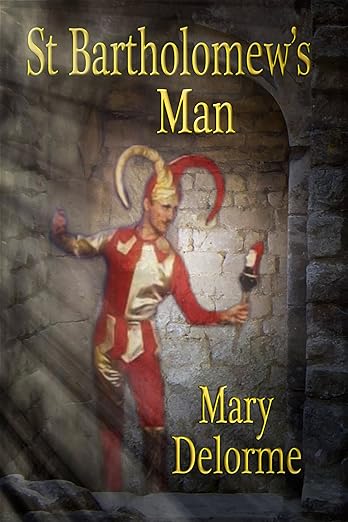
I was intrigued when I was asked if I would like to read Mary Delorme’s book St Bartholomew’s Man, about Rahere, a man who was a court jester to Henry I and who was also instrumental in the foundation of St Bartholomew’s Hospital in 1123. I was intrigued because it seemed an odd combination, that a jester and the founder of St Bartholomew’s should be one and the same person. And I wondered how that had come about.

It is historical fiction but as Mary Delorme clarifies in her Author’s Note it is based on fact with this proviso:

Almost nine hundred years lie between Rahere and myself; enough to blur historical facts, and leave room for doubt. Rahere is often described as a man of lowly origins, and a jester – something I find difficult to accept, bearing his mind his outstanding achievements and experiences. I therefore began my novel assuming that he was more highly born; not of the highest, but still an educated man. (Loc 26)

It seems to me that she has thoroughly researched her material, and managed to incorporate it seamlessly into her book. St Bartholomew’s Man follows the life of Rahere, from his childhood growing up as an orphan in a monastery, where he was one of the singing children, and he helped the monks in their healing work.

It is a book that left me knowing a lot more about the late 11th and early 12th centuries. It tells of the lives of ordinary people, of the monastic life and above all of the dangers and turbulence of life, moving through the oppressive reign of the irreligious William II (William Rufus), the more settled and peaceful reign of Henry I, followed by the violent conflict that ensued with the reign of Stephen and Matilda. I liked the historical setting and the detail both about healing and building methods. The plot kept me interested to read on to find out whether Rahere succeeded, despite all the suffering he endured and the challenges he had to overcome, in fulfilling his vow to build a hospital to care for the poor in London. The characterisation is good and I felt all the main characters came over as real people, who grew and developed throughout the book.

I enjoyed reading this book, which made me want to find out more about Rahere and St Bartholomew’s. St Bartholomew’s Hospital website outlines the history of the Hospital and St Bartholomew the Great’s website gives some information about the founding of the Priory church and Prior Rahere. Rahere’s tomb is in the church.

Then there is Rudyard Kipling’s poem Rahere, based on the legend that Rahere founded St Bartholomew’s Hospital after suffering a bout of depression and seeing a family of lepers in a London street. I also see that Rosemary Sutcliff’s children’s book The Witch’s Brat is set in the reign of Henry I and features Rahere – I’m hoping to read that one too.

My thanks to Jon Delorme for providing a copy of St Bartholomew’s Man for review, a book that entertained me and led me on to other sources of history and literature. I really want to know more about the 12th century. My knowledge is limited to schoolgirl history and Ken Follett’s The Pillars of the Earth!

The Hangman's Song by James Oswald

The Hangman’s Song by James Oswald is the third in his Inspector McLean series set in Edinburgh.

DI McLean, seconded to the Sexual Crimes Unit (SCU) by Acting Superintendent Charles Duguid (nicknamed Dagwood) finds himself working on two separate cases – one for the SCU  investigating a group of prostitutes and the subsequent death of their pimp, Malky Jennings, who was beaten to death – and the second, two suicides, which he and his DC, MacBride consider to be suspicious, and continue to investigate against Duguid’s instructions.

I think you need to have read the first two books in the series to fully understand the background or at least have read their synopses, as I found some elements of this book confusing – a small example being the name of the Acting Superintendent and his nickname, as it is not clear that Duguid and Dagwood are one and the same person. At times both names were used within a few paragraphs, making me think they could be two people.

The Hangman’s Song is a dark, tense book; crime fiction with elements of the supernatural  and parapsychology thrown in. The police force is undergoing great change as it prepares for unification as Police Scotland, adding to McLean’s own difficulties with his colleagues, most of whom dislike him, regarding him as a pain in the arse and a troublemaker. He views them as incompetent, lazy and in some cases corrupt. I did get a bit tired of his constant battle with Duguid, which detracted from the story at times. All is not well in McLean’s private life either. His girlfriend Emma (who was nearly killed in the previous book, The Book of Souls) comes out of a coma, but she has lost most of her memory, regressing to an eight-year old. She moves into McLean’s house to help with her recovery.

It is a complicated book with three storylines to keep in mind, and a large cast of characters, not all of them clearly distinguishable. It’s not a book for the faint-hearted or the squeamish as there are details of some gruesome deaths, murders and beatings that the characters go through. At times I had to read with my imagination turned down – a bit like watching something gory on TV from behind my fingers.

Having said that, it was still a compelling, if disturbing, book (particularly the last chapter) that kept me turning the pages to find out what happened next.

James Oswald runs a 350 acre livestock farm in north-east Fife. In addition to his DI McClean books he has also written a fantasy series, The Ballad of Sir Benfro, set in Wales. I have the first book in the series, Dreamwalker, which I have yet to read.

Thanks to www.lovereading.co.uk for the uncorrected advance proof of this book for review. The published book will be available in February 2014.

The Year of Miracle and Grief by Leonid Borodin

I received my copy of The Year of Miracle and Grief by Leonid Borodin, translated into English by Jennifer Bradshaw, for review from the publishers, Quartet Books. It’s a new edition due to be published in November, a beautiful little book – just 192 pages, and a pleasure to read.

Synopsis adapted from Quartet Books website:

Nearly thirty years after its first publication in English, in November Quartet Books will publish a brand new English edition of a classic fairytale, The Year of Miracle and Grief by Leonid Borodin. A twelve-year-old boy, the son of teachers, finds magic, mystery, romance, and sadness at beautiful Lake Baikal in Siberia. Deep in Siberia lies the second largest and deepest lake on earth, Lake Baikal. When a small boy arrives on its banks, he is amazed by the beauty of the lake and surrounding mountains. As this astonishment yields to inquisitiveness, he begins to explore the fairytale of the area.  

My view:

This book combines the elements of fantasy and reality, so much so that the narrator is convinced that he is not a spinner of yarns, but that he is relating what actually happened in his childhood. Writing 25 years later, he is now free to tell the tale. And it is a magical and grief stricken tale, a tale of love, forgiveness and suffering!

As he explores the area he is fascinated by Lake Baikal and Dead Man’s Crag, a high bare crag except for a pine tree on its peak, a pine tree with just four branches, two pointing up towards the sky and two larger ones pointing down along the trunk. Despite warnings not to climb the Crag he does just that and it is there that he meets a woman sitting on a throne of stone in a niche hollowed out of the rock. This is Sarma, a wrinkled old woman, so old it was impossible to imagine anyone older:

Her hermetically sealed lips were supported by a large jutting chin which came up to meet her nose, and her eyes were so deeply sunk into the network of wrinkles that the old woman seemed to be blind. She was wearing flowing sky-blue clothes, and this flowing blue enveloped her from head to foot; only her hands, encased in sky-blue gloves reaching to the elbow, contradicted the impression that the blue cocoon contained only a head. (pages 44-5)

She is a descendent of the Great Sibir (the origin of the name Siberia). She flooded Prince Baikolla’s valley, the Valley of the Young Moon, creating Lake Baikal, and guards the cave/underground castle where she holds the Prince and his daughter Ri captive, bewitched by a spell because the Prince had killed her son. But she allows the boy to enter the cave where he falls in love with Ri and begs Sarma to release her. What follows is a dramatic transformation in the boy’s life.

Borodin was a Christian and a Soviet dissident. He was born in 1938 in Irkutsk, near Lake Baikal and both his parents were teachers, like the boy in his book. He was imprisoned twice and wrote A Year of Miracle and Grief whilst in prison. It contains Christian elements focussing on the nature of forgiveness and suffering. He won the 2002 Solzhenitsyn Prize and died in 2011.

Other elements of this book are the landscape, the lake and the mountains and the miracle that takes place in experiencing the beauty of the world, the transformation of your thoughts, feelings and your entire being ‘into a sensation of total rapture in the presence of a miracle.’ (page 8).