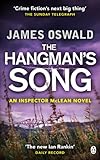
The Hangman's Song by James Oswald

The Hangman’s Song by James Oswald is the third in his Inspector McLean series set in Edinburgh.

DI McLean, seconded to the Sexual Crimes Unit (SCU) by Acting Superintendent Charles Duguid (nicknamed Dagwood) finds himself working on two separate cases – one for the SCU  investigating a group of prostitutes and the subsequent death of their pimp, Malky Jennings, who was beaten to death – and the second, two suicides, which he and his DC, MacBride consider to be suspicious, and continue to investigate against Duguid’s instructions.

I think you need to have read the first two books in the series to fully understand the background or at least have read their synopses, as I found some elements of this book confusing – a small example being the name of the Acting Superintendent and his nickname, as it is not clear that Duguid and Dagwood are one and the same person. At times both names were used within a few paragraphs, making me think they could be two people.

The Hangman’s Song is a dark, tense book; crime fiction with elements of the supernatural  and parapsychology thrown in. The police force is undergoing great change as it prepares for unification as Police Scotland, adding to McLean’s own difficulties with his colleagues, most of whom dislike him, regarding him as a pain in the arse and a troublemaker. He views them as incompetent, lazy and in some cases corrupt. I did get a bit tired of his constant battle with Duguid, which detracted from the story at times. All is not well in McLean’s private life either. His girlfriend Emma (who was nearly killed in the previous book, The Book of Souls) comes out of a coma, but she has lost most of her memory, regressing to an eight-year old. She moves into McLean’s house to help with her recovery.

It is a complicated book with three storylines to keep in mind, and a large cast of characters, not all of them clearly distinguishable. It’s not a book for the faint-hearted or the squeamish as there are details of some gruesome deaths, murders and beatings that the characters go through. At times I had to read with my imagination turned down – a bit like watching something gory on TV from behind my fingers.

Having said that, it was still a compelling, if disturbing, book (particularly the last chapter) that kept me turning the pages to find out what happened next.

James Oswald runs a 350 acre livestock farm in north-east Fife. In addition to his DI McClean books he has also written a fantasy series, The Ballad of Sir Benfro, set in Wales. I have the first book in the series, Dreamwalker, which I have yet to read.

Thanks to www.lovereading.co.uk for the uncorrected advance proof of this book for review. The published book will be available in February 2014.

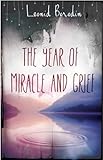
The Year of Miracle and Grief by Leonid Borodin

I received my copy of The Year of Miracle and Grief by Leonid Borodin, translated into English by Jennifer Bradshaw, for review from the publishers, Quartet Books. It’s a new edition due to be published in November, a beautiful little book – just 192 pages, and a pleasure to read.

Synopsis adapted from Quartet Books website:

Nearly thirty years after its first publication in English, in November Quartet Books will publish a brand new English edition of a classic fairytale, The Year of Miracle and Grief by Leonid Borodin. A twelve-year-old boy, the son of teachers, finds magic, mystery, romance, and sadness at beautiful Lake Baikal in Siberia. Deep in Siberia lies the second largest and deepest lake on earth, Lake Baikal. When a small boy arrives on its banks, he is amazed by the beauty of the lake and surrounding mountains. As this astonishment yields to inquisitiveness, he begins to explore the fairytale of the area.  

My view:

This book combines the elements of fantasy and reality, so much so that the narrator is convinced that he is not a spinner of yarns, but that he is relating what actually happened in his childhood. Writing 25 years later, he is now free to tell the tale. And it is a magical and grief stricken tale, a tale of love, forgiveness and suffering!

As he explores the area he is fascinated by Lake Baikal and Dead Man’s Crag, a high bare crag except for a pine tree on its peak, a pine tree with just four branches, two pointing up towards the sky and two larger ones pointing down along the trunk. Despite warnings not to climb the Crag he does just that and it is there that he meets a woman sitting on a throne of stone in a niche hollowed out of the rock. This is Sarma, a wrinkled old woman, so old it was impossible to imagine anyone older:

Her hermetically sealed lips were supported by a large jutting chin which came up to meet her nose, and her eyes were so deeply sunk into the network of wrinkles that the old woman seemed to be blind. She was wearing flowing sky-blue clothes, and this flowing blue enveloped her from head to foot; only her hands, encased in sky-blue gloves reaching to the elbow, contradicted the impression that the blue cocoon contained only a head. (pages 44-5)

She is a descendent of the Great Sibir (the origin of the name Siberia). She flooded Prince Baikolla’s valley, the Valley of the Young Moon, creating Lake Baikal, and guards the cave/underground castle where she holds the Prince and his daughter Ri captive, bewitched by a spell because the Prince had killed her son. But she allows the boy to enter the cave where he falls in love with Ri and begs Sarma to release her. What follows is a dramatic transformation in the boy’s life.

Borodin was a Christian and a Soviet dissident. He was born in 1938 in Irkutsk, near Lake Baikal and both his parents were teachers, like the boy in his book. He was imprisoned twice and wrote A Year of Miracle and Grief whilst in prison. It contains Christian elements focussing on the nature of forgiveness and suffering. He won the 2002 Solzhenitsyn Prize and died in 2011.

Other elements of this book are the landscape, the lake and the mountains and the miracle that takes place in experiencing the beauty of the world, the transformation of your thoughts, feelings and your entire being ‘into a sensation of total rapture in the presence of a miracle.’ (page 8).

Over My Dead Body by Hazel McHaffie

Over My Dead Body by Hazel McHaffie is a novel that raises questions such as would you be an organ donor, or agree to donating your child’s heart, or eyes. I’ve never read a novel that considered these issues, so when Hazel McHaffie contacted me and asked if I would read and review her book it didn’t take me long to write back, ‘yes please’. She is very well qualified to write such a book – a nurse and midwife, with a PhD in Social Sciences, and a Research Fellow in Medical Ethics.

Synopsis (from Hazel McHaffie’s website):

Carole Beacham is in her mid-sixties and planning to leave her husband. Before she can do so her daughter, Elvira, and two little granddaughters are involved in a fatal road traffic accident. Then a stranger appears in the Intensive Care Unit claiming to be Elvira’s boyfriend, insisting Elvira wanted to donate her organs. But Carole has her own reasons for rejecting such a possibility: a dark family secret which has been hidden for thirty years.

She’s torn in two, but gradually her need to respect Elvira’s wishes overcomes her fear, and the transplants go ahead. Letters from grateful recipients bring comfort and Carole’s dread recedes. Then the barriers created to safeguard anonymity start to slip. A troubling communication from a publishing firm €¦ a moving poem from a teenager €¦ an ambitious would-be journalist €¦ and the family’s peace is in grave danger.

My view:

This is a fascinating, compassionate and informative book, the factual information fitting seamlessly into the narrative. The characters are realistic, so much so that at times I had to stop reading because their predicaments and situations were so poignant and difficult.

I’m familiar with some of the issues surrounding transplants, having watched Casualty and Holby City for years. But there is nothing to beat reading a book written by someone who knows the issues, writes with sensitivity and can go into much more depth than an isolated incident in a TV drama series can. The story is told through a number of the characters’ eyes and poses the questions, thoughts and fears they each have about organ transplants – from both the recipients’ and the donor families’ points of view. Carole fears that her daughter could recover or they could find a miracle cure and it would be too late to bring her back. Some people are worried about the personalities of the recipients – do they deserve the transplant, is their lifestyle healthy enough and so on.

Above all it is a moving story, well-told and with an element of mystery – just what is it in Elvira’s background that causes her family concern? From little hints that were dropped I guessed what it was, but that didn’t detract from my enjoyment of the book. Over My Dead Body certainly gave me much to think about.

Hazel McHaffie’s other novels cover medical ethic issues such as Alzheimer’s and the right to die. Her non-fiction books are about life and death decisions.

Silver: Return to Treasure Island by Andrew Motion

Silver

I first read Treasure Island as a child. It’s a book that has remained in my memory as a great adventure story, so I was interested to see that Andrew Motion (poet laureate of the UK from 1999- 2009, now professor of creative writing at the University of London and fellow of the Royal Society) had written a sequel: Silver: Return to Treasure Island. I was intrigued and when the publishers offered me a copy to read and review I immediately accepted it.

Description from the back cover:

Silver is the rip-roaring sequel to the greatest adventure ever told: Treasure Island. Almost forty years following the events of Robert Louis Stevenson’s classic, Jim Hawkins and Long John Silver have seemingly put their maritime adventures to rest. Jim has settled on the English coast with his son Jim, and Silver has returned to rural England with his daughter Natty. While their escapades may have ended, for Jim and Natty the adventure is only just beginning. One night, Natty approaches young Jim with a proposition: return to Treasure Island and find the remaining treasure that their fathers left behind. As they set sail in their fathers’ footsteps, Jim and Natty cannot imagine what awaits them. Murderous pirates, long-held grudges, noxious greed, and wily deception lurk wickedly in the high seas, and disembarking onto Treasure Island only proves more perilous. Their search for buried treasure leaves every last wit tested and ounce of courage spent. And the adventure doesn’t end there, since they still have to make their way home…

My view:

The book, narrated by young Jim Hawkins has a good beginning. I was immediately captivated by Jim’s encounter with Natty and his subsequent meeting with her father, Long John Silver, now a disintegrating body, emaciated, blind, shrunken and shrivelled but still raging with anger with a core of steel. As I had imagined a book by Motion would be, it’s beautifully written, and the scenes came to life as I read. The scenes at the beginning, on the island and in the final scenes are powerful and for me are the book’s greatest strength.

There is a lot packed into its pages, with plenty of references to Stevenson’s Treasure Island, so much so that part way through Silver I decided I had to re-read Treasure Island (so for me Silver really was a return to Treasure Island!). But this is not just a story about pirates, or the search for the silver that was left behind, it’s also a story about the island itself, about what happened to the three pirates marooned there for forty years and about the horrors of slavery and savagery.

On the whole I enjoyed Silver, but at times its pace slows, almost to a standstill and not just when the voyage on the Nightingale comes to a dead calm and the crew subside into a lethargy for several weeks, but also during some passages on the island which seemed to last an eternity – I felt I was languishing in the doldrums. There were times when I began to tire of the book, but it does pick up, with danger and death during a terrific storm.

One little touch amused me – one of the crew is a certain Mr Stevenson – ‘a Scotsman and a wisp of a fellow, whose place was generally in the crow’s nest, where he acted as our lookout.’ (page 115)

  • Paperback: 416 pages
  • Publisher: Vintage (4 April 2013)
  • Language: English
  • ISBN-10: 0099552655
  • ISBN-13: 978-0099552659
  • Source: review copy
  • My Rating: 3/5

The Bookman's Tale by Charlie Lovett

When Alma Books contacted me to ask if I would like a review copy of The Bookman’s Tale: a novel of love and obsession by Charlie Lovett I was delighted. How could I resist a book about books, involving a search to discover the truth behind what could be a priceless Shakespearean manuscript? The book arrived the next day and I made the ‘mistake’ of looking at it whilst I drank a cup of coffee. I couldn’t put it down and by the end of the day I had read half the book.

The Bookman’s Tale

Synopsis from the back cover:

 A mysterious portrait ignites an antiquarian bookseller’s search – through time and the works of Shakespeare – for his lost love.

After the death of his wife, Peter Byerly, a young antiquarian bookseller, relocates from the States to the English countryside, where he hopes to rediscover the joys of life through his passion for collecting and restoring rare books. But when he opens an eighteenth-century study on Shakespeare forgeries, he is shocked to find a Victorian portrait strikingly similar to his wife tumble out of its pages, and becomes obsessed with tracking down its origins. As he follows the trail back to the nineteenth century and then to Shakespeare’s time, Peter learns the truth about his own past and unearths a book that might prove that Shakespeare was indeed the author of all his plays.

My view:

There are three different strands to this book, which interconnect and are interwoven throughout the book: the present day ie 1995 with Peter in England, the 1980s in America when Peter met and fell in love with Amanda, and the story of the Pandosto manuscript, a romance by Elizabethan poet Robert Greene, on which Shakespeare based The Winter’s Tale, from 1592 to 1879.

It began really well and Peter is not the only bookseller involved in the story – there is Bartholomew Harbottle in the Elizabethan/Stuart period and the Victorian Benjamin Mayhew both of whom play important roles. I really liked the historical sections and the details about the book trade and forgery is fascinating. I found the love story between Peter and his beloved Amanda rather cloying. Peter himself, suffers from an anxiety disorder and it is only his love for books and Amanda that seemed to make it possible for him to function at all – a good portrayal of an obsessive neurotic character.

By the second half of the book however, my enthusiasm for it began to droop a little as the chase around England became more frantic and a bit improbable. The many story lines as the book progressed became a series of cliff hangers, culminating in what seemed to me like something out of a cross between a Dan Brown novel, an Enid Blyton Famous Five book and a murder mystery. But, although there are just too many coincidence, twists and turns, and at times it is a bit melodramatic I still enjoyed it, swept along by the plot, an absorbing mix of historical fact and fiction, mystery and romance set in a book lovers’ world.

Charlie Lovett is a writer, teacher and playwright of plays for children. He is also a former antiquarian bookseller and an avid book collector. All this is evident in The Bookman’s Tale! He has a website with more information about the book and the sources he used.