Fools and Mortals by Bernard Cornwell

Publication: 19 October 2017, Harper Collins

Source: Review copy from the publisher via NetGalley

My rating: 5*

Fair of Face by Christina James

Tina Brackenbury and her baby daughter Bluebell are dead …

Fair of Face

Fair of Face is the sixth novel in the DI Yates series and  I think it stands well on its own. It is not a book you can read quickly as there are plenty of characters and several plot threads that need to be kept in mind. It is an intricately plotted mystery, re-assessing a crime from the past whilst investigating a present day murder, set in Spalding in Lincolnshire. I  didn’t find it an easy book to review.

The book begins with Tristram Arkwright, a prisoner in HMP Wakefield. He works in the prison library and is secretly in correspondence with Jennifer Dove, a bookseller who regularly supplies the prison. Jennifer is bored and finds Tristram a welcome diversion. He, meanwhile, is planning an appeal against his sentence insisting he is innocent.

Tina’s 10 year old foster daughter, Grace Winter was staying with a friend, Chloe and arrives home as DI Tim Yates and DS Juliet Armstrong are beginning their investigations into the deaths of Tina and Bluebelle. Grace acts strangely and doesn’t seem very upset by the murders and asks to see the bodies. But Grace has had a difficult life as this isn’t the first murder that she has encountered. Four years earlier her mother, sister and grandparents had been killed at their farmhouse and Grace had escaped by hiding in a cupboard. Grace was then adopted by Amy Winter, and only later sent to live with Tina. Her friend, Chloe, also has a troubled background, with brothers who are regularly in trouble with the police. She is noticeably intimated by them and by Grace. As both girls are only 10 years old the police work with Social Services in order to question them

I struggled for a while to sort out the relationships between all the characters and the relationship between the opening chapters and Tina and Bluebell’s murders. The narrative switches between the first person present tense (Juliet) and the third person past tense, which I found a bit awkward until I got used to it. And I was confused by characters with similar names – Tom and Tim for example – regularly having to check who was who. I also failed to see relevance of Jennifer Dove’s character in the opening chapters. But despite these drawbacks I enjoyed the book and was eager to solve the mysteries.

My thanks to the publishers for a review copy of the book.

  • Paperback: 320 pages
  • Publisher: Salt Publishing (15 Oct. 2017)
  • Language: English
  • ISBN-10: 1784631086
  • ISBN-13: 978-1784631086
  • My rating: 3*

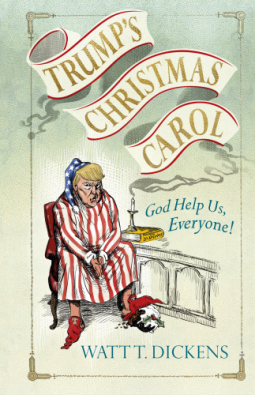
Trump’s Christmas Carol by Lucien Young

 I have the best ghosts, everyone says so’

Publication: Penguin Random House UK – Ebury Press, 2 November 2017

Source: review copy from the publishers via NetGalley

My Rating: 3*

Blurb:

President Ebenezer Trump is a rich old fool, whose heart is as small as his hands and whose words are as false as his hair. On Christmas Eve, he is visited by three spirits, all intent on changing his evil ways: Bill Clinton, the jovial Ghost of Christmas Past; Barack Obama, the big-eared Ghost of Christmas Present; and the terrifying Ghost of Christmas Yet to Come, who shows him how abolishing Obamacare will finish off Tiny Tim…

‘This Scrooge is gonna be yooooge…’

Trump’s Christmas Carol by Lucien Young (Watt T. Dickens) sub-titled Being a Ghost Story of Democracy is a short book (112 pages in hardcover) parodying Charles Dickens’ A Christmas Carol. It’s easy reading, amusing and entertaining and Young doesn’t pull his punches, mercilessly portraying Trump as Scrooge, with Richard Nixon standing in for Jacob Marley,  warning him he is on a path to impeachment and eternal damnation. He offers him a way to escape his fate – three spirits will visit him to show him the error of his ways.

Whilst this is a clever version of Dickens’ book I doubted that Young’s Scrooge would wake up on Christmas Day a changed man. And I much prefer Dickens’ original version where he is criticising Victorian society, its greed, self interest and lack of charity, drawing attention to the terrible living conditions of the poor – in particular to child poverty. Its timeless message is still applicable today.

My thanks to the publishers for a review copy via NetGalley.

The Last Hours by Minette Walters

Blurb:

June, 1348: the Black Death enters England through the port of Melcombe in the county of Dorsetshire. Unprepared for the virulence of the disease, and the speed with which it spreads, the people of the county start to die in their thousands. 

In the estate of Develish, Lady Anne takes control of her people’s future – including the lives of two hundred bonded serfs. Strong, compassionate and resourceful, Lady Anne chooses a bastard slave, Thaddeus Thurkell, to act as her steward. Together, they decide to quarantine Develish by bringing the serfs inside the walls. With this sudden overturning of the accepted social order, where serfs exist only to serve their lords, conflicts soon arise. Ignorant of what is happening in the world outside, they wrestle with themselves, with God and with the terrible uncertainty of their futures. 

Lady Anne’s people fear starvation but they fear the pestilence more. Who amongst them has the courage to leave the security of the walls?

And how safe is anyone in Develish when a dreadful event threatens the uneasy status quo…?

My thoughts:

I liked the historical setting of The Last Hours in 1348 at the time of the Black Death.  It’s well researched, giving vivid descriptions of the setting in an moated manor in the Dorsetshire countryside and of the Black Death, the plague that ravaged the population in 1348. The characters are interesting, showing the clear division between the serfs and the lord of the manor, but I thought some of them were rather one-dimensional, such as Sir Richard of Develish (Lady Anne’s husband) who is portrayed as irredeemably villainous.

I think the book as a whole is overlong and so slow in parts where the description is so detailed that it slows down the action to snail’s pace. It could have been shorter without losing any of the drama.

What really interested me was the medical development and health issues, as people struggled to understand the nature of the plague, what caused it, how it spread so quickly and how could they treat it. And what disappointed me most is the ending – there isn’t one. The last sentence reads: ‘To be continued …

You can watch Minette Walters talking about her book:

My thanks to the publishers and NetGalley for a digital review copy.

Amazon UK

The Square and the Tower by Niall Ferguson

Published: Penguin Books (UK), 5 October 2017, 535 pages

Source: review copy from the publishers via NetGalley

My Rating: 2*

Blurb:

What if everything we thought we knew about history was wrong? From Niall Ferguson, the global bestselling author of Empire, The Ascent of Money and Civilization, this is a whole new way of imagining the world.

Most history is hierarchical: it’s about popes, presidents, and prime ministers. But what if that’s simply because they create the historical archives? What if we are missing equally powerful but less visible networks – leaving them to the conspiracy theorists, with their dreams of all-powerful Illuminati?

The twenty-first century has been hailed as the Networked Age. But in The Square and the Tower Niall Ferguson argues that social networks are nothing new. From the printers and preachers who made the Reformation to the freemasons who led the American Revolution, it was the networkers who disrupted the old order of popes and kings. Far from being novel, our era is the Second Networked Age, with the computer in the role of the printing press. Once we understand this, both the past, and the future, start to look very different indeed.

My thoughts:

Subtitled ‘Networks, Hierarchies and the Struggle for Global Power‘, this is described as ‘a whole new way of imagining the world’ as it’s possible that we’re missing information about networks because it’s not recorded in historical archives. But what I found in this book is rather different, being a run through history in what seemed to me a disjointed way, albeit very detailed, with network diagrams and many footnotes. I found parts of it quite tedious, especially the early section detailing the research on the history of networking. If I hadn’t requested the book from NetGalley I would have not bothered reading any more. Fortunately I found some sections were more interesting (such as on such varied topics as social media, the Illuminati, the Reformation, European Royal families, the Cambridge spies, Al Qaeda, ISIS and Trump to name but a few) and I did finish the book.

Ferguson states that his book seeks to learn about the future mainly by studying the past, in particular by looking at the importance of networks in the past that had been at times very powerful. But by the end of the book I didn’t feel too enlightened in that respect as often the distinction between hierarchies and networks is blurred – there are networks that are hierarchical and hierarchies that are parts of wider networks. As Ferguson acknowledges, the dichotomy between hierarchy and network is an over-simplification.

I requested this book when I saw it on NetGalley because history is a subject that I find fascinating, and the blurb interested me. However, although there are sections that I did find interesting, mainly those written as conventional narrative history, overall I was disappointed. I think it is disjointed with sections that don’t seem to me to have much connection with the main theme, overstretching the analogy. To summarise – I don’t think such theoretical historical analysis is for me.

My thanks to the publishers and NetGalley for a review copy.

After the Fire by Henning Mankell

Publication: Random House UK, Vintage Publishing, Harvill Secker, 5 October 2017

Source: review copy via NetGalley

My rating: 5*

Description:

Fredrik Welin is a seventy-year-old retired doctor. Years ago he retreated to the Swedish archipelago, where he lives alone on an island. He swims in the sea every day, cutting a hole in the ice if necessary. He lives a quiet life. Until he wakes up one night to find his house on fire.

Fredrik escapes just in time, wearing two left-footed wellies, as neighbouring islanders arrive to help douse the flames. All that remains in the morning is a stinking ruin and evidence of arson. The house that has been in his family for generations and all his worldly belongings are gone. He cannot think who would do such a thing, or why. Without a suspect, the police begin to think he started the fire himself.

Tackling love, loss and loneliness, After the Fire is Henning Mankell’s compelling last novel.

My thoughts:

After the Fire by Henning Mankell, translated by Marlaine Delargy, is not standard crime fiction and although there are crimes committed they are not the main focus of the book.  Living alone on an isolated island in the Swedish archipelago, Fredrik, a retired doctor, is devastated by the fire which destroyed the house he had inherited from his grandparents. He has nothing left apart from a boathouse, where he had set up an improvised surgery, a caravan (belonging to his daughter, Louise), and a boat. Suspected by the police of starting the fire, he tries to discover the culprit.

But the main emphasis of the book is on his reflections on life, death, ageing, and loneliness.  I found it absolutely fascinating as Fredrik looks back over his life.  His relationship with his daughter, Louise, who he hadn’t known about until she was an adult, is difficult – he knows almost nothing about her. However this changes when she comes to the island to decide what to do next and he gets more involved in her life.

Told in the first person by Fredrik it goes into detail about his fears of dying and the difficulties of understanding other people and both beginning and maintaining relationships. He has no real friends and only knows a handful of people living on the islands.  There is Jansson, a hypochondriac, the former postman, a snooper who read all the postcards he delivered, Oslovski, who he describes as a strange woman his contact with her is only to the extent of checking her blood pressure from time to time and parking his car outside her house on the mainland. Then there is Lisa, a journalist who writes for the local paper, a new acquaintance who interviews him about the fire and Nordin who owns the chandlery.

It’s beautifully written and I was entranced. I found it all very real, the people, the places and the mystery. It is both a character study  and a meditation on the complexities of life and death. Once I began reading I just didn’t want it to end.