Writing Wild by Kathryn Aalto

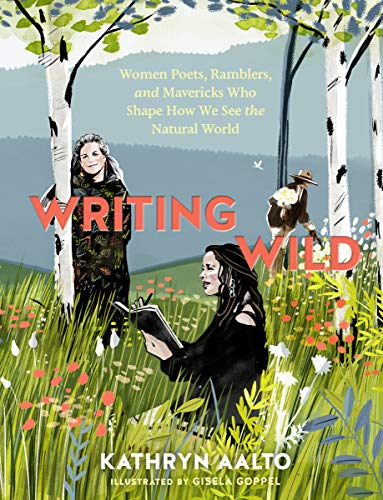
Writing Wild

3.5*

‘An exciting, expert, and invaluable group portrait of seminal women writers enriching a genre crucial to our future.’ —Booklist

Blurb:

In Writing Wild, Kathryn Aalto celebrates 25 women, both historical and current, whose influential writing helps deepen our connection to and understanding of the natural world. These inspiring wordsmiths are scholars, spiritual seekers, conservationists, scientists, novelists, and explorers. They defy easy categorization, yet they all share a bold authenticity that makes their work both distinct and universal.

Part travel essay, literary biography, and cultural history, Writing Wild ventures into the landscapes and lives of extraordinary writers and encourages a new generation of women to pick up their pens, head outdoors, and start writing wild.

My thoughts:

Writing Wild: Women Poets, Ramblers and Mavericks Who Shape How We See The Natural World is by Kathryn Aalto and illustrated by Gisela Goppel. Published by Timber Press it will be released in paperback on 1 April, with a Kindle edition to follow on 14 April 2020.

I don’t read a lot of nonfiction, but I do enjoy reading books about nature, so Writing Wild appealed to me. Kathryn Aalto’s reason for writing her book was to highlight what these 25 women writers have written, their historical significance and the barriers, biases and bullying they overcame to write. It covers two hundred years of women’s history through nature writing, including natural history, environmental philosophy, country life, scientific writing, garden arts, memoirs and meditations and does not aim to dismiss men’s contributions. Gisela Goppel’s portraits of each writer head each chapter. Aalto writes an introduction to each writer and includes excerpts of prose, poems and essays with added recommendations for further reading, plus a list of sources and an index.

Predominantly American and British, some of these women writers are familiar to me, such as Dorothy Wordsworth, Vita Sackville West, Nan Shepherd, Rachel Carson, Mary Oliver, Annie Dillard and Helen Macdonald. Others are new to me, but I would like to read several of their works, such as Andrea Wulf’s book The  Brother Gardeners in which  she explores how England became a nation of gardeners. Wulf, a design historian, writes horticultural and historical history through narrative nonfiction, borrowing techniques from fiction to make nonfiction come alive. Elena Passarello’s Animals Strike Curious Poses essay collection, which Aalto describes as written with  laugh-out-loud humour and depth of empathy, also particularly appeals to me.

One of the things I learned reading this book is the name ‘Cli-fi’. I hadn’t come across it before but of course, it is not a new genre. As Aalto points out it goes back at least to Jules Verne’s 1889 The Purchase of the North Pole. Contemporary examples including Oryx and Crake by Margaret Atwood and Barbara Kingsolver’s Flight Behaviour. The writer she chooses to illustrate this genre is Saci Lloyd, an acclaimed writer of cli-fi, whose vivid and action packed books include The Carbon Diaries, about the effects of carbon reduction policies. They are gritty eco-thrillers featuring Laura Brown a 16 year old trying to manage life with a carbon deficit card.

Kathryn Aalto is a writer, designer, historian and lecturer. For the past twenty-five years, her focus has been on places where nature and culture intersect: teaching literature of nature and place, designing gardens, and writing about the natural world. Her work explores historic and horticultural themes with a contemporary twist. She is the author of The Natural World of Winnie-the-Pooh: A Walk Through the Forest that Inspired the Hundred Acre Wood (2015) and Nature and Human Intervention (2011). Her website is kathrynaalto.com.

My thanks to Timber Press for a review copy via NetGalley.

The Sleepwalker by Joseph Knox

The Sleepwalker Knox

The Sleepwalker by Joseph Knox is the third Detective Aidan Waits novel. It has to be the most complicated book that I’ve read in a very long time. Two years ago I read the second book, The Smiling Man, even though I hadn’t read the first one, Sirens, and loved it, so I was keen to read the third one. It certainly didn’t disappoint me and although I think the books read well as stand-alones, it would probably be best to read them in order. To say that Waits has troubled background is an understatement. He is a disturbed and complex character, other police officers don’t trust him or want to work with him.  He plays very close to the edge and has little regard for his own safety. 

The Sleepwalker is dark, violent and absolutely brilliant. I just didn’t want it to end and at the same time I just had to know what happened next. There are so many strands that you have to keep in mind, so many characters to sort out where they fit into the story and it’s all so cleverly linked together. You think you have it sorted and then you realise there’s more to come. It’s perfectly paced throughout, culminating in an astounding and shocking conclusion that had me reeling.

Quite simply, I loved it.

My thanks to Transworld Publishers for a review copy via NetGalley.


The Year Without Summer by Guinevere Glasfurd

Year without summer

Two Roads| 6 February 2020| 416 pages| e-book| review copy via NetGalley| 5 stars

The Year Without Summer: 1816 – one event, six lives, a world changed by Guinevere Glasfurd is a most remarkable book, telling how the volcanic eruption of Mount Tambora on Sumbawa Island in Indonesia in 1815 had a profound and far reaching impact on the world. It led to sudden cooling across the northern hemisphere, crop failures, famine and social unrest in the following year, which became known as The Year Without Summer and in North America as Eighteen hundred and froze to death. But it wasn’t until the mid twentieth century that volcanic eruptions were shown to affect climate change.

Guinevere Glasfurd’s novel illustrates how the impact of the extreme weather conditions affected the lives of six people. They never meet, or know each other, but their stories are intertwined throughout the book in short chapters, giving what I think is a unique look at the events of 1816. I enjoyed all the stories.

Henry Hogg was the ship’s surgeon on the Benares, the ship sent to investigate the eruption of Mount Tambora in 1815. He discovered the sea full of floating pumice and charred bodies, whilst the decks of the ship were covered a foot thick with ashes. The immediate effects of the eruption were simply tremendous and horrific, within a hundred miles forests, towns were covered, deep valleys were filled in and the contours of the coast were changed.

In 1816 Mary Shelley travelled to Switzerland with Percy Shelley and her son Willmouse, her step-sister, Claire and Lord Byron and Dr Polidori and after a month of rain, Byron suggests that they should each write a ghost story and that led to her writing Frankenstein.

John Constable’s love of landscapes is deeply unfashionable and his hopes to marry Maria Rebow depend upon him gaining a commission from her parents. His father is near to death and as he has passed his business to Abram, John’s younger brother, John has few prospects other than to make a living from his painting.

Farmworker Sarah Hobbs in the Fens is finding work hard to get and has to settle for shovelling shit in the stables in her bare feet for a penny a day.  Always hungry and with work getting even more scarce she gets involved in the Littleport hunger riots. Her story is based loosely on a real person who was condemned to hang for her part in the riots, but her sentence was eventually commuted to transportation. The suppression of these riots was repeated in the 1819 Peterloo Massacre when protesters had gathered in Manchester demanding political reform

The other two people are fictional – preacher Charles Whitlock in Vermont is struggling, having persuaded his flock not to travel to Ohio to escape the draught, only to find that this is followed by periods of hard frost and snow in August. Their prospects are very bleak and death soon follows.

The other fictional character is Hope Peter, a soldier returned from the Napoleonic wars, who finds his mother has died, his family home demolished and a fence has gone up in its place, enclosing the land. He too ends up taking part in a riot – this one at Spa Fields at Islington.

 I thoroughly enjoyed this book. It’s more like a collection of short stories than a novel, but it works very well for me, highlighting the global connections. It is of course about climate change, showing the far-reaching effects of the Tambora eruption, which weren’t limited to 1815 and 1816. It led to hardships in 1817 and 1818 with the outbreak of cholera and typhoid epidemics triggered by the failure of monsoons. As Guinevere Glasfurd explains in her afterword the eruption is ‘credited with social change throughout the nineteenth century and with the pressure for social reform.’

This was the first book by Guinevere Glasfurd  that I’ve read, but it’s not her first book – that was The Words in My Hand, shortlisted for the Costa First Novel Award and Authors’ Club Best First Novel Award and was also longlisted in France for the Prix du Roman FNAC. She is currently working on her third novel, a story of the Enlightenment, set in eighteenth century England and France. I’ll be reading more of her work.

Many thanks to Two Roads for a review copy via NetGalley.

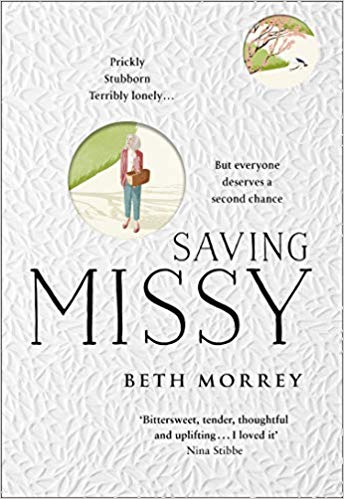
Saving Missy by Beth Morrey

Saving Missey

Harper Collins| 6 February 2020| 384 pages| e-book| review copy via NetGalley| 5+ stars

I absolutely loved Saving Missy, Beth Morrey’s debut novel. It is about love and loss,  family relationships, friendship, loneliness, and guilt but also about the power of kindness. It moved me to tears (not many books do that) but it is not in the least sentimental. 

Missy (Millicent) Carmichael is seventy nine, living on her own in a large house, left with sad memories of what her life used to be, a wife, mother and grandmother, but now she is alone. Her husband, Leo is no longer with her, her son and his family are in Australia and she and her daughter are estranged after a big row. And there is something else too, for Missy has a guilty secret that is gnawing away at her.

And then one morning as she is walking in the park she meets Angela and her young son Otis and their friend Sylvie. From that point on Missy’s life begins to change in a good way as she finds new friends, including a wonderful dog, Bobby. But can she let go of the past and the guilt that is crippling her emotions?

As the story follows Missy’s life in the present (told from Missy’s perspective) events from the past are also revealed – about her parents and grandparents, how she met Leo, and her struggles as a mother unable to follow the academic career she had thought was hers.

This really is a special book, full of wonderful characters, ordinary people drawn from life, about everyday events, pleasures and difficulties. I don’t want to write anymore about the book as that would reveal Missy’s secrets – for there is more than one. It conveys the misery of loneliness, and depths of despair of being stuck in memories (not all of them happy) and of the joys that friendship can bring.  It’s also about reconciliation and forgiving yourself – and last but not least, the love and companionship that a dog can give you.

Beth Morrey (from Goodreads)

Beth Morrey was inspired to write her debut novel, Saving Missy, while pushing a pram around her local park during maternity leave. Getting to know the community of dog owners, joggers, neighbours and families, she began to sow the seeds of a novel about a woman saved by the people around her, strangers who became friends. Previously Creative Director at RDF Television, Beth now writes full time. She was previously shortlisted for the Grazia-Orange First Chapter award, and had her work published in the Cambridge and Oxford May Anthologies while at university. Beth lives in London with her husband, two sons and a dog named Polly.

Many thanks to Harper Collins for a review copy via NetGalley.

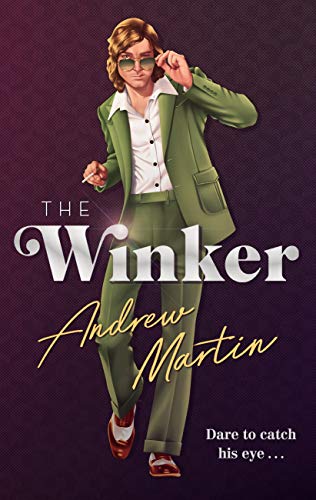
The Winker by Andrew Martin

The Winker

Corsair| 6 June 2019| 272 pages| e-book| review copy via NetGalley|4 stars

I haven’t read anything by Andrew Martin before and as I began reading The Winker I found it decidedly odd and a bit creepy. I don’t like the cover at all and the title didn’t appeal to me either. But the description interested me:

London, 1976.

In Belgravia in the heat of summer, Lee Jones, a faded and embittered rock star, is checking out a group of women through the heavy cigarette smoke in a crowded pub. He makes eye contact with one, and winks. After allowing glances to linger for a while longer, he finally moves towards her.

In that moment, his programme of terror – years in the making – has begun.

Months later, the first of the many chilling headlines to come appears: ‘Police hunting winking killer.’

Meanwhile in France.

Charles Underhill, a wealthy Englishman living in Paris, has good reason to be interested in the activities of the so-called Winking Killer. With a past to hide and his future precarious, Charles is determined to discover the Winker’s identity.

In the overheating cities of London, Oxford, Paris and Nice, a game of cat and mouse develops, and catching someone’s eye becomes increasingly perilous. But if no one dares look, a killer can hide in plain sight . . .

From ‘a master of historical crime fiction’ (The Guardian), The Winker is a gripping thriller that won’t let you look away.

My thoughts:

I like the structure of this book. It is set in 1976 with flashbacks to 1951, in several locations, mainly London and Nice and sometimes in Paris and Oxford. Each time and place is clearly highlighted. The book is largely character-led. Lee Jones, a failed pop singer and psychopath is working on a ‘project’, nothing to do with music, aiming to achieve world-wide fame. He calls it a ‘programme’ and involves something he calls a ‘folder’ and his ‘trademark’. He is living in a fantasy world, accompanied by Abigail a journalist who intermittently interviews Lee. It was all a bit ambiguous at first and it took me a few pages to decide what I thought about Abigail and her role in the book. 

Then there is Charles Underhill, a man of about fifty,  living a self-imposed exile in France, because of an event in Oxford whilst he was a student there. He lives a very routine life in Paris with his mother Syl, except for his annual holiday in Nice. His routine is upset when he receives a postcard with a picture of the river at Oxford showing a boat full of university rowers, but no message on the back. When more unsigned postcards arrive he is worried that they are from Pat Price who was at the university with him in 1951.

In Nice Charles meets Howard Miller, a crime fiction writer. His first novel wasn’t a great success and he is looking for inspiration for his next novel, to prove to his father he wasn’t wasting his time. These three men are now set on a collision course as Charles offers to pay Howard for a couple of days work in Oxford to find out who had sent him the anonymous postcards. From that point onwards everything fell into place for me and I was hooked.

This is psychological crime fiction, you know right from the beginning who the ‘Winker’ is, but the precise method of the murders is not clear (at least not to me) until later in the book. And Charles’ secret is revealed quite early in the book. Neither Lee nor Charles are pleasant characters and this is decidedly a creepy tale, but it’s also a compelling one. Howard, on the other hand, is rather a naive character, who nevertheless gets to the bottom of the mystery. I loved the settings – they are so vivid and evocative of the 1970s; the places, the intense heat of the summer  of 1976, the people, their clothes, the hairstyles, sunglasses, cars, exotic cigarettes, and especially the music of the 70s, bring it all to life in technicolour. I think this is ripe for being made into a film.

Andrew Martin, a former Spectator Young Writer of the Year, grew up in Yorkshire. He has written for the Evening Standard, the Sunday Times, the Independent on Sunday and the Daily Telegraph, among others. His weekly column appears in the New Statesman and he is the author of numerous articles and books – of both fiction and non-fiction. For more information see his website.

I received a copy of this book from the publisher, via NetGalley, for review.

The Last Day by Andrew Hunter Murray

A thriller set in a world which has spun to a halt, bringing civilisation to the brink of collapse

The last day

Cornerstone| 6 February 2020| 432 pages| e-book| review copy via NetGalley| 5 stars

It’s not often I read dystopian fiction, a bit wary that I won’t like it, but I’m glad to say that I was fascinated by The Last Day by Andrew Hunter Murray. I’m not sure about the plausibility of the concept but I was gripped by the story of a world coming to an end and the effects that had on the planet and the population.

A white dwarf star, the size of earth but two hundred thousand times as dense had barrelled through space, and travelling at two thousand kilometres a second its trajectory and gravity had dragged the earth backwards. The earth’s rotation had gradually slowed and eventually came to a full stop. Chaos followed, earthquakes, volcanic eruptions and gales swept the earth’s surface, but gravity still functioned as the planet was still the same mass and exerted gravitational force. As the planet stopped on the dawning of the last day in 2029 the boundaries of day and night were locked in place, with a slender ring of borderlands that varied between total darkness and a fractional glimpse of light. Europe was in the constant light of the sun with an isolationist Britain on the warm side far enough in to raise crops but far enough out to still be habitable.

Set in 2059, thirty years after the earth had finally stopped spinning The Last Day presents a totalitarian world, and gives such a vivid picture of what life has become for the people who live on the burning sun side of the planet. There is, of course, no night, but there is a curfew during the ‘night’ hours.  I warmed to Ellen Hopper, a scientist working on a rig two hundred miles off the south-west coast of England in the North Atlantic, where it is always dawn, as she studies the ocean’s currents. She receives a letter from Dr Edward Thorne her old college tutor at Oxford who is dying. He has something important to tell her, information that would ruin the British government and that they would do anything to keep hidden. Prior to his appointment at Oxford he had  been a scientist and an adviser to the British Prime Minister, Richard Davenport, until he had been ignominiously sacked. 

What follows is Hopper’s search to discover the details of this secret, interspersed with flashbacks to her past and her family history, in particular about what happened to her parents, her relationship with her brother, who works in security, her fears that she shouldn’t trust him, and her ex-husband David. It is full of political intrigue and danger with a high body count and builds to a dramatic conclusion. I thoroughly enjoyed it, was glued to the pages and by the end of the book I was convinced of the reality of this implausible world (at least I hope it is). 

Andrew Hunter Murray, is a writer and journalist from London. The Last Day is his first novel. when he’s not writing fiction he works for the TV show QI, as one of the ‘Elves’ finding out Quite Interesting facts about everything under the sun. He also co-hosts the podcast No Such Thing As A Fish, and write jokes and journalism for Private Eye, the UK’s leading satirical magazine. No Such Thing As A Fish has also led to a spin-off TV series, No Such Thing As The News, and three books co-written with his colleagues on the show – the Book Of The Year, The Book Of The Year 2018, and the Book Of The Year 2019.

He is already working on his next novel idea. I definitely want to read it when he’s finished it!

Many thanks to Cornerstone for a review copy via NetGalley.