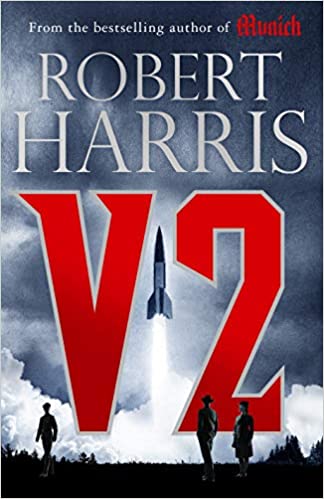
V2 by Robert Harris

Random House UK, Cornerstone| 17 September 2020| 314 pages| Kindle review copy| 5*

Description

Victory is close. Vengeance is closer.

On the brink of defeat, Hitler commissioned 10,000 V2s – ballistic rockets that carried a one-ton warhead at three times the speed of sound, which he believed would win the war.

Dr Rudi Graf who, along with his friend Werner von Braun, had once dreamt of sending a rocket to the moon, now finds himself in November 1944 in a bleak seaside town in Occupied Holland, launching V2s against London. No one understands the volatile, deadly machine better than Graf, but his disillusionment with the war leads to him being investigated for sabotage.

Kay Caton-Walsh, an officer in the WAAF, has experienced first-hand the horror of a V2 strike. When 160 Londoners, mostly women and children, are killed by a single missile, the government decides to send a team of WAAFs to newly-liberated Belgium in the hope of discovering the location of the launch sites. But not all the Germans have left and Kay finds herself in mortal danger.

As the war reaches its desperate end, their twin stories play out, interlocked and separate, until their destinies are finally forced together.

My thoughts:

V2 is historical fiction with a solid factual framework. I like to know when I’m reading historical fiction how much is history and how much is fact. So, I was pleased to find that at the end of the book Harris has included a list of the sources he consulted on the history of the V2 and how it worked, including the work of the photographic reconnaissance interpreters, before writing V2. In particular he acknowledges Eileen Younghusband’s two volumes of memoirs – Not an Ordinary Life and One Woman’s War. She had worked as a WAAF officer on the Mechelen operation, working on detecting the location of the V2 launch sites, and her memoirs had provided him with a vivid insight into her wartime life. Without them he would not have written V2.

It’s set over five days at the end of November 1944 as the Germans fired V2 missiles on London from the woods around Scheveningen on the Dutch coast. The British response was a counter-operation, including a team of WAAFs. The cast includes some historical figures such as Werner von Braun, the real-life head of the Nazi rocket programme, and SS-General Hans Kammler. It’s told in alternating chapters from two of the fictional characters’ perspectives – Dr Rudi Graf, a rocket engineer on the V2 team and Kay Caton-Walsh of the Women’s Auxiliary Air Force. Kay was part of the team based at Mechelen using radar to try to locate the V2 firing sites. Harris emphasises that his fictional character, Kay, bore no resemblance to Mrs Younghusband, apart from the fact that she worked on the Mechelen project.

I thoroughly enjoyed reading this novel, learning a lot about that period of the Second World War and about the V2. It is detailed and tense, and very readable, describing the intricate details of the launching of the V2s and Kay’s work, which became increasingly dangerous as their location became known to the Germans.

Many thanks to the publishers and NetGalley for my digital proof copy.

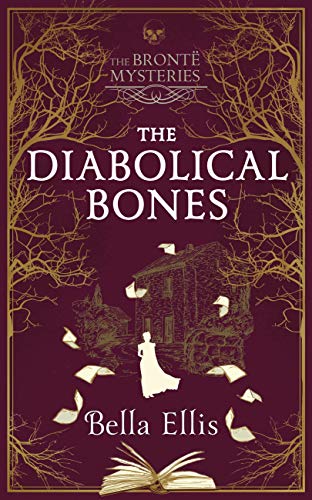
The Diabolical Bones by Bella Ellis

It’s Christmas 1845 and Haworth is in the grip of a freezing winter.

Hodder and Stoughton|5 November 2020| 309 pages| e-book| Review copy|4*

The Diabolical Bones is the second novel by Bella Ellis about the Brontë sisters. It’s historical fiction that brings the period (1845) and the setting vividly to life. It begins with Charlotte in 1852 looking back to that December of 1845 when her brother and sisters had still been alive and they had faced the hidden horror that lay within Top Withins Hall. This is a dark story, as the four Brontës discover – it involves not only murder, but also the occult and child exploitation. It highlights what life was like in the mid nineteenth century, the living conditions and the inequalities between the well-to-do and the poor.

Charlotte, Emily and Anne and their brother, Branwell became real people before my eyes, seeing them in their home in the Parsonage at Howarth. And together they make a formidable team as they set about discovering the truth about the bones of a child hidden in a chimney in the oldest part of Top Withins Hall, an ancient house high up on the moors above Howarth.

The Hall is the home of the Bradshaw family, known by Tabby, the Brontes’ housekeeper as a ‘bad lot’. She is steeped in the local superstitions and folklore and believes the land where the Bradshaws live is where the ‘hidden folk’ live. It fills her with horror as she tells the sisters about the children of Adam and Eve who live among the rocks and woodland, moors and rivers, unseen. In the past people would leave out offerings for them to keep away ill fortune. She warns them that now that there is a heavy price to be paid – and that the discovery of the bones is just the start of it.

There are links to other Brontë books in the names of some of the characters – for example, imagine finding Mrs Grace Poole, the guardian of the mad woman in the attic in Jane Eyre in charge of an orphanage. And I was delighted to find Emily in particular was inspired by Top Withins Hall and the events that took place there to write a novel, because its resemblance to Wuthering Heights struck me immediately. The more I read the more I could believe that the Brontë family were just as Bella Ellis has described them.

Bella Ellis’ is the Brontë inspired pen name for the author Rowan Coleman, who has been a Brontë devotee for most of her life – and it shows so well in this book. The setting is superb, the characters are ‘real’ and the book is well plotted. It was only towards the end that I suspected the identity of the main culprit and the danger that the four siblings had to face. I do hope there will be a third Brontë book.

My thanks to Hodder & Stoughton for an e-book review copy via NetGalley

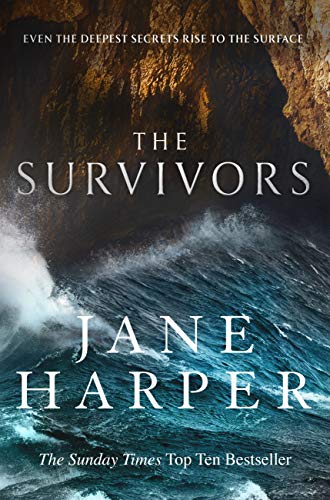
The Survivors by Jane Harper

Little, Brown Book Group UK| 1 October 2020| 337 pages| Kindle review copy| 4*

Kieran Elliott has moved back to his home town of Evelyn Bay on the island of Tasmania twelve years after the death of his older brother, Finn. His father has dementia and he has come home to help his mother move house. He feels guilty as Finn died trying to rescue him during a violent storm at sea and he has always thought that his parents blamed him for the loss of their favourite son. On that same day twelve years earlier, a teenage girl went missing. Her bag was later found on the beach, washed up by the tide, but her body was never found. The day after Kieran’s arrival, Bronte, a waitress at the Surf and Turf bar, is found dead on the beach, which stirs up memories of the events of twelve years ago.

I struggled reading the first part of this book. I couldn’t easily make out who was who, especially between the male characters, and I had no idea who or what the ‘Survivors‘ in the title were. There were hints about what had happened twelve years ago, but it wasn’t really compelling me to read on to find out who did what, where and how – until, that is, I’d read about 25% of the book. I was on the point of giving up, when things became clearer, the characters came to life and I realised what was going on – and I just had to read on.

Evelyn Bay is a small community where everyone knows everyone else. There are plenty of rumours flying around, and suspicion falls on several people. Just who and what the ‘Survivors‘ are plays a major role in the story – along with the sea, the caves and the tides. So, this is a slow-burner at first, that turns into an emotionally charged book rather than one of high tension and suspense. I enjoyed it, but not as much as Jane Harper’s earlier books, The Dry, Force of Nature or The Lost Man, which all had me enthralled.

My thanks to the publishers and NetGalley for my review copy.

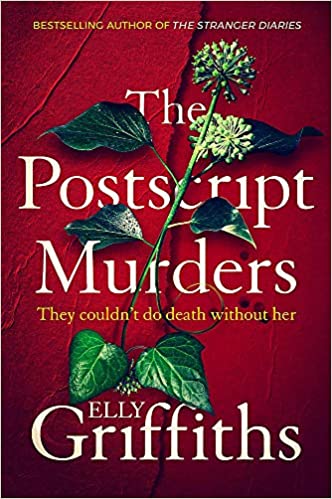
The Postscript Murders by Elly Griffiths

Quercus Books| 1 October 2020| 352 pages| Review copy| 4*

From the sleepy seaside town of Shoreham to the granite streets of Aberdeen, The Postscript Murders is a literary mystery for fans of Anthony Horowitz, Agatha Christie and anyone who’s ever wondered just how authors think up such realistic crimes..

PS: Trust no one.

My thoughts:

I enjoyed Elly Griffiths’ first DS Harbinder Kaur book, The Stranger Diaries, so I was keen to read the second book, The Postscript Murders. It’s very different, in a much lighter style and I think Elly Griffiths was enjoying herself writing this poking fun at crime fiction writers and the book world, with book bloggers and a literary festival. I really enjoyed it. It’s very readable, cleverly plotted, with interesting and well defined characters.

Peggy Smith is ninety, living in a retirement flat at Seaview Court in Shoreham. The book begins as she is ‘lurking’ in a bay window watching the world go by and writing down details of everyone she sees. But when Natalka, Peggy’s Ukranian carer, finds her sitting in her armchair by the window, she knows immediately that she is dead and suspects that something is wrong, especially when she finds a business card – ‘Mrs M Smith, Murder Consultant’. For Peggy is a woman with a past, who helps crime fiction writers with their plots and gory ways for people to die.

But Peggy had a heart condition and DS Harbinder Kaur certainly sees nothing to concern her about her death and initially she does not feature much in the book. Natalka enlists the help of Peggy’s friends, ex-monk Benedict, the local cafe owner and Edwin, who also lives at Seaview Court to help her investigate. When they find sinister notes with the threatening message We are coming for you, and Natalka and Benedict are threatened by a mysterious gunman who bursts into Peggy‘s flat, both D S Kaur and D S Neil Winston then take on an active role.

Their investigations lead them to Peggy’s author friends and another murder victim. Then Natalka, Benedict and Edwin then travel from Shoreham to Aberdeen to a literary festival to warn another of Peggy’s author friends, J D Monroe, Julie, that she too might be in danger, thinking she is the next victim. From then on the mystery deepens, and the suspects increase. There are plenty of red herrings and twists and turns, that kept me guessing throughout.

Many thanks to the publishers and NetGalley for my review copy.

The Searcher by Tana French

Penguin| 5 November 2020| 400 pages| Review copy| 5*

I enjoyed The Searcher very much. For the most part this standalone mystery novel moves quite slowly, but it held my attention right from the beginning. It certainly isn’t a book to rush through, rather it’s one to savour. The main characters are Cal Hooper and thirteen-year old Trey Reddy living in Ardnakelty, a remote Irish village. After twenty five years in the Chicago police force, Cal has recently moved to the village, wanting to build a new life after his divorce. He is a loner and wants a quiet life in which nothing much happens. But he finds himself getting involved in the search for Brendan, Trey’s older brother who had gone missing from home.

Cal is a methodical man, slowly doing up his run-down cottage and getting to know the locals – his neighbour Marty, Noreen who runs the village shop, her sister Lena and above all, Trey. I liked the slow build up to the mystery, and I loved Tana French’s beautiful descriptions of the Irish rural landscape. It’s the sort of book I find so easy to read and lose myself in, able to visualise the landscape and feel as if I’m actually there with the characters, watching what is happening.

But this is no ‘cosy’ crime fiction novel. Trey is like a dog with a bone and won’t let Cal give up when it looks as though they will never discover why Brendan left and what had happened to him. I realised after a while what could have happened to Brendan, but I hadn’t foreseen the twists and turns in this book, one of which really surprised me. The ending is terrific. The tension builds and builds as Cal and Trey find themselves in danger. Above all, it is about family relationships, responsibility and friendship. It is atmospheric, spellbinding, and compelling reading. Tana French is a great storyteller.

Many thanks to the publishers and NetGalley for my review copy.

And Now For the Good News … To the Future With Love by Ruby Wax

Penguin Life/ 17 September 2020/ 256 pages/ e-book/ Review copy/ 3*

And Now For the Good News … To the Future With Love by Ruby Wax is a positive look at some recent developments in community, business, education, technology, and food that promise to make the world a better place.

She began writing this in 2018 before the outbreak of Covid-19, but ends the book with some ‘Post Covid-19 Good News.’ Whilst researching for her book she found what she calls ‘green shoots of hope peeping through the soil of civilisation’ that ‘may just bloom into a brighter future.’ It’s easy reading, written clearly in a breezy conversational style, covering a large amount of information. She emphasises the importance of compassion and kindness, of community and on working for the good of all. Maybe, above all she focuses on the benefits of mindfulness and on positive experiences.

She begins with writing about herself and sections about her own story are interspersed between the ‘Bad News’ and the ‘Good News’ throughout the book. In each section she gives a brief history of the topic, along with the story of her own experiences and then looks at examples of how things are improving. Not all of it was new to me, but I did learn a lot, as the book is simply crammed with information.

I’ll just mention two examples that interested me particularly. In the section on Education I was amazed to read about the discipline and regimentation in Chinese schools contrasting with the relaxed and caring approach in Finnish schools. And in the UK she visited a school in Hertfordshire, where children, many from disadvantaged backgrounds, learn about emotions as well as academic topics.

In the Business section she writes about new models of businesses that are ‘going green’ in companies such as the outdoor clothing company Patagonia, based in California. They believe they owe the earth for the industrial impact of business and consequently give away 10% of all profits and are very conscientious about what products they use because the textile industry is one of the most chemically intensive industries on earth, second only to agriculture.

The final section of the book is called ‘To the Future with Love’ in which she summarises the good news for each of the topics covered in her book. Her hope is that we will remember the’ feelings of interconnnectedness and caring for each other and … keep them going’ when the pandemic is over.

Overall, this is an interesting book with some inspiring stories but in places it felt as though I was reading newspaper articles or company brochures, which is why I’ve given it 3 stars rather than 4.

My thanks to the publishers for my copy via NetGalley.