Penguin| 5 November 2020| 400 pages| Review copy| 5*
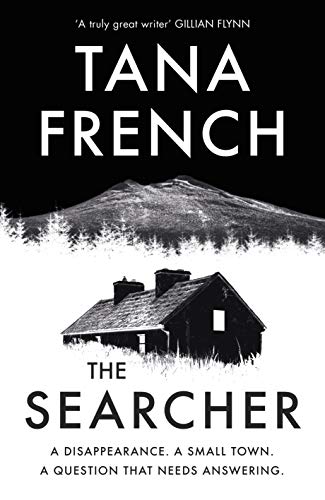
I enjoyed The Searcher very much. For the most part this standalone mystery novel moves quite slowly, but it held my attention right from the beginning. It certainly isn’t a book to rush through, rather it’s one to savour. The main characters are Cal Hooper and thirteen-year old Trey Reddy living in Ardnakelty, a remote Irish village. After twenty five years in the Chicago police force, Cal has recently moved to the village, wanting to build a new life after his divorce. He is a loner and wants a quiet life in which nothing much happens. But he finds himself getting involved in the search for Brendan, Trey’s older brother who had gone missing from home.
Cal is a methodical man, slowly doing up his run-down cottage and getting to know the locals – his neighbour Marty, Noreen who runs the village shop, her sister Lena and above all, Trey. I liked the slow build up to the mystery, and I loved Tana French’s beautiful descriptions of the Irish rural landscape. It’s the sort of book I find so easy to read and lose myself in, able to visualise the landscape and feel as if I’m actually there with the characters, watching what is happening.
But this is no ‘cosy’ crime fiction novel.Trey is like a dog with a bone and won’t let Cal give up when it looks as though they will never discover why Brendan left and what had happened to him. I realised after a while what could have happened to Brendan, but I hadn’t foreseen the twists and turns in this book, one of which really surprised me. The ending is terrific. The tension builds and builds as Cal and Trey find themselves in danger. Above all, it is about family relationships, responsibility and friendship. It is atmospheric, spellbinding, and compelling reading. Tana French is a great storyteller.
Many thanks to the publishers and NetGalley for my review copy.
Penguin Life/ 17 September 2020/ 256 pages/ e-book/Review copy/ 3*
And Now For the Good News … To the Future With Love by Ruby Wax is a positive look at some recent developments in community, business, education, technology, and food that promise to make the world a better place.
She began writing this in 2018 before the outbreak of Covid-19, but ends the book with some ‘Post Covid-19 Good News.’ Whilst researching for her book she found what she calls ‘green shoots of hope peeping through the soil of civilisation’ that ‘may just bloom into a brighter future.’ It’s easy reading, written clearly in a breezy conversational style, covering a large amount of information. She emphasises the importance of compassion and kindness, of community and on working for the good of all. Maybe, above all she focuses on the benefits of mindfulness and on positive experiences.
She begins with writing about herself and sections about her own story are interspersed between the ‘Bad News’ and the ‘Good News’ throughout the book. In each section she gives a brief history of the topic, along with the story of her own experiences and then looks at examples of how things are improving. Not all of it was new to me, but I did learn a lot, as the book is simply crammed with information.
I’ll just mention two examples that interested me particularly. In the section on Education I was amazed to read about the discipline and regimentation in Chinese schools contrasting with the relaxed and caring approach in Finnish schools. And in the UK she visited a school in Hertfordshire, where children, many from disadvantaged backgrounds, learn about emotions as well as academic topics.
In the Business section she writes about new models of businesses that are ‘going green’ in companies such as the outdoor clothing company Patagonia, based in California. They believe they owe the earth for the industrial impact of business and consequently give away 10% of all profits and are very conscientious about what products they use because the textile industry is one of the most chemically intensive industries on earth, second only to agriculture.
The final section of the book is called ‘To the Future with Love’ in which she summarises the good news for each of the topics covered in her book. Her hope is that we will remember the’ feelings of interconnnectedness and caring for each other and … keep them going’ when the pandemic is over.
Overall, this is an interesting book with some inspiring stories but in places it felt as though I was reading newspaper articles or company brochures, which is why I’ve given it 3 stars rather than 4.
My thanks to the publishers for my copy via NetGalley.
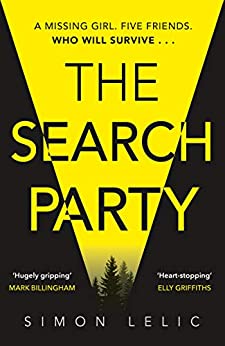
Three years ago I read The House by Simon Lelic and enjoyed it, so I was looking forward to reading The Search Party. I’m delighted to say that I think it is even better.
16-year-old Sadie Saunders is missing and five of her friends set out into the woods to find her. At the same time the police’s investigation, led by Detective Inspector Robin Fleet and Detective Sergeant Nicola Collins, is underway. The narrative alternates between the two groups. Sadie is a clever girl, popular with her school friends and loved by her parents, who favour her over her twin brother Luke and their younger brother, Dylan.
The opening lines propelled me straight into the story as one of Sadie’s friends, lost in the woods her makes an incoherent phone call to the emergency services. The caller doesn’t know their location other than it is ‘somewhere in the woods‘ near an abandoned building. And from that point on I was gripped, compelled to follow this complex novel, full of red herrings and multiple twists and turns. It is tense from start to finish, ending in an exhausting and terrifying chase that had me on the edge of my seat!
I really like Fleet, and the way he stands up to his boss, Superintendent Burton, whose main concern is the cost of the investigation. Burton puts pressure on him to arrest Mason, assuming he has killed Sadie even though her body has not been found. Mason is part of the search party, but Fleet’s instincts tell him Mason is innocent. Fleet is known for his ability to find missing persons and sticks to his gut feelings.
My only criticism is that at times the teenagers’ rambling discussions about what could have happened to Sadie and their disagreements went on too long for my liking. But that is just a minor point. They are all keeping secrets and in their interviews with the police they all lie and withhold vital facts and they are suspicious of each other, not knowing who they can trust. And I couldn’t decide what had happened to Sadie – had she run away, committed suicide or was she murdered and if so who was the murderer. They are all suspects, including Sadie’s parents. It was only just before the end of the book that I realised just what had happened.
My thanks to NetGalley and Viking, the publishers for a review copy.
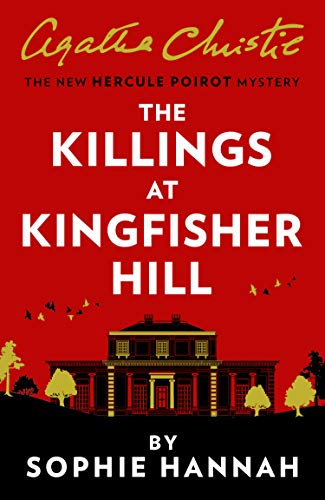
The Killings at Kingfisher Hill is Sophie Hannah’s fourth Hercules Poirot mystery novel and the first one I’ve read. I have read some of Hannah’s books previously. So, I know that she writes complicated and tricky plots. Whilst not attempting to reproduce Christie’s Poirot this book is loosely based on Christie’s books, as Hannah incorporates all the twists and turns, red herrings and misdirections that you find in them. There’s a country house setting, a number of suspects, and a gathering together at the end where Poirot reveals all.
Blurb:
Hercule Poirot is travelling by luxury passenger coach from London to the exclusive Kingfisher Hill estate, where Richard Devonport has summoned him to prove that his fiancée, Helen, is innocent of the murder of his brother, Frank. But there is a strange condition attached to this request: Poirot must conceal his true reason for being there.
The coach is forced to stop when a distressed woman demands to get off, insisting that if she stays in her seat, she will be murdered. Although the rest of the journey passes without anyone being harmed, Poirot’s curiosity is aroused, and his fears are later confirmed when a body is discovered with a macabre note attached…
Could this new murder and the peculiar incident on the coach be clues to solving the mystery of who killed Frank Devonport? And if Helen is innocent, can Poirot find the true culprit in time to save her from the gallows?
I wasn’t expecting a cloned Poirot and Hannah’s Poirot is not Christie’s Poirot. There’s no Captain Hastings in this book, Poirot’s faithful friend. Instead Poirot is accompanied by Inspector Catchpole from Scotland Yard. How on earth he got to be an inspector is beyond me – he comes across as rather dim and stupid and Poirot treats him as such, endlessly explaining things to him and telling him what to do in an officious manner.
There are three strands to the plot – who killed Frank Devonport; who is the hysterical woman with an ‘unfinished face’ who insists she will be murdered if she sits in a specific seat on the coach; and who is the mysterious woman who tells Poirot she is a murderer – what a stupid thing to do when she knows he is a ‘world-renowned detective’? And I wondered what makes Richard so sure that Helen didn’t kill Frank when she had immediately confessed that she had? And I’m still wondering why when he was invited to Kingfisher Hall, an exclusive and private country estate, he went by coach with 30 other passengers – even if it was a ‘luxury’ coach. I just can’t see Poirot travelling by coach!
This all makes the book extremely convoluted, confusing and tangled as well as long-winded. Poirot though works his way methodically through the mess and gets to the truth. However, I found it quite dull and repetitive and rather contrived. So, my rating for this book is 2.5 stars, rounded up to 3.
My thanks to HarperCollins for a review copy via NetGalley.
Faber and Faber Ltd/ 19 March 2020/ 256 pages/ Kindle edition/ 5*
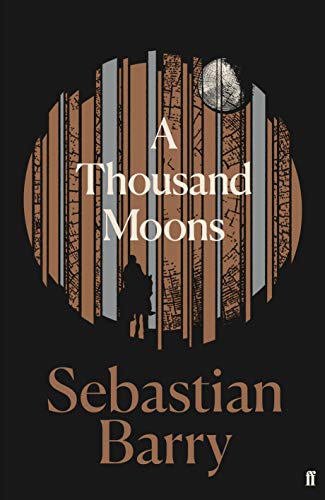
Three years ago I read Sebastian Barry’s Days Without End which has to be one of the best books I’ve read, so I began reading A Thousand Moons with great anticipation of a good read. I wasn’t disappointed and I loved it. It continues the story of Thomas McNulty and John Cole, and Winona, the young Indian girl they had adopted. It really helps if you have read Days Without End first to understand the characters’ history and relationships and how they got to this stage in their lives.
Winona is a young Lakota orphan adopted by former soldiers Thomas McNulty and John Cole. Living with Thomas and John on the farm they work in 1870s Tennessee, she is educated and loved, forging a life for herself beyond the violence and dispossession of her past. But the fragile harmony of her unlikely family unit, in the aftermath of the Civil War, is soon threatened by a further traumatic event, one which Winona struggles to confront, let alone understand.
They are living and working on a farm owned by Lige Magan in Tennessee, about seven miles from a little town called Paris. It is now the 1870s, some years after the end of the Civil War, but the town was still full of rough Union soldiers and vagabonds on every little byway. Dark skin and black hair were enough to get you beaten up – and it wasn’t a crime to beat an Indian. Life wasn’t any better for the other two workers on the farm, black ex-slaves, Rosalee Bouguereau and her brother, Tennyson. These are dangerous times not just in the town but also in the woods outside the town from Zach Petrie’s gang of ‘nightriders’.
Winona remembers little of her early life, beyond seeing in the back of her mind a ‘blackened painting’ of blood and screaming, bayonets, bullets, fire and death. But their lives are full of love at the farm; Winona is loved as a daughter by Thomas and John, who are themselves lovers. She works for lawyer Briscoe as his clerk and ventures into town for supplies, which was where she met Jas Jonski, a young man who declares he wants to marry her. At first she hopes that she might very much like to marry Jas. But, then things go disastrously wrong. First racism rears its ugly head as Jas is white and the Paris townspeople began to talk. As his employer said he thought Jas had gone mad or wicked in some way – ‘to want to go marrying something closer to a monkey than a man’ was how he put it.
And then came the dreadful day when Winona was brutally attacked so badly that she shook for two weeks and something deep within her was shaking a long time after. She can’t remember at first what had actually happened to her, except that she was plied with ‘distillery whiskey’, nor who had carried out the assault. But all the signs pointed to Jas Jonski. Then Tennyson Bouguereau was also attacked, and their peaceful happy life was shattered. Winona set out for revenge. And in so doing she began to remember more about her early life and about her mother, a strong Lakota woman, full of courage and pride.
‘A thousand moons’ was her mother’s deepest measure of time. To her time was ‘a kind of hoop or a circle not a long string and if you walked far enough she said you could find the people still living in the long ago’ – ‘a thousand years all at once’. As she sets off on her quest it is the thought of her mother’s courage that enabled Winona to find her own courage – the ‘courage of a thousand years’.
I just love everything about this book, so beautifully written, rendering the way the characters speak so that I could hear them, and describing the landscape so poetically and lyrically that the scenes unfolded before my eyes; and the characters too, all real people from the American West of the 1870s, as though I was there in their midst. It would make a superb film.
Sebastian Barry was born in Dublin in 1955. His novels and plays have won, among other awards, the Kerry Group Irish Fiction Prize, the Costa Book of the Year award, the Irish Book Awards Best Novel, the Independent Booksellers Prize and the James Tait Black Memorial Prize. He also had two consecutive novels, A Long Long Way (2005) and The Secret Scripture (2008), shortlisted for the MAN Booker Prize. He lives in Wicklow with his wife and three children.
My thanks to Faber and Faber Ltd for my copy of this book, via NetGalley.
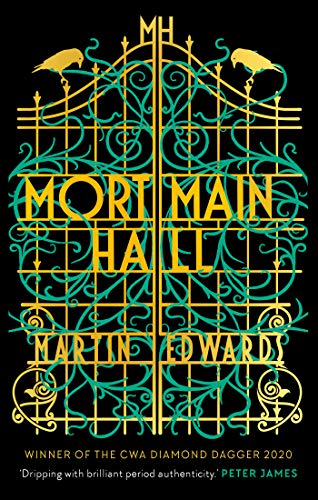
Mortmain Hall by Martin Edwards is the sequel to Gallows Court. Both books are set in 1930 in London and reflect Martin Edwards’ fascination with that period in history and his love of Golden Age detective fiction.
1930. A chilling encounter on London’s Necropolis Railway leads to murder and a man escapes the gallows after a witness gives sensational evidence. After this string of strange, fatal events, journalist Jacob Flint discovers that he has been framed for murder. To save himself, he flees to Mortmain Hall, a remote estate on the northern coast. There, an eccentric female criminologist hosts a gathering of eclectic people who have all escaped miscarriages of cruel justice. This strange group puts Jacob a little on edge, but they may be his only hope to clear his name.
When a body is found beneath the cliffs near the house, it seems this gathering might be an ingenious plot to get away with murder. Are these eccentrics victims or are they orchestrators of the great deception? Jacob must now set out to uncover the labyrinthine of secrets within Mortmain Hall, alongside Rachel Savernake, woman whose relentless quest for the truth might just bring down the British establishment…
This is one of those books that I find difficult to review – it is complex with several plot lines. So, I’m going to be brief. It begins most unusually with an Epilogue in which Rachel Savernake is talking to a dying man about a ‘perfect crime’ and asks him what had happened at Mortmain Hall. Then chapter one begins with this strange statement, ‘The ghost climbed out of a hackney carriage‘ and I was hooked. Rachel followed the ‘ghost’ as he entered a funeral train run by the London Necropolis Company for privileged first-class passengers. What was going on?
The novel moves on to a scene in the Old Bailey where Jacob Flint, a journalist is watching the trial of Clive Daneskin, accused of murder. After the trial he meets Leonora Dobell, a mysterious woman. Then the book gets very detailed, as more murder cases were described at length and I couldn’t see, at first, how they were connected, or how Mortmain Hall came into the story. But then I thought about the Epilogue and I realised that this is a book about ‘a perfect crime’, so I persevered and eventually it all became much clearer.
And there is further clarification when you reach the end of the book where the Epilogue, in its right place, is continued, followed by a chapter called Cluefinder, in which Martin Edwards lists 30 clues in the narrative, in the tradition of the Golden Age detective novels. Mortmain Hall is not a quick read because it is so detailed, but I did enjoy it.
Mortmain Hall was first published in the UK by Head of Zeus in April 2020 and is scheduled to be published in the US by Poisoned Pen Press on 20 September 2020. My thanks to Poisoned Press and NetGalley for a review copy.