The Woman Who Walked into the Sea by Mark Douglas-Home

Earlier this year I read and loved The Sea Detective, the first Cal McGill book. Cal is an oceanographer using his skills in tracking human bodies and sea-borne objects. So I was really looking forward to reading the second book, The Woman Who Walked into the Sea. Maybe my expectations were too high because I was a bit disappointed – that’s not to say I didn’t like it because I did, but it lacked the pace and complexity of the first book and just didn’t grip my imagination in the same way. Cal is really a secondary character and there is very little sea detection in the story.

Set in an imaginary coastal village of Poltown in the north of Scotland, the story revolves around the main character,Violet who had been abandoned as a new-born baby. An anonymous letter to a social worker reveals that her mother, Megan Bates, had last been seen walking into the sea. Her body had never been found and it had been assumed after her bag and hat had drifted ashore that she had drowned herself. Cal helps Violet with details of the tides and currents which convinces Megan had not committed suicide. She is determined to discover what had happened.

I liked the mystery surrounding Megan and the local people, most of whom have problems/secrets and then there is the ‘local’ mafia and a controversial wind farm proposal. But the appeal of The Sea Detective for me was not just the detective elements but Cal himself and his expertise in the marine environment, the mystery of how the ocean currents and wind speeds affect where things get washed ashore and tracking back to find where they originated.  And I thought this second book was unevenly paced, the action slowed down by long descriptive passages so that the suspense that had been built up drained away and my attention drifted.

So, even though I liked this book, I don’t think it quite lived up to The Sea Detective. There is a third book, The Malice of Waves and I hope that the focus is more on Cal and his sea detective work.

Reading Challenges: Read Scotland 2016 ‘“ by a Scottish author and set in Scotland.

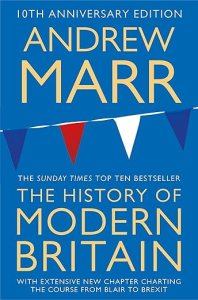
The History of Modern Britain by Andrew Marr

I’ve taken quite a long time (nearly two months) to read Andrew Marr’s The History of Modern Britain, which covers the post World War II period up to 2006, with an added introduction in the paperback edition written in 2008. This is a brief review of a very long and detailed book – too long and detailed for me to sum up meaningfully in a few paragraphs.

So, here is the blurb from the back cover:

This is an account of great political visions – and how they were defeated – and of the resilience, humour and stroppiness of the British public. From the Second World War onwards, Britain has been a country on edge: first of invasion, then of bankruptcy, then on the vulnerable front line of the Cold War, and later in the forefront of the great opening up of capital and migration now reshaping the world. This history follows all the political and economic stories, but deals too with comedy, cars, the war against homosexuals, Sixties anarchists, oil-men and punks, Margaret Thatcher’s wonderful good luck, the true heroes of British theatre, and the victory of shopping over politics.

I wanted to read this book after watching Andrew Marr’s BBC 2 series, History of Modern Britain, which was first shown in 5 episodes in 2007 –  but it was the EU Referendum that nudged me into reading it this year. Like many others, I’ve now become addicted to news and comment programmes, but my knowledge of modern history, even though, or maybe because, I’ve lived through a lot of it, is sketchy, so it was fascinating, if somewhat scary, to read about events I remembered or had half-forgotten.

It’s an obvious statement, but still true, that Britain has changed since 1945 to be almost unrecognisable today and inevitably it is still changing. This book shows how we were then and how we got to where we are today. It’s mainly a political and economic history, with short sections on social and cultural events thrown into the mix.

Despite its length and complexities it is a readable book, which doesn’t surprise me as Andrew Marr is a journalist, TV presenter and political commentator. He was born in Glasgow in 1959. He studied English at the University of Cambridge and has since enjoyed a long career in political journalism, working for the Scotsman, the Independent, the Daily Express and the Observer. From 2000 to 2005 he was the BBC’s Political Editor. He has written and presented TV documentaries on history, science and politics, and presents the weekly Andrew Marr Show on Sunday mornings on BBC1 and Start the Week on Radio 4.

  • Paperback: 672 pages
  • Publisher: Pan; Reprints edition (6 Mar. 2009)
  • Language: English
  • ISBN-10: 0330511475
  • ISBN-13: 978-0330511476
  • Source: my own copy

Reading challenges: Mount TBR Reading Challenge and Read Scotland.

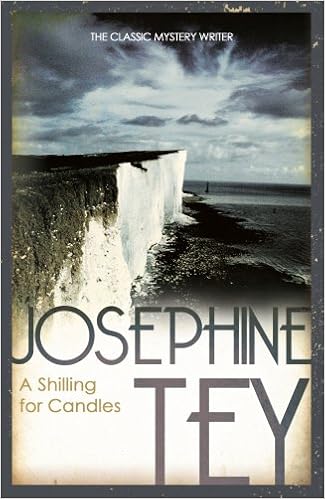
A Shilling for Candles by Josephine Tey

A Shilling for Candles, is the fourth book by Josephine Tey that I’ve read. It was first published in 1936 and is the second book in her Inspector Grant series. I enjoyed it but I have to admit that I don’t think it’s as good as the other books by her that I’ve read, namely:

  • The Daughter of Time, first published in 1951, a fascinating novel in which Inspector Alan Grant is in hospital and to keep his mind occupied he decides to discover whether Richard III really did murder his nephews – the Princes in the Tower;
  • Miss Pym Disposes, first published in 1946, a psychological study of characters and motives, in which Miss Pym investigates the death of a student at a physical training college; and
  • The Franchise Affair, first published in 1948, set in a post Second World War England reflecting the social attitudes of its time and based on a real case from the 18th century of a girl who went missing and later claimed she had been kidnapped.

Inspector Alan Grant investigates the apparent suicide of a young and beautiful film star, Christine Clay, who was found dead beneath the cliffs of the south coast. But he soon discovers that was in fact murder as a coat button was found twisted in her hair and he suspects a young man, Robin Tisdall who had been staying with Christine in a remote cottage near the beach, especially when it is revealed that she has named him as a beneficiary in her will. Tisdall has lost his coat and so the search is on to find it to prove either his innocence or guilt.

But it is not so straight forward and Grant has other suspects – Christine’s aristocratic and wealthy husband, an American songwriter, and her estranged brother to whom she had left the gift of ‘ a shilling for candles’. Then there are her friends, including the actress Marta Hart, a leading lady, Judy Sellers, who played dumb blondes and Lydia Keats, an astrologer who casts horoscopes for the movie stars.

Other characters include my favourite in the book, Erica Burgoyne, the Chief Constable’s 17 year old daughter, a quirky character who proves to be most resourceful.

I enjoyed it but thought that overall it was a bit messy, a bit all over the place, as Grant dashed about the south coast and London. It’s definitely a book of its time with several casual anti-Semitic references and Tey has used a lot of slang and idioms that aren’t so recognisable today. There are red herrings and plenty of twists and turns, all of which meant that although at first I identified the culprit, by the end I had no idea who it was. What I thought was more interesting is the way she wrote about the destructive nature of celebrity and the lengths to which the stars went to keep some privacy in their lives – not so different from today.

This book fits into several of the challenges I’m doing this year – the 20 Books of Summer, Mount TBR Reading Challenge, the Vintage Mystery Scavenger Hunt (in the category of a cover showing a body of water) and the Read Scotland Challenge, because Josephine Tey, whose real name was Elizabeth Mackintosh (1896 – 1952). She was a Scottish author who wrote mainly mystery novels.

Josephine Tey’s books:

Alan Grant
The Man in the Queue (1929) aka Killer in the Crowd
A Shilling for Candles (1936) (the basis of Hitchcock’s 1937 movie Young and Innocent)
The Franchise Affair (1948) 
To Love and Be Wise (1950)
The Daughter of Time (1951)
The Singing Sands (1952)

Novels
Kif: an Unvarnished History (1929) (writing as Gordon Daviot)
The Expensive Halo (1931)
Miss Pym Disposes (1946)
Brat Farrar (1949) aka Come and Kill Me
The Privateer (1952)
Non-Fiction

Claverhouse (1937) (writing as Gordon Daviot) A biography of John Graham of Claverhouse, 1st Viscount Dundee (1648 ‘“ 1689), known as ‘Bonnie Dundee’after leading the Jacobites to victory at the Battle of Killiecrankie in 1689, in which he lost his life.

  • Paperback: 256 pages
  • Publisher: Arrow; First Thus edition (3 Feb. 2011)
  • Language: English
  • ISBN-10: 0099556685
  • ISBN-13: 978-0099556688
  • Source: I bought my copy

Inside of Me by Hazel McHaffie

I’ve read one of Hazel McHaffie’s books in the past – Over My Dead Body and was impressed by the way she weaves facts into her fiction so seamlessly that it doesn’t detract from the story. So, when she asked if I would like to read Inside of Me I didn’t hesitate to say yes please. And I wasn’t disappointed. I think this is an excellent book and once I started reading it I didn’t want to stop, keen to find out what was going to happen next.

Hazel McHaffie’s novels all cover medical ethics issues and the issues in Inside of Me concern body image, in particular, but not exclusively, about anorexia; identity, and relationships. There is also a mystery – teenage girls are going missing, the latest one being Maria aged sixteen, last seen walking alone along Regent’s Park Canal. Tonya Grayson is worried, no terrified is a better description, that her missing husband, Victor, could be involved. But the police are convinced he is dead; his clothes were found neatly folded in a beach, although his body was never found. India, their daughter, who was eight at the time, believes, even after seven years, that he is still alive, reinforced by hearing his voice in a crowded London station, the day after Maria was reported missing.

The narrative, told in the first person, switches between Tonya and India living in Scotland, and Chris, who works in a florist shop in London, mourning the loss of a daughter. Chris, after reading the newspaper report about the missing teenager, spots Maria at a local car boot sale, offers to help and ends up taking her home, anxious about her safety.

India is anorexic, but won’t accept the truth, either that her father is dead or that she has a weight problem. Tonya tries to help her but cannot get through to her and for most of the book seems completely out of her depth, unable to move forward herself. She is plagued with doubts about Victor and his relationship with India, which had been very close. India’s best friend, Mercedes is also obsessed with her weight and encourages India both to find her father and to take even more drastic ways to gain her target weight.

Hazel McHaffie has got right inside each character’s mind, making this a compelling and convincing story. And it is a gripping story, easy to read, but by no means a comfortable read, in turns emotional and troubling. It conveys the complex dilemmas of living with eating disorders, problems with body image and difficult family relationships, issues with control and coping with emotional disturbance, obsessions and compulsive behaviour. Added to all this there is the mystery of what happened to Victor – his pile of clothes on the beach reminded me of Reginald Perrin (from the TV series  in the 1970s). I think it is a wonderful book and I don’t think I’ve read another novel like it. I’ve only touched its surface in this post!

  • Paperback: 242 pages
  • Publisher: VelvetEthics Press (5 Mar. 2016)
  • Language: English
  • ISBN-10: 099262312X
  • ISBN-13: 978-0992623128
  • Source: Review copy from the author

Hazel McHaffie is a Scottish author. For details of her background and qualifications as a nurse, midwife, PhD in Social Sciences and Research Fellow in Medical Ethics see her website, where she also lists her awards, life changing experiences, and more personal stuff such as her character traits, addictions (including good books), and hobbies. She also writes a most interesting blog.

The Sea Detective by Mark Douglas-Home

Lovereading.co.uk  sent me a copy of  The Sea Detective by Mark Douglas-Home for review in advance of the publication of the third title in the series The Malice of Waves on 19 May and I’m glad to say that I thoroughly enjoyed it.

It’s one of those books that grabbed my attention right from the start when two young teenage girls from India are sold into the sex trafficking trade, completely unaware of the dangers and terror that awaits them. Then, Edinburgh-based oceanographer, Cal McGill is caught on camera planting a rare wild flower in the garden of the Scottish Environment Minister in a campaign to make politicians aware of the dangers of climate change. Detective Inspector Ryan wants to charge him with vandalism but the minister’s wife wants to keep the plant!

From then on the story gets complicated. It’s more of an investigative story than crime fiction, with several strands to the story, but it’s so well told that I had no difficulty in following all of them: a story of unsolved mysteries both from the present day and from the Second World War, and of two Indian girls, sold into the sex trafficking trade. It’s set mainly in Scotland with a strong sense of place throughout.

The main characters are all fully rounded and complex – Cal McGill works for environmental organisations tracking oil spills using wind speeds and data on ocean currents; DI David Ryan and DC Helen Jamieson are investigating the appearance of severed feet in trainers that had been washed on shore on islands miles apart – tests had revealed that they belonged to the same body; and Basanti, one of the Indian girls, whose resourcefulness saved her life. I especially liked Helen Jamieson, the overweight policewoman, whose boss, Ryan mistakenly thinks is stupid, and the way she deals with him.

The strand that interested me most concerns Cal’s grandfather, from the (fictional) island of Eilean Iasgaich. He had died during the Second World War, washed overboard during a storm, whilst their trawler was patrolling the sea around Norway, one of seven men who had died ‘“ and yet his name had not been included in the island’s war memorial. Cal eventually discovers the truth about what actually happened and how his grandfather met his death.

It’s a gripping and emotional story. I loved it.

The Sea Detective is Mark Douglas-Home’s first book. Before writing books he was the editor of Scotland’s leading daily newspaper, The Herald, and The Sunday Times Scotland. He is the nephew of the late Sir Alec Douglas-Home who was Prime Minister of the UK from October 1963 to October 1964. He lives in Edinburgh.

I’m looking forward to reading his second book, The Woman who Walked into the Sea as well as his third, The Malice of Waves.

Reading Challenges: Read Scotland 2016 – by a Scottish author and set in Scotland.

The Legacy of Elizabeth Pringle by Kirsty Wark

I quoted an extract from the opening paragraph of The Legacy of Elizabeth Pringle by Kirsty Wark in an earlier post, whilst I was in the middle of the book. I finished reading it a few days ago and have been wondering what to write about it ever since. It’s one of those books that has received a mixed reception with some reviewers thinking it’s a well written book whereas others think it isn’t. I enjoyed it very much.

It’s a story centred on the lives of two women – Elizabeth Pringle and Martha Morrison. Elizabeth has lived all her life on the Isle of Arran and knowing that she is dying and has no living relatives, leaves her house, Holmlea in Lamlash, to Anna Morrison, a woman she had seen years before, pushing her daughter’s pram down the road outside. Anna Morrison, had fallen in love with the house and written to Elizabeth asking her to get in touch if she ever thought of selling it. But Anna is now suffering from dementia and it is her daughter, Martha who goes to Arran to see the house on her mother’s behalf.

What follows is a dual narrative moving between Elizabeth’s account in her own words of her life up to the present day and Martha’s current situation, told in the third person, as she meets the people Elizabeth knew, in particular, Saul, a Buddhist, Niall, a young man who is passionate about gardening, and Catriona his sister who runs a hotel on the island. It’s a deceptive book in that it appears that not much happens and it is gentle and leisurely paced, but it is actually packed with events, some of them dramatic and devastating in their effect on the characters’ lives. And it has a vivid sense of place and of Arran’s history, which I loved.

I much preferred Elizabeth’s story beginning when she was just four and her father went off to fight in the First World War; her relationship with her mother; her life as a teacher and her love life. I found the ending of her life very moving. Martha’s story seems rather pat, everything falls into place a bit too easily – especially her relationship with her mother and sister and the instant friendships she makes on the island.

It’s a book about family, relationships, especially mother/daughter/sister relationships, about happiness, love and heartbreak, old age, memories and the contrast between life in the early part of the twentieth century and the present. It’s strong on description, which is important to me as I like to visualise the locations – and I had no difficulty at all with that in this book.

All in all, I was captivated by this story.

Kirsty Wark is a journalist, broadcaster and writer who hosts a variety of BBC programmes. Her home has always been Scotland and her family’s connection to Arran goes back over many years.

————-

Reading Challenges: Mount TBR Reading Challenge – a book I’ve had for two years, and Read Scotland 2016 – a book by a Scottish author and set in Scotland.