Saturday Snapshot

Not very far from where we live stands Twizel Castle, high up on the hillside above the River Till. You can see it from the road glimpsed through the trees. I imagined what it was like to have lived there and wondered who had built it. It’s now in ruins, was it one of the castles that had been attacked centuries ago by the Scots, from just over the border?

Twizel Castle

One day instead of just looking as we passed it we stopped and walked up to see it properly. It’s up a steep footpath:

Footpath up to Twizel Castle

and this is what we found:

Twizel Castle

and inside, dereliction:

Twizel Castle inside

It’s amazing it’s still standing:

Twizel Castle

This castle is not what it seems. It was never lived in as it’s an 18th century castle that was never completed. It stands on the site of a medieval tower house, that was, indeed, destroyed by the Scots in 1496. It’s a Grade 2 Listed Building and is on English Heritage’s At Risk Register. For more information see Images of England and Gatehouse Gazetteer.

See more Saturday Snapshots on Alyce’s blog At Home With Books.
Saturday Snapshot: Dewars Lane

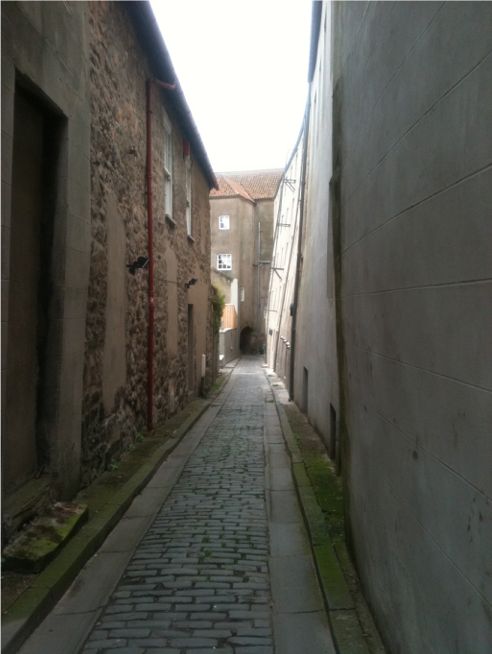
Berwick-upon-Tweed is an interesting English town near the border with Scotland, with three bridges crossing the Tweed. There are the Elizabethan Town Walls, Ramparts, Barracks, a ruined castle and quaint passageways like Dewars Lane, which dates back to medieval times. This is what it looks like today.

Dewars Lane, Berwick

The white building on the right at the end of the passageway is now a Youth Hostel, Art Gallery and Bistro. It was built in 1769 and was originally a granary. Its fantastic tilted walls are the result of a fire in 1815, after which it was propped up rather than being rebuilt. It was used for storing grain up until 1985 and was then left unoccupied, gradually becoming derelict. It has recently been restored by the Berwick Preservation Trust.

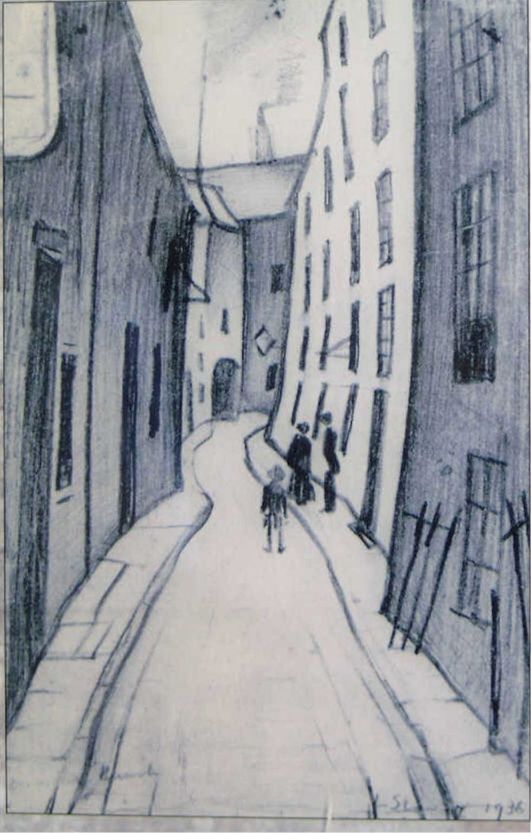
The artist L S Lowry sketched it in 1936  on one of his many visits to the town and it is now part of the town’s Lowry Trail. Below is Lowry’s pencil drawing of the Lane.

Lowry Dewars Lane

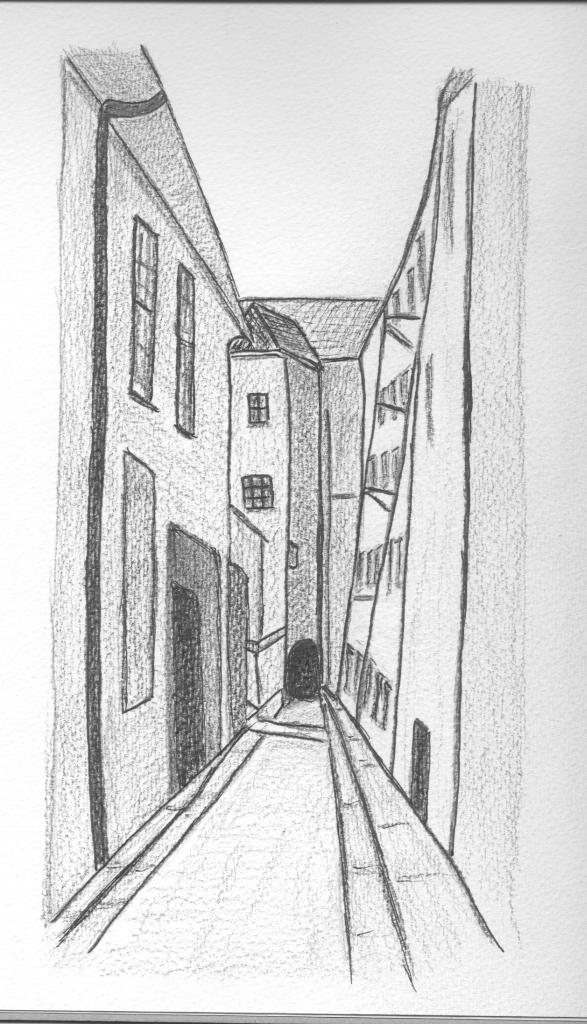
And here is my sketch:

Dewars Lane 001

See more Saturday Snapshots on Alyce’s blog At Home With Books.


Saturday Snapshot

Coldstream

Coldstream is our nearest Scottish town, the other side of the River Tweed. The view as you approach from the English side of the border is dominated by this monument that towers 70 feet above the town. It’s known as ‘Charlie‘ and was erected in 1834 as a tribute to Sir Charles Marjoribanks who was the first Liberal Member of Parliament for Berwickshire after the Reform Act of 1832. He died in 1833 at the age of 39.

'Charlie' - Sir Charles Marjoribanks

Below my photo is rather dark, just showing the silhouette of the statue as it rears up behind the houses in front and below it.

Coldstream - Marjoribanks Monument

For more Saturday Snapshots see Alyce’s blog At Home with Books.

Saturday Snapshot: Cragside Again

Following on from last Saturday’s snapshots of Cragside here are a few more photos.

There were many other visitors when we were there and it was difficult sometimes to get a good photo and I had to be quick before someone moved in front of my camera. So, some of my photos are a bit out of focus and rather dark. (It’s amazing that you can take photos in National Trust properties – in the past it was strictly forbidden. I asked one of the room stewards why they allowed them now and he explained that because you can take photos on mobile phones it was impossible to stop people. It’s good to take your own photos, but actually there are much better ones than mine in the guidebook.)

The first room we saw was the kitchen. As you can see the area is fenced off. It’s not very big but there are also sculleries and larder and cellar storage beneath the kitchen, with a ‘dumb waiter’ to carry food and equipment up and down. The Butler, Housekeeper and Cook each had their own areas.

In the next photo you can see the spits with joints of meat in front of the range.

There is a dishwasher. Rather primitive compared to the modern models this dishwasher has wire compartments for crockery, a motor turned it whilst hot soapy water was squirted into it from a boiler. This had been invented in 1886 by a wealthy American, Josephine Cochrane whose servants had chipped her fine china.

None of the rooms at Cragside are very large, apart from the Drawing Room, and I could imagine being comfortable in most of them, such as the Dining Room. It has a lovely inglenook fireplace with stained glass windows designed by William Morris.

The windows either side represent the Four Seasons. the photo below shows two of the windows – Spring and Summer.

I still have more photos, but these are enough for one post. (Click the photos to see a larger view.)

Cragside is open to visitors from today. I  would really like to go there again this year, there is so much I didn’t take in and I only had a brief look at the grounds.

See more Saturday Snapshots on Alyce’s blog At Home With Books.
Saturday Snapshot

My photos this week are a few of Cragside in Northumberland, now owned by the National Trust. It was built in 1863, with further extensions over the next 15 or so years, by William Armstrong, who later became Lord Armstrong. Armstrong was a remarkable man – a scientist, an innovator and a successful industrialist.

We visited it last year. Here is the view of the house approaching from the public car park:

and the view from the gardens:

It has to be one of my favourite National Trust properties and it’s a very popular house with everyone else too – the place was packed when we were there last April. There is so much to see inside the house, too much for one post. The house was very modern for its times, with all the latest and advanced technical devices of the day.

One of my favourite rooms is the Library, with its  stained glass windows, comfy chairs, leather sofas and the latest lighting available. This was the first room in the world to be lit by hydro-electricity.

The light suspended from the ceiling has four bulbs within the ornate and fringed light shade. I tried very hard to get a photo without any of the other visitors, but gave up when there was just one person looking out of the window – anyway he gives scale to the room.

There are four more bulbs around the room, place in globes, sitting on vases:

The books are in oak bookcases around the room:

Note the library steps at the left-hand side of the photo.

Click on the photos to enlarge them.

At a later date I might post more photos – of the kitchen with its dishwasher, the lovely dining room with its William Morris stained glass windows and of the amazing Gallery, with its collection of paintings and sculptures. As for the Drawing Room, this was not to my taste at all with its huge marble chimney piece.

See more Saturday Snapshots on Alyce’s blog At Home With Books.

Saturday Snapshots

A few years ago we had a holiday in the Cotswolds and visited Burford in Oxfordshire. We had  welcome cup of tea and cakes in The Copper Kettle on the High Street.

This is the view looking down the High Street.

The building dates back to around 1500.

See more Saturday Snapshots on Alyce’s blog, At Home With Books.