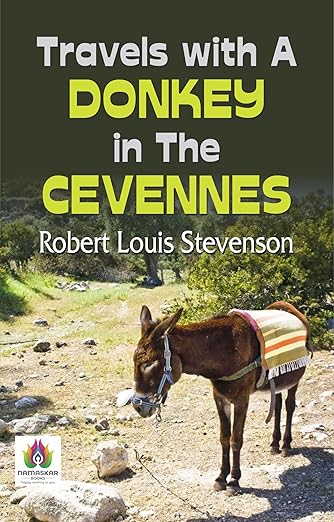
Travels with a Donkey in the Cévennes by Robert Louis Stevenson – Short Nonfiction

Travels with a Donkey in the Cévennes: A Journey of Solitude and Reflection  by Robert Louis Stevenson, first published 1879

Namaskar Books| 2022| 124 pages| e-book| my own copy| 4*

The wild Cévennes region of France forms the backdrop for the pioneering travelogue Travels with a Donkey, written by a young Robert Louis Stevenson. Ever hopeful of encountering the adventure he yearned for and raising much needed finance at the start of his writing career, Stevenson embarked on the 120-mile, 12-day trek and recorded his experiences in this journal. His only companion for the trip was a predictably stubborn donkey called Modestine. Travels with a Donkey gives the reader a rare glimpse of the character of the author, and the journalistic and often comical style of writing is in refreshing contrast to Stevenson’s more famous works. (Goodreads)

This is a short nonfiction book, just right for both Nonfiction November and Novellas in November. It’s a book I’ve had since 2011 and I’m glad to say that it was well worth the wait. I enjoyed it on several levels, as travel writing, history of the Cévennes region, descriptive writing of the French countryside in 1878, observations of the local people and Stevenson’s thoughts on religion.

He began his journey through the Cévennes, a range of mountains in south-central France, at Le Monastier, a highland valley fifteen miles from Le Puy, where he spent a month preparing for his excursion southward to Alais (modern name, Alès) a distance of 120 miles.

I was struck by what he took with him – a sleeping sack, because he didn’t intend to rely on the hospitality of a village inn, and a tent was troublesome to pitch and then strike. Whereas, a sleeping sack was always ready to get into. His was extraordinary, made of green waterproof cart-cloth lined with blue ‘sheep’s fur’, nearly six feet square plus two triangular flaps to make a pillow at night and the top and bottom of the sack by day. It was a huge sort of long roll or sausage, large enough for two at a pinch. And that was why he bought a donkey from an old man. He called her Modestine because she was

a diminutive she-ass, not much bigger than a dog, the colour of a mouse, with a kindly eye and a determined under-jaw. There was something neat and high-bred, a quakerish elegance, about the rogue that hit my fancy on the spot.

But he soon discovered that unless he beat Modestine with a staff, which he didn’t want to do; it sickened him – and me too. He had to let her go at her own pace and patiently follow her and there were times when she just stopped and wouldn’t go any further. This was extremely slow and in the end he resorted to a goad, which was a plain wand with an eighth of an inch of pin which worked wonders on poor Modestine, who carried most of his equipment.

As well as his clothing, he also took his travelling wear of country velveteen, pilot coat and knitted spencer (a short waist-length, double-breasted, man’s jacket, originally named after George Spencer, 2nd Earl Spencer), some books, a railway rug, food, and a variety of other things including a revolver, a spirit lamp, lantern, candles, a jack-knife and large leather flask, a bottle of Beaujolais, a leg of cold mutton and a considerable quantity of black bread and white for himself and the donkey and of all things an eggbeater, which he later abandoned. He wasn’t travelling light!

The book is full of Stevenson’s descriptions of the countryside, such as this one of the landscape as he approached the Trappist Monastery of Our Lady of Sorrows:

The sun had come out as I left the shelter of a pine-wood, and I beheld suddenly a fine wild landscape to the south. High rocky hills, as blue as sapphires, closed the view, and between these lay ridge upon ridge, heathery, craggy, the sun glittering on veins of rock, the underwood clambering in the hollows, as rude as God made them at first.

Modestine had to stop at St Jean du Gard, as she just couldn’t travel any further and needed to rest. He sold her and continued on to Alais by diligence (a public stagecoach). He missed her after she was gone.

For twelve days we were fast companions; we had travelled upwards of a hundred and twelve miles, crossed several respectable ridges, and jogged along with our six legs by many a rocky and many a boggy road. After the first day, although sometimes I was hurt and distant in manner, I still kept my patience; and as for her, poor soul! she had come to regard me as a god. She loved to eat out of my hand. She was patient, elegant in form, the colour of an ideal mouse, and inimitably small.

And he wept!

I was rather surprised by how much I enjoyed this book, mainly because I didn’t know anything about it other than its title and thought it was perhaps fiction. Of course it isn’t and it’s full of detail of his hike that I haven’t mentioned in this review. I shouldn’t have been surprised as I’ve enjoyed other books by Stevenson – Treasure Island, Kidnapped and Catriona.

I read in Wikipedia that Stevenson’s purpose in making his journey ‘was designed to provide material for publication while allowing him to distance himself from a love affair with an American woman of which his friends and family did not approve and who had returned to her husband in California’, but without giving a source for this information. In his book Stevenson does say when talking to a monk he met at the Trappist Monastery that he was not a pedlar (as the monk thought), but a ‘literary man, who drew landscapes and was going to write a book’.


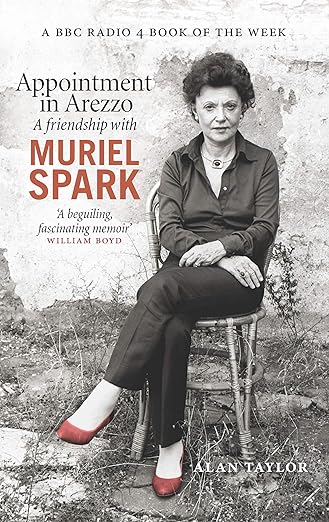
Appointment in Arezzo by Alan Taylor – Short Nonfiction

Appointment in Arezzo: A friendship with Muriel Spark by Alan Taylor

Polygon| 2017| 169| e-book| My own copy| 5*

Description:

This book is an intimate, fond and funny memoir of one of the greatest novelists of the last century. This colourful, personal, anecdotal, indiscreet and admiring memoir charts the course of Muriel Spark’s life revealing her as she really was. Once, she commented sitting over a glass of chianti at the kitchen table, that she was upset that the academic whom she had appointed her official biographer did not appear to think that she had ever cracked a joke in her life.

Alan Taylor here sets the record straight about this and many other things. With sources ranging from notebooks kept from his very first encounter with Muriel and the hundreds of letters they exchanged over the years, this is an invaluable portrait of one of Edinburgh’s premiere novelists. The book was published to celebrate the 100th anniversary of Muriel’s birth in 2018.

My thoughts:

This is a short nonfiction book of 169 pages on Kindle, so it’s just right for both Nonfiction November and Novellas in November. It’s a book I’ve had for a few years after a friend recommended it to me. I didn’t read it straight away because at the time the only book by Muriel Sparks I’d read was The Prime of Miss Jean Brodie, which I loved. Since then I’ve read Loitering with Intent, (review to follow in due course), so I thought it was time I read Appointment in Arezzo.

Muriel Spark was born on 1 February 1918, in Edinburgh, the daughter of Bertie Camberg, a Jew who was born in Scotland and her mother, Sarah who was English and an Anglican. Alan Taylor touches on her early life and teenage years in Edinburgh in a middle -class enclave , where she attended James Gillespie’s High School for Girls – immortalised as Marcia Blaine School in The Prime of Miss Jean Brodie.

In July 1990 Alan Taylor first met Muriel Spark and her friend Penelope – Penny – Jardine in a hotel in Arezzo for dinner. The two women had shared a rambling house deep in the Val di Chiana 15 kilometres from Arezzo in Tuscany for twenty years. Penny is a sculptor who has exhibited at the Royal Academy in London; she supplied the domestic and business circumstances which allowed Muriel to flourish. Alan Taylor, a former deputy editor of The Scotsman and the founder-editor of the Scottish Review of Books, was there to interview her on the publication of her novel Symposium (1990). Their meeting led to a friendship and since then they met frequently during the last fifteen years of her life. She died at her home in Tuscany in April 2006 and is buried in the cemetery of Sant’Andrea Apostolo in Oliveto.

Following that first meeting, over the next fifteen years they met many times, when Taylor visited her in Tuscany, New York, London, Prague and finally in 2004 in Scotland and Edinburgh as well as exchanging many letters and telephone conversations. Taylor outlined details of her brief marriage in 1937 to Sidney Oswald Spark, which only lasted until 1940 when they separated, and about her son, Robin and their disagreement over her Jewishness. Robin believed that one must be either a Jew or a Gentile, whereas Muriel believed:

It was impossible ‘to separate’ the Jewess within her from the Gentile. In her mind, the two coexisted in harmony’ ‘uncomplainingly amongst one’s own bones’. Was she a Gentile? Or a Jewess? ‘Both and neither. What am I? I am what I am.

But Robin couldn’t cope with such ambiguity; he wanted certainty – in his mind one must be either Jew or Gentile. Their beliefs were irreconcilable. The full details are in Chapter 6, A Question of Jewishness.

Amongst many other topics they talked about her writing:

Fleur in Loitering with Intent spoke for her when she said: ‘I’ve come to learn for myself how little one needs, in the art of writing, to convey the lot, and how a lot of words, on the other hand, can convey so little. (page 17)

She had no idea when writing a book how it might turn out. Its theme built of itself and if it did not develop, it ramified. I wanted to know what she saw as her achievement, her legacy. ‘I have realised myself, ‘ she replied. ‘I have expressed something I brought into the world with me. I have liberated the novel in many ways, shown how anything whatever can be narrated, any experience set down, including sheer damn cheek. I think I have opened doors and windows in mind, and challenged fears – especially the most inhibiting fears about what a novel should be. (pages 98-99)

In a very real sense Muriel’s life is to be found in her work. She always said that if anyone wanted to know about the person behind the prose and poems they had only to read them closely and imaginatively. She is there, in the times and places and characters, in the choice of words and the construction of sentences, in the tone of voice, above all in the philosophy of existence. (pages 141-142)

There is so much more in this book. It is a fascinating insight into her life, and what she thought about writing, as well as reflecting on her books, as well as much more. I’ve really only touched the surface of this very readable book and I finished it knowing a lot more about Muriel Spark and her books – and keen to read more of them. And it’s illustrated with many photographs making it a warm, personal and affectionate account.

The Yellow Dog by Georges Simenon

The Maigret books are also a good choice for Novellas in November, they’re all under 200 pages. I’ve been a Maigret fan for a long time, ever since I was in my teens, watching the TV series with Rupert Davies in the title role. And I’ve been reading the Maigret series as I’ve come across the books in libraries, bookshops, and more recently as e-books, so not in the order they were originally published.

Penguin| 2014| 164 pages| My own copy| 3*

This is a short review because, once more I’m behind with writing reviews. The Yellow Dog is the 5th book in the new Penguin Maigret series, translated by Linda Asher. It was first published in 1931 and also published in a previous translation as A Face for a Clue. It’s a tale of small town suspicion and revenge.

In the windswept seaside town of Concarneau, a local wine merchant is shot. In fact, someone is out to kill all the influential men and the entire town is soon sent into a state of panic. For Maigret, the answers lie with the pale, downtrodden waitress Emma, and a strange yellow dog lurking in the shadows…

It’s only 134 pages but with a slow start it did seem longer than that. It begins with the shooting of Monsieur Mostaguen, a local wine merchant, followed by the appearance of the yellow dog, a big, snarling yellow animal, and then an attempt at poisoning for Maigret to investigate. I wondered what the significance of the yellow dog was and who it belonged to; no one seems to know. The locals had never seen it before and they all viewed it with fear and suspicion. I’ve read some of the earlier Maigret and have noted before that I’ve been confused and baffled, with little idea of what was going on and it was just the same with this book. Maigret doesn’t seem to be very concerned about the man who was shot and seriously injured, nor about the attempted poisoning until there’s a murder and another man disappears. He walks around the town, observing but not actively investigating.

Simenon is good at conveying atmosphere and skilled at setting the scene and drawing convincing characters in a few paragraphs.  As the book begins there’s a south-westerly gale slamming the boats together in the harbour in Concarneau and the wind surges through the streets. Contrast the weather at the beginning of the book with the change by the time Maigret is getting close to clearing up the mystery – the weather turned fine, with a vibrant blue sky, the sea sparkled, and ‘the Old Town’s walls, so gloomy in the rain, turn a joyful, dazzling white.

I don’t think this is one of the best Maigret book, but it is puzzling with Maigret keeping his thoughts to himself until the end of the book, when like Agatha Christie’s Hercule Poirot, he explains it all.

The Christmas Book Hunt by Jenny Colgan

Summary from Amazon:

A heartwarming meet-cute short story from the Sunday Times bestselling author of The Christmas Bookshop. A Christmas mission…

Mirren’s beloved great-aunt Violet is seriously ill. Her one Christmas wish is to be reunited with a long-lost hand-illustrated book from her childhood, a challenge Mirren gladly accepts to give Violet some much-needed festive cheer.

An enchanting journey…

With no sign of the cherished volume online, Mirren falls into the fascinating world of rare books. From London to snowy Hay-on-Wye and Edinburgh’s cobbled streets, she chases leads from bookshop to bookshop—and bumps into mysterious, charming Theo, who, unbeknownst to her, is searching for the same book for reasons of his own…

The start of a new chapter?

As the two join forces to track the book down before time runs out for Violet, will Mirren find her Christmas miracle—and maybe even a kiss under the mistletoe… ?

I normally don’t choose to read romantic stories, and I’m not a fan of short stories but The Christmas Book Hunt by Jenny Colgan sounded interesting because of the book connection. Although it’s described as a short story, at over 100 pages I think it is really a novella. It looked at first as though I was going to find it too cutesy but once the story got going I began to enjoy it. Mirren is looking for a copy of A Child’s Garden of Verses by Robert Louis Stevenson, a particular one that had belonged to her Great Aunt Violet. It was a special edition, with hand-drawn plates by Aubrey Beardsley and now Great Aunt Violet, who is in hospital seriously ill would love to see the book for Christmas. I loved that book as a child, so this is what made the story irresistible for me. It’s easy reading and I read it quickly.

I also liked the story of Mirren’s search in various bookshops in various places in England and Scotland trying to track down what had happened to that particular version of the book. She went to the book town Hay-on-Wye, bookshops in Edinburgh and a secondhand bookshop in Northumberland that sounds very like Barter Books in Alnwick, my favourite bookshop. I was not so keen on the romance element as the relationship develops between Mirren and Theo, who is not the person he appears to be. There are one or two coincidences that cropped up towards the end of the book that I thought were rather remarkable and conveniently tied up all the ends. But overall it was the book element that I found most satisfying.

The Bunner Sisters by Edith Wharton, a Novella

Rating: 3 out of 5.

This has been on my TBR list for several years, so I thought it was about time I read it. It was written in 1898, but not published until 1916, one of the short stories in Xingu and Other Stories, set in a working class neighbourhood in New York.

In the days when New York’s traffic moved at the pace of the drooping horse-car, when society applauded Christine Nilsson at the Academy of music and basked in the sunsets of the Hudson River School on the walls of the National Academy of Design, an inconspicuous shop with a single show-window was intimately and favourably known to the feminine population of the quarter bordering on Stuyvesant Square.

It was a very small shop in a shabby basement, in a side-street already doomed to decline; and from the miscellaneous display behind the window-pane and the brevity of the sign surmounting it (merely ‘Bunner Sisters’ in blotchy gold on a black background) it would have been difficult for the uninitiated to guess the precise nature of the business carried on within. (page 1)

As the title indicates it’s about two sisters, Ann Eliza the elder, and Evelina the younger, who have a small shop selling artificial flowers and small handsewn articles. The sisters, both unmarried, have fallen on hard times.They meet Herbert Ramy, a German immigrant who also has a small shop, when Ann Eliza buys a clock from him as a birthday present for Evalina.

This is a sad tale, very readable and very descriptive. The characters are memorable, well drawn and are clearly distinguishable. Their lives are mainly filled with daily routine. But there’s a growing sense of foreboding and mystery, especially surrounding Ramy. As he gradually becomes an important part of their lives, the sadness becomes overwhelming, eventually turning into tragedy.

Asking for the Moon by Reginald Hill

Asking for the Moon is described on the cover as a Dalziel and Pascoe novel, but it is actually a collection of four novellas. According to Wikipedia the collection was first published in 1996 in hardback by HarperCollins.

The first story is The Last National Service Man which tells how Dalziel and Pascoe first met. Neither of them are impressed by the other. Dalziel thinks Pascoe is everything he dislikes – a graduate, well spoken, and a Southerner from south of Sheffield. Pascoe thinks Dalziel is an archetypical bruiser who got results by kicking down doors and beating out questions in Morse code on a suspect’s head. When Dalziel and Pascoe are kidnapped by a madman with a serious and justifiable grudge against the Superintendent they need to get over their differences and work together to escape their jailer.

The next two stories both feature ‘ghosts’ – Pascoe’s Ghost and then Dalziel’s Ghost (both first published in 1979 in another collection of short stories). In Pascoe’s Ghost a man whose wife has been missing for a year gets some strange phone calls—as well as a visit from Detective Inspector Pascoe—in a novella that pays homage to Edgar Allan Poe, with each chapter headed with a quotation from Poe’s poetical works. This is the longest story and reminded me of Agatha Christie’s Golden Age Mysteries as Pascoe interviews the suspects in the library.

Dalziel’s Ghost is a brief and rather odd story in which the two detectives keep a nightly vigil in Sandstone Rigg farmhouse, an isolated house that had been renovated, apparently disturbing a ghost. In Dalziel’s experience there are three main causes of ghosts – ‘One: bad cooking. Two: bad ventilation and Three – bad conscience.’ Things aren’t what they seem and Dalziel is once again his devious self. But I think this one is the least convincing of the four stories.

One Small Step, was originally published in 1990 by Collins Crime Club.The story is set in 2010, when a French astronaut, one of an international space team from the Federated States of Europe, became the first man to be murdered on the moon. Retired Detective-Superintendent Andrew Dalziel, suffering from gout and Peter Pascoe, now Commissioner of Eurofed Justice are called upon to investigate – on board the space ship. In his Foreword I gather that Hill wrote this to celebrate the twenty years he’d been writing the Dalziel and Pascoe novels.

I think the best story in the book is the first one, The Last National Service Man.

If you haven’t read any of the Dalziel and Pascoe novels, don’t start with this one. It’s not the best, but still an enjoyable 3* book for me.