The Steel Bonnets: the opening chapter

A friend has just lent me The Steel Bonnets : the Story of the Anglo-Scottish Border Reivers by George MacDonald Fraser and having looked at the opening chapter I know I just have to read on, rather than waiting for January when Peggy Ann’s Read Scotland 2014 Challenge starts. It’s a long, detailed book so I shall probably still be reading it in January anyway.

The Steel Bonnets 001I live on the English side of the Border with Scotland and the history of the area just fascinates me. The Steel Bonnets covers the period from the building of Hadrian’s Wall to 1603, when James VI of Scotland became James I of England. Four hundred or so years ago it was all very different around here and as the history of the Border Reivers is very complicated I’m hoping this book will guide me through it.

The opening paragraph took me by surprise:

At one moment when President Richard Nixon was taking part in his inauguration ceremony, he appeared flanked by Lyndon Johnson and Billy Graham. To anyone familiar with Border history it was one of those historical coincidences which send a little shudder through the mind: in that moment, thousands of miles and centuries away in time away from the Debateable Land, the threads came together again; the descendants of three notable Anglo-Scottish Border tribes – families who lived and fought within a few miles of each other on the West Marches in Queen Elizabeth’s time – were standing side by side, and it took very little effort of the imagination to replace the custom-made suits with leather jacks or backs-and-breasts. Only a political commentator would be tactless enough to pursue the resemblance to Border reivers beyond the physical, but there the similarity is strong.

In the following paragraphs he goes on to describe their physical features, particularly those of Nixon and Johnson, as ‘excellent specimens of two distinct but common Border types.’ I hadn’t expected this at all.

For more Book Beginnings see Gilion’s blog Rose City Reader.

Gone With the Wind: Historical Fiction

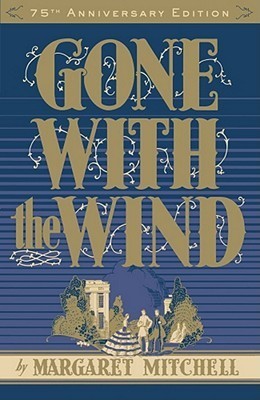
Gone With the Wind

In a previous post on Gone With the Wind I wrote that I had learned a lot about the American Civil War and Reconstruction, about slavery (very different from Uncle Tom’s Cabin) and a lot about Georgia and Atlanta. In the comments Jane pointed out, quite correctly, that the book ‘shouldn’t be taken as history, but as reflective of a very strong point-of-view of American history, circa 1930.’

I hadn’t meant that I was taking GWTW as historical fact, but that it had led me to wanting to know more about the period and in that respect it had opened up new areas for me. For example, I’d never heard of ‘Reconstruction’ before in the sense of what happened to the southern states following the Civil War and I knew next to nothing about the causes of the war, other than the fact that the southern states wanted to leave the Union, that they wanted to be an independent nation. I was in no doubt, however, that the book is a novel – historical fiction, not historical fact.

All written history is a selection of facts and involves to a greater or lesser extent an interpretation of those facts. Its accuracy depends on the sources used, and in turn those sources inevitably are subject to perspective and bias. Similarly, historical fiction can throw light on the past; it can flesh out the facts, bringing the past to life – and it can be subject to the bias and opinions of the author.

I was fascinated to read that Margaret Mitchell, who was born in Atlanta in 1900 grew up listening to the war stories of Confederate veterans and yet she didn’t know until she was ten years old that the South had lost the war!

Margaret Mitchell was writing from a Southerner’s perspective, but that does not mean that her book is any the less invalid. She presents the Civil War period and its aftermath as seen through southern eyes and basically it is the story as seen through the women’s eyes. There is little about the actual battles, but this is still a war novel, even though it’s set mostly in the homes of the characters – in Tara, and in Atlanta. It depicts the hardships and suffering of the civilian population as well as the wounded soldiers, their grief and desolation and the devastating effect on the land and townships. You can see Atlanta going up in flames, the devastation of the countryside as the railroads and plantations were destroyed, and feel the hunger as the people starved.

Then there is the question of slavery and the Ku Klux Klan, both essential elements in the novel. The depiction of slaves divides them into two categories – house slaves and field hands, raising racial issues and the different attitudes between the North and the South towards the slaves. The plantation owners are portrayed as viewing their slaves, in particular the house slaves, as part of their family, protecting them and caring for them, treating them as children and of lower intelligence, and the slaves responded with loyalty to their owners. Again this is one perspective on the past, one that is at variance that of the northern states – clearly indicated in the novel. There are several references in Gone With the Wind to Uncle Tom’s Cabin in which Margaret Mitchell contradicts Harriet Beecher Stowe’s scene of bloodhounds chasing runaway slaves. Similarly the view she gives of the Ku Klux Clan is not what I expected. This led me to want to know more about the history of slavery in America and I turned to the one book I own, specifically on American history – Out of Our Past: The Forces that Shaped Modern America by Carl N Degler to find out more.

This is one of the things  I like about reading historical fiction – as well as giving me a glimpse into the past, showing me areas of history I know little or nothing about, bearing in mind that there is always more than one side to a story. And I really need to do more research into these matters.

First Chapter: Shakespeare the Biography by Peter Ackroyd

First chapterEvery Tuesday Diane at Bibliophile by the Sea hosts First Chapter First Paragraph Tuesday Intros, where you can share the first paragraph or (a few) of a book you are reading or thinking about reading soon.

In my last post I mentioned Peter Ackroyd’s biography of William Shakespeare when deciding which book to read next. As soon as I began the first chapter I knew that this is the next non fiction book I’ll be reading.
The first paragraph is:

William Shakespeare is popularly supposed to have been born on 23 April 1564, or St George’s Day. The date may in fact have been 21 April or 22 April, but the coincidence of the national festival is at least appropriate.

But it is the second paragraph that caught my attention, after all Shakespeare’s birthday or supposed birthday was not a surprise to me. The second paragraph, however, gives me information I hadn’t known before:

When he emerged from the womb into the world of time, with the assistance of a midwife, an infant of the sixteenth century was washed and then ‘swaddled’ by being wrapped tightly in soft cloth. Then he was carried downstairs in order to be presented to the father. After this ritual greeting, he was taken back to the birth-chamber, still warm and dark where he was lain beside the mother. She was meant to ‘draw to her all the diseases from the child’, before her infant was put in a cradle. A small portion of butter and honey was usually placed in the baby’s mouth. It was the custom in Warwickshire to give the suckling child hare’s brains reduced to jelly. ( page 3)

Ackroyd is not of course saying that this is what happened when Shakespeare was born, merely that this was the ritual at the time and he refers to David Cressy’s book, Birth, Marriage, and Death: Ritual, Religion, and the Life Cycle in Tudor and Stuart England as the source of his information. But it is fascinating, nonetheless to think of the infant William wrapped in swaddling clothes and sucking hare’s brain jelly! Butter and honey sounds far more delectable. And how different from birth today.

Sunday Selection: Choosing the next book to read

Yesterday I finished reading both Instructions for a Heatwave by Maggie O’Farrell and Julius by Daphne Du Maurier, leaving me with no books on the go. This morning I started to read The Midwich Cuckoos by John Wyndham, but I like to read more than one book at a time of different genres so that I don’t get them mixed up in my mind, preferably with one non-fiction book.

I think I’ll read a biography or an autobiography.

There was a programme on TV last night about D H Lawrence, a Culture Show Special, which reminded me that I haven’t read his biography yet which I bought a few years ago when we visited the house in Eastwood where he was born. It’s D H Lawrence: the Life of an Outsider by John Worthen who was one of the contributors to the programme. I got the book off the shelf and immediately saw why I haven’t read it yet – it’s in such a small font, with quotations in an even smaller font – not good for my eyes. It’s a pity I don’t have it on Kindle but maybe I’ll give it a go, definitely a book to read in daylight. And as I have just one of D H Lawrence’s books that I haven’t read yet – St Mawr – I may read that. It’s a novella, so it won’t take me long.
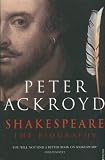
Anther book I’ve been meaning to read before now is Peter Ackroyd’s Shakespeare:the Biography. The Classics Club is running a new project next year Twelve Months of Classic Literature with different topics for each month and January’s topic is William Shakespeare.  I think Ackroyd’s book would be a good choice for this project. It’s described on the book jacket as
 … neither an academic description, nor a didactic analysis. Written with intuition and imagination unique to Peter Ackroyd, a book by a writer about a writer, brilliant and straightforward, it vividly presents the reader with the circumstances of Shakespeare’s life and art.

It sounds just right. I think I’ll begin with this book.

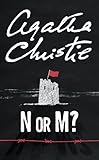
That leaves me with choosing a crime fiction book and I have quite a lot of those to choose from. I haven’t read an Agatha Christie this month so I’m going to choose one of hers or some of her short stories (I have several collections still unread). I think I’ll read the oldest I have, which is N or M? a Tommy and Tuppence war time mystery, first published in 1941. I have a feeling this will be better than the last Tommy and Tuppence book I read, Postern of Fate, which was Agatha Christie’s last novel and not one of her best.

Library Loot

Library LootLibrary Loot is a weekly event co-hosted by Claire from The Captive Reader and Marg from The Adventures of an Intrepid Reader that encourages bloggers to share the books they’ve checked out from the library. To participate, just write up your post and link it using the Mr. Linky any time during the week. And of course check out what other participants are getting from their libraries.

It’s been a while since I did a Library Loot post and as I’ve got quite a pile of books out right now I thought I’d do one today.

Libr Loot Oct 13

There are three books I have on loan that I’m thinking of taking back to the library without finishing reading, all of which I’ve renewed a few times – Dominion by C J Sansom, The Assassin’s Prayer by Ariana Franklin and The Idea of Perfection by Kate Grenville. It’s a shame because I’ve enjoyed other books by these authors, but each time I start reading these books I lose interest and put them down and am in no hurry to pick them up again. Of course, it could just be that it’s not the right time for me to read these books.

I have actually got up to page 154 in The Assassin’s Prayer, which has 414 pages and maybe it’s just me at the moment but it seems so boring, with Adelia, Henry II’s anatomist accompanying his daughter to Sicily, lusting after Bishop Rowley and once more regretting refusing to marry him.

I haven’t read much of Dominion, but have gone off the idea of reading an alternative history of what could have happened if Britain had made peace with Germany in 1940. Similarly with The Idea of Perfection, the beginning chapters are just not interesting me – too much about bridges. It may be the large print edition that’s putting me off too.

I have finished Elly Griffith’s Dying Fall which I enjoyed despite its being written in the present tense. It’s the fifth of her Ruth Galloway books. In this book Ruth travels from her home in Norfolk up to the north of England – Lancashire, to be precise Blackpool, Lytham, Pendle, Preston and Fleetwood – because Dan Golding a friend from university has died in a house fire. He had written to her just before his death with news of an amazing find. It turns out that Dan was murdered and Ruth and Inspector Harry Nelson are instrumental in discovering the truth. It’s yet another book I’ve read about the whereabouts of King Arthur’s Bones – this time it seems he’s the Raven King. A satisfying if undemanding read.

Then there are the books I haven’t started yet, although I have dipped into them. They are:

In the Woods by Tana French – a while back book bloggers were writing enthusiastically about this book, so when I saw it on the shelf I thought I’d see if I like it too. It’s a psychological thriller, so I hope it’s not too scary!

Two Cornish mysteries by Carola Dunn – Manna from Hades and Valley of the Shadow, Cornish village murder mysteries, featuring Eleanor Trewynn recently widowed who runs a charity shop from the ground floor of her house. They’re set in Port Mabyn a fictional village sometime in the 1960s and 70s. I’ve read and enjoyed a few of the Daisy Dalrymple books set in the 1920s, so I’m hoping these will be good too.

Brideshead Revisited by Evelyn Waugh, described on the jacket as Waugh’s most celebrated novel mourning the passing of the aristocratic world Waugh knew in his youth. I missed this when it was serialised on TV and I’ve not seen the film either, so I thought I should read this.

And last but not least a non-fiction book –  Britain’s Last Frontier: a Journey along the Highland Line by Alistair Moffat. The Highland Line marks the furthest north the Romans advanced, dividing the country geologically and culturally, marking the border between Highland and Lowland, Celtic and English-speaking, crofting and farming. This won’t be a quick read as it includes history, myth and anecdote as Moffat makes a journey both in imagination and geographically tracing the route of the Line.  I hope I’ll be able to renew this book.

Saturday Snapshot – Flodden

It’s the 500th anniversary of the Battle of Flodden this year – it was on 9th September 1513 that the armies of England and Scotland met at Flodden Field, near Branxton in Northumberland. There have been events this year to commemorate the battle and the men from both nations who died in this last medieval battle between England and Scotland.

Living not far from the site of the battle this week we went to see what had changed as a result of the anniversary. There’s now a surfaced path leading up to the Monument.

(Click on the photos to see them enlarged)

500th anniversary P1010826

There are some more information boards and signs to guide you round the Battlefield Trail:

Battlefield trail signpost P1010837The monument isn’t actually on the site of the battle but stands on Piper’s Hill.

Flodden MonumentFrom the monument you can look towards the north down on the village of Branxton:

Branxton P1010831The two armies lined up south of the monument with a marshy dip between them. The Scots advanced first, unaware of the of the ground conditions below them. Now it’s a ditch but in 1513 there was a brook surrounded by a reeded quagmire downhill – where the Scots were bogged down, the rear ranks pushing forward into the front ranks, crushing the fallen bodies and causing chaos. They were then easy prey for the deadly English billhooks.

It looks like this now – the ditch between the hedge and fence is now nearly dry, after weeks of rain in 1513 it was a quagmire:

Boggy Ground P1010835

 and the two armies came face to face:

Tthe Killing Fields P1010858

Flodden 1513: Scotland’s Greatest Defeat by John Sadler is an excellent account of the strategies and tactics of both armies, with maps and plans showing how the battle began and a time timeline of the various conflicts giving a detailed account of events.

Having read this book and the information boards around the trail I was able to visualise the battle, even on a peaceful weekday afternoon 500 years later. The Scottish troops had moved from their original position on Flodden Edge as the English approached the battlefield, putting them at a disadvantage. The outcome could have been different if they had seen the dip below them as they charged down the hill – or even if the English had attacked first.

But then, the battle needn’t have taken place at all if James IV of Scotland had not invaded England in an attempt to divert English troops from their fight against the French. Indeed he had entered into a Treaty of Perpetual Peace with England in 1502. But in 1512 he had also renewed the Auld Alliance with the French, putting him in the position of either declaring for France against Henry VIII (James’s brother-in-law) or remaining neutral, which would make him vulnerable to any further English expansion, as Henry had revived his claim to the Scottish throne.

Despite pressure from senior members of his council to avoid an outright breach with England, when Henry arrived in Calais preparing to wage war against the French, James decided to go to war against the English. Prior to the battle at Flodden he had crossed the River Tweed into England where he then attacked and captured Norham Castle, and then destroyed both Etal and Ford Castles whilst the English were still mustering their troops. But the outcome was a disaster for Scotland and James was killed on Flodden Field:

The king’s was but one of many hundreds of bodies, sprawled and piled on the bloodied turf. The whole hillside from the brook northwards was a killing ground, the dead, maimed and horribly injured competing for space, severed limbs and streaming entrails spilling fresh gore. The din would have been terrific, with hoarse shouts and the screams of the dying men, the crash of spears, a crescendo rising and spilling like breakers against the shore. (page 82, Flodden 1513 by John Sadler)

Each time I go to Branxton, or see the monument as we drive south along the A697, I think about the battle and all those who died there in 1513.

For more Saturday Snapshots see Melinda’s blog West Metro Mommy Reads.