The English by Jeremy Paxman

The English: a Portrait of a People by Jeremy Paxman (an English journalist, broadcaster and author) is a very interesting book, described as:

A book on what constitutes Englishness, and what are considered the essential characteristics and values. Using literary sources and interviews, Jeremy Paxman attempts to define how “Englishness” has changed over this century, and what it is now both in our own and outsider’s views.

It is full of historical information, but is a bit rambling, but even so it is very entertaining. He begins with ‘Being English used to be so easy‘ and goes on to say ‘It’s all so much more complicated now.’ And then proceeds to prove his point.

This makes it difficult to write about it, but easy to read. I like Paxman’s style of writing, I could almost hear him speaking as I read. He’s a person who has grown on me over the years and  lately I’ve enjoyed his TV documentaries too. It’s always been entertaining to watch his interviews, even if I didn’t agree with his views – or his aggressive approach. It’s toned down in this book, but every now and then his acerbic nature comes across.

The easiest way to describe the book is to look at the chapter headings. There are chapters on ‘Funny Foreigners’, ‘The English Empire’, and ‘There Always Was An England’ – in which he concludes ‘the chasm between the imaginative England and the real England won’t do any longer because it fails to reflect the lives of the majority.‘ Other chapters are about the ‘Ideal Englishman’, the ‘True Born Englishman and Other Lies’ and so on. But it’s the index that shows the full breadth of the topics he covers, from the ‘Abbey National Bank’ to ‘Zadok the Priest (Handel)’.

He writes about food, sport, football hooligans, language, individualism, education, religion, ‘John Bull’, cities and the countryside – the English idyllic village, class structure and social tone, attitudes to women, business and trade to name but a few topics. It’s well researched and very readable, with a bibliography listing all the books he mentions plus others that presumably he has used.

It was published in 1998, so things have moved on a lot since then, but I still think it’s a valid book. I’ve had it for about four years and was prompted to read it now by all the discussion about Scottish Independence, if only to see if he could clarify what it means to be ‘English’. He points out the thoughtless way people have of muddling up ‘England’ with ‘Britain’, as if the Scots and Welsh do not exist (it annoys me too).

But I don’t really feel any clearer about what is is to be ‘English’. It seems there really is no such thing as ‘the English’ – we’re a mixture of all sorts, or as Paxman puts it, The English are a mongrel race‘. (page 59) It’s hard to do justice to this book in one short post and there is so much more that I could write about – but it would be far better to read the book itself.

The Steel Bonnets by George MacDonald Fraser

The Steel Bonnets 001The full title of this book is The Steel Bonnets: the Story of the Anglo-Scottish Border Reivers by George MacDonald Fraser. It’s a detailed account of the Border between England and Scotland up to the accession of James VI’s succession to the English throne in 1603.

The people living in the Borders, both English and Scottish feuded amongst themselves, Scots against Scots, English against English, and Scots against English – robbery, blackmail, raiding, arson, kidnapping, murder and extortion were regular events during that period, amongst a number of families, including Armstrongs, Johnstones, Forsters and Hetheringtons, Elliots, Fenwicks, Bells and Nixons, Littles and Scotts, Maxwells and Kerrs. Some families had both English and Scottish members, making it all very confusing. Fraser searched many sources in compiling this history, including State and Border papers and letters, listed in the Bibliography.

There is a map showing the six Marches that made up the Border – three on each side, East, Middle and West. Each March had its own Warden. It’s not very easy to see on my copy of this map, but it shows the general locations:

Border Marches map

The seamen of the first Elizabeth might sweep the world’s greatest fleet off the seas, but for all the protection she could give to her Northumbrian peasants they might as well have been in Africa. While young Shakespeare wrote his plays, and the monarchs of England and Scotland ruled the comparatively secure hearts of their kingdoms, the narrow hill land between was dominated by the lance and the sword. The tribal leaders from their towers, the broken men and outlaws of the mosses, the ordinary peasants of the valleys, in their own phrase, “Shook loose the Border.” They continued to shake it as long as it was a political reality, practising systematic robbery and destruction on each other. History has christened them the Border Reivers.*

*Reiver, reaver – robber, raider, marauder, plunderer. the term is obsolete, but lingers on in words like bereave. (page 3)

The book is divided into five parts:

  • Part I a brief historical sketch up to 1500 from the Roman period.
  • Part II describing what the Border was like in that century, the people who lived there, who were the leading robber families, how they lived, ate, dressed, built their homes, the games they played (football, the fore-runner of rugby, soccer and American football, horse racing, hawking, hunting, fishing and gambling), and the songs they sang – Border ballads.
  • Part III – about the reivers, how they rode their raids, conducted their feuds etc and the Border Law, and how the March Wardens tried to keep order, what it was like for ordinary folk living in the frontier country.
  • Part IV – historical survey of the reiving century from 1503 – 1603, how the reivers fitted into the history of their time and the part they played in the long-drawn Anglo- Scottish struggle..
  • Part V – how their story ended when England and Scotland came under one king, and the old Border ceased to be.

James became the King of all Britain in 1603:

… he was determined to make one country where there had been two before, to bury the old quarrels, and to keep the peace. (page 360)

Fraser makes the point that whilst James pacified the Borders using a

‘heavy hand and it makes an ugly story’, … ‘at the end of the day he left the old, wild, bloody Border a fit place for ordinary folk to live. If the border riders were harshly dealt with, it is not irrelevant to point out that they had dealt fairly harshly in their time. Undoubtedly injustice and atrocity took place in settling the frontier, but the victims are not to be accounted any nobler just because of that.

It is also wrong to suggest that James was ignorant of Border conditions. He knew a great deal about them, from first-hand experience – certainly more than any occupant of the English throne since Richard III. He may be charged with cruelty, indifference and dishonesty in his attitude to Border affairs, but not with ignorance or stupidity. (pages 360 -361)

It’s taken me since the beginning of December to read this book. I read it slowly in small sections as there is a lot to take in and I found the structure of the book a bit confusing and disjointed, as inevitably it meant that information was repeated. There are a large number of footnotes, which interrupted the flow of the text if I paused to read them – which I did, as they contained much relevant information. I would have preferred it to have been incorporated into the main body of the book.

However, I’m glad I read it – it’s a tour de force, and a mine of information! An ideal book for Read Scotland 2014 if you are interested in the history of the region and/or the families, or like me, you live there.

George MacDonald Fraser (1925 – 2008) was a Scot born in England (Carlisle), a Borderer himself. In 1943 he enlisted in The Border Regiment and served in the Burma Campaign. He was later granted a commission into the Gordon Highlanders. After the War he became a journalist. He was the author of the ‘Flashman‘ books, other novels and movie scripts.

Reading Non-Fiction in 2014

Most of my reading is fiction, but I do like to read non-fiction too. Last year I read 9 non-fiction books and would like to read more this year, maybe 12 which would average out at one a month. I’ve decided that I won’t join any of the non-fiction reading challenges run by other bloggers but I’m going to record what I’ve read on my own personal non-fiction project for 2014 on this page – Reading Non-Fiction in 2014.

Non Fiction books

The photo above shows a small selection of my non-fiction books. I’ve got plenty more to choose from in different categories including Autobiographies, Biographies, Diaries, Letters, History, Philosophy, Religion, Writing, and Nature. I hope by the end of the year I’ll have read at least one book from each category.

At present I’m reading a history book – Steel Bonnets: the Story of the Anglo-Scottish Border Reivers by George MacDonald Fraser. I’m planning on reading one non-fiction book alongside any novels I’m reading, but apart from that I’m leaving my options open and shall see where my fancy takes me.

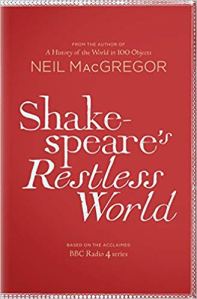
Shakespeare's Restless World by Neil MacGregor

Shakespeare’s Restless World was an impulse buy last year. I saw it on display at Main Street Trading bookshop, took it down off the shelf to look at it whilst having lunch there and then couldn’t resist buying it. It’s such a beautiful book recreating Shakespeare’s world through examining twenty objects. It reveals so much about the people who lived then, who went to see Shakespeare’s plays in the 1590s and 1600s, and about their ideas and living conditions.

The objects include an iron fork  found, when the Rose Theatre on the south bank of the river Thames was excavated, in the remains of the theatre’s inner gallery walls, relics, medals, gold objects, a rapier and a dagger and strange objects such as an eye relic mounted in silver, complete with photos and illustrations. Through looking at each object MacGregor explores a number of themes, not just the theatre, but including what people ate whilst watching plays, religion, medicine, the plague, magic, city life, treason, and the measuring of time amongst other topics. It’s all fascinating and informative, and easy to read. There are plenty of quotations from Shakespeare’s plays and puts both him and his work into context. For me, it was a new way of seeing into the past, which I missed when the series was broadcast on BBC Radio4.

It may seem strange to include this book in the Read Scotland 2014 challenge, but Neil MacGregor, the Director of the British Museum, was born in Glasgow and the challenge is to “read and review Scottish books -any genre, any form- written by a Scottish author (by birth or immigration) or about or set in Scotland.”

I would have read this book in any case, but I was pleased to find that there are sections in it that fit very well into the challenge, including a chapter on Shakespeare’s ‘Scottish Play’ ie Macbeth. Shakespeare lived through a period of great change for Britain, not only the changes to be expected through the passage of time, but also changes nationally and politically with the death of Elizabeth I. The big question of the day in the 1590s was the constitutional question of who would succeed her, but in England the Treasons Act of 1571 forbade any discussion of the succession.  But dramatists addressed this through their plays – such as Shakespeare’s dramatization of the Wars of the Roses.

MacGregor covers James VI of Scotland’s succession to the English crown in 1603, bringing the whole island of Britain under one rule for the first time.  It was not clear then how things would change:

Everybody knew that with James as King of England and King of Scotland a new political world had been born. But it was not at all clear how things were going to change. …

But making a new nation turned out to be very difficult. For much of the previous 300 years England and Scotland had been at war; they had very different political and legal systems, a different established church, different currencies, separate parliaments and a long history of intense dislike and deep suspicion. James’s central ambition was to make two very foreign countries into one new state, with a new name – Great Britain.

The succession of James VI of Scotland to the English throne in 1603 created a dynastic union, and a personal union of political authority, but it did not create a union of the crowns in constitutional, legal, ecclesiastical or economic terms. Forging such a union was James’s paramount aim. (pages 204 – 205)

It was another hundred years before the formal Act of Union united England and Scotland into one state of Great Britain. These days Scotland is currently debating whether to break the union and once again things are very unclear – how will things change if Scotland becomes an independent state?

This post is also my contribution to The Classics Club’s event Shakespeare in January, as well as qualifying for the Mount TBR Challenge 2014.nIt’s also the first non-fiction book I’ve read this year.

The Steel Bonnets: the opening chapter

A friend has just lent me The Steel Bonnets : the Story of the Anglo-Scottish Border Reivers by George MacDonald Fraser and having looked at the opening chapter I know I just have to read on, rather than waiting for January when Peggy Ann’s Read Scotland 2014 Challenge starts. It’s a long, detailed book so I shall probably still be reading it in January anyway.

The Steel Bonnets 001I live on the English side of the Border with Scotland and the history of the area just fascinates me. The Steel Bonnets covers the period from the building of Hadrian’s Wall to 1603, when James VI of Scotland became James I of England. Four hundred or so years ago it was all very different around here and as the history of the Border Reivers is very complicated I’m hoping this book will guide me through it.

The opening paragraph took me by surprise:

At one moment when President Richard Nixon was taking part in his inauguration ceremony, he appeared flanked by Lyndon Johnson and Billy Graham. To anyone familiar with Border history it was one of those historical coincidences which send a little shudder through the mind: in that moment, thousands of miles and centuries away in time away from the Debateable Land, the threads came together again; the descendants of three notable Anglo-Scottish Border tribes – families who lived and fought within a few miles of each other on the West Marches in Queen Elizabeth’s time – were standing side by side, and it took very little effort of the imagination to replace the custom-made suits with leather jacks or backs-and-breasts. Only a political commentator would be tactless enough to pursue the resemblance to Border reivers beyond the physical, but there the similarity is strong.

In the following paragraphs he goes on to describe their physical features, particularly those of Nixon and Johnson, as ‘excellent specimens of two distinct but common Border types.’ I hadn’t expected this at all.

For more Book Beginnings see Gilion’s blog Rose City Reader.

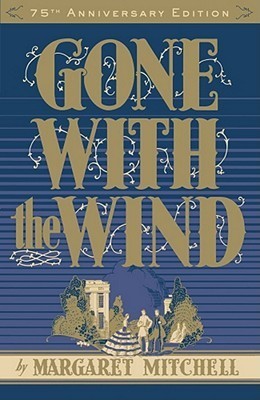
Gone With the Wind: Historical Fiction

Gone With the Wind

In a previous post on Gone With the Wind I wrote that I had learned a lot about the American Civil War and Reconstruction, about slavery (very different from Uncle Tom’s Cabin) and a lot about Georgia and Atlanta. In the comments Jane pointed out, quite correctly, that the book ‘shouldn’t be taken as history, but as reflective of a very strong point-of-view of American history, circa 1930.’

I hadn’t meant that I was taking GWTW as historical fact, but that it had led me to wanting to know more about the period and in that respect it had opened up new areas for me. For example, I’d never heard of ‘Reconstruction’ before in the sense of what happened to the southern states following the Civil War and I knew next to nothing about the causes of the war, other than the fact that the southern states wanted to leave the Union, that they wanted to be an independent nation. I was in no doubt, however, that the book is a novel – historical fiction, not historical fact.

All written history is a selection of facts and involves to a greater or lesser extent an interpretation of those facts. Its accuracy depends on the sources used, and in turn those sources inevitably are subject to perspective and bias. Similarly, historical fiction can throw light on the past; it can flesh out the facts, bringing the past to life – and it can be subject to the bias and opinions of the author.

I was fascinated to read that Margaret Mitchell, who was born in Atlanta in 1900 grew up listening to the war stories of Confederate veterans and yet she didn’t know until she was ten years old that the South had lost the war!

Margaret Mitchell was writing from a Southerner’s perspective, but that does not mean that her book is any the less invalid. She presents the Civil War period and its aftermath as seen through southern eyes and basically it is the story as seen through the women’s eyes. There is little about the actual battles, but this is still a war novel, even though it’s set mostly in the homes of the characters – in Tara, and in Atlanta. It depicts the hardships and suffering of the civilian population as well as the wounded soldiers, their grief and desolation and the devastating effect on the land and townships. You can see Atlanta going up in flames, the devastation of the countryside as the railroads and plantations were destroyed, and feel the hunger as the people starved.

Then there is the question of slavery and the Ku Klux Klan, both essential elements in the novel. The depiction of slaves divides them into two categories – house slaves and field hands, raising racial issues and the different attitudes between the North and the South towards the slaves. The plantation owners are portrayed as viewing their slaves, in particular the house slaves, as part of their family, protecting them and caring for them, treating them as children and of lower intelligence, and the slaves responded with loyalty to their owners. Again this is one perspective on the past, one that is at variance that of the northern states – clearly indicated in the novel. There are several references in Gone With the Wind to Uncle Tom’s Cabin in which Margaret Mitchell contradicts Harriet Beecher Stowe’s scene of bloodhounds chasing runaway slaves. Similarly the view she gives of the Ku Klux Clan is not what I expected. This led me to want to know more about the history of slavery in America and I turned to the one book I own, specifically on American history – Out of Our Past: The Forces that Shaped Modern America by Carl N Degler to find out more.

This is one of the things  I like about reading historical fiction – as well as giving me a glimpse into the past, showing me areas of history I know little or nothing about, bearing in mind that there is always more than one side to a story. And I really need to do more research into these matters.