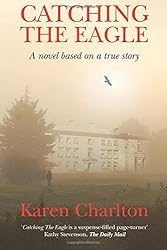
Catching the Eagle by Karen Charlton

I wanted to read a novel by a local author so I checked the library website for North East writers, where I found Catching the Eagle by Karen Charlton.
Summary from the book cover:

Easter Monday, 1809: Kirkley Hall manor house is mysteriously burgled. When suspicion falls on Jamie Charlton, he and his family face a desperate battle to save him from the gallows.

When 1,157 rent money is stolen from Kirkley Hall, it is the biggest robbery Northumberland has ever known. The owner sends for Stephen Lavender, a principal officer with the Bow Street magistrate’s court in London, to investigate the crime. Suspicion soon falls on impoverished farm labourer, Jamie Charlton, and the unpopular steward, Michael Aynsley.

Jamie Charlton is a loving family man but he is hot-tempered and careless. As the case grows against him, it seems that only his young brother, William, can save him from an impending miscarriage of justice.

But William is struggling with demons of his own–he is falling in love with Jamie’s wife.’Catching the Eagle’, the first novel in the Regency Reivers series, is a fictionalized account of a trial that devastated a family and divided a community.

This is not just by a local author, and set in Northumberland, it is also based on a true story –  that of Karen Charlton’s husband’s ancestors.

I liked the opening of Catching the Eagle beginning with a Prologue, setting the scene as an eagle soared over the Northumberland landscape:

… its huge shadow caressed the ruined walls of crumbling castles and the creaking rotting stumps of ancient gibbets.The eagle plucked unsuspecting prey from the bleak, snow-covered fells and drank from remote rocky waterfalls dripping with golden daggers.

It landed in a tree above a labourer’s cottage where Jamie Charlton lived with his wife Priscilla and their children. I like Karen Charlton’s leisurely descriptive style of writing and found the whole book to be fascinating.  She has written an even-handed account of the robbery and the subsequent trials, so much so that I began to wonder whether Jamie Charlton was innocent or guilty, although you know from the outset that he was transported as a convicted felon to New South Wales. Did he or did he not steal the money? And what will happen to the eagle?

This is the type of historical fiction that I like. The characters come across as real people, with real problems in a real time and place (Northumberland 1809 – 1811). It highlights the social and cultural setting. Jamie was without influence or money behind him up against a judicial system run by people with power who needed to find a culprit. His family suffered along with him as he languished in goal in squalor, where he was caged as he awaited trial – not once, but twice.

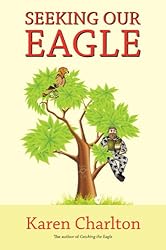
I wondered whether Stephen Lavender, the detective employed by  Nathaniel Ogle, the owner of Kirkley Hall was also a real historical figure. Karen Charlton has also written Seeking Our Eagle, another fascinating book, an account of how she came to write Catching the Eagle whilst researching her husband’s family history.  And yes, Stephen Lavender did exist and he was a detective. He later became the Deputy Chief Constable of Manchester after the formation of the police force by Sir Robert Peel.
Indeed reading Catching the Eagle reminded me of The Suspicions of Samuel Whicher by Kate Summerscale, featuring Detective Inspector Jonathan Whicher of Scotland Yard, the book that won the Samuel Johnson Prize for Non-Fiction in 2008.

Karen Charlton has done her research very well and has written a novel full of intrigue, tension and realism that kept me captivated from start to finish. See her website, Karen Charlton, to read more about Karen and her books.

She has also written The Heiress of Linn Hagh, a spin-off novel from Catching the Eagle, which features Detective Stephen Lavender and his sidekick, Constable Woods. And there are more Detective Lavender Series books on the way!

Catching the Eagle:

  • Paperback: 280 pages
  • Publisher: Famelton Publishing; 1 edition (19 July 2014)
  • ISBN-10: 0992803640
  • ISBN-13: 978-0992803643
  • Product Dimensions: 15.2 x 1.8 x 22.9 cm
  • Source: Library book

Seeking the Eagle:

  • Format: Kindle Edition
  • File Size: 1969 KB
  • Print Length: 166 pages
  • Publisher: Famelton Publishing; 1st edition (7 Aug. 2012)
  • Sold by: Amazon Media EU S.à r.l.
  • Language: English
  • ASIN: B008UZYOR2
  • Source: I bought it

As always I didn’t read either book just for any Reading Challenges, but Catching the Eagle does fit very well into a couple – the 2015  Historical Fiction Reading Challenge and the What’s in a Name Challenge, in the book with an animal in the title category and Seeking Our Eagle into the Nonfiction Reading Challenge.

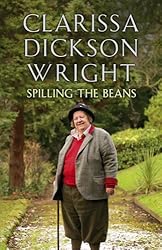
Spilling the Beans by Clarissa Dickson Wright

I’ve left it a bit too long to write about Spilling the Beans, Clarissa Dickson Wright’s autobiography because I’ve now forgotten much of the detail.  It’s a book I really enjoyed, but I finished it nearly two weeks ago! I’ve  been feeling a bit under the weather recently with a rotten cold and although I have been reading I haven’t been able to summon up enough mental energy to write much!

I quoted from the opening of the book in this post, with these details about Clarissa:

Clarissa Dickson Wright was an English celebrity chef ‘“ one of the Two Fat Ladies, a television personality, writer, businesswoman, and former barrister. She died last year on 15 March in the Edinburgh Royal Infirmary. Clarissa was a huge character in more than her size! Her autobiography is fascinating, coming from a privileged and wealthy background she had a difficult childhood- her father, a well respected surgeon was also an alcoholic who beat his wife and Clarissa.

After her mother died she took comfort from alcohol and at the mid point of the book she was as she described it ‘˜sunk in gin’ and homeless. I am looking forward to reading about her road to recovery.

In the rest of the book she described her period of homelessness, sleeping on benches in the Victoria Coach Station for two nights, but spending the rest of the time staying with friends, until she took jobs in domestic service, where she learned to cook. I liked her attitude to being a servant:

I have never understood the aversion to domestic service … I am not sufficiently bourgeoise to worry about my place in the class system and if you don’t understand this, well, that’s your problem. I had no sense of downshifting; maybe I should have had but pragmatism is the saving of many an alcoholic. (page 154)

She then went on to tell about her ‘dark night of the soul’ and her time at addiction centres, the treatment and her eventual recovery. All this took years and she was very honest and open.

She also wrote about her bookselling experience – all totally news to me – her time at ‘Cooks for Books’ changed her life and later after she had moved to Scotland in the late 1980s  she ran the Cook’s Bookshop in Edinburgh near the Grassmarket. She was declared bankrupt three times, was rector of Aberdeen University for six years. And then, of course, there were her TV shows – Two Fat Ladies, with Jennifer Paterson and Clarissa and The Countryman with Johnny Scott. She was a staunch supporter of the Countryside Alliance, against the ban on foxhunting .

Despite all her difficulties and her alcoholism this is an upbeat autobiography, ending on a positive note: “Believe me on one thing: I have a splendidly enjoyable life”. And believe me this is  a ‘splendidly enjoyable’ autobiography.

My copy is a hardback book, which I bought, but it is also available in paperback and ebook.

Note: I didn’t read this book to meet any challenges, but it does:

There is a spot just by the Scots Border at Berwick-upon-Tweed, where the train passes a stretch of the sea coast. Looking out of the window I felt, Oh it’s so lovely to be home, and if it’s home, I thought, I’d better stay and I have been here ever since. (page 225)

For another review see Cath’s blog Read Warbler.

Book Beginnings: Spilling the Beans

As I have several books on the go right now (listed on the side bar), it will be some time before I can write a full post about any of them. So I thought I give a taster of one of them to be going on with.

It’s Spilling the Beans by Clarissa Dickson Wright, her autobiography. It begins:

I was conceived in a bath in Norfolk in September 1946. How can I know? Well my mother told me. As she put it they were all exhausted after the war and there weren’t that many opportune occasions. I was born in the London Clinic on 24 June 1947 and my first journey in the world was in a London taxi. My mother had become bored waiting for my father to collect us, so she wrapped me in a blanket, went outside, hailed a taxi and took me home, leaving the luggage for my father to pick up later. The only really good advice my mother ever gave me was, ‘If in doubt take a taxi,’ and I have followed it ever since.

Clarissa Dickson Wright was an English celebrity chef – one of the Two Fat Ladies, a television personality, writer, businesswoman, and former barrister. She died last year on 15 March in the Edinburgh Royal Infirmary. Clarissa was a huge character in more than her size! Her autobiography is fascinating, coming from a privileged and wealthy background she had a difficult childhood- her father, a well respected surgeon was also an alcoholic who beat his wife and Clarissa.

I’ve been reading this book slowly over the last few weeks and have read nearly half of it. After her mother died she took comfort from alcohol and at the mid point of the book she was as she described it ‘sunk in gin’ and homeless. I am looking forward to reading about her road to recovery.

Book Beginnings Button

Every Friday Book Beginnings on Friday is hosted by Gillion at Rose City Reader where you can share the first sentence (or so) of the book you are reading, along with your initial thoughts about the sentence, impressions of the book, or anything else the opener inspires.

An Autobiography by Anthony Trollope

The primary object of a novelist is to please

2015 is the bicentenary of Anthony Trollope’s birth on 24th April 1815, and  the Trollope Society and other organisations (such as the British Library, the Post Office, the BBC, the Catholic University of Leuven and Oxford University) have planned a whole series of events to celebrate this anniversary.

But I didn’t know that when I began reading his Autobiography. I found it absolutely fascinating, even though I’ve only read two of his books, The Warden and The Way We Live Now, both of which I enjoyed.

Autobiography Trollope 001

(The link above is to the latest edition, edited by Nicolas Shrimpton and published in October 2014 which includes some of his other writings – my copy is a paperback in The World’s Classic series, edited by Michael Sadler and Frederick Page, first published in 1930, reprinted in 1989, shown above.)

I’d almost forgotten about his Autobiography because I’ve  had it for so long. Although it was new when I bought it the pages are now yellowed and the paperback a bit worn and damaged from moving house. I bought it when I was doing an Open University course and my tutor was an avid fan of Trollope. Part of the reason it has sat unread on my shelves is that when I bought it I hadn’t read any of Trollope’s books and I thought it would be better if I knew a bit about his work before reading about his life. So now I’ve read two and have started reading Barchester Towers I decided it was time to read it.

Anthony Trollope was the son of an unsuccessful barrister and had a miserable childhood, his family most often in debt and struggling to make ends met. It was his mother who supported the family through her writing. He was unhappy at school where he was bullied, always in disgrace and had no friends. When he was 19 he became a clerk in the London Post Office, eventually  becoming a Surveyor, working in both Ireland and England and he introduced the red pillar boxes to Britain.

I found it fascinating because it is not only his life story – his unhappy childhood, his work in the Post Office, including his work in Ireland and abroad, his marriage and family life and his love of hunting, but Trollope also writes a lot about his writing, criticises his own books and discusses his fellow writers in a chapter called ‘On English Novelists of the Present Day’, including – Thackeray, George Elliot, Dickens, Wilkie Collins, Charlotte Brontë to name but a few.

Remarkably whilst he was working full time he was also writing his novels. His practice was to get up at 5.30 am and work for 3 hours before dressing for breakfast. He wrote with his watch before him, writing 250 words every 15 minutes. But he didn’t confine his writing to the early hours he also wrote whilst travelling on trains, making a ‘tablet’ to write on and ‘found that after a few days’ exercise that I could write as quickly n a railway-carriage as I could at my desk. I worked with a pencil, and what I wrote my wife copied afterwards.’ He included a list of the books he had written with the dates of publication and the sums he had received for them, totalling £68, 959 17 shillings and 5 pence.

But he wasn’t just a remarkably disciplined writer, he was a writer who made his characters come alive – I can see that in just the two books I’ve read. When I went to see Hilary Mantel at the Borders Book Festival she said that she lives in a parallel world in the present and in the world of Cromwell and Henry VIII, plus all the characters, at one and the same time. It is always with her. So it was with Trollope. Here he writes about how an author can make characters ‘speaking, moving, living, human creatures’:

They must be with him as he lies down to sleep, and as he wakes from his dreams. He must learn to hate them and to love them. He must argue with them, quarrel with them, forgive them, and even submit to them. He must know of them whether they be cold-blooded or passionate, whether true or false, and how far true and how far false. The depth and the breadth, and the narrowness and the shallowness of each should be clear to him.

I have lived with my characters … I may say that I know the tone of voice, and the colour of the hair, every flame of the eye, and the very clothes that they wear. Of every man I could assert whether he would have said those words; of every woman, whether she would then have smiled or so have frowned. (page 233)

Here are some more passages I marked as I read the book that I thought interesting (there are many more!):

An author can hardly hope to be popular unless he can use popular language. (page 176)

His language must come from him as music comes from the rapid touch of the great performer’s fingers; as words come from the mouth of the indignant orator; as letters fly from the fingers of the trained compositor; as the syllables tinkled out by little bells form themselves to the ear of the telegraphist. (page 177)

Short novels are not popular with readers generally. Critics often complain of the ordinary length of novels, – of the three volumes to which they are subjected; but few novels which have attained great success in England have been told in fewer pages. (page 237)

And as my blog is called BooksPlease I was delighted to read this sentence:

The primary object of a novelist is to please … (page 248)

Nonfiction Reading Challenge 2015

I wasn’t going to take part in any more challenges this year – I’m probably doing too many – but when I saw this Nonfiction Challenge, hosted by The Introverted Reader I thought it could encourage me to read my non-fiction books. It runs between 1 January to 31 December 2015. You can sign up any time throughout the year.

Unlike some of the challenges I’ve joined this one really is a challenge for me, because although I like to read non-fiction I often find my self opting for fiction.

Nonfiction Reading Challenge hosted at The Introverted Reader
Image courtesy of Serge Bertasius Photography at FreeDigitalPhotos.net

The Challenge:  Read any non-fiction book(s), adult or young adult.That’s it. You can choose anything. Memoirs, History, Travel – absolutely anything that is classified as non-fiction counts for this challenge.

The levels:

Dilettante–Read 1-5 non-fiction books

Explorer–Read 6-10

Seeker–Read 11-15

Master–Read 16-20

I am aiming at the Seeker level and hoping to read more than 12 books (my total for last year!)

See my progress page here.

Wilkie Collins by Peter Ackroyd

Wilkie CollinsOn Thursday I finished reading Wilkie Collins by Peter Ackroyd and it was also the anniversary of his birth – he was born in Marylebone at a house in New Cavendish Street on 8 January 1824.

I’ve read just two of Wilkie Collins’ books – The Moonstone and The Woman in White, and this year I hope to read more. I knew that he was a friend of Charles Dickens, but that was about all I knew of him. Peter Ackroyd’s biography looked as though it could be a good book to start with. And it is – it’s short, just over 200 pages, very readable and a clear and concise account of Collins’ life and work.

Wilkie’s father was William Collins, an English painter, a member of the Royal Academy, who specialised in landscapes and seascapes. He was christened William Wilkie – Wilkie after his godfather, the painter Sir David Wilkie.

Ackroyd’s account may be brief but he gives details of Wilkie’s childhood, his schooldays – the books he liked as a child – The Arabian Nights, Robin Hood and Don Quixote, books by Sir Walter Scott and he admired Byron. He moves on through Wilkie’s struggle to become a writer, his friendship with Charles Dickens, his travels abroad, his unconventional life style, never marrying but living with Caroline Graves for thirty years whilst having a liaison with Martha Rudd, his ill health and reliance on laudanum, his tour of America, his relationships with and views about women and their place in society, as well as discussing his short stories, articles, novels and plays.

Wilkie Collins died on 23 September 1889 after a year in which he had suffered from neuralgic attacks, a stroke that paralysed his life side and affected his brain, and a bout of bronchitis, but he  had still carried on writing.

I marked several passages as I was reading. Here are just a few of them:

He was essentially liberal in his social and political views, averse to coercion and conflict; he showed some sympathy with the principles of socialism as it was then understood, and was instinctively on the side of the oppressed. (page 46)

He might best be described as a Christian humanist who accepted Christ as his Saviour but detested all formal and outward shows of religion. He preserved his particular wrath for evangelicals. … he was not an atheist. He rarely entered a church, and his actual beliefs are hard, if not impossible, to unravel. (page 47)

He may have believed with Charles II that God would not punish him for a few sins of pleasure. (page 47)

He lived through a period in which the audience for fiction was rapidly widening, and the novels themselves were increasing in importance. … Novels had become the repository of dreams and ideals, the fantasies and the speculations, of the nation. (page 81)

One of the characters in ‘The Diary of Anne Rodway’ said -‘what I want is something that seizes hold of my interest, and makes me forget when it is time to dress for dinner – something that keeps me reading, reading, reading, in a breathless state to find out the end.’ That is precisely the excitement Collins conveys to his readers. (page 88)

Collins was writing about mysteries ‘deep under the surface’ three decades before Freud began his own enquiries. He was concerned with doubles and double identity, with monomania and delusion. He traced the paths of unconscious associations and occluded memories. (page 93)

It was believed that the ‘detective element’ disqualified the novel as a work of art, when in fact it opened up the way for an entirely new direction in English literature. There had been earlier exercises in the genre, but all of them are inconsiderable besides the over-whelming power and authority of ‘The Moonstone’. Collins’s novel, since its publication in 1868, has never been out of print. (page 132)

There is an awful lot packed into this short biography! And it’s an excellent stepping stone into Wilkie Collins’s novels.

  • Hardcover: 208 pages
  • Publisher: Chatto & Windus (23 Feb. 2012)
  • Language: English
  • ISBN-10: 0701169907
  • ISBN-13: 978-0701169909
  • Source: a Christmas present