The Grave Tattoo: Book Beginnings & The Friday 56

Every Friday Book Beginnings on Friday is hosted by Gillion at Rose City Reader where you can share the first sentence (or so) of the book you are reading. You can also share from a book you want to highlight just because it caught your fancy.

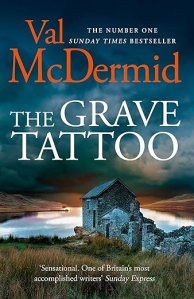
I’m featuring The Grave Tattoo by Val McDermid, a book I’m currently reading.

The Prelude

All landscapes hold their own secrets.

Chapter One:

Jane Gresham stared at what she had written, then with an impatient stroke of her pen crossed it through so firmly the paper tore and split in the wake of a nib. Bloody Jake, she thought angrily.

Also every Friday there is The Friday 56, hosted by Freda at Freda’s Voice, but she is taking a break and Anne at My Head is Full of Books has taken on hosting duties in her absence. You grab a book and turn to page 56 (or 56% of an eBook), find one or more interesting sentences (no spoilers), and post them.

‘The black tattoos. They’re the sort that sailors used to get in the South Seas back in the old days when sailing ships put in at the islands to take on stores and trade with the natives,’ Jake explained.

Description

The award-winning and Number One bestselling Val McDermid crafts an electrifying psychological suspense thriller that mixes history, heritage and heinous crimes.

A 200 year-old-secret is now a matter of life and death.And it could be worth a fortune.

It’s summer in the Lake District and heavy rain over the fells has uncovered a bizarrely tattooed body. Could it be linked to the old rumour that Fletcher Christian, mutinous First Mate on the Bounty, had secretly returned to England?

Scholar Jane Gresham wants to find out. She believes that the Lakeland poet William Wordsworth, a friend of Christian’s, may have sheltered the fugitive and turned his tale into an epic poem – which has since disappeared.

But as she follows each lead, death is hard on her heels. The centuries-old mystery is putting lives at risk. And it isn’t just the truth that is waiting to be discovered, but a bounty worth millions …

My favourite genres are crime fiction and historical fiction. So, the combination of the two really appeals to me. What do you think, does this book appeal to you? What are you currently reading?

Daisy Darker by Alice Feeney

I’ve read Alice Feeney’s debut novel, Sometimes I Lie and His and Hers and loved them. So I had high hopes for Daisy Darker, her fifth book.  Sadly, I was disappointed and I have to say that I didn’t enjoy it. I’ll even go as far as admitting, which I really don’t want to say because I don’t like being negative about a book, I think it is dire. But there are plenty of other readers who enjoyed it, even loved it, so I’m in the minority here. Don’t let me put you off reading it, if it appeals to you. This is just my opinion.

Description (Goodreads)

After years of avoiding each other, Daisy Darker’s entire family is assembling for Nana’s 80th birthday party in Nana’s crumbling gothic house on a tiny tidal island. Finally back together one last time, when the tide comes in, they will be cut off from the rest of the world for eight hours.
The family arrives, each of them harboring secrets. Then at the stroke of midnight, as a storm rages, Nana is found dead. And an hour later, the next family member follows… Trapped on an island where someone is killing them one by one, the Darkers must reckon with their present mystery as well as their past secrets, before the tide comes in and all is revealed.

With a wicked wink to Agatha Christie’s And Then There Were NoneDaisy Darker’s unforgettable twists will leave readers reeling.

My thoughts:

I’m going to be brief. The beginning, was promising and made me interested enough to read on as the Darker family reunited for their Nana’s 80th birthday party at Halloween. They all arrive, Daisy, her father Frank, her mother Nancy, her siblings Rose and Lily and her niece, Trixie. Nana lives on a tidal island, which means that when the tide was in they couldn’t leave, making this a variation on the ‘locked room murder’ mystery, which I generally like. So, I read on, as hour by hour, one by one they’re all found dead. There’s a poem written in chalk on the back wall of the kitchen about the Darker family. As each death occurs the lines about each person are struck through. The poem is pure doggerel and painful to read.

The story quickly began to drag for me and I got fed up with the repetition of how many hours were left until low tide. I got tired of the unlikable characters in this dysfunctional family, the platitudes scattered throughout the book and the increasingly stupid plot, culminating in a surreal supernatural conclusion. I was glad to get to the end.

Hamlet, Revenge! by Michael Innes

A Golden Age Mystery

Hamlet, Revenge! by Michael Innes has been languishing on my TBR shelves for 9 years, mainly because it is in such a small font making it difficult for me to read. It was first published in 1937. My copy was published in 1961 in paperback with the cover shown in the photo above.

Synopsis:

A Scotland Yard detective probes a high-society house party for someone rotten when a government official is murdered in this classic British mystery.

Preparations are underway for a grand party at Scamnum Court, the sweeping English country estate of the fabulously wealthy Duke of Horton. Some of the nation’s elite are invited for dinner, and some are even set to star in a semi-amateur production of Hamlet on an authentic Elizabethan stage in the banqueting hall. No expense is spared, but one guest soon pays with his life. Before the play ends, a shot is fired, and the actor playing Polonius―Lord Auldearn, the Lord Chancellor of England―is dead.

With war looming on the horizon, suspicions arise over the possibility of espionage. Therefore, the prime minister sends Insp. John Appleby not only to investigate, but to also find a confidential government document. Appleby is lucky there’s a mystery novelist eager to lend a hand with the extensive guest list at Scamnum Court. He will need all the help he can get if he hopes to prevent the killer from making an encore performance . . .

My thoughts

This is the second Inspector John Appleby book. And like the first, Death at the President’s Lodging (my review) it is a most complex mystery. When Lord Auldearn, Lord Chancellor of England is murdered on stage during an amateur production of Hamlet at Scamnum Court the Prime Minister asks Appleby to investigate. Because there’s a possibility that espionage is involved, the PM tells Appleby not to trust anybody. It’s all very vague. The PM tells him there’s a document concerning

… the organization of large industrial interests on an international basis, in the event of a certain international situation. The general drift towards the matter such a document embodies cannot, you realize, well be secret; nothing big can be secret. But the details may be. And this document might be useful in two ways: the detailed information might be useful to one powerful interest or another: and accurate possession of the details, as circumstantial evidence of something already known in general terms, might be useful to an unfriendly government.

…War? said Appleby … (pages 83,84)

The book begins with a Prologue.which is is longer than most prologues. It sets the scene, describing Scamnum Court in detail. It’s the family seat of the Crispin family, described as ‘a big place: two counties away it has a sort of little brother in Blenheim Palace.’ All the characters are introduced, including Giles Gott, who was also in Death at the President’s Lodging. An eminent Elizabethan scholar, he is the director of the play. The other characters are also introduced; Lord Auldearn, the Lord Chancellor of England, who plays Polonius, and numerous other family members, guests and members of the Scamnum Court staff.

There are thirty people involved in the play, actors and those behind the scenes, plus twenty seven in the audience. I found this section too long (74 pages in my copy) and it took me more than a while to identify who was who! My attention was drooping as I read pages of long meandering, descriptive paragraphs and I wondered when there would be a murder. And there is a lot of information about the staging of the play and numerous Shakespearean references. Before the performance the murderer delivered a number of warning messages about revenge, so everybody is on edge.

Appleby doesn’t appear until the second section and then the pace picks up considerably as he and Gott question the suspects. It gets more complicated when a second murder, that of Mr Bose, the prompter who was on stage and who could possibly have seen who shot Lord Auldearn. I was puzzled for much of the time as I read – it’s a book that you can’t read quickly and it requires concentration. I had no idea who the culprit was as Appleby and Gott tried to eliminate the suspects and answer numerous questions, such as why was Lord Auldearn shot and not stabbed as Polonius the character he played was, why did the murderer come onto the stage to shoot him and risk being seen by Bose, why did he send the mysterious messages about revenge – what revenge was being sought, and was the possible espionage plot the reason behind the shooting? Or was the reason a personal one?

From being confused and overwhelmed by the puzzle I became thoroughly absorbed by the mystery and was eagerly turning the pages to find out all the answers. It’s a book I really need to re-read to get to grips with it – I’m sure I missed so much. My post falls far short of doing justice to the book!

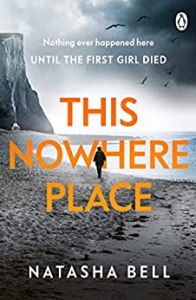
This Nowhere Place by Natasha Bell

Mo, Cali, Jude.

Three teenagers befriend each other on the white cliffs, thinking they’ll save each other.

Within months, two of them are dead and the third is scarred for life.

Ten years later, documentary-maker Tarek Zayat and his film crew are in town, asking difficult questions, looking for secrets in the silence around that fateful summer.

Because in the shadow of the white cliffs it’s easy for stories, histories and people to get lost. And in a small town, the truth is something that must be carefully unburied – in case it buries you.

I was really expecting to like this book, attracted by the synopsis, but unfortunately I didn’t enjoy it. It’s one of the books that has been on my NetGalley shelf for too long because I made several attempts to start it. I found it difficult to follow at the beginning and didn’t like the format with extracts from a TV/film Tarek is making. This made the beginning disjointed, switching between different characters. So I was in two minds about reading the book, and put it aside whilst I read other books. But there was enough mystery about what was going on to make me want to keep reading and I started it again recently, this time finishing it.

The narrative moves between 2016 and 2026, which usually doesn’t bother me but in this case I did have difficulty for a while sorting out the time line and what all the characters were doing – and when and how they were connected. This Nowhere Place covers a number of difficult issues – racism, immigrants, suicide, drugs and mental health problems. It also explores family relationships, and friendships. After a slow start the pace didn’t pick up for most of the book. The mystery element wasn’t too puzzling to work out despite all the twists and turns and the fact that most of the characters are lying or withholding information. I was relieved when I reached the ending with yet another twist, which I had suspected for a while.

On the plus side I think it’s well researched and the author recommends a list of books for further reading. The Dover setting is also well described, which has made me interested to find out more about the locations of the Western Heights fortifications, the Grand Shaft with its triple staircase, and the White Cliffs, in particular, the Shakespeare Cliff.

My thanks to Penguin, the publishers for a review copy via NetGalley.

  • ASIN: ‎ B08C793RMB
  • Publisher ‏: ‎ Penguin (18 March 2021)
  • Print length: 367 pages
  • Review copy
  • My rating : 3*

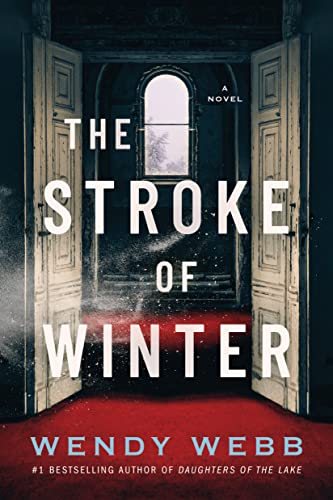
The Stroke of Winter by Wendy Webb

Lake Union| 1 November 2022 | 300 pages| e-book edition| My own copy| 2.5*

She’s restoring the old family home on the hill. And unearthing something evil.

In the tourist town of Wharton, on the coast of Lake Superior, Tess Bell is renovating her old family home into a bed-and-breakfast during the icy dead of winter…

As the house’s restoration commences, a shuttered art studio is revealed. Inside are paintings Tess’s late grandfather, beloved and celebrated artist Sebastian Bell, hid away for generations. But these appear to be the works of a twisted mind, almost unrecognizable as paintings she and others familiar with his art would expect. The sinister canvases raise disturbing questions for Tess, sparking nightmares and igniting in her an obsession to unearth the truth around their origins.

What evil has been locked away for so many years? The ominous brushstrokes, scratching at the door, and moving shadows begin to pull Tess further and further into the darkness in this blood-chilling novel of suspense by the #1 Amazon Charts bestselling author of The Keepers of Metsan Valo.

I haven’t read any of Wendy Webb’s books, but I liked the blurb so I got an ebook through Amazon First Reads. I didn’t know what to expect but I was rather disappointed. It is easy to read, almost too easy in a simplistic style in which actions such as getting items out of the fridge are described in detail. In fact it is so detailed that all the rooms in the house are described, along with all the furniture and furnishings. It is a mix of genres – a cozy mystery, a haunted house/ghost story with some creepy scenes, a horror story, a romance and a recipe book. There is lots of unnecessary repetition as various events are described over and over again and the ending is rushed.

Its good parts are that I liked the setting in the fictional town of Wharton on the shores of Lake Superior and despite my disappointment in the writing style I liked the plotline centered on Amethyst (known as Tess) Bell’s family and their family home. So I wanted to read on to find out what was going on, just what was making the scratching noises Tess hears in the middle of the night and what is the secret of the large room that had been closed off, the door permanently bolted and the windows shuttered in black? It had been like that as long as Tess could remember.

The Girl Who Died by Ragnar Jonasson, translated from the Icelandic by Victoria Cribb

Penguin| 3 June 2021| 328 pages| Review Copy| 3*

‘TEACHER WANTED AT THE EDGE OF THE WORLD . . .’

After the loss of her father, Una sees a chance to escape Reykjavík to tutor two girls in the tiny village of Skálar – population just ten – on Iceland’s storm-battered north coast.

But city life hasn’t prepared her for the unforgiving weather nor inhospitable village life. Worse, the creaky old house where she lives is playing on her already fragile mind when she’s convinced she hears the ghostly sound of singing.

Then, at midwinter, a young girl is found dead.

And one of the villagers must have blood on their hands . . .

The Girl Who Died is Icelandic noir, a mix of horror and psychological thriller, with a strong sense of place. Skálar is a close-knit community that doesn’t welcome newcomers, keeping its secrets well hidden. The only person who welcomes Una, to the village is Salka, the mother of Edda, one of the two girls Una is to teach. But even her welcome is short lived.

When Una arrived she had the feeling that it was like being a folk tale, an ominous supernatural tale set in a vague shifting world where nothing was solid or real, almost like a ghost town. The feeling grows stronger when she sees a little girl with long, pale hair in the window of Salka’s house – but Salka tells her that Edda was in bed. Later she discovers that the ghost of a young girl who had died fifty years earlier was said to haunt the house.

The supernatural elements of the story and the dark brooding atmosphere add to the mystery, but it is not quite as creepy or chilling as I’d thought it would be, mainly because of the slow plodding pace. Also I’m in two minds about Una as I really didn’t find her a very interesting character. And I began to care less and less about what was happening to her. Overall I found it a bit disappointing, and I found the ending puzzling.

However, the Author’s Note is interesting. Jonasson explains that Skálar is a real place. But it was abandoned in the mid 1950s, so the setting is real, but the buildings and the characters are fictitious. However, he has tried to give an accurate representation of the history of Skálar that describes in the book. He has also used the folk tales in Sigfús Sigfússon’s collections of Icelandic tales and legends.

My thanks to the publishers for a review copy via NetGalley.