Mount TBR 2020 Final Checkpoint & Sign Up for Mount TBR 21

We’ve come to the end of Bev’s Mount TBR Challenge, so it’s time for the final checkpoint!

1. Tell us how many miles you made it up the mountain:

I began the year aiming for Mount Vancover – that is 36 books and I made it, ending the year by reading 38 of my TBRs.

2. The Words to the Wise According to Mount TBR: Using the titles of the books you read this year, see how many of the familiar proverbs and sayings below you can complete with a book read on your journey up the Mountain. Feel free to add/subtract a word or two to help them make sense. I have given my titles as examples:

A stitch in time…[saves] Hitler’s Secret (Rory Clements)
Don’t count your chickens…[before] Becoming Mrs Lewis (Patti Callahan)
A penny saved is…. Saving Missy (Beth Morrey)
All good things must come… (to) The Last Day (Andrew Hunter Murray)
When in Rome… [bring] Fresh Water for Flowers (Valerie Perrin)
All that glitters is not… Looking Good Dead (Peter James)
A picture is worth… The Year Without Summer (Guinivere Glasfurd)
When the going gets tough, the tough get… The Guardians (John Grisham)
Two wrongs don’t make… A Killing Kindness (Reginald Hill)
The pen is mightier than…. The Power-House (John Buchan)
The squeaky wheel gets… Yesterday’s Papers (Martin Edwards)
Hope for the best, but prepare for… Smallbone Deceased (Michael Gilbert)
Birds of a feather flock… [in] Thin Air (Michelle Paver)

My thanks to Bev for hosting Mount TBR 2020. And so on to Mount TBR 2021

Books must be owned by you prior to January 1, 2021. No library books.  Any reread may count, regardless of how long you’ve owned it prior to 2021, provided you have not counted it for a previous Mount TBR Challenge.  Audiobooks and E-books may count if they are yours and they are one of your primary sources of backlogged books. You may count “Did Not Finish” books provided they meet your own standard for such things, you do not plan to ever finish it, and you move it off your mountain [give it away, sell it, etc. OR remove it from your e-resources].

There are a number of different levels to choose from:

Pike’s Peak: Read 12 books from your TBR pile/s
Mount Blanc: Read 24 books from your TBR pile/s
Mt. Vancouver: Read 36 books from your TBR pile/s
Mt. Ararat: Read 48 books from your TBR pile/s
Mt. Kilimanjaro: Read 60 books from your TBR pile/s
El Toro*: Read 75 books from your TBR pile/s (*aka Cerro El Toro in South America)
Mt. Everest: Read 100 books from your TBR pile/s
Mount Olympus (Mars): Read 150+ books from your TBR pile/s

and for now I’m going for Mt Vancouver, which is to read 36 books and hope to move up to the higher levels if I can.

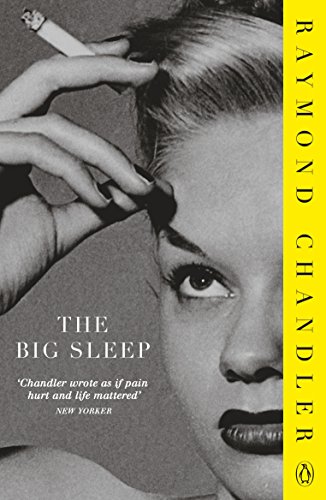
The Big Sleep by Raymond Chandler

In December I read 12 books, most of them short ones, and because I was reading them one after the other I hardly paused to write about them. Before they slip out of my memory I want to write about some of them at least. –

I particularly want to write about The Big Sleep by Raymond Chandler as it is one of those books that I’ve always heard about but have never read. It’s been on my Kindle for the last three years. It was first published in 1939 and is an excellent example of what is known as ‘hardboiled’ crime fiction, which generally featured a private eye with a whisky bottle in a filing cabinet, a femme fatale, and rich and usually corrupt clients. Female sexuality is a snare in a dangerous society where manipulative politicians and corrupt police thrive.

About the book:

Best-known as the creator of the original private eye, Philip Marlowe, Raymond Chandler was born in Chicago in 1888 and died in 1959. Many of his books have been adapted for the screen, and he is widely regarded as one of the very greatest writers of detective fiction. His books include The Big SleepThe Little SisterFarewell, My LovelyThe Long Good-byeThe Lady in the LakePlaybackKiller in the RainThe High Window and Trouble is My Business.

The Big Sleep has been adapted for film twice, in 1946 with Humphrey Bogart, Lauren Bacall, John Ridgely, Martha Vickers, and again in 1978, with Robert Mitchum, Sarah Miles, Richard Boone, Candy Clark.

My thoughts:

The novel is narrated by Philip Marlow, who describes himself as a ‘lone wolf, unmarried, getting middle-aged, and not rich.’ He’s been in jail more than once, likes liqour and women and the cops don’t like him much, although he does get on with a couple of them.

It’s not really the type of crime fiction that I like, but I did enjoy it. There are damsels in distress, gangsters, corrupt officials, and plenty of dark, violent and bloody situations. And of course there are murders – the ‘big sleep’ is death, after all. It’s fast-paced, violent, complicated and in times I found it a bit difficult to follow.

Reading the book took me back in time and place to Los Angeles in the late 1930s, a baking hot LA in which Private Investigator Marlow is hired by the paralysed millionaire General Stallwood, who is being blackmailed. His investigations are hampered by the General’s two daughters, one of whom proves to be a femme fatale, out to entrap Marlow and vindictive when her efforts fail. Chandler’s writing is sharp, snappy and richly descriptive with witty one-liners.

The Guest Cat by Takashi Hiraide: a Novella

This is my first novella review for Novellas in November hosted by Cathy and Rebecca

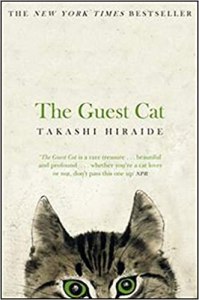
It was the cover of The Guest Cat by Takashi Hiraide, translated by Eric Selland, that first caught my eye. As a cat lover how could I resist this book? It is only short, 146 pages but it packs so much within those pages. And there was a lot that struck chords with me.

It is a story of how a cat made itself at home with a couple in their thirties who lived in a small rented house in a quiet part of Tokyo. The opening chapter describes the house and its position on a little alleyway the couple called ‘Lightning Alley’ because of its frequent sharp turns that one sees in drawings of lightning blots – or, I imagine, of the one on Harry Potter’s forehead. The alleyway followed a twisting path between the extensive grounds of an old estate and the place they were renting. It had originally been a guesthouse of the old estate, where their landlady lived. There was a rickety gate in a wooden fence, that was the landlady’s side entrance and the tenants’ front gate. And just beyond the gate was a knothole. I couldn’t quite visualise it but after reading it a few times I gave up trying to picture the scene and the optical illusion, like a camera obscura, the knothole projected on the small window in the corner of the kitchen.

I simply moved on to the story of the cat the narrator noticed in their garden. Their neighbours’ house to the east, which because of the twists and turns of Lightning Alley, was a distance away from them so that they rarely met face to face. But they could hear their neighbours’ little boy often playing where the alleyway turned sharply. One morning he announced his intention to keep a stray cat, Chibi, and they could hear the tinkling of the cat’s little bell. At first the cat was cautious and just peeked inside their little house but eventually Chibi spent a lot of time with the couple coming and going as she pleased.

Chibi was a jewel of a cat. Her pure white fur was mottled with several lampblack blotches containing just a bit of light brown. The sort of cat you might see just about anywhere in Japan, except she was especially slim and tiny.

These were her individual characteristics – slim and small, with ears that stood out, tapering off beautifully at the tips, and often twitching. She would approach silently and undetected to rub up against one’s legs. (page 11)

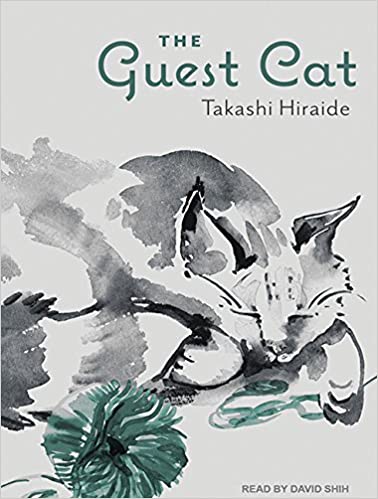
So, I wondered why the picture of the cat on the cover that caught my eye was different. I think the picture on the cover of the audio book is more like Chibi:

There’s not really much more to say about the story, except that is a collection of fragments – of events that gradually change the couple’s lives. Chibi becomes a source of joy to them both and they began to see the beauty around them. There are passages about Chibi’s activities – her agility, her unexpected ways and playfulness.

Having played to her heart’s content, Chibi would come inside and rest for a while. When she began to sleep on the sofa – like a talisman curled gently in the shape of a comma and dug up from the prehistoric archaeological site – a deep sense of happiness arrived as if the house itself had dreamed this scene. (page 14)

Hiraide’s description of nature is detailed – the garden of the large house in particular. And I was struck by his description of two dragonflies, copulating while flying, in formation like a bracelet ‘in the shape of a distorted heart.’

But then something happens that changes their lives again. Change over the passage of time is one of the main themes in this book. Others are about nature and the nature of belonging – who does Chibi belong to, were her visits to their home actually a homecoming or was her home really with the neighbours? This was one of the chords that resonated with me because my in-laws once had a little white cat, Mitzi, who went to live with one of their neighbours. The neighbours clearly thought she didn’t belong to them because although = they fed her and she lived with them they brought the vet bill to my in-laws for them to pay it.

And so the changes continued. The ending which gave me much pause (pun not intended) for thought, is ambiguous, a mystery left hanging for you to decide for yourself what had happened – inevitable, maybe.

I was curious about this book – is it fact or fiction? So, I looked online and I came across this article, about a book signing/discussion organised by the Japan Foundation at the International Anthony Burgess Foundation’s venue on Cambridge Street in Manchester. Takashi Hiraide explained that some of the novel including the location and living quarters for instance, are based on fact, although the novel is a mixture of reality and fiction.

He also explained that the novel is a Japanese ‘I’ novel and pointed out the problems in translating it into English. For example whereas in Japanese personal pronouns (such as ‘I’, ‘he and ‘she’) are not necessary in a sentence, in English they are. As a result the narrator, who in the novel is meant to be a detached observer, in the English translation sometimes becomes a character in the story, which explains the detached feeling I had whilst reading it. I was also interested to find out that Hiraide is influenced by modern art and that he regards book covers as an art form in themselves. So, the cover that first attracted me to the book was his choice (I guess).

I loved this novella – so different from other books I’ve read. It’s one of my To-Be-Read books that has been hiding in my Kindle for five years, until I looked to see if I had any novellas in e-book form.
My Friday Post: Maigret and the Reluctant Witnesses by Georges Simenon

Every Friday Book Beginnings on Friday is hosted by Gillion at Rose City Reader where you can share the first sentence (or so) of the book you are reading. You can also share from a book you want to highlight just because it caught your fancy.

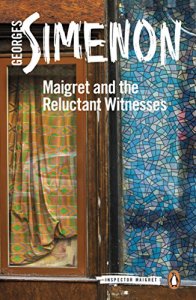
Maigret and the Reluctant Witnesses is one of the novellas I included in my Novellas in November post. It has 172 pages and is Simenon’s 53rd Inspector Maigret book, first published in 1959.

It begins:

‘You haven’t forgotten your umbrella, have you?’

‘No.’

The door was about to shut, and Maigret was already turning towards the stairs.

‘You’d better wear your scarf.’

His wife ran to get it unaware that this little remark would leave him out of sorts for some time, melancholy thoughts churning through his brain.

Also every Friday there is The Friday 56, hosted by Freda at Freda’s Voice. *Grab a book, any book. *Turn to Page 56 or 56% on your  ereader . If you have to improvise, that is okay. *Find a snippet, short and sweet, but no spoilers!

  1. Grab a book, any book.
  2. Turn to page 56, or 56% on your eReader. If you have to improvise, that is okay.
  3. Find any sentence (or a few, just don’t spoil it) that grabs you.
  4. Post it.
  5. Add the URL to your post in the link on Freda’s most recent Friday 56 post.

Page 56:

My job is to look for the truth, and that is what I’m doing. Your presence in fact would incline me not to look very far, because it’s very unusual for the relatives of a murder victim to send for a lawyer before they can even be questioned by the police.

Blurb:

When the head of a powerful Parisian family business is murdered in his bed, Maigret must pick apart the family’s darkest secrets to reveal the truth.

“The curious thing was that there seemed to be no grief here, only a strange dejection, a kind of uneasy stupor…”

Maigret is called to the home of the high-profile Lachaume family where the eldest brother has been found shot dead. But on his arrival, the family closes ranks and claims to have heard and seen nothing at the time of the murder. Maigret must pick his way through the family’s web of lies, secrets, and deceit, as well as handle Angelot, a troublesome new breed of magistrate who has waded into the case. And it’s the estranged black sheep of the family, Veronique, who may hold the key to it all with her knowledge of the depths to which the family will sink to protect their reputation.

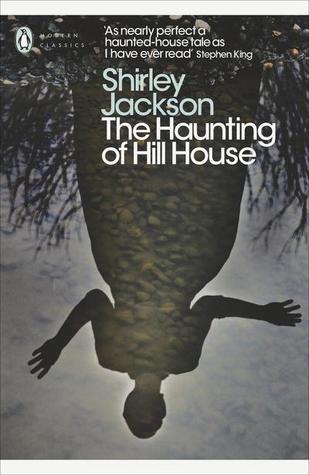
The Haunting of Hill House by Shirley Jackson

I read The Haunting of Hill House by Shirley Jackson at the end of September and it is one of the books that’s in my ‘to be reviewed pile’, which is getting far too big, as I keep reading book after book without writing about them!

About the book:

It is the story of four seekers who arrive at a notoriously unfriendly pile called Hill House: Dr. Montague, an occult scholar looking for solid evidence of a “haunting”; Theodora, the lighthearted assistant; Eleanor, a friendless, fragile young woman well acquainted with poltergeists; and Luke, the future heir of Hill House. At first, their stay seems destined to be merely a spooky encounter with inexplicable phenomena. But Hill House is gathering its powers—and soon it will choose one of them to make its own. (Goodreads)

This is a horror story, but thank goodness there is no gore. Instead it is macabre and has a chilling atmosphere. It’s more of a psychological study than a horror story and as such I don’t think it’s as good or as terrifying as her later book, We Have Always Lived in the Castle.

Dr. Montague, a doctor of philosophy with a keen interest in the supernatural and psychic manifestations had been looking for a ‘haunted’ house to investigate all his life. So, when he heard the stories about the strange goings on at Hill House he decided he would spend three months living there and see what happened, and he set about finding other people to stay there with him.

Eleanor is the main character in the book, next to the House itself, and what happens is told from Eleanor’s point of view. As a child Eleanor had once seemed to activate a poltergeist, although she doesn’t remember that. As an adult she had spent eleven years looking after her invalid mother and it had left her a lonely, embittered spinster of thirty two. After her mother died she sees Dr. Montague’s invitation to spend the summer at Hill House as something she had been waiting for all her life, an opportunity to change her life. Theodora is not at all like Eleanor – her ‘world was one of delight and soft colors’ and after arguing with her friend with whom she shared an apartment, she accepted Dr. Montague’s invitation too. The third person to accept was Luke, the nephew of the owner of Hill House, who would one day inherit the House. He was a liar and also a thief.

These four people arrived at Hill House where they were met by the Dudleys – Mr Dudley, the surly caretaker and his dour wife, the housekeeper. Neither of them live in the house but having told the guests which rooms they were to sleep in, and the arrangements for meals, they leave them alone at night. They leave before it gets dark.

Eleanor realises she should have turned back at the gate and a voice inside her tells her to ‘get away from here, get away.’ There are stories about the tragedies connected with the house, scandal, madness and a suicide – when a girl hanged herself from the turret in the tower. Dr Montague believes

the evil is in the house itself and that it has enchained and destroyed its people and their lives, it is a place of contained ill will.

Strange things happen, doors open themselves, the walls and floors are at odd angles, the rooms all connect so Eleanor and the others lose their sense of direction and get lost, the rooms they want to find eluding them. There are places where there are ‘cold spots’, and strange noises scare them at night. The tone shifts from the bright sunlight outside to the chill and foreboding of the house. Nothing is what it first appears to be and as I read on I felt I was sinking into the story in an unpleasant way – Eleanor becomes increasingly unstable and I began to realise that she is an unreliable narrator. The story took several ambiguous turns, so that I was not quite sure what was really happening. Was the house really haunted or was it all an effect of what was going on in their minds, or was it all just in Eleanor’s fevered imagination?

The book is well written, full of confusion and misdirection. There are moments of pure fear, a sense of excitement, friendship and even humour with the arrival of Dr Montague’s wife and her pompous friend Arthur Parker, and their ridiculous efforts with a ‘planchette’, a device similar to a Ouija Board. I thought was an odd interlude in the story, and not really necessary. The best parts are, I think, the descriptions of Hill House – the dark horror at the centre of the story.

No human eye can isolate the unhappy coincidence of line and place which suggests evil in the face of a house, and yet somehow a manic juxtaposition, a badly turned angle, some chance meeting of roof and sky turned Hill House into a place of despair, more frightening because the face of Hill House seemed awake, with a watchfulness from the blank windows and a touch of glee in the eyebrow of a cornice. …

It was a house without kindness, never meant to be lived in, not a fir place for people or for love or for hope. Exorcism cannot alter the countenance of a house; Hill House would stay as it was until it was destroyed. (pages 34 – 35)

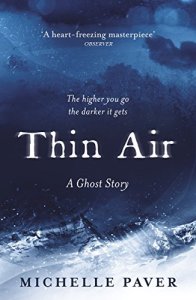
Thin Air by Michelle Paver

I read Thin Air: A Ghost Story by Michelle Paver in the summer, but it’s a good choice to read for Halloween. I didn’t find it as scary as Dark Matter, but even so it is very atmospheric and chilling – in more ways than one. The setting is Kangchenjunga in the Himalayas as a group of five men set out to climb the mountain in 1935.

Kanchenjunga, the third highest mountain in the world, had claimed many lives and no one had reached the summit. Held to be a sacred mountain, it is one of the most dangerous mountains in the world – believed to be the haunt of demons and evil spirits. An unsuccessful attempt had been made in 1907, led by Edmund Lyell, when only two men had returned. The group in 1935, led by Major Cotterell, attempted to follow the 1907 route up the south-west face.

Their story is narrated by medic, Dr. Stephen Pearce, accompanying his older brother, Kits. The brothers have always been rivals and this continues as they make their way up the mountain. Things start to go wrong almost straight away and Stephen is full of foreboding. He fears someone is following them and when he finds a rucksack left behind by the earlier climbers he fears he is loosing his mind. Under the most extreme weather conditions, the constant fear of an avalanche and the increasing effects of mountain sickness Stephen’s paranoia rises. More horrors keep piling on.

It’s not a long book, 240 pages, and almost half of it describes the mountain itself and the route the climbers took to get to the start of the climb and setting up their base camp. So it is only in the later part where the terror hinted at before sets in. The isolation, a sense of ‘otherness’, the extreme cold and the immense scale of the mountain with its towering pinnacles, deep crevasses, and above all the silence dominates. Were Stephen’s experiences the result of being at a high altitude, were they hallucinations – or was what he saw really there? I was never sure and that was part of the horror.

Thin Air is based on real events, although the 1907 and 1935 expeditions described in it are fictional. But the setting is real, the characterisation is excellent as is the feel of the 1930s, with its class snobbery, and racism and above all the creeping sense of dread that pervades the whole book.