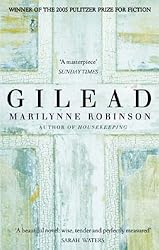
Gilead by Marilynne Robinson

This is another short post as I am still trying to catch up with writing about the books I’ve read in February. Gilead by Marilynne Robinson is one of them. It is narrated by the Reverend John Ames as he nears the end of his life. Set in Gilead, Iowa in 1956 John Ames is 76, dying of heart disease, and writing a letter to his young son aged 7 telling him the things he would have told him if he had lived to see him grow up. A letter for his son to read when he is an adult.

Ames writes stories of his brother, and his father and grandfather, including tales of what had happened in Gilead, such as the story of the horse that sank into the ground into one of the tunnels the inhabitants had made and the lengths they had gone to get it out and fill in the hole. He also wrote about his beliefs and his relationship with his friend, also a preacher, Boughton and Boughton’s son, Jack. There is a mystery surrounding Jack, what is the ‘great sin’ he committed, why he had left home, what happened to him and why he had come back. Jack is named after John, who struggles to forgive and understand Jack.

In parts I found this a bit rambling and repetitive, reflecting the fact that Ames wrote over a period of time and probably forgot he’d mentioned things before, or because he was emphasising their importance – such as the first time he met his wife, who is a lot younger than him.

I took my time reading because you do have to concentrate and not rush to find out what happened. I enjoyed it and think I would probably get even more out of it on a second reading, especially for the philosophical and religious ideas.

Reading Challenges: Mount TBR Reading Challenge ( a book I’ve owned for about 8 years).

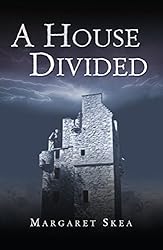
A House Divided by Margaret Skea

One of the best historical fiction books I read last year was Margaret Skea’s debut novel, Turn of the Tide, which captivated me completely transporting me  back in time to 16th century Scotland.  So I approached its sequel, A House Divided, hoping it would be just as good, and it is. Indeed it’s even better. Once more I was whisked back to the world of the feuding clans of Cunninghame and Montgomerie. It is the most gripping story of warring factions in Scotland, the French Wars of Religion, superstition and horrific witchcraft trials.

It’s now 1597, six years after the events in Turn of the Tide. The Munro family are believed to have died in a fire at their home, Broomelaw but Kate Munro and her three children are living at Braidstane in Ayrshire under the protection of the Montgomerie family. They have the assumed the name of ‘Grant’, in hiding from the Cunninghame family, particularly from William Cunninghame, the son of the Earl of Glencairn, head of the Cunninghame clan. Kate’s husband is in France, fighting with the Scots Gardes for the French Henri IV. Meanwhile William Cunninghame has taken possession of Broomelaw and is rebuilding the tower house. And it’s becoming more difficult and dangerous to keep their identity secret; the children are asking questions and the eldest, Robbie, wants to go to join his father in France.

Kate, who has gained a reputation as a ‘wise woman’ from her knowledge and skill in the use of herbs and plants for healing and as a midwife, is called to help Margaret Maxwell, the wife of Patrick, a Cunninghame supporter, with the birth of her baby. When Patrick meets Kate and her daughter, Maggie, he is suspicious. thinking they look familiar, reminding him of Munro’s wife, and so the danger begins. And it increases as Kate’s reputation grows and she is summoned to the Scottish court as Queen Anne (James VI’s wife), having heard of Kate’s expertise, needs her advice in carrying a baby to full-term.  She had been advised to try a number of methods to avoid a miscarriage:

I have eaten crushed orchid leaves, powdered fox’s lungs and crab’s eyes; drunk wolf oil and tincture of foxglove; been bled and leeched till I think I have little blood left; told to lie on my side and on my stomach, even upside down. Few treatments convenient and none effective. (location 3242)

It’s no wonder they failed and a wonder she survived!

There is so much I loved in this book – first of all the story itself, expertly narrated, full of tension and surprise, and then the characters, some based on real historical figures and others fictitious, such as the Munro family. The story is well grounded in research and based on facts – James VI, whilst waiting to inherit the English crown, wanted to bring peace to Scotland and to put an end to the wars between the clans. His interest in, or rather his obsession with witchcraft comes to the fore in this novel as Kate is accused as a witch and brought to trial as part of the Great Scottish Witch Hunt of 1597. Also historically accurate is the Scots involvement in France as under the terms of the ‘Auld Alliance’ they had citizenship rights in France as well as trading agreements and the Scots Gardes were an elite Scottish regiment whose duties included the provision of a personal bodyguard to the French King.

But it’s the personal touches that brought home to me what life was like in the 16th century, what their houses were like, the food they ate, the dangers that faced them in their daily lives, as well as the growing interest in science and medicine as opposed to superstition and religious bigotry and fervour.

This is an excellent book, one of the best I’ve read this year. Not only is the story absolutely fascinating, but it is also well written and well paced. The historical facts all blend seamlessly into the narrative, with beautiful descriptive passages not just of the landscape and the Scottish Court, but also of the grim details of warfare, of the horrors of the witch trials and of sickness, typhoid and plague, of wounds, of childbirth and of death. It’s strong, compelling reading, a book that made me keen to find out what would happen next and at the same time one I didn’t want to end.

  • Format: Kindle Edition – also available as a paperback
  • File Size: 1017 KB
  • Print Length: 480 pages
  • Publisher: Sanderling Books; 1 edition (15 Oct. 2015)
  • Author’s website: Margaret Skea, Writing yesterday, today

Margaret Skea is currently working on her third novel – I’m looking forward to reading it!

Reading Challenges: Read Scotland 2016
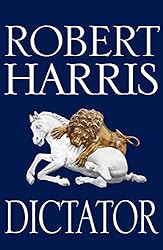
Lustrum and Dictator by Robert Harris

I’d enjoyed the first book in Robert Harris’ Cicero Trilogy, Imperium. So I’d been looking forward to reading Lustrum, the second in the trilogy (published as Conspirata in the US and Italy) . It didn’t fail to live up to my expectations – it surpassed them. I think it’s historical fiction at its best. I immediately went on to read Dictator, the third book in the trilogy, which I also enjoyed very much, but I think Lustrum is the outstanding book of the three.

I had intended to write a more detailed post about Lustrum and Dictator but life and medical issues decided otherwise, so this is just a short post on both books.

Lustrum begins where Imperium finished in 63 BC with a dramatic scene, as the body of a child is pulled from the River Tiber, a child who had been killed as a human sacrifice, grotesquely mutilated. What follows is an account of the five year period (a lustrum) of Cicero’s consulship and the battle for power between him, Julius Caesar, Pompey the republic’s greatest general, Crassus its richest man, Cato a political fanatic, Catilina a psychopath, and Clodius an ambitious playboy. It ends with his exile from Rome.

Once I began reading I was immediately drawn into the world of Cicero. The story is once again narrated by his secretary, the slave Tiro, giving access to Cicero’s thoughts and feelings. Tiro is an interesting character in his own right – he is reported to be the first man to record a speech in the senate verbatim and some of the symbols in his shorthand system are still in use today, such as &, etc, ie, and eg. As in Imperium and in the third book, Dictator, Harris has used Cicero’s actual words, adding to the books’ authenticity. Harris states that he hopes it is not necessary to read the books in order but I think it adds much to the enjoyment if you do.

Dictator covers the last 15 years of Cicero’s life when he was no longer a dominant political figure in Rome. The book begins with Cicero in exile, separated from his wife and children and in constant danger of losing his life. Apart from the first part of the book when Cicero is working towards returning to Rome, I didn’t find it as exciting or as compelling as the first two books. This is mainly because there is so much happening such as the civil war and the downfall of the republic from which Cicero is excluded first because on his return to Rome he is sidelined, and then retired.

All three books are based on extensive research but Harris is such a good story teller that they don’t read like text books. Roman history has always fascinated me and reading this trilogy has revived my interest, so much so that I am now reading Mary Beard’s book, SPQR: a History of Ancient Rome, that goes right back to the beginning describing how Rome grew and became such a dominant power.

When I saw Catilina’s Riddle by Steven Saylor sitting in the mobile library shelves I just had to borrow it. It’s historical crime fiction in which Gordianius the Finder gets involved in the Catilina conspiracy to overthrow the republic.

And I would also like to re-read Colleen McCullough’s Masters of Rome series to compare with Harris’ trilogy, or at least some of the books involving Cicero and Caesar. Oh for more time to read!

Lustrum is one of my Mount TBR Mountain Challenge 2016 books (ie books I’ve owned before 1 January 2016) .

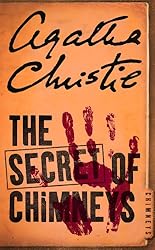
The Secret of Chimneys by Agatha Christie

In The Secret of Chimneys, Anthony Cade is drawn into a deadly conspiracy when he agrees to carry out an errand for his old friend, Jimmy McGrath. He has to deliver the manuscript memoir of Count Stylptich of Herzoslovakia to a firm of London publishers and to return a packet of letters to a blackmail victim.

It’s one of Agatha Christie’s early ‘thrillers’, first published in 1925. It is also the last full length crime novel of hers that I had left to read. I really thought I had read it but I think I was getting it mixed up with The Seven Dials Mystery, which features some of the same characters and is also set at Chimneys, a large country house, the home of Lord Caterham. The Secret of Chimneys is the first book in which Superintendent Battle of Scotland Yard appears. He is an intelligent officer, outwardly impassive and stolid, but who reaches his conclusions applying common sense. Later he appeared in four more of her novels – The Seven Dials Mystery, Cards on the Table, Murder is Easy and Towards Zero.

Agatha Christie declines to describe Chimneys, other than to say it is a ‘venerable pile‘ and that descriptions of it can be found in any guidebook. ‘It is also No. 3 in Historic Homes of England, price 21s. On Thursdays coaches come over from Middleham and view those portions of it which are open to the public. In view of all these facilities, to describe Chimneys would be superfluous.‘ (page 128)

The 1920s upper class life style is evident in the lavish breakfast that is laid on at Chimneys, set out on ‘half a score of heavy silver dishes, ingeniously kept hot by patent arrangements. Omelet, said Lord Caterham, lifting each lid in turn. Eggs and bacon, kidneys, devilled bird, haddock, cold ham, cold pheasant.’ (page 134)

I’m not going to attempt to summarise the plot of this book, other than to say that it revolves around political events in the fictitious Balkan state of Herzoslovakia, with attempts to reinstate its royal family, and also international crime concerning the theft of jewellery  by a thief known in Europe as ‘King Victor’. It reminds me of P G Wodehouse’s books, written in the same light and humorous style.  It is sheer escapism and although it is not one of my favourite of her books, it is an entertaining book.

Reading Challenges: Agatha Christie Reading Challenge, Mount TBR challenge and Golden Vintage Mystery Cover Challenge: Bloodstains

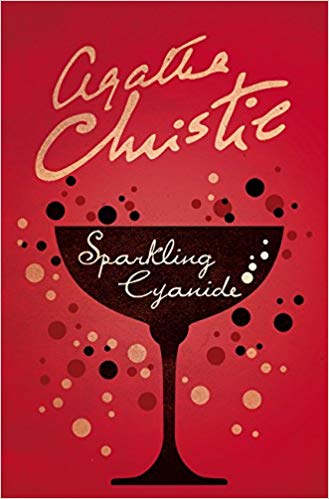
Sparkling Cyanide by Agatha Christie

Sparkling cyanideAC

Sparkling Cyanide (published as Remembered Death in America) was first published in 1945. It is a novel in which a crime is investigated a year after it was committed.

Rosemary, the wife of wealthy George Barton dies suddenly at her birthday party at a West End Restaurant, the Luxembourg, after drinking a glass of champagne laced with cyanide. Rosemary had been in a depressed and unhappy state of mind after having a bout of influenza.The official verdict was that she had committed suicide but a year on George, having received anonymous letters stating her death wasn’t suicide, is convinced that she was murdered. He arranges another party, this time for Iris, Rosemary’s younger sister, inviting the same guests, hoping to identify the murderer. But his plan goes awry, as after drinking a toast to Rosemary’s remembrance the party ends with yet another death.

Rosemary was a wealthy heiress in her own right and after her death her inheritance had passed to Iris. George had invited Colonel Race* to both parties, but he had been absent both times. He had known George since his boyhood but had only once met Rosemary, who he thought of as ‘a singularly lovely nit-wit – but certainly not a melancholic type‘. He helps Chief Inspector Kemp of Scotland Yard to investigate both deaths. As well as Iris and George the guests at the party were Ruth Lessing, George’s efficient secretary, and Rosemary’s friends, Anthony Browne, a man with a dubious past and a politician Stephen Farraday and his wife Sandra.

In a series of flashbacks Agatha Christie highlights each person and their relationships with Rosemary and it appears that each one, including George and Iris had a motive for killing her. I was convinced quite early on that one particular character had to be the murderer, but reading further on I began to have doubts, switching from one person to another. As it turned out I was right about my first suspect – Agatha Christie was expert at writing things that could be taken two ways. If I was right about the ‘who’ I couldn’t work out the ‘how’, particularly for the second death, but knew that where everyone sat at the round table was significant. When that was revealed I thought it was difficult to believe, which is why I don’t place it among her best books – but it’s still a very enjoyable read. And it was popular with the public achieving sales of thirty thousand in the first year of publication.

*Colonel Race – first appeared in The Man in the Brown Suit, also in Cards on the Table and Death on the Nile. His appearance in Sparkling Cyanide was his last. He was an agent working for the British Secret Service, often sent on difficult or sensitive missions. In this book he is over sixty, described as ‘a tall, erect, military figure with sunburnt face, closely cropped iron-grey hair, and shrewd dark eyes‘.

Reading Challenges: Mount TBR Reading Challenge and Vintage Mystery Cover Scavenger Hunt for the Golden Age in the category of ‘Bottle/Glass for drinking’.

Death Comes as the End by Agatha Christie

In 1944 Agatha Christie published Death Comes as the End and in 1945 Sparkling Cyanide, neither of them featuring Hercule Poirot or Miss Jane Marple. By chance these two books are the last full length crime fiction novels by Agatha Christie that I had left to read. There are plenty of short stories of hers that I still have to read and her Mary Westmacott novels as well as her plays, so it is not the end of my reading of her work.

Death Comes As The End

The idea to write a detective story set in Ancient Egypt came from a friend, Professor Stephen Glanville – Death Comes as the End was the result. It is set on the West bank of the Nile at Thebes in about 2000 BC. But in her Authors Note Agatha Christie explained that both time and place are incidental and any other time or place would have served as well. She based her characters and plot on some letters from a Ka priest in the 11th Dynasty:

The letters painted to perfection the picture of a living family: the father fussy, opinionated, annoyed with his sons who did not do as he said; the sons, one obedient but not obviously bright, and the other sharp-tempered, showy, and extravagant. The letters the father wrote to his two sons were about how he must take care of a certain middle-aged woman, obviously one of those poor relations who all through the ages live with families, to whom the heads of families are always kindly, whereas the children usually grow up disliking them because they are often sycophants and makers of mischief. (Agatha Christie’s Autobiography page 514)

From these letters she constructed her story, adding Renisenb, a daughter, Nofret, a concubine for Imhotep, the father, a spoilt younger son and a greedy but shrewd grandmother. He is besotted by Nofret who antagonises the family, setting Imhotep against them. Things come to a head after Nofret has manipulated Imhotep to disinherit his sons and marry her and she is found dead, apparently having fallen from a cliff. More deaths follow.

The mystery in this book is actually not too puzzling. For me, its interest lay in the setting and period details. Agatha Christie, according to her Autobiography had done a lot of reading from books lent to her by Glanville and had also bombarded him with questions about daily life and customs in the 11th Dynasty – such as what food did they eat, how did they cook it, did men and women eat together, what sort of rooms did they sleep in, where did they keep their linen, what sort of houses did they have, and so on?

The end result for me was of authenticity – it all came over as real, the characters were individuals, their relationships were convincing and although Agatha Christie wasn’t happy with the ending, which she changed on Glanville’s suggestion, I thought it was fine. And just as she had pleasure in writing it I had pleasure in reading it.

Reading Challenges: Agatha Christie Reading Challenge, Mount TBR Reading ChallengeVintage Cover Scavenger Hunt for the Golden Age in the category ‘A Green Object’.