The Wonderful Wizard of Oz by L Frank Baum

The Wonderful Wizard of Oz has been on my shelves for a few years and as I’m taking part in the Once Upon a Time event hosted by Carl at Stainless Steel Droppings I decided it was time I read it. It’s a complete change of genre for me as I rarely read children’s books.

It was first published in 1900, made into a Broadway Musical in 1902 and a film in 1939. I’ve seen the film and also a stage version in a local amateur dramatic society production some years ago.

I enjoyed this entertaining story, pure escapism, which I would have loved as a child, following Dorothy’s adventures in the Land of Oz after the cyclone whisked her house high in the air out of Kansas and set it down on top of the Wicked Witch of the East, thus killing her. Dorothy and her little dog, Toto, are very anxious to get back home to Kansas and they set out on the yellow brick road leading to the Emerald City to ask the Wizard of Oz to help them. On the way she meets the Scarecrow, the Tin Man and the Cowardly Lion, who go with her as they want the Wizard to give them brains, a heart and courage respectively.

Their journey is interrupted in various places and by a variety of creatures, some very dangerous indeed; as in most fairy tales, there is a fair amount of violence in the book, as Dorothy and her friends combat the Wicked Witch of the East. I was fascinated by the Winged Monkeys, who can grant three wishes, the Fighting Trees, the Dainty China Country and its pretty little, fragile people and by the Quadlings with their flat hammer heads.

There are several interpretations* of the story that I’ve come across, but the simple message of the story is, of course, that you have to use your brains yourself, after all the Scarecrow can think, he just doesn’t realise that he can and he came up with lots of ingenious ideas along the way; courage comes from facing danger even when you are afraid – it comes from within and the Lion does that without realising he already has courage. As for the Tin Man, again he truly did have a heart – his desire for one shows his kindness and goodness.

And by the way Dorothy’s shoes are silver and not red as in the film.

*On Goodreads there are several reviews that draw parallels with the economics of America in the late 19th century and the political climate of the time.

And I found this interesting article in The New York Times Scarecrow, Lion, Tin Man and Freud, Too by Janet Maslin discussing this book: The Real Wizard of Oz, The Life and Times of L. Frank Baum by Rebecca Loncraine. Baum apparently drew on his own experiences in writing his book – images of the Civil War amputees led to the Tin Man, bizarre sights such as displayed by PT Barnum, the Chicago World Fair and so on. It sounds a fascinating book! I am constantly finding reading one book leads on to wanting to read yet more books – and I hadn’t realised before that there are more Oz books that Baum wrote!

Three Act Tragedy by Agatha Christie

Three Act Tragedy 001

I’ve been working my way through Agatha Christie’s books over the past few years and I have just a few left to read. Three Act Tragedy is one of them. It was first published in 1935 (as Murder in Three Acts in America).

As the title indicates the book is divided into three acts, or rather parts, First Act – Suspicion, Second Act – Certainty and Third Act – Discovery. It begins as though it were a theatre programme:

Directed by

SIR CHARLES CARTWRIGHT

Assistant Directors
MR SATTERTHWAITE
MISS HERMIONE LYTTON GORE

Clothes by
AMBROSINE LTD

Illumination by
HERCULE POIROT

Summary from the back cover:

Sir Charles Cartwright, the distinguished actor, was giving a party. Around him his guests stood talking and drinking. The Reverend Stephen Babbington sipped his cocktail and pulled a wry face. the chatter continued all around. Suddenly Mr Babbington clutched at his throat and swayed …

The beginning of the drama …

Sir Charles suspects that Mr Babbington was murdered but Hercule Poirot, one of the guests, disagrees and there is nothing to show that his death was by any other than natural causes and besides who could possible have cause to kill him! However, later when Sir Bartholomew Strange, a distinguished Harley Street doctor who was also a guest at Sir Charles’ party, drops dead after sipping a glass of port at another party with some of the original guests, it becomes clear that this is murder by poisoning.

This is one of those cases where Poirot plays a secondary role, preferring to think rather than act and it is Mr Satterthwaite and Sir Charles who investigate the deaths. Mr Satterthwaite is an interesting character – ‘ a  dried-up little pipkin of a man’, ‘ a patron of art and drama, a determined but pleasant snob’ and ‘a man of considerable intelligence and a very shrewd observer of people and things.’ An ideal partner in investigation for Poirot.

(This is Mr Satterthwaite’s first appearance outside a Harley Quin story – I have yet to read the Harley Quin stories.)

As for the other characters, some fade into the background, whilst others like Sir Charles and Hermione Lytton Gore, known affectionately as Egg are in the spotlight. This is one of Agatha Christie’s earlier books and is full of baffling clues, conjuring tricks, clues concealed in conversations, with larger than life personalities, and above all with puzzles to be solved. I really enjoyed it.

In this book Hercule Poirot reveals a little of his history, coming from a large and poor family he had worked hard in the Belgian police force, made a name for himself and an international reputation. He was injured in the First World War and came to England as a refugee, eventually becoming a private inquiry agent. He displays his usual vanity and egotism when talking to Mr Satterthwaite, who had realised that he might have accidentally have drunk the poisoned cocktail, by saying:

‘There is an even more terrible possibility that you have not considered. … It might have been ME.

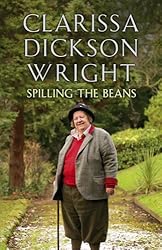
Spilling the Beans by Clarissa Dickson Wright

I’ve left it a bit too long to write about Spilling the Beans, Clarissa Dickson Wright’s autobiography because I’ve now forgotten much of the detail.  It’s a book I really enjoyed, but I finished it nearly two weeks ago! I’ve  been feeling a bit under the weather recently with a rotten cold and although I have been reading I haven’t been able to summon up enough mental energy to write much!
I quoted from the opening of the book in this post, with these details about Clarissa:

Clarissa Dickson Wright was an English celebrity chef ‘“ one of the Two Fat Ladies, a television personality, writer, businesswoman, and former barrister. She died last year on 15 March in the Edinburgh Royal Infirmary. Clarissa was a huge character in more than her size! Her autobiography is fascinating, coming from a privileged and wealthy background she had a difficult childhood- her father, a well respected surgeon was also an alcoholic who beat his wife and Clarissa.

After her mother died she took comfort from alcohol and at the mid point of the book she was as she described it ‘˜sunk in gin’ and homeless. I am looking forward to reading about her road to recovery.

In the rest of the book she described her period of homelessness, sleeping on benches in the Victoria Coach Station for two nights, but spending the rest of the time staying with friends, until she took jobs in domestic service, where she learned to cook. I liked her attitude to being a servant:

I have never understood the aversion to domestic service … I am not sufficiently bourgeoise to worry about my place in the class system and if you don’t understand this, well, that’s your problem. I had no sense of downshifting; maybe I should have had but pragmatism is the saving of many an alcoholic. (page 154)

She then went on to tell about her ‘dark night of the soul’ and her time at addiction centres, the treatment and her eventual recovery. All this took years and she was very honest and open.

She also wrote about her bookselling experience – all totally news to me – her time at ‘Cooks for Books’ changed her life and later after she had moved to Scotland in the late 1980s  she ran the Cook’s Bookshop in Edinburgh near the Grassmarket. She was declared bankrupt three times, was rector of Aberdeen University for six years. And then, of course, there were her TV shows – Two Fat Ladies, with Jennifer Paterson and Clarissa and The Countryman with Johnny Scott. She was a staunch supporter of the Countryside Alliance, against the ban on foxhunting .

Despite all her difficulties and her alcoholism this is an upbeat autobiography, ending on a positive note: “Believe me on one thing: I have a splendidly enjoyable life”. And believe me this is  a ‘splendidly enjoyable’ autobiography.

My copy is a hardback book, which I bought, but it is also available in paperback and ebook.

Note: I didn’t read this book to meet any challenges, but it does:

There is a spot just by the Scots Border at Berwick-upon-Tweed, where the train passes a stretch of the sea coast. Looking out of the window I felt, Oh it’s so lovely to be home, and if it’s home, I thought, I’d better stay and I have been here ever since. (page 225)

For another review see Cath’s blog Read Warbler.

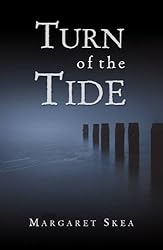
Turn of the Tide by Margaret Skea

I have read some wonderful debut novels this year –  Turn of the Tide by Margaret Skea is one of them. I loved it. It’s historical fiction and it captivated me completely transporting me  back in time to 16th century Scotland. If you have ever wondered,  as I have, what it must have been like to live in a Tower House in the Scottish Borders then this book spells it out so clearly. And it puts you firmly in the middle of the centuries old feud between the Cunninghames and the Montgomeries, with all the drama of their battles, ambushes and schemes to further their standing with the young King James VI. It’s a tale of love, loyalty, tragedy and betrayal.
It’s no wonder that the book was  the Historical Fiction Winner in the 2011 Harper Collins / Alan Titchmarsh People’s Novelist Competition and won the Beryl Bainbridge Award for Best First Time Author 2014.

There is a map setting the scene in Ayreshire on the west of Scotland between the Firth of Clyde and the Solway Firth, showing the major sites in the book. I found both the map and the list of main characters most useful whilst following the story. And to complete my understanding there is a Glossary of Scottish words at the back of the book, although the meaning of most of them was clear from the context.

It begins in 1586  with an ambush in which several of the Montgomerie Clan, on their way to James VI’s court at Stirling are killed, followed by the Clan’s reprisal on the Cunninghames. James, anxious to settle the feud between his nobles, asks them to swear to bring their feud to an end, which brings an uneasy peace between them – for a while.

Most of the characters are real historical figures, includingJames VI, the Cunninghames – William, the Master of Glencairn and the Montgomeries – Hugh, the Master of Braidstane and their families. The feud is also a matter of fact. It began in 1488 when James IV gave control of the Balliewick of Cunninghame to a Montgomerie! It didn’t come to an end until the beginning of the 17th century.

The main characters,  Munro and his wife Kate and a few of the others are fictional. Munro is a minor laird who whilst owing allegiance to the Cunninghames, has increasing sympathy and liking for the Montgomeries. His dilemma only increases throughout the book.

Margaret Skea has done her research well, not just the feud and battles but also the domestic settings are detailed down to descriptions of the clothing, the food and so on – even how the town house rooms were finished with limewash, which involved carrying bucket-load after bucket-load up four flights of stairs to rejuvenate the attic chamber where the children slept. But it slots seamlessly into the story, adding colour and life to the scenes.

It’s all fascinating  – the hunt arranged for the king, the account of his journey across the North Sea to bring home his bride, Anne of Denmark, the scenes as the royal party lands at Leith and the coronation in Edinburgh, as well as the jockeying for positions, and the battles all culminating in a tense and dramatic finale.

Not only is this riveting history it is also so well written, beautifully descriptive:

Across the valley the castle reared against the skyline, the town tumbling down the slope below, wisps of smoke beginning to unfurl, first one, then another, then too many to count, as Stirling awoke.

The countryside was spread out before him like a map; the distant hills to the south west smudged against the watery sky; the river a dark ribbon snaking through the marshland below, cradling Cambuskenneth in a giant u-shaped loop. (pages 98-99)

and this – such a startling image:

Daylight slipped into their bedchamber like wraith; grey and insubstantial, filtered through the grime and soot that coated the outside of the windowpanes. (page 247)

And I’m delighted that Margaret Skea is writing a sequel as I really want to know what happened next to Munro and his family. The working title is A House Divided, continuing the story in the late 1590s.

  • Paperback: 416 pages – also available on Kindle
  • Publisher: Capercaillie Books Limited; first edition (22 Nov. 2012)
  • Language: English
  • ISBN-10: 1909305065
  • ISBN-13: 978-1909305069
  • Source: I bought my copy
  • Author’s website: Margaret Skea, Writing yesterday, today

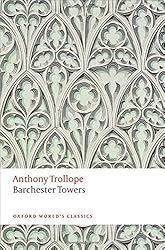
Barchester Towers by Anthony Trollope

First published in 1857 Barchester Towers, is the second book in Anthony Trollope’s Chronicles of  Barchester series, following on from The Warden.

As I began reading this book I was thinking it’s really slow, very much set in its period detailing the religious and ecclesiastical controversies of its time, but then the story of who was going to succeed the old dean, who was going to be the warden, Mr Harding or Mr Quiverful (with his 14 children) and above all who was going to marry Eleanor, Mr Harding’s widowed daughter took hold of me. Not to mention the odious Mr Slope, chaplain to the new Bishop, the ambitious, but hen-pecked Dr. Proudie and his overbearing wife who would dearly like to be the Bishop herself; the Archdeacon Dr Grantly and his wife, Susan Mr Harding’s elder daughter; the Stanhope family including the entrancing cripple, Madeline, ‘a basilisk from whom an ardent lover of beauty could make no escape‘; and the Thornes of Ullathorne.

Barchester Towers provides a view of the class structure of society, in Victorian Britain. Miss Thorne and her brother, the local squire  hold a party, a gala day, inviting all the main characters and the local labourers, their wives and children. The guests are divided according to their place in society – the upper classes and the non-quality were to eat in separate marquees. The question arose as to who should go where amongst the lower class of yokels, with the Lookalofts and the Greenacres. The Lookalofts won’t sit among the bumpkins, nor will Mrs Lookaloft think Mrs Greenacres should sit next to her and talk about cream and ducklings. But neither is she a fit companion to the Thornes and Grantlys – what a dilemma for Miss Thorne! It’s scenes like these that make Barchester Towers such an entertaining novel.

This is a novel strong on character, less strong on plot, with strong female characters, power-hungry men, humour and pathos as the various battles for supremacy are played out. And throughout the book the narrator frequently expresses his opinion on the characters and on the novel itself. Here he describes Obadiah Slope:

I never could endure to shake hands with Mr Slope. A cold, clammy perspiration always exudes from him, the small drops are ever to be seen standing on his brow and his friendly grasp is unpleasant. (page 31)

The characters, however, are not portrayed as wholly good or wholly bad. Here Trollope indicates Mr Slope’s better (if you can call it that) side:

And here the author must beg it to be remembered that Mr Slope was not in all things a bad man. His motives, like those of most men were mixed, and though his conduct was generally different from that which we would wish to praise, it was actuated perhaps as often as that of the majority of the world by a desire to do his duty. (page 146)

He also comments on how he has made his characters withhold the truth from each other, causing such misunderstandings between them:

Everything would have been explained … had she but heard the whole truth … But then where would have been my novel? (page 337)

In his Autobiography Anthony Trollope wrote that he had taken great delight in writing Barchester Towers, the characters of the Bishop and Mrs Proudie were very real to him, as were the troubles of Dr Grantly, the archdeacon and the loves of Mr Slope. As they are to me too.

I thought this statement of his was very interesting:

It [Barchester Towers] achieved no great reputation, but it was one of those novels which novel readers were called upon to read. Perhaps I may be assuming more to myself than I have a right to do in saying now that Barchester Towers has become one of those novels which do not die quite at once, which live and are read for perhaps a quarter of a century; but if that be so, its life has been so far prolonged by the vitality of some of its younger brothers. Barchester Towers would hardly be so well known as it is had there been no Framley Parsonage and no Last Chronicle of Barset. (page 104)

and here we are over 150 years later still reading Barchester Towers.

The next book in the series is Doctor Thorne, which Trollope thought had a good plot and was, he believed, the most popular book he had written. I’m looking forward to reading it.

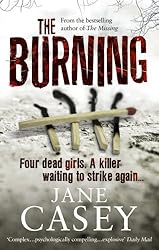
The Burning by Jane Casey

The Burning by Jane Casey is one of the books I selected for the TBR Pile Challenge 2015. It’s a book that I read about on other book blogs and thought I would like.  I was right – I really enjoyed it.

It’s the first the DC Maeve Kerrigan series. Maeve is on the murder task force investigating the case of the serial killer the media call The Burning Man. Four young women have been brutally murdered, beaten to death and their bodies burnt in secluded areas of London’s parks. When a fifth body is discovered that of Rebecca Haworth, it appears to be the work of The Burning Man – but is it, there are slight differences? The more that Maeve and her colleague Rob Langton check out the facts it appears it could be a copy-cat killing.

The pace of the book is quite slow at first as the characters are introduced and the story unfolds mainly through Maeve’s eyes  with some  chapters narrated by Rebecca’s friend Louise, and briefly by Rob. Because the pace is slow to begin with the main characters are fully rounded – Maeve in particular is a likeable character, intelligent and empathetic, working to impress her male colleagues and determined to catch the murderer. She’s new to the job, which both her boyfriend and her family criticises. Rebecca’s character is revealed through Louise’s eyes,  fleshed out as other friends give their versions of her past to Maeve and Rob. As the pace picks up, a complex  plot develops providing several suspects which kept me turning the pages right to the end.

I have the third Maeve Kerrigan book, The Last Girl, but I think I’ll postpone reading it until I’ve read the second book, The Reckoning. There are now six books in the series and Maeve has her own website!

As well as the TBR Pile Challenge The Burning completes one of the categories in the What’s In a Name challenge, that of a book title containg a word ending in ‘ing’, the My Kind of Mystery challenge and also the Mount TBR Reading Challenge (a book I’ve owned prior to 1 January 2015).