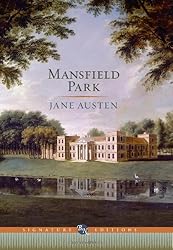
Mansfield Park by Jane Austen

For years I’ve thought I’d read all of Jane Austen’s books, apart from Lady Susan/The Watsons/Sanditon, but then last year I wondered about Mansfield Park, and I realised I couldn’t remember much about it. At first I thought it was one of those books I must have read years ago and forgotten the detail. So, I thought I’d have a look at it again to refresh my memory, but when I looked for my copy I couldn’t find it and slowly I began to think I hadn’t read it at all and bought one. And, lo and behold it was totally new to me – I hadn’t even watched the TV version!

On the surface Mansfield Park is a simple story about a family and their relationships. Fanny Price, as a child of 10 goes to live with her wealthy aunt and uncle, Sir Thomas and Lady Bertram at Mansfield Park, where as the poor relation she is not treated badly, but not as cared for or as kindly as her cousins, but more as an unpaid servant dependent on the family for her welfare – a sort of Cinderella story.

But through the story, Jane Austen reveals the complicated interaction of society, shows the development of Fanny’s character and the depiction of a heroine who is good and gentle who matures throughout the novel. Fanny is an unassuming character who at first appears to be too self-effacing and timed, but who grows in strength of character. I think it’s a very clever portrayal because the reader sees things through Fanny’s eyes. Whilst at first I wanted to give her a shake and say pull yourself together, you’re being a doormat, I realised that Jane Austen was drawing a realistic portrait and waited to see how she would develop.

Like the other novels, Mansfield Park is full of detail of everyday life, its boredom as well as its entertainments and pleasures, the  balls and dinners. There is much in it about the houses and gardens, not only of the wealthy but also of the lower classes, such as Fanny’s parents home in Portsmouth – but they have servants themselves, so it is only comparative poverty. Seen mainly through Fanny’s eyes, it’s a study of morals, the damage caused by being unwanted and unloved.

There is, of course, so much more to say about this book – Mrs Norris’s snobbery, her obsession with  penny-pinching and her nasty, spiteful behaviour; the opinion of clergymen, seen through Mary Crawford’s mercenary eyes as she thinks about Edmund Bertram’s position; the flirty behaviour of the ‘charming’ Henry Crawford; the apparent coldness of Sir Thomas and his family’s distance from him; Lady Bertram’s languid life from her sofa; the disruption caused by the play and so on. There is also a gentle strain of humour and satirical observations about contemporary values, and even, with Mary Crawford’s pun on ‘Rears and Vices‘, a bawdy note.

Yes, I definitely like Mansfield Park and pleased it came up for me in the Classics Club Spin, which gave me the necessary push to read it in June.

Mount TBR Checkpoint 2: June 2014

It’s time for the second quarterly check-in post for Bev’s Mount TBR Reading Challenge 2014. The months are speeding by! Bev asks:

1. Tell us how many miles you’ve made it up your mountain (# of books read). 

I’ve read 30 of my TBRs, so I’m nearly at the top of Mt Vancouver with just six more books to go. The list of books I’ve read is here. These last three months I’ve read 6.5 books. I did much better in the first 3 months of the year as I only read from my own shelves then, reading 23.5 books. But after that I’ve read mainly library books and books I’ve recently acquired.

To reach my target of Mt Ararat (48 books) by the end of the year I really will have to concentrate on books I’ve had on my shelves since before the beginning of this year.

2. Use titles from your list to complete as many of the following as you can. If you haven’t read enough books to give you good choices, then feel free to use any books yet to be read from your piles. I’ve given my answers as examples. Feel free to add words (such as “a” or “the” or others that clarify) as needed.

My Day in Books

I began the day with Ethan Frome
before breakfasting on Five Little Pigs. (No, I really wouldn’t eat even one little pig!!)

On my way to work I saw Mansfield Park
and walked by Cannery Row
to avoid The Crow Trap
but I made sure to stop at The Thirty-Nine Steps.

In the office, my boss said, The Grass is Singing
and sent me to research Shakespeare’s Restless World .

At lunch with Nemesis
I noticed  The Lost Army of Cambyses
playing a game of Not Dead Enough.

When I got home that night,
I studied [the] Cloud Atlas
because I’m interested in  The Sea Change
and I decided that They Do it with Mirrors.

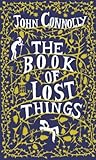
The Book of Lost Things by John Connolly

I like fantasy, so when I came across The Book of Lost Things, a modern version of traditional fairy tales that has glowing reviews from various sources, I was keen to read it. Fairy tales are full of bad things happening to people, wicked stepmothers, evil witches, wolves and trolls, fantasy characters, damsels in distress and magic and enchantments, but in the end good overcomes evil and they live happily ever after.

The Book of Lost Things begins at the start of World War Two, with David, a boy of twelve, who is mourning the death of his mother, resenting his father’s new wife, Rose and his new baby brother, George. Alone in his bedroom he hears the books on the shelves murmuring and whispering in the darkness, and his fantasy world becomes peopled with the characters from his books and he dreams of the Crooked Man, waiting for him out in the woods beyond the house.

One night his dreams and nightmares become reality as he sees through a fissure in his room into another realm beyond. He falls unconscious and coming to he hears his mother calling out him to save her, saying she is not dead but trapped in a strange place. He climbs out of his window and then as a bomber crashes in the garden David escapes through the sunken garden into a different world, a world peopled by the characters from the stories he has been reading. Told that the king has a ‘Book of Lost Things’ that will help him find the way back to his own world, he is met with the most terrible and gruesome opposition.

As well as stomach churning and excruciatingly toe-curling grisly detail there are some very dark episodes in this book with an element of moralising within the story from a number of ‘father figures’ David meets, for example the Woodsman and the knight Roland who tells him that life is filled with threats and dangers.

It is indeed filled with danger but the book becomes a sequence of ‘this happened and then that happened’, of showing rather than telling. The writing is flat; there is no sense of suspense, David is attacked and goes on to fight battle after battle as the characters helping him are killed off. There are his battles against the Loups, wolves who dress like men. He has to answer a riddle to choose the right bridge to cross a chasm thronged with harpies. He meets seven dwarves  dominated by an obese Snow White, her face caked with white make-up (this story is quite funny actually with its references to communism). He comes across a peasant village terrorised by a monstrous loathsome worm which gives birth in mid-battle. He eventually finds the castle of thorns where his mother may be imprisoned, and then finally the great castle of the ancient and now dying king, the guardian of the ‘book of lost things’. And behind it all is the sinister and evil Crooked Man.

I quite liked the concept of this book, it promised much, but I didn’t like its gruesomeness, the torture chambers, the animal and human experimentations, the sexual innuendos, nor did I like the ending, which I thought was weak. These details didn’t leave me with a chill down my spine, but just feeling rather sick.

Still, it seems an appropriate book to include in the Once Upon a Time Challenge, which ended yesterday and certainly for the Mount To Be Read Challenge as it has sat unread on my shelves for 7 years. Maybe fairy stories are no longer magical for me, this one wasn’t.

I can almost hear the rest of my books muttering, well thank goodness that one’s on its way out of the house.

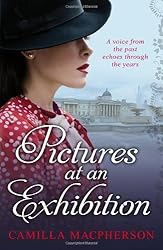
Pictures at an Exhibition by Camilla Macpherson

I enjoyed Pictures at an Exhibition by Camilla Macpherson very much. It’s a dual time period novel moving between the present day and the Second World War, a format I think that can be hard to do successfully. In this book, Camilla Macpherson’s first published novel, I think it is successful as I was equally keen to find out what happened next in both periods.

Pictures at an Exhibition is structured around Daisy’s letters to her cousin Elizabeth telling her about the paintings on display at London’s National Gallery during the war years – one a month. In the present day Claire reads the letters, left to her husband Rob, by his grandmother, Elizabeth. They are not just about the paintings but also about Daisy’s life and the man she meets and loves. Claire meanwhile, is struggling to recover from a tragedy that threatens to overwhelm her and wreck her marriage. She decides to read the letters, one a month, and visit the National Gallery to see the paintings and compare them with Daisy’s descriptions.

I found the characters thoroughly convincing, the settings and the time periods contrasting vividly and loved all the details about the paintings. I also liked the way the characters developed throughout the book. For example, at the beginning of the book, which I found so devastatingly sad, Claire is full of anger and grief, affecting her relationship with Rob:

It was the grief speaking. It could do strange things grief. She had not known that until now. She had never had to know. It had brought with it this desperate, physical need to blame someone, someone who would be right there when she had to lash out – Rob. The only person who was always there. (page 106)

She becomes obsessed with the letters, the paintings and with Daisy’s life. It’s a remarkable portrayal of a woman in crisis and how she managed to find herself again. Daisy’s story is just as convincing describing life in London during the Blitz and along with Claire I really wanted to know more about her and what happened to her.

I think it was the art that drew me to this book in the first place and I found those parts of the book absolutely fascinating. The National Gallery did display one painting a month after most of them had been transported away from London and the bombs for safe keeping. You can see the paintings described by scanning the QR codes at the beginning of each chapter and also see them on Camilla Macpherson’s website, and of course on the National Gallery’s site too. I knew of most of them before, but not all of them and as I was reading I printed copies to see what Daisy and Claire saw.

But by the end of the book it was the characters and the story that had captivated me too.  It’s about life and death, love and loss, grief and relationships and I found it compelling reading – when I wasn’t reading it I was thinking about it and keen to get back to it. It’s a book I want to re-read at some time – and there aren’t many of those.

My thanks go to Camilla Macpherson, who kindly sent me a copy of her book. I look forward to reading more of her work in the future.

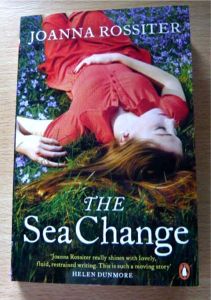
The Sea Change by Joanna Rossiter

Set in lost landscapes, The Sea Change is Joanna Rossiter’s debut novel revolving around a mother and daughter caught up in catastrophic events. The lost landscapes are the village of Imber, a Wiltshire village that was requisitioned by the army during World War Two, where Violet had grown up, and the coastal village of Kanyakumari in Southern India, where her daughter Alice was caught up in the tsunami that devastated the area in 1971.

It’s about lost lives too, wrecked relationships, the isolation of people through their inability to communicate with each other, about love, loss and grief and above all about the relationship between mothers and daughters and sisters.

I enjoyed reading this beautifully written book; I could easily visualise the different landscapes as I read. It begins with drama in the ‘present’ (1971) as the tsunami sweeps through Kanyakumari, separating Alice from her new husband, James and she is in danger of drowning. The story is a dual time novel told alternately by Alice and Violet. After the dramatic opening scenes it then moves immediately to Imber in 1971 as Violet returns to Imber and recalls how they were forced to leave, clinging to Imber ‘as if it were a lost soul.

There are parallels between their stories, both caught up in events outside their control. I was more interested in Violet’s story as she and her mother and sister try to carry on with their lives during the war, mourning the death of her father. And yet Alice’s story is also moving as she desperately searches for James.  Alice and Violet had not parted on good terms when Alice had left home to go on the hippy trail and I liked the way the two stories gradually came together and details of their lives became clearer.

I wrote about the opening paragraphs of this book in this earlier post.

Thanks to Penguin for providing a review copy of this book. I’m sorry to say that it has sat unread apart from the opening pages on my bookshelves since last year when I received it. This is one reason I’m reluctant sometimes to accept review copies – there are so many books clamouring to be read!

Joanna Rossiter has her own website where you can see a YouTube video of her reading from the beginning of the book and talking about her book. I hope she writes more books!

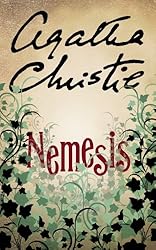
Nemesis by Agatha Christie

Nemesis first published in 1971, is one of Agatha Christie’s later books written in her eighties. It is the last book she wrote about Miss Marple. There are two more books that were published later, but those were written earlier. It’s not among the best of her books, it’s slow moving, lots of dialogue, lots of recapping of events and clues, lots of moralising and social commentary. It follows on, although it is not a sequel to, A Caribbean Mystery in which Miss Marple met Mr Rafiel.

It’s slow moving because for quite a while Miss Marple doesn’t know what the crime is that she has been asked to investigate. Mr Rafiel, who she met in the West Indies, has left her £20,000 in his will on condition she investigates a certain crime, but doesn’t give her any details. He wrote that she had a natural flair for justice leading to a natural flair for crime and reminded her that the code word is Nemesis. Then she is invited to join a tour of Famous Houses and Gardens of Great Britain at Mr Rafiel’s expense. And off she goes.

As Miss Marple remarks:

Murders as reported in the press have never claimed my attention. I have never read books on criminology as a subject or really been interested in such a thing. No, it has just happened that I have found myself in the vicinity of murder rather more often than would seem normal. (page 90)

What an understatement!

Miss Marple has to first of all work out who she can trust.Very gradually through meeting people and talking to them in her usual rather scatty old-lady manner Miss Marple begins to uncover a crime committed years earlier, working largely on intuition. During this process Miss Marple ponders on a number of subjects from wondering how the three witches in Macbeth should be portrayed, during the visit Mr Rafiel had arranged for her with the three sisters at the Old Manor House, to her disapproval of the clothes young women wore. I suspect this was Agatha Christie using Miss Marple as a mouthpiece for her own views – just as this view of rape expressed by  another character, Professor Wanstead, a friend of Mr Rafiel may be her own thoughts too:

Girls you must remember, are far more ready to be raped nowadays than they used to be. Their mothers insist, very often, that they should call it rape. (page 182)

But I wondered about the whole premise of the book – would someone really ask a person to investigate a crime and not give them any details?  It seems highly improbable to me even if Mr Rafiel had wanted Miss Marple to approach the crime with an open mind. And surely if Mr Rafiel really wanted to discover the true facts about the crime he could easily have done so before he died.

I think Nemesis lacks tension and suspense. The characters are rather hard to differentiate, mainly because there are too many, and too many who have no part in the mystery. There are few red herrings to deflect the reader, just unexplained facts that Miss Marple clears up in the last chapters. But I think it is an unusual book and I quite enjoyed it.