Catching Up

Half of September has gone! I’ve read 5 books and haven’t written about any of them (except for one and that’s for the Shiny New Books blog – more about that book later). The other four books are:

  1. The Goldfinch by Donna Tartt (on Kindle)
  2. Wycliffe and the House of Fear by W J Burley
  3. Testament of a Witch by Douglas Watt (on Kindle)
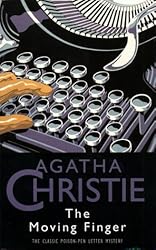
  4. The Moving Finger by Agatha Christie

It’s much easier to write about a book straight after I’ve read it, so today’s post is about the last book I’ve finished, which is The Moving Finger by Agatha Christie. I’ll try to nudge my brain into writing about the other books as soon as I can.

The Moving Finger is a book I’ve had for a few years now, so it’s one off my to-be-read shelves. It is described as a Miss Marple mystery, but as she doesn’t appear in the book until three-quarters of the way through and after there have been two deaths, she doesn’t have a big part, although she is instrumental in unveiling the murderer.

The story is narrated by Jerry Burton, who has recently moved into the market town of Lymstock with his sister, Joanna. His doctor had instructed him to move to the country where he can take things slowly and easily whilst he recovers from a flying accident. Lymstock seems to be a ‘peaceful backwater where nothing happens‘, but soon after the Burtons have moved in Joanna receives a very nasty anonymous poison-pen letter. They discover that other people have also received them, and soon afterwards Mrs Symmington apparently commits suicide followed by the death of her maid, Agnes, which is without doubt murder.

I liked The Moving Finger. As usual with Agatha Christie’s novels there are plenty of suspects, including Mrs Cleat, well-known as the ‘local witch’, and there are plenty of clues, with a good deal of misdirection throwing me into confusion about who could possibly be the culprit. She captures the nastiness of the anonymous letters well with their accusations of illicit sexual activities. I always think Agatha Christie excels with her dialogue. It’s all so natural and I have no difficulty following who is speaking. I was also convinced about the characters, especially Megan Hunter, Mrs Symmington’s twenty-year old daughter and her relationship with her step-father. Lymstock, itself is a place about fifty years behind the times, but by no means the ‘peaceful backwater where nothing happens‘ that Jerry Burton was seeking.

The police are eventually called in, in the person of Superintendent Nash who then requests help from an expert from London on anonymous letters – Inspector Graves. But the vicar’s wife, Mrs Dane Calthrop isn’t satisfied and brings in an expert of her own, an expert who ‘knows people‘, ‘someone who knows a great deal about wickedness‘ and that person is of course, Miss Marple.

The Moving Finger was first published in 1942 in New York and then in the United Kingdom in the spring of 1943. Along with the puzzle, Agatha Christie, speaking through her characters. makes several comments that interested me – on work/idleness for example. The local doctor’s sister, Miss Griffith, who is a Girl Guide leader, states that idleness is an unforgivable sin, and in response Jerry Burton says:

Sir Edward Grey … afterwards our foreign minister was sent down from Oxford for incorrigible idleness. The Duke of Wellington, I’ve heard, was both dull and inattentive to his books. And has it ever occurred to you, Miss Griffith, that you would probably not be able to take a good express train to London if little Georgie Stephenson had been out with his youth movement instead of lolling about, bored, in his mother’s kitchen until the curious behaviour of the kettle lid attracted the attention of his idle mind?

Another example – considering whether Providence/the Almighty/God would permit dreadful things to happen ‘to awaken us to a sense of our own shortcomings‘, Jerry Burton responds:

There’s too much tendency to attribute to God the evils that man does of his own free will. I might concede you the Devil. God doesn’t really need to punish us, Miss Barton. We’re so very busy punishing ourselves.

Re-reading at her detective novels, Agatha Christie wrote in her Autobiography:

I find that one I am really pleased with is The Moving Finger. It is a great test to re-read what one has written some seventeen or eighteen years later. One’s views change. Some do not stand the test of time, others do.
Put On By Cunning by Ruth Rendell

Put On By Cunning, aka in America as Death Notes is another book off my to-be-read shelves, an enjoyable read. It was first published in 1981.

The epigraph indicates just what is to follow:

So shall you hear
Of deaths put on by cunning and forc’d cause;
Fall’n on th’inventors’ heads all this can I
Truly deliver.

Hamlet

It is a tale of great complexity, a tale of murder and conspiracy to murder. A wealthy old man, Sir Manuel Camargue, one of greatest flautists of his time is found dead. Ankle deep in snow he had lost his footing in the dark and slipped into an icy lake and became trapped. His heiress, his daughter Natalie, had only recently been reunited with him after an absence of nineteen years. Although it seems a straight forward death, Camargue’s much younger fiancée puts doubts in Chief Inspector Wexford’s mind when she tells him that Camargue had said that the woman who presented herself as Natalie was an imposter.

As is Wexford’s way he becomes obsessed with finding the truth and wonders if Camargue’s death was actually murder, despite the Chief Constable’s insistence that he forgets about it as the evidence all points to his death being an accident. Indeed, the verdict of the inquest is ‘Misadventure’. Wexford, however, is persistent in his doubts and convinced Natalie is an imposter, he is determined to investigate, which leads him to both California and France.

There is much I enjoyed in this, the eleventh Wexford book. It begins well, Ruth Rendell sets an excellent scene, and I could easily visualise the locations and characters, with beautiful descriptive passages. Inevitably, as both Wexford and Inspector Burden, begin to unravel the mystery more and more characters are implicated, until it really does seem a complex case becoming even more complicated, with too many coincidences and characters.

I thought that Wexford was keeping far too much to himself – leaving both Burden and me too much in the dark. The ending came as somewhat of an anti-climax as Wexford explained what had really happened and revealed all the false leads. Still, it kept me guessing to the end and I wondered (as I often do) just what clues I had missed along the way.

And now I’m wondering if I could attempt a ‘Ruth Rendell/Barbara Vine Reading Challenge’, along the lines of the ‘Agatha  Christie Reading Challenge’, ie to read all her books. I’ve read several already.

The Shadows in the Street by Susan Hill

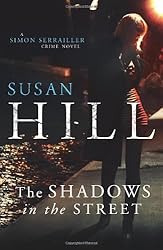
The Shadows in the Streets is Susan Hill’s fifth Simon Serrailler crime novel. I’ve read the earlier books which I enjoyed, although I found the fourth book, The Vows of Silence rather a gloomy book not just because of the murders but also because of the unhappy state of Simon and his family. So, I decided to wait a while before moving on to the fifth book. And I am now way behind in reading the series, which will reach book 8 in October!

Susan Hill’s Serrailler novels, whilst being crime fiction, concern moral and social issues. They also follow the lives of the Serrailler family, the main characters being Simon and his sister, Dr Cat Deerbon, which is why I think it’s best to read them in order. I noticed that in this book there are references to events and characters in the earlier books and I had to look back to refresh my memory. Without knowing what happened before those incidents would not have made much sense. The books are character-driven, concentrating on the people involved in the crime rather than the police investigations, although that of course is also part of the story.

There are two major themes in this book. One concerns the murders of local prostitutes, found strangled and Susan Hill draws a sympathetic, but never a condescending or judgemental view of these women’s lives, resulting in a moving storyline of a young woman, Abi who is a single mother. Alongside this is the problem of mental illness, with Ruth Webber, who suffers from manic depression. She is the wife of the new Dean of the Cathedral and arrives full of plans to change things, which causes problems. When she too goes missing there are fears she may become one of the murder victims.

I think of these novels more as psychological studies than crime fiction – the characters and their lives predominate, whilst the police make slow progress in finding the murderer (much like real life, maybe). Anyway it’s the characters and their problems that interested me more in this book than the police procedures.

The Shadows in the Street is a complex book, but it is immensely readable and once the mystery really got under way it’s tense and full of suspense. I really enjoyed it.

Dark Matter by Philip Kerr

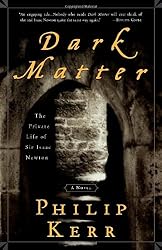
Dark Matter by Philip Kerr is a book from my to-be-read piles. I bought it at a library sale a couple of years ago now, attracted by the title. I soon realised that it is not about Newton, the mathematician and physicist because the sub-title is : The Private Life of Sir Isaac Newton. It is actually historical crime fiction, set in 1696 when Newton was the Warden of the Royal Mint at the Tower of London.

Christopher Ellis, the narrator of the book, is sent to the Tower to assist Newton to hunt down counterfeiters during the period of the Recoinage of the currency, when fake gold coins were being forged. This leads to the discovery in the Tower moat of the body of the former clerk of the Mint , followed by yet more murders. Newton at times seems remarkably like Sherlock Holmes in his powers of observation and deduction, as he and Ellis follow the trail of the murderers, involving tales of the missing treasure of the Knights Templars, (was the clue to its whereabouts in a book hidden in the Tower?), a difficult code to decipher, plots against Roman Catholics, astronomy and alchemy all thrown into the mix.

It’s very atmospheric, with shadowy London streets and back alleys; the Tower itself a centre of suspicion and intrigue. I liked the mix of fact and fiction. Titus Oates, Samuel Pepys and Daniel Defoe among others, make brief appearances, there’s the war with France and the mix of religion, science and politics that characterised the late 17th century. But I did find the characters, apart from Newton and Ellis confusing at times, having to backtrack a few times to sort them out. Newton himself is seen through Ellis’s eyes, a person who doesn’t like to speak  ‘anything that is extraneous to my business‘. But at times his sense of humour and wit, his dedication to his work, and his resolution of the science/faith conflict all come through.

I liked Dark Matter and reading it has certainly made me interested to know more about Newton, in particular about his religious beliefs. Although I’m happy to read this as fiction I wonder just how much is based on fact? In his Author’s Note, Philip Kerr explains that much is known about Newton’s work at the Royal Mint and that Christopher Ellis was in fact his assistant, following the mysterious disappearance of the previous clerk. As for his religious beliefs, Kerr writes:

Newton’s interest in alchemy, as well as his dissenting, not to say blasphemous, Arian view, which made him violently opposed to the ruling Trinitarian religious orthodoxy of the day, is also accurate. And anyone wishing to know more should read Richard Westfall’s magisterial biography of Newton, as I have done. But any mistakes in the novel are my own. (page 345)

And I also want to know did he really have a cat, and if so did he call it Melchior?

Although I didn’t read it just to fit in with several reading challenges I’ve joined, it is ideal for several and I’ve indicated those challenges in the Categories listed below this post.

Philip Kerr, is a Scot, born in Edinburgh. ‘He is the author of more than 20 books, including seven Bernie Gunther novels, several standalone thrillers, and six books in the young-adult series Children of the Lamp under the pen name of P.B. Kerr.

In 2009, he won the British Crime Writers’ Association Ellis Peters Historical Fiction Award and Spain’s RBA International Prize for Crime Writing for his Bernie Gunther series. A former advertising copywriter who released his first book in 1989 and in 1993 was named one of Granta magazine’s Best Young British Novelists, he now divides his time between London and Cornwall.’ (copied from his website)

Shakespeare and The Classics Club’s July question

The question this month is:

Have you ever read a biography on a classic author? If so, tell us about it. If you had already read works by this author, did reading a biography of his/her life change your perspective on the author’s writing? Why or why not? // Or, if you’ve never read a biography of a classic author, would you? Why or why not?

This question came at just the right time for me because I’ve just finished reading Shakespeare: The Biography by Peter Ackroyd. It’s taken me a long time to read because I began it in March and have been reading it almost daily a few short chapters each day.

Shakespeare biography

I bought the book in Stratford-upon-Avon some years ago after going to the theatre there. I first came across Shakespeare’s plays at school – doesn’t everyone? Years later I took an Open University course and studied more plays and managed to see productions of each one, either at the Barbican in London or at the Stratford.

So, I’m familiar with several plays, which helps enormously with reading Ackoyd’s biography as he has structured it mainly around the plays.  But above all, he has placed Shakespeare within his own time and place, whether it is Stratford or London or travelling around the countryside with the touring companies of players. Shakespeare spans the reigns of two monarchs, which saw great changes and Ackroyd conjures up vividly the social, religious and cultural scene. It’s a very readable book, full of detail. My only reservation about it is one I often have when reading biographies – there are inevitably assumptions, those phrases such as ‘must have’  ‘would have’, ‘most likely’, ‘could have’, ‘there is also a possibility that’ and so on that biographers use.

I learnt a lot that I hadn’t known before as my study of Shakespeare hadn’t gone much beyond the plays, and studying them as entities in themselves is not the same as seeing them in their contemporary settings, or as a part of his whole work. I knew very little (or if I did learn anything years ago, I’ve forgotten) for example of the theatrical world, of how the actors worked, their patrons and managers, nor about how Shakespeare interacted with other writers, or of how his work was received by the public and the monarchy. I particularly liked the sections on religion and the religious conflicts of the late 16th and early 17th centuries and his discussion about Shakespeare’s own beliefs and practices:

This raises the vexed question of his religion, endlessly debated through the centuries. It is true that he used the language and the structure of the old faith in his drama, but that does not imply that he espoused Catholicism. His parents are likely to have been of the old faith, but he did not necessarily take it with him into his adulthood. The old religion was part of the landscape of his imagination, not of his belief.

His own adult beliefs are much more difficult to estimate. It is possible that he was, in the language of the period, a ‘church papist’; he outwardly conformed, as in the ceremony of christening, but secretly remained a Catholic. This was a perfectly conventional stance at the time. (pages 446 – 7)

Ackroyd’s account of the language of the plays is also fascinating. Understanding the plays can be demanding. I’ve found that when I’ve seen a play acted it makes much more sense to me than when I’ve only read it and I’ve often wondered how the plays were understood by their 16th century audiences. Ackroyd considers that

Some of Shakespeare’s more recondite phrases would have passed over them, as they baffle even the most highly educated contemporary audience, but the Elizabethans understood the plots and were able to appreciate the contemporary allusions. Of course scholars of a later age have detected in Shakespeare’s plays a subtlety of theme and intention that may well have escaped Elizabethan audiences. But it may be asked whether these are the inventions of scholars rather than the dramatist. (page 349)

In a book of over 500 pages there is much more to be said about it than I’ve attempted in this post – I’ve only just touched the surface!

My overall view of this biography is that it is well researched, with an extensive bibliography, notes and index. Ackroyd acknowledges that he ‘came to this study as a Shakespearian enthusiast‘ rather than as an expert and lists other biographies that he found ‘most illuminating’.

In answer to the Classics Club question on whether reading a biography has changed my perspective on an author’s writing I think the answer has to be that it hasn’t really changed it but it has enhanced my understanding of the world in which Shakespeare lived and wrote and emphasised the fact that the plays are/were made for an audience:

Shakespeare relied upon the audience and, with such devices as the soliloquy, extended the play towards it; the drama did not comprehend a completely independent world, but needed to be authenticated by the various responses of the crowd. (page 349)

Midnight in St Petersburg by Vanora Bennett

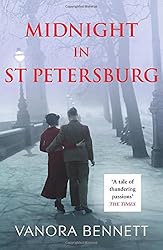
Sometimes I get requests from authors/publishers to review books and occasionally a book just turns up in the post unannounced. Over a year ago now I unexpectedly received a copy of Midnight in St Petersburg by Vanora Bennett and although it appealed to me I put it to one side whilst I finished other books. It has taken me until now to get round to actually reading it.

And I’m glad I did as it is an interesting book – historical fiction beginning in 1911 in pre-revolutionary Russia with Inna Feldman travelling by train to St Petersburg to escape the pogroms in Kiev hoping to stay with her distant cousin, Yasha Kagan. She is welcomed into the Leman family where she and Yasha are apprentices in their violin-making workshop. Inna is a talented, albeit shy, violinist and she falls in love with Yasha through their shared love of music.

The book is split into three sections – September – December 1911, 1916-17 and 1918-19 as Russia enters the First World War and is plunged into Revolution and life becomes increasingly dangerous for them all. Inna is torn between her love for Yasha, wildly rebellious and an activist in the revolution, and the older and more secure Englishman, Horace Wallick who works for the jeweller, Faberge, painting miniatures. It’s a story of survival under extreme conditions.

I liked the way Vanora Bennett intermingled Inna’s personal story with the historical characters of the time, including Father Grigory, Prince Youssoupoff and Lenin. I particularly liked the Father Grigory sections. Inna first met him on the train to St Petersburg when he helped her and I had my suspicions about who he really was, although it was a while before Inna discovered his identity. I also thought the details of violin-making were fascinating and I really liked the sections about Horace and his work for Faberge. What is perhaps even more fascinating is that Horace Wallick was a real person, Vanora Bennett’s great-great-uncle who really did work for Faberge from 1910 to 1919, which makes the story all the more authentic.

However, I thought the pace of the novel wasn’t very well structured as after an attention grabbing opening I thought it dragged a bit in the middle and that it was drawn to a too hasty conclusion. Overall, though I thought this portrayal of the Russian Revolution and the effect it had on ordinary people was well done and I did enjoy it.

This is the second of Vanora Bennett’s books I’ve read – the first was Portrait of an Ordinary Woman the story of Sir Thomas More’s fall from Henry VIII’s favour and that of his adopted daughter Meg Giggs. I shall look out for more of her books.