The Virtual Mount TBR Challenge

I’ve decided to take part in another challenge this year – because I always like to borrow library books and this is a place to record them. It’s Bev’s new challenge – The Virtual Mount TBR Challenge.

This challenge is for books is only for books you do not own. They may be borrowed from the library, a friend, or anywhere else as long as they are not something that you buy and keep. Also–unlike Mount TBR, there is no date limit.

Challenges Levels:

Mount Rum Doodle: Read 12 books
Mount Crumpit: Read 24 books
Mount Munch: Read 36 books
White Plume Mountain: Read 48 books
Stormness Head: Read 60 books
Mount Mindolluin: Read 75 books
Mount Seleya: Read 100 books
Mount Olympus: Read 150+ books

In keeping with the virtual nature of the challenge, all mountains are fictional. See the comments in Bev’s sign-up post for explanations of their origins and for the full rules.

For the time being I am aiming to climb Mount Rum Doodle. I’ve already read two library books this year and as I currently have 8 books out on loan plus 2 that I’ve reserved this will give me a good start and maybe I’ll even carry on up the next virtual mountain, Mount Crumpit.


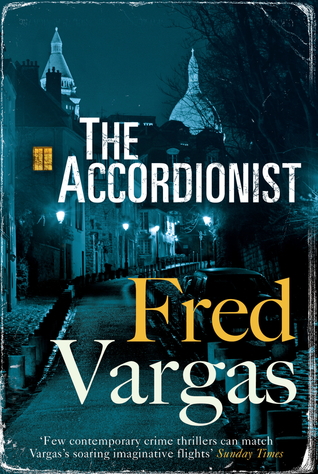
The Accordionist by Fred Vargas

The Accordionist (Three Evangelists 3)

The Accordionist by Fred Vargas and translated by SianReynolds is the third book in the Three Evangelists series and it’s probably the most puzzling of the three. They are quirky crime fiction novels, with eccentric characters and intricate plots. The three ‘Evangelists’ are thirty-something historians, Mathias, Marc and Lucien, all specialists in three different periods of history, who live in a rambling house in Paris. Together with ex-special investigator Louis Kehlweiler, retired from the Ministry of the Interior, they find themselves involved in murder mysteries, mainly because Louis just can’t resist trying to solve particularly difficult crimes.

In this third book a simple-minded young man, Clément Vauquer, who plays the accordion, is the prime suspect for the murders of two Parisian women as he was seen watching both of their apartments before their murders. Desperate to prove his innocence he appeals to Marthe, who had looked after him as a child, for help.

Louis is supposed to be translating a biography of Bismark, but the newspaper reports of the two murdered women have distracted him so when his old friend Marthe tells him that Clément, who is like a son to her, is innocent and being used as a scapegoat he agrees to investigate and find the real culprit. He in turn, enlists the help of the three evangelists and Marc’s uncle, a retired policeman and they take Clément into their house to protect him whilst they dig deeper into the mystery.

I found this book the most baffling of the trilogy and really had no idea of how they managed to unravel all the strands of this murder mystery which has its roots in the past. They worked on instincts and by deciphering Clément’s muddled thoughts and memories, and with the help of a poem by the nineteenth century poet, Gerard de Nerval, finally uncover the killer’s identity. It’s the eccentric characters and the complicated plots that make Fred Vargas’ books stand out for me.

Fred Vargas is the pseudonym of of the French historian, archaeologist and writer Frédérique Audoin-Rouzeau. She has won three International Dagger Awards from the Crime Writers Association, for three successive novels: in 2006, 2008 and 2009. I’ve also enjoyed her Commissaire Adamsberg books, probably more even than the Three Evangelists, and I still have a few of that series left to read including the tenth and latest book in the series, This Poison will Remain, due to be published in August this year.

  • Format: Paperback
  • File Size: 783 KB
  • Print Length: 370 pages
  • Page Numbers Source ISBN: 0099548364
  • Source: Library book
  • My Rating: 4*

Books Read in November 2018

This month I read seven books, made up of one review copy that came to me via  NetGalley, two library books and four of my own books (two of these on Kindle). Two of the seven books are non-fiction and the rest are fiction. My ratings range from 5 to 2.5 stars and are based solely on my reactions to the books.

I’ve written about three of these books (click on the links to read my reviews):

Jacob's Room is Full of Books: A Year of ReadingAbsolute ProofIn a Dark, Dark Wood

  1. Jacob’s Room is Full of Books by Susan Hill 5*  – in which Susan Hill describes a year of her reading.
  2. Absolute Proof by Peter James 3.5* –  a standalone thriller that is very different from his Roy Grace books. It has similarities to Dan Brown’s The Da Vinci Code, as the search is on for proof of  God’s existence.
  3. In a Dark, Dark Wood by Ruth Ware 2.5* – I was disappointed as this book promised to be a psychological thriller but it neither thrilled nor scared me, although it is a page-tuner. Leonora and Clare haven’t seen  or even spoken to each other since they were 16, ten years ago. So why has Clare invited Leonora to her hen party held in a glass house in the middle of a wood?

Here are some brief notes about the remaining four books:

I Am, I Am, I Am: Seventeen Brushes With DeathThe ReckoningThe New Mrs CliftonTombland (Matthew Shardlake, #7)

I Am, I Am, I Am by Maggie O’Farrell 5* – I wrote this Friday post about this book, with two quotations and a summary of the book. It’s a memoir with a difference: seventeen encounters of near-death experiences, with Maggie at different ages, in different locations, revealing a whole life in a series of tense, visceral snapshots. It’s a beautifully written book that I loved.

The Reckoning by John Grisham 5*, about Pete Banning, Clanton’s favourite son, a returning war hero, the patriarch of a prominent family, a farmer, father, neighbour, and a faithful member of the Methodist Church. Why did he shoot and kill the Reverend Dexter Bell? And then refuse to say why he killed him? I was intrigued and fascinated by the whole book that went back into Pete’s wartime experiences during world War Two during the Bataan Death March in the Philippines.

The New Mrs Clifton by Elizabeth Buchan 4* this begins in 1974 with the discovery of a skeleton, the remains of a woman, between twenty-five and thirty, buried beneath a tree in the garden of house in Clapham, facing the Common. Her identity and why and how she was killed is not revealed until very nearly the end of the book.

It then moves back in time to 1945 when Intelligence Officer Gus Clifton returns to London with Krista, the German wife he married secretly in Berlin. For his sisters, Julia and Tilly, this broken woman is nothing more than the enemy. For Nella, Gus’s loyal fiancée, it is a terrible betrayal. Elizabeth Buchan paints a convincing and moving picture of life in both London and Berlin post-war, highlighting the devastation of the bombing and showing how people have to come to terms with the changes in their lives. All the way through the book I wondered who the killer was and which woman had been murdered.

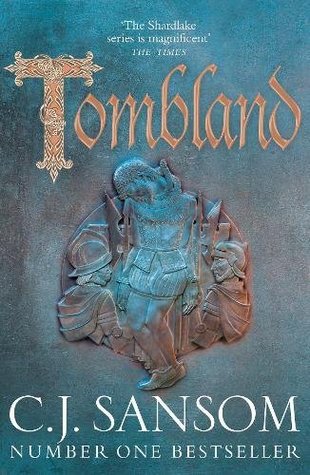
Tombland by C J Sansom 5* – I wrote this Friday post this book, giving two quotations and a summary of the book. Set in 1549 this is a remarkable and detailed book about the situation as Edward VI is on the throne following the death of his father Henry VIII and his uncle Edward Seymour, Duke of Somerset, rules as Protector.

Matthew Shardlake has been working as a lawyer in the service of Edward’s sister, the Lady Elizabeth. He is employed to investigate the gruesome murder of Edith Boleyn, the wife of John Boleyn – a distant Norfolk relation of Elizabeth’s mother. But the main part of the book is about Kett’s Rebellion – as thousands of peasants, in protest about the enclosures of common land, gather together on Mousehold Heath outside Norwich and battle ensues.

It’s an enormous book and I’m planning to write a longer post about it.


Jacob’s Room is Full of Books by Susan Hill

Nine years ago I read Susan Hill’s Howards End is on the Landing: A Year of Reading, a book in which she wrote about the books from her own collection she’d read or re-read over the course of a year. Jacob’s Room is Full of Books is a similar book in that it follows month by month a year during which she reflects on the books she has read, reread, or returned to the shelves as well as her thoughts on a whole variety of topics.

Jacob's Room is Full of Books: A Year of Reading

It’s full of her observations on the weather, on nature – birds, flowers, trees, moles, eels, egrets and so on – on writers and writing, about religion and fairy tales and many more besides as well as on books. She also writes about herself and notes her obsessions with, for example, Virginia Woolf and the Bloomsbury Set, Marilyn Monroe, wood engravings, medieval monasticism, Elizabeth Bowen, Benjamin Britten and her collection of Ladybird Books. Some of her observations on other topics are short but conjure up vivid pictures, such as in November she recorded: ‘RAINING. Sky like the inside of a saucepan.‘ (page 208) And in October: ‘THIS GOLDEN OCTOBER continues to drift slowly down like a twirling leaf.’  (page 186)

One of the things I like about this book is the passion with which Susan Hill writes and her strong opinions about books, writers, literary prizes, what makes a good reader and so on and so forth, that she has no qualms about expressing (and why should she?) You are left in no doubt about what she does and does not like. For example she likes Robert Louis Stevenson (so do I) and the way he cleverly and cunningly creates a sense of sinister and evil in his creation of Mr Hyde. She thinks he’s the ‘perfect writer’ (page 188) and describes him thus: ‘Next to Dickens, I think RLS was the greatest writer of his time.’ (page 54) She didn’t like fairy tales as a child (I did), describing fairies as

Wispy, wafty, wish-washy things. Nowhere near on a par with sprites and goblins, witches, wizards, trolls. As a child I lapped up stories about any of these. I can understand why I did not, and do not, have any patience with fairies and their stories. They are so colourless (despite Andrew Lang’s best attempts). So dull. Yes. Just dull. (page 21)

And yet as a child she also liked the Flower Fairies books by Cecily Mary Baker (as did I) and pored over their illustrations, but followed that up by describing them as ‘just an excuse for pretty pastel pictures.

She doesn’t like fantasy and science fiction, although as a child she loved fantasy. She likes, amongst others, Thomas Hardy, Somerset Maugham, Raymond Chandler, Muriel Spark and Barbara Pym, to a certain extent, describing her books as ‘dated, but not dated enough’, but not Jane Austen – oh my, I love Jane Austen’s books:

I read most of the reissued novels [of Pym’s] at the time and never entirely saw the point of the praise, probably because everyone compared them to Jane Austen and that is never a good recommendation to me. (page 200)

She then goes on to change her mind about Pym after reading Shirley Hazzard’s review of Pym’s Quartet in Autumn, which I haven’t read, but after reading her description I think I would like.

She has no interest left in the First World War, particularly in fiction about it (I have) since she wrote Strange Meeting in 1971, but she admires Ford Madox Ford’s The Good Soldier, but has ‘not even tried Parade’s End‘. She seems to have more time for the Second World War novels, praising Olivia Manning’s novels, the Balkan and Levant trilogies, which reminds  me I still haven’t read the third book in the Balkan Trilogy.

She is scathing about creative writing courses: ‘I don’t suppose anything is obligatory for these courses, which are as thick as autumn leaves on the ground. Writing is the thing. Ye gods.’ (page 189)

There’s plenty more on the same lines about other authors and books – there are many, many more that I could mention – and I found it all fascinating, rambling and chatty, a bit repetitive in parts, but still fascinating. And there is a list of the books she refers to at the end of the book. It’s probably a book that could stand a second reading.

And as she says:

Reading is magic. Books are magic. It starts when we are shown picture books and realise there is another world beyond the everyday one we know. Once we can read ourselves, we live inside the magic. The only problem is that we have to emerge at the end of a book, and we don’t want to return to that dull domestic world we know. The only solution to that problem, of course, is that there is always the next book, and the next and there is bonus magic if it is another in a series we already love, so we are plunging back into a magic other world but one we already know. We feel a lift of the heart, a lurch of the stomach, when we find ourselves in it again. (pages 55 – 56)

Yes, reading is, indeed, magic!

  • Hardcover: 272 pages
  • Publisher: Profile Books (5 Oct. 2017)
  • Language: English
  • ISBN-10: 9781781250808
  • ISBN-13: 978-1781250808
  • ASIN: 1781250804
  • Source: a library book
  • My Rating: 5*

In a Dark, Dark Wood by Ruth Ware

In a Dark, Dark Wood

Nora hasn’t seen Clare for ten years. Not since the day Nora walked out of her old life and never looked back.

Until, out of the blue, an invitation to Clare’s hen party arrives. A weekend in a remote cottage – the perfect opportunity for Nora to reconnect with her best friend, to put the past behind her.

But something goes wrong.

Very wrong.

And as secrets and lies unravel, out in the dark, dark wood the past will finally catch up with Nora.

I featured In a Dark, Dark Wood by Ruth Ware in this Friday Post on book Beginnings and said that I wasn’t sure I wanted to read it having been disappointed  by the only other book by her that I’ve read, The Woman in Cabin 10.  But as some people commented that they had enjoyed it and as it has good reviews on Amazon and Goodreads I decided to read on. It promises to be a psychological thriller – a scary book – but maybe I’ve read too many psychological thrillers as I didn’t find it thrilling or scary. It’s mystery novel that slowly reveals why Leonora, known either as Lee or Nora or Leo, and Clare haven’t seen  or even spoken to each other since they were 16, ten years ago. That was also when Nora’s heart was broken when her relationship with James came to an abrupt end. She had never come to terms with their break up.

I thought the setting was good – the hen party is held in a glass house in the middle of a wood in Northumberland. The mobile phone signal is practically nonexistent and they are cut off from the outside world and isolated when the snow sets, in cutting off the landline. But the characters are stereotypes – a new mother pining for her baby back home, a gay male actor, a gay female doctor (who is in my opinion the most sensible of the group), the dippy devoted friend of the bride who has organised this terrible hen party, the bride, self-obsessed, selfish and manipulative as well as Nora, who can’t move on from her past. The outcome is predictable when footprints appear in the snow, the backdoor that was supposed to be locked is found open and the hen party keep arguing and antagonising each other. It’s obvious from the start that something terrible had happened when Nora wakes up in a hospital bed and realises that she can’t remember what had happened … or what she had done.

In a Dark, Dark Wood is Ruth Ware’s debut novel and the film rights have been optioned  by New Line Cinema.  I can imagine that a film would be much more terrifying than the book – it should be, the potential is there. I don’t like being critical of a book, but I can’t recommend this book.


First Chapter First Paragraph: The Twilight Hour by Nicci Gerrard

Every Tuesday First Chapter, First Paragraph/Intros is hosted by Vicky of I’d Rather Be at the Beach sharing the first paragraph or two of a book she’s reading or plans to read soon.

This week I’m featuring The Twilight Hour by Nicci Gerrard, one of the books I’ve borrowed from the library.

The Twilight Hour

It begins:

Eleanor woke to what was not there. Outside, the wind still roared,dashing pellets of rain against the windows; inside it was too silent, not a breath or a heartbeat save hers. The darkness felt uninhabited. Before she reached out her hand, groping past the water jug and the vase of dying flowers to touch the bed and find it empty, the blanket thrown back and the pillow dislodged, she knew she was alone. She let fear seep through her, into every space in her body. She could taste the muddy, metal ache of it in her mouth; feel it in the palms of her hands and the base of her spine and in her throat like a rippling, oily snake; she could smell it on her skin, sour as spoilt milk.

That’s a terrifying feeling to wake up with – that image of a rippling, oily snake in her throat leaves me feeling sick –  and wondering why she is so scared.

Blurb:

Eleanor Lee has lived a fiercely independent existence for over ninety years, but now it’s time to tidy her life away – books, photographs, paintings, letters – a lifetime of possessions all neatly boxed up for the last time. But amongst them there are some things that must be kept hidden. And, nearing blindness, Eleanor needs help to uncover them before her children and grandchildren do.

Peter, a young man with a broken heart who feels as lost as Eleanor’s past, is employed to help with this task. And together they uncover traces of another life – words and photographs telling a story of forbidden love, betrayal, passion, grief and self-sacrifice, which Eleanor must visit one last time.

By speaking her memories out loud, and releasing the secrets of her past, Eleanor can finally lay them to rest. To honour them at last, and protect those who must never know.

What do you think? Would you keep reading?