Midnight in St Petersburg by Vanora Bennett

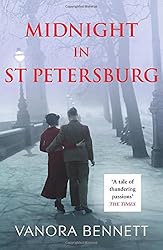
Sometimes I get requests from authors/publishers to review books and occasionally a book just turns up in the post unannounced. Over a year ago now I unexpectedly received a copy of Midnight in St Petersburg by Vanora Bennett and although it appealed to me I put it to one side whilst I finished other books. It has taken me until now to get round to actually reading it.

And I’m glad I did as it is an interesting book – historical fiction beginning in 1911 in pre-revolutionary Russia with Inna Feldman travelling by train to St Petersburg to escape the pogroms in Kiev hoping to stay with her distant cousin, Yasha Kagan. She is welcomed into the Leman family where she and Yasha are apprentices in their violin-making workshop. Inna is a talented, albeit shy, violinist and she falls in love with Yasha through their shared love of music.

The book is split into three sections – September – December 1911, 1916-17 and 1918-19 as Russia enters the First World War and is plunged into Revolution and life becomes increasingly dangerous for them all. Inna is torn between her love for Yasha, wildly rebellious and an activist in the revolution, and the older and more secure Englishman, Horace Wallick who works for the jeweller, Faberge, painting miniatures. It’s a story of survival under extreme conditions.

I liked the way Vanora Bennett intermingled Inna’s personal story with the historical characters of the time, including Father Grigory, Prince Youssoupoff and Lenin. I particularly liked the Father Grigory sections. Inna first met him on the train to St Petersburg when he helped her and I had my suspicions about who he really was, although it was a while before Inna discovered his identity. I also thought the details of violin-making were fascinating and I really liked the sections about Horace and his work for Faberge. What is perhaps even more fascinating is that Horace Wallick was a real person, Vanora Bennett’s great-great-uncle who really did work for Faberge from 1910 to 1919, which makes the story all the more authentic.

However, I thought the pace of the novel wasn’t very well structured as after an attention grabbing opening I thought it dragged a bit in the middle and that it was drawn to a too hasty conclusion. Overall, though I thought this portrayal of the Russian Revolution and the effect it had on ordinary people was well done and I did enjoy it.

This is the second of Vanora Bennett’s books I’ve read – the first was Portrait of an Ordinary Woman the story of Sir Thomas More’s fall from Henry VIII’s favour and that of his adopted daughter Meg Giggs. I shall look out for more of her books.

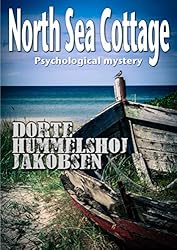
North Sea Cottage by Dorte Hummelshoj Jakobsen

Dorte Hummelshoj Jakobsen’s latest book, North Sea Cottage, is an e-book, a novella set in Denmark. It’s another dual time period book – it seems that each book I’ve read recently is one of these. This one is split between the present day and 1943/4 and it works very well.

I thoroughly enjoyed this book; the cottage in the title is owned by Tora’s aunt, Bergatora. As soon as I began reading I was immediately transported in place away to the other side of the North Sea to Denmark with Tora, and in time back to the Second World War, with her aunt, Bergatora. In just a few words Dorte Hummelshoj Jakobsen draws a vivid picture of the old fisherman’s cottage surrounded by dense sea fog.

Tora is struggling to overcome her own problems when she is faced with a new problem. The old stable next to the cottage catches fire during a thunder storm and in the aftermath of the fire Tora finds a skeleton in the potato cellar under the ruined stable. Who is it who had died in the cellar? Bergatora is reluctant to talk about the war years and her brother, Tora’s father, was too young at the time to help. It was a time when Denmark was under German occupation and a resistance movement was under way. Inspector Thomas Bilgren suspects the victim may have been related to the German occupation.

Tora, helped by Bilgren attempts to discover the truth, but is hampered by the strong character of her aunt and the silence surrounding what happened during the war. I loved this aspect of the book – the delving back into history, the way the narrative switches backwards and forwards, gradually revealing what had happened. North Sea Cottage is only about 90 pages but it has depth both in mystery and in characterisation and the setting is so atmospheric. I was fearful for Tora’s safety as she dug deeper into the mysteries from the past.

Thanks to Dorte Hummelshoj Jakobsen, who kindly sent me a copy of her book. She has a blog – Djskrimiblog and used to be a teacher. She writes both serious mysteries as well as humorous and cosy stories about the Gershwin family in Knavesborough, a fictional village in Yorkshire, publishing in Danish and English. I like her humorous stories but prefer the serious ones like North Sea Cottage and her previous novel, Anna Märklin’s Family Chronicles. She is currently at work on her next novel – Crystal Nights, to be published in 2014/5.

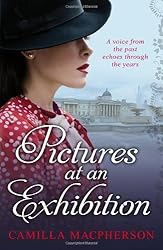
Pictures at an Exhibition by Camilla Macpherson

I enjoyed Pictures at an Exhibition by Camilla Macpherson very much. It’s a dual time period novel moving between the present day and the Second World War, a format I think that can be hard to do successfully. In this book, Camilla Macpherson’s first published novel, I think it is successful as I was equally keen to find out what happened next in both periods.

Pictures at an Exhibition is structured around Daisy’s letters to her cousin Elizabeth telling her about the paintings on display at London’s National Gallery during the war years – one a month. In the present day Claire reads the letters, left to her husband Rob, by his grandmother, Elizabeth. They are not just about the paintings but also about Daisy’s life and the man she meets and loves. Claire meanwhile, is struggling to recover from a tragedy that threatens to overwhelm her and wreck her marriage. She decides to read the letters, one a month, and visit the National Gallery to see the paintings and compare them with Daisy’s descriptions.

I found the characters thoroughly convincing, the settings and the time periods contrasting vividly and loved all the details about the paintings. I also liked the way the characters developed throughout the book. For example, at the beginning of the book, which I found so devastatingly sad, Claire is full of anger and grief, affecting her relationship with Rob:

It was the grief speaking. It could do strange things grief. She had not known that until now. She had never had to know. It had brought with it this desperate, physical need to blame someone, someone who would be right there when she had to lash out – Rob. The only person who was always there. (page 106)

She becomes obsessed with the letters, the paintings and with Daisy’s life. It’s a remarkable portrayal of a woman in crisis and how she managed to find herself again. Daisy’s story is just as convincing describing life in London during the Blitz and along with Claire I really wanted to know more about her and what happened to her.

I think it was the art that drew me to this book in the first place and I found those parts of the book absolutely fascinating. The National Gallery did display one painting a month after most of them had been transported away from London and the bombs for safe keeping. You can see the paintings described by scanning the QR codes at the beginning of each chapter and also see them on Camilla Macpherson’s website, and of course on the National Gallery’s site too. I knew of most of them before, but not all of them and as I was reading I printed copies to see what Daisy and Claire saw.

But by the end of the book it was the characters and the story that had captivated me too.  It’s about life and death, love and loss, grief and relationships and I found it compelling reading – when I wasn’t reading it I was thinking about it and keen to get back to it. It’s a book I want to re-read at some time – and there aren’t many of those.

My thanks go to Camilla Macpherson, who kindly sent me a copy of her book. I look forward to reading more of her work in the future.

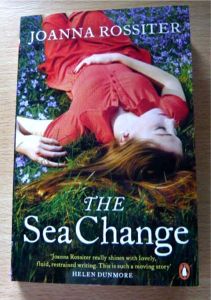
The Sea Change by Joanna Rossiter

Set in lost landscapes, The Sea Change is Joanna Rossiter’s debut novel revolving around a mother and daughter caught up in catastrophic events. The lost landscapes are the village of Imber, a Wiltshire village that was requisitioned by the army during World War Two, where Violet had grown up, and the coastal village of Kanyakumari in Southern India, where her daughter Alice was caught up in the tsunami that devastated the area in 1971.

It’s about lost lives too, wrecked relationships, the isolation of people through their inability to communicate with each other, about love, loss and grief and above all about the relationship between mothers and daughters and sisters.

I enjoyed reading this beautifully written book; I could easily visualise the different landscapes as I read. It begins with drama in the ‘present’ (1971) as the tsunami sweeps through Kanyakumari, separating Alice from her new husband, James and she is in danger of drowning. The story is a dual time novel told alternately by Alice and Violet. After the dramatic opening scenes it then moves immediately to Imber in 1971 as Violet returns to Imber and recalls how they were forced to leave, clinging to Imber ‘as if it were a lost soul.

There are parallels between their stories, both caught up in events outside their control. I was more interested in Violet’s story as she and her mother and sister try to carry on with their lives during the war, mourning the death of her father. And yet Alice’s story is also moving as she desperately searches for James.  Alice and Violet had not parted on good terms when Alice had left home to go on the hippy trail and I liked the way the two stories gradually came together and details of their lives became clearer.

I wrote about the opening paragraphs of this book in this earlier post.

Thanks to Penguin for providing a review copy of this book. I’m sorry to say that it has sat unread apart from the opening pages on my bookshelves since last year when I received it. This is one reason I’m reluctant sometimes to accept review copies – there are so many books clamouring to be read!

Joanna Rossiter has her own website where you can see a YouTube video of her reading from the beginning of the book and talking about her book. I hope she writes more books!

Books Read in May

I can’t quite believe it but despite spending many hours in the garden in May mowing the grass and weeding (there are still too many weeds!) I managed to read ten books, bringing my total for the year so far to 45. They’re a bit of a mixed bag of excellent and not very good, with some good ones in between!

They are, in the order I read them, with links to my reviews (* marks crime fiction novels):

  1. The Big Four* by Agatha Christie – a bit of a let down, not up to her best!
  2. The Lost Army of Cambyses by Paul Sussman – goodish
  3. The Dance of Love by Angela Young – her second book due out at the end of July. I loved it!
  4. The Wicked Day by Mary Stewart – good
  5. The Graveyard Book by Neil Gaiman – very good
  6. Nemesis* by Agatha Christie – disappointing
  7. The Witch’s Brat by Rosemary Sutcliff – good
  8. No Stranger to Death*by Janet O’Kane – very good, her first book
  9. The Little Coffee Shop of Kabul by Deborah Rodriguez -not very good and I don’t intend to write about it
  10. A Whispered Name* by William Broderick – excellent – see my thoughts below.

I’m not taking The Dance of Love into account in considering which book is my favourite book of the month because I’m saving my review for July when the book is published – but I can say now that it is brilliant!

The Graveyard Book and No Stranger to Death are both really good books and as I was reading each one I thought either could be my favourite book for May but then I read A Whispered Name and that decided it – it is my favourite book of the month and also my Crime Fiction Pick of the Month (hosted by Kerrie at Mysteries in Paradise)!
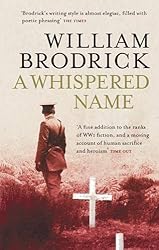
 

A Whispered Name by William Brodrick is the third Father Anselm novel, which won the Crime Writers’ Association Gold Dagger Award in 2009.

I think this is a most remarkable book and it kept me glued to the pages as I read about the First World War and the effects it had on those who took part, those left at home and on future generations. It is, of course, historical fiction.

From the back cover:

During the slaughter of Passchendaele in 1917, an Irish soldier faced a court martial for desertion. On the panel was a young captain, Herbert Moore, charged with a responsibility that would change him for ever.

After the war Herbert became a monk, one of the founders of Larkwood monastery, where Father Anselm came across two visitors, Kate Seymour and an unnamed old man, searching for Father Herbert. But he had died in 1985 and no one could answer their questions about the trial of a deserter, Joseph Flanagan and Father Herbert’s part in it. Father Herbert was revered and loved by all who knew him and Anselm was deeply dismayed at the thought that there was anything in his past that he had lied about and he set out to discover the truth.

I think the whole book is so well thought out with chapters revealing what happened from different characters’ viewpoints during the war and what Anselm discovered as he went through the records and talked to people. Nothing is straight forward, the records are ambiguous and there is confusion about identities. The horror of the war is there:

After the wallop, Herbert found himself prostrate with his face against the dirt, vaguely aware that time had passed, that water was creeping on him; that he would have to move or he’d drown.

… Herbert slid through a sludge of intestines and grit, hauling himself into the open. Staring across the beaten land he tried to gain his bearings … he couldn’t see anyone else from the regiment. (page 35)

And Herbert did indeed serve on a court martial that condemned Joseph Flanagan to death. But there is not just the horror of war in this book, it’s an intricate, evocative novel focussing on the themes of morality, justice, sacrifice and human redemption. It is a book above all that identifies the place of the individual within history, written so lyrically putting the past under a searching spotlight. One of the best books I’ve read for quite some time.

A Whispered Name is a thoroughly researched book with a list of sources at the end of the book, but it never reads like a dry factual account – it comes so vividly to life. Although based on fact, gathered from memoirs, reports, published research, Battalion War diaries and the original transcripts of trials, William Brodrick explains in his Author’s Note:

This novel is not about FGCMs [Field General Court Martial] in general. It does not imply a comprehensive critique of First World War executions from any perspective, be that historical, legal or moral. Rather, one might say, it is a parable of how a man found meaning in death, and how another – on seeing that – found faith in life. And it is about a fictional trial that cannot be compared with any genuine case. (p 344) (my emphasis)

William Brodrick became a barrister, having been an Augustinian monk for six years (the other way round from his fictional character, Father Anselm). After 10 years at the Bar, his interest in writing led him to writing the Father Anselm books.

The Father Anselm books are:

  1. The Sixth Lamentation (2003)
  2. The Gardens of the Dead (2006)
  3. A Whispered Name (2008)
  4. The Day of the Lie (2012)
  5. The Discourtesy of Death (2013)

I’ve now read the first three books and think A Whispered Name is probably the best. I have yet to read the next two – I hope to do so soon.
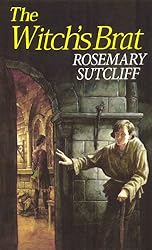
The Witch's Brat by Rosemary Sutcliff

Rosemary Sutcliff was one of my favourite authors when I was a child, but it’s been years since I read any of her books. I came across her children’s book, The Witch’s Brat after reading Mary Delorme’s novel, St Bartholomew’s Man about Rahere, the founder of St Bartholomew’s Hospital. I wanted to know more about Rahere and discovered that he featured in Rosemary Sutcliff’s book set in 12th century England.

The Witch’s Brat, first published in 1971, tells the tale of Lovel, a boy born crippled with a twisted leg and crooked shoulder, but also with a gift for healing. His grandmother was the local Wise Woman whom people feared thinking she was a witch, and after she died he was driven from his village in a shower of stones, both because he was her grandson and because he was a cripple. He is taken in by the monks at a priory and it is here that he meets Rahere, who encourages him to be a healer. This is how Rahere looked when Lovel first met him:

Lovel gazed with his mouth open in awed delight at this mad and magnificent man with the monk’s face and the cool mocking voice and long fantastic legs like a crane fly, who spoke English, but in such splendid and far-off words that much of it was as far beyond his reach as the Norman French spoken by most of the knights and wealthy travellers who passed that way, and by some of the brethren among themselves. (page 29)

It’s a beautifully written little book (112 pages), full of period detail, including herbal lore and vivid imagery. Like St Bartholomew’s Man it’s about the building of St Bartholomew’s Hospital, but seen through Lovel’s eyes instead of through Rahere’s. As well as being historical fiction, this book is about overcoming prejudice and and disability. Rahere is seen as a charismatic character, an inspiration to Lovel, a man who thought there must be more to life than entertaining a king and who vowed to raise an infirmary, a hospital for the poor sick.

This a ‘feel good’ book that is a delight to read.