My Week in Books: 4 April 2018

This Week in Books is a weekly round-up hosted by Lypsyy Lost & Found, about what I’ve been reading Now, Then & Next.

IMG_1384-0

A similar meme,  WWW Wednesday is run by Taking on a World of Words.

Currently reading:

I have started to read The Fire Court by Andrew Taylor, due to be published 5 April 2018 and it’s looking good so far.

Blurb:

Somewhere in the soot-stained ruins of Restoration London, a killer has gone to ground…

The Great Fire has ravaged London, wreaking destruction and devastation wherever its flames spread. Now, guided by the incorruptible Fire Court, the city is slowly rebuilding, but times are volatile and danger is only ever a heartbeat away.

James Marwood, son of a traitor, is thrust into this treacherous environment when his ailing father claims to have stumbled upon a murdered woman in the very place where the Fire Court sits. Then his father is run down and killed. Accident? Or another murder…?

Determined to uncover the truth, Marwood turns to the one person he can trust – Cat Lovett, the daughter of a despised regicide. Marwood has helped her in the past. Now it’s her turn to help him. But then comes a third death… and Marwood and Cat are forced to confront a vicious and increasingly desperate killer whose actions threaten the future of the city itself.

Recently finished:

The Tenderness of Wolves

The last book I finished is The Tenderness of Wolves by Stef Penney, historical fiction set in Canada in 1867. I am so, so pleased to finish this as it has taken me almost 4 weeks to read it. I found it really hard to get into it at first and disliked the use of the present tense throughout. But overall I did like the story and will try to expand on these thoughts in a separate post.

Next:

Now the difficult part – what to read next!

Little Dorritt

I really should get back to reading Little Dorrit which I temporarily put on the back burner so that I could finish The Tenderness of Wolves. It’s my Classics Club Spin book but haven’t got very far with it yet and it’s looking extremely unlikely that I’ll finish it by the end of April!

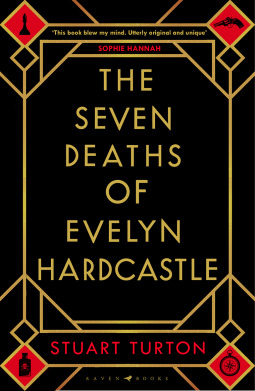
But I am so tempted to read The Seven Deaths of Evelyn Hardcastle by Stuart Turton that I’ve borrowed from my local library as I suspect I won’t be able to renew it.

The Seven Deaths of Evelyn Hardcastle

Blurb (Goodreads):

How do you stop a murder that’s already happened?

At a gala party thrown by her parents, Evelyn Hardcastle will be killed–again. She’s been murdered hundreds of times, and each day, Aiden Bishop is too late to save her. Doomed to repeat the same day over and over, Aiden’s only escape is to solve Evelyn Hardcastle’s murder and conquer the shadows of an enemy he struggles to even comprehend–but nothing and no one are quite what they seem.

Deeply atmospheric and ingeniously plotted, The Seven Deaths of Evelyn Hardcastle is a highly original debut that will appeal to fans of Kate Atkinson and Agatha Christie.

Have you read any of these books?  Do any of them tempt you? 

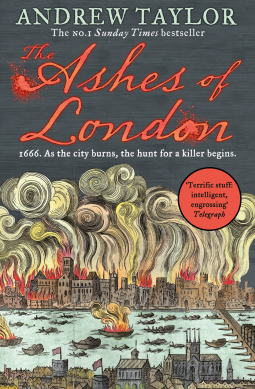
The Ashes of London by Andrew Taylor

Harper Collins UK|7 April 2016|497 p|e-book|Review copy|5*

Munich by Robert Harris

Munich

Munich is about  the 1938 Munich Conference and I found it absolutely fascinating  as I know very little about the period beyond the basic facts – PM Neville Chamberlain was trying to maintain the peace in the face of Hitler’s aims to expand German territory (but I was a bit vague about the actual details) and in 1938 came back from the Munich conference with a piece of paper signed by Hitler, proclaiming that it meant ‘peace for our time‘.

MunichAgreement

Munich is a mix of fact and fiction. Harris uses two fictional characters, Hugh Legat as one of Chamberlain’s private secretaries and Paul Hartmann, a German diplomat and a member of the anti-Hitler resistance to tell his story. Harris’ interest in the Munich Agreement began thirty years ago when he made a BBC TV documentary, ‘God Bless You Mr Chamberlain’ to mark the fiftieth anniversary of the conference in 1988. He has thoroughly researched the subject, consulting many books (listed in the Acknowledgements) and has seamlessly woven the facts into the novel. It has a a strong sense of place, based no doubt on his visits to what was once the Führerbau, now the Faculty of Music and Theatre and Hitler’s old apartment in Prinzregentenplatz, now used as a police headquarters.

Munich explores the moral dilemma of appeasement, and of making a stand. It portrays Chamberlain as a man of high moral principals, deeply concerned that the horrors of World War One should not be repeated and not as a weak appeaser easily fooled by Hitler. His objective was:

… to avert war in the short term, and then to try to build a lasting peace for the future – one month, one day at a time, if needs be. The worst act I could possibly commit for the future of mankind would be to walk away from this conference tonight. (page 267)

Reading this book has made me want to know more about Neville Chamberlain and I hope to read one of the biographies that Harris lists.

The fictional story of Hugh and Paul, who had been friends at university six years earlier adds additional tension and drama to the already tense story of the Munich conference. As in his earlier books Harris has captured the atmosphere and mood of the times, making me feel as though I’m there with the characters taking part in the action. The key characters are seen through Hugh’s and Paul’s perspectives – Chamberlain and Hitler – and others such as Mussolini, Goering and the other British politicians who travelled with Chamberlain to Munich.  Among the later was Lord Dunglass, described by one of Chamberlain’s secretaries as ‘one of the cleverest politicians she had ever encountered‘; she considered that he would ‘be Prime Minister one day‘. At the time it was inconceivable that a premier could sit in the House of Lords and her prediction was dismissed. However, Dunglass went on to inherit his father’s title and become the 14th Earl of Home and as Sir Alec-Douglas-Home (renouncing his peerage) he did indeed become Prime Minister.

I really like Harris’ straight forward writing style with no flashbacks, fly forwards or ambiguities. I learned a lot from this book and as far as I can tell (as I said I don’t know much about the period) it is an accurate version of what happened at Munich. It is a dramatic story well told – definitely a 5* book!

  • Hardcover: 352 pages
  • Publisher: Hutchinson; 01 edition (21 Sept. 2017)
  • Language: English
  • ISBN-10: 0091959195
  • ISBN-13: 978-0091959197
  • Source: Library book
  • My rating: 5*

The Western Wind by Samantha Harvey

Jonathan Cape, Vintage Digital| 1 March 2018|304 p|Review copy|4.5*

Description

My Week in Books: 28 February 2018

This Week in Books is a weekly round-up hosted by Lypsyy Lost & Found, about what I’ve been reading Now, Then & Next.

IMG_1384-0

A similar meme,  WWW Wednesday is run by Taking on a World of Words.

Now:

51IBFwYPBfLMunich by Robert Harris, set in 1938, beginning in September as Hitler is determined to start a war and Chamberlain is desperate to preserve the peace. I’ve read about half the book and am finding it fascinating.

Blurb

As Chamberlain’s plane judders over the Channel and the Führer’s train steams relentlessly south from Berlin, two young men travel with secrets of their own. 

Hugh Legat is one of Chamberlain’s private secretaries; Paul Hartmann a German diplomat and member of the anti-Hitler resistance. Great friends at Oxford before Hitler came to power, they haven’t seen one another since they were last in Munich six years earlier. Now, as the future of Europe hangs in the balance, their paths are destined to cross again. 

When the stakes are this high, who are you willing to betray? Your friends, your family, your country or your conscience?

Bookworm: A Memoir of Childhood Reading by Lucy Mangan, due to be published tomorrow, 1 March 2018. This is a delightful book taking me back to the books of my childhood as Lucy Mangan describes the books she loved. I’ve nearly finished it, so I’ll post my review soon.

Blurb

The Cat in the Hat? Barbar? The Very Hungry Caterpillar? Whoever it was for you, it’s very hard to forget the vivid intensity of your first encounter with a book.

As a bespectacled young bookworm, Lucy Mangan devoured books: from early picture books, to Swallows and Amazons, Enid Blyton to Little Women, and from trashy teen romances to her first proper ‘grown-up’ novels. In Bookworm, she revisits this early enthusiasm; celebrating the enduring classics, and disinterring some forgotten treasures.

This is a love letter to the joys of childhood reading, full of enthusiasm and wit, telling the colourful story of our best-loved children’s books, the extraordinary people who created them, and the thousand subtle ways they shape our lives. It also comes packed with brilliant recommendations to inspire the next generation of bookworms and set them on their way.

This impassioned book will bring the unforgettable characters of our collective childhoods back to life – prompting endless re-readings, rediscoveries, and, inevitably, fierce debate. It will also act as an invaluable guide to anyone looking to build a children’s library and wondering where to start, or where to go next.

Then:

The last book I finished is Dry Bones in the Valley by Tom Bouman. This book has won several awards: Los Angeles Times Book Prize for Mystery/Thriller (2014), Edgar Award for Best First Novel (2015), Strand Critics Award Nominee for Best First Novel (2014). I really enjoyed it. My review will be up soon.

Blurb

When an elderly recluse discovers a corpse on his land, Officer Henry Farrell follows the investigation to strange places in the countryside, and into the depths of his own frayed soul.

In Wild Thyme, Pennsylvania, secrets and feuds go back generations. The lone policeman in a small township on the sparse northern border, Henry Farrell expected to spend his mornings hunting and fishing, his evenings playing old-time music. Instead, he has watched the dual encroachment of fracking companies and drug dealers bring money and troubles to the area. As a second body turns up, Henry’s search for the killer opens old wounds and dredges up ancient crimes which some people desperately want to keep hidden.

With vivid characters and flawless pacing, Tom Bouman immerses readers in this changing landscape. In these derelict woods, full of whitetail deer and history, the hunt is on…

Next:

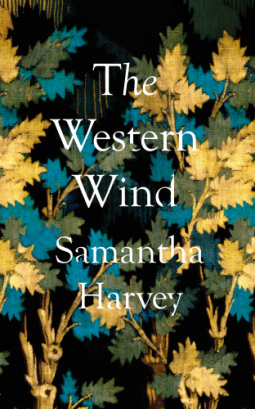
The Western Wind by Samantha Harvey, also due to be published tomorrow, 1 March 2018.

Blurb (Amazon):

15th century Oakham, in Somerset; a tiny village cut off by a big river with no bridge. When a man is swept away by the river in the early hours of Shrove Saturday, an explanation has to be found: accident, suicide or murder? The village priest, John Reve, is privy to many secrets in his role as confessor. But will he be able to unravel what happened to the victim, Thomas Newman, the wealthiest, most capable and industrious man in the village? And what will happen if he can’t?

Moving back in time towards the moment of Thomas Newman’s death, the story is related by Reve – an extraordinary creation, a patient shepherd to his wayward flock, and a man with secrets of his own to keep. Through his eyes, and his indelible voice, Harvey creates a medieval world entirely tangible in its immediacy.

Have you read any of these books?  Do any of them tempt you? 

New-to-Me Books from Barter Books

On Tuesday it was time for another visit to my favourite bookshop Barter Books, one of the largest secondhand bookshops in Britain. We were early getting there just after it had opened for the day, so there was space to park right outside the entrance.

I was quite restrained and only brought three books home, with me. But at least I’ve made some room on my bookshelves as I’d brought in six books. These are the books I brought home:

IMG_20180222_095337630_HDR.jpg

Killing Floor by Lee Child,the first in his Jack Reacher series. I’m keen to read this because I’ve recently read the 22nd book in the series and want to know more about Reacher, an ex-military cop of no fixed abode.

The Ghost of the Mary Celeste by Valerie Martin. I’ve read some of Valerie Martin’s books before and enjoyed them. This one weaves fact and fiction concerning the mystery surrounding the Mary Celeste, looking at it from different viewpoints including those of a psychic and Arthur Conan Doyle, who was inspired by it to write a short story, J. Habakuk Jephson’s Statement

Defying Hitler: a Memoir by Sebastian Haffner, a memoir of life in Germany during the Nazi rise to power. It was written in 1939 during Haffner’s exile in England. I’ve been reading novels about the Second World War period, so I think it would be good to know more about  the Wiemar Republic, particularly from a German who lived through those times.

What do you think? Have you read any of these? Do they tempt you too?