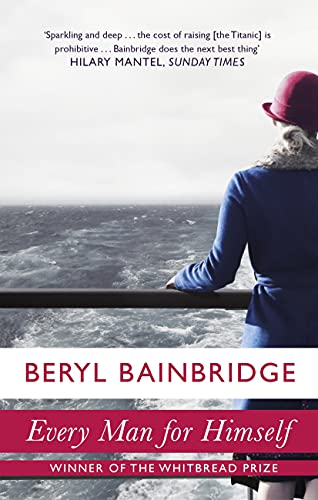
Every Man For Himself by Beryl Bainbridge

Rating: 3 out of 5.

Every Man For Himself was the winner of the 1996 Whitbread Novel Award and was shortlisted for the Booker Prize in that year.

For the four fraught, mysterious days of her doomed maiden voyage in 1912, the Titanic sails towards New York, glittering with luxury, freighted with millionaires and hopefuls. In her labyrinthine passageways the last, secret hours of a small group of passengers are played out, their fate sealed in prose of startling, sublime beauty, as Beryl Bainbridge’s haunting masterpiece moves inexorably to its known and terrible end.

This is one of her historical novels, so it’s no surprise that this is a disaster novel. It’s the story of Morgan’s voyage divided into four days as he tells it. It’s mainly the story of the young rich people as they drink and party their way across the Atlantic. Morgan is part of the crowd but he is not rich, and although he has connections, he’s a young American who has to earn his living. We only see a glimpse into his background and I found it confusing for quite a way into the book. But eventually we learn more about him and things became clearer,

By the time he writes about day 4, the sinking itself, the pace speeds up, and the story came to life for me. I think Bainbridge conveys what it must have been like –

There was such a dearth of information, of confirmation or denial of rumours – the racquet court was under water but not the Turkish baths; a spur of the iceberg had ripped the ship from one end to the other but the crew was fully equipped to make good the damage and were even now putting it to rights – and such an absence of persons in authority to whom one might turn that it was possible to imagine the man in the golfing jacket had spoken no more than the truth when presupposing we were victims of a hoax. (page 179)

I could easily imagine what it was like to be a passenger, people rushing about the boat, trying to get on the lifeboats and being separated from friends and family. And the final scenes bring home the reality that it really was a case of every man for himself with the callous attitude towards the steerage passengers, the lack of lifeboats and the disregard of the ice warnings. And so the boat described as unsinkable, sank.

Restless Dolly Maunder by Kate Grenville

Canongate Books| 2 November 2023|257 pages| Review copy| 4*

Synopsis

Dolly Maunder is born at the end of the nineteenth century, when society’s long-locked doors are just starting to creak ajar for determined women. Growing up in a poor farming family in rural New South Wales, Dolly spends her life doggedly pushing at those doors. A husband and two children do not deter her from searching for love and independence.

Restless Dolly Maunder
 is a subversive, triumphant tale of a pioneering woman working her way through a world of limits and obstacles, who is able – despite the cost – to make a life she could call her own.

My thoughts:

Kate Grenville is one of my favourite authors, so I was looking forward to reading Restless Dolly Maunder. I was not disappointed.

This is the fictionalised life story of Kate Grenville’s maternal grandmother, Sarah Catherine Maunder, known as Dolly. She was the sixth child of Thomas and Sarah Maunder, born in Currabubula, New South Wales, Australia in 1881. She was not only restless but also clever and determined – she knew what she wanted and she did her best to achieve it.

As a child she longed to be a pupil-teacher but in a world where women were subservient to men she had to obey her father who wouldn’t allow it. She could marry or be a spinster. Eventually she married Bert Russell and began a life away from the farm and her family, moving from place to place and from one business to the next to better herself and her family – a shop, a boarding house, a pub, and a grand hotel.. But she was a difficult person, not easy to like and unable to show love. Hers was a success story but also a tragedy as her wanderlust impelled her to keep striving for more and better things in life.

Restless Dolly Maunder casts light not just on Dolly’s life but also on life in Australia for most of the 20th century. The book has a relentless pace as it tells her life story as she propels herself from place to place and from business to business, enjoying success whilst it lasted and enduring all else, not stopping to pause breath in her restless pursuit of what came next.

Many thanks to the publishers for a review copy via NetGalley.

I can recommend all of Kate Grenville’s books. One of my favourites is One Life:My Mother’s Story, her biography of Nance Russell, Dolly’s daughter. Hers was a happier and more fulfilled life.

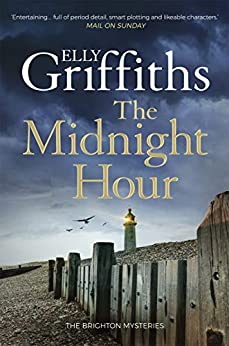
The Midnight Hour by Elly Griffiths

Brighton, 1965

When theatrical impresario Bert Billington is found dead in his retirement home, no one suspects foul play. But when the postmortem reveals that he was poisoned, suspicion falls on his wife, eccentric ex-Music Hall star Verity Malone.

Frustrated by the police response to Bert’s death and determined to prove her innocence, Verity calls in private detective duo Emma Holmes and Sam Collins. This is their first real case, but as luck would have it they have a friend on the inside: Max Mephisto is filming a remake of Dracula, starring Seth Billington, Bert’s son. But when they question Max, they feel he isn’t telling them the whole story.

Emma and Sam must vie with the police to untangle the case and bring the killer to justice. They’re sure the answers must lie in Bert’s dark past and in the glamorous, occasionally deadly, days of Music Hall. But the closer they get to the truth, the more danger they find themselves in…

The Midnight Hour is the sixth book in the DI Edgar Stephens and Max Mephisto series. Known as the ‘Magic Men’ they had been part of a top-secret espionage unit during the War. These books are historical crime fiction, beginning with The Zig Zag Girl set in 1950. Now, with The Midnight Hour, fifteen years have gone by and DI Stephens’ wife, Emma formerly a policewoman is now a private detective working with Sam (Samantha) Collins, formerly an investigative reporter.

There’s a lot going on as both Edgar’s team and Emma and Sam investigate Bert’s death, at first in competition and then they combine forces. Bert’s son Aaron thinks his mother, Verity, killed Bert, who has a very shady past, with plenty of affairs with other women. And there are other suspects with a motive to want him dead.

It provides an insight into what life was like in the mid 1960s, particularly for women. There was plenty of sexism, with, for example, married women being forced to retire from the police force. Married women were not allowed to drive panda cars, and were largely employed to make tea and do the paperwork. Women were expected to stay at home looking after the home and their children.

I enjoy the Dr. Ruth Galloway series, with the forensic archaeological details, despite wishing they weren’t written in the present tense. I also find the theatrical elements of this series fascinating and much prefer the fact that they are written in the past tense. I really liked the glimpses of Max and Seth Bellington, Bert’s son, filming a remake of Dracula in Whitby.

You can read this as a standalone as there is a guide to the main characters and their back stories at the end of the book, but it helps if you read at least some of the earlier books to have a sense of who everyone is and the character progression.

Rating: 4 out of 5.

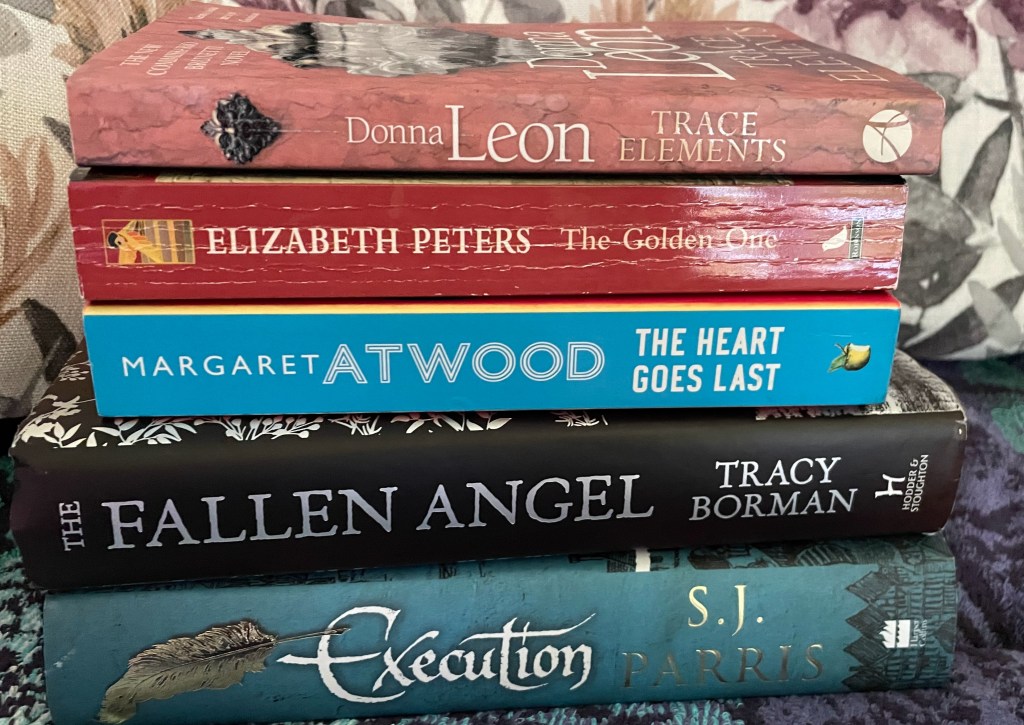
Recent Additions from Barter Books

We went to Barter Books in Alnwick yesterday, for the first time since last October. It was absolutely packed as it was a Bank Holiday and the school holidays. There was a long queue for the Station Buffet and then a 30 minute wait after we’d ordered our food.

Despite the crowds of people I found these books and left a lot behind. :)

From the bottom to the top they are:

Execution by S J Parris, Book 6 in the Giordano Bruno series of historical thrillers.  I’ve read the second book, Prophecy which I really enjoyed. This one is set in 1586 about the Babington plot to assassinate the Protestant Queen Elizabeth I and replace her with her Catholic cousin, Mary, Queen of Scots. I vaguely remember the Babington plot from history lessons at school. I just hope I’m not going to find it’s too long

The Fallen Angel by Tracy Borman, the final book in the Frances Gorges Historical Trilogy. I have the first one, The King’s Witch, but I haven’t read it yet. On the back cover it says this can be read entirely on its own. It covers the final years of James I’s reign when his new favourite was George Villiers, later the Duke of Buckingham

The Heart Goes Last by Margaret Atwood. Charmaine sees an advertisement for a project called Positron that promises you a job, a place to live, a bed to sleep in – imagine how appealing that would be if you were working in a dive bar and living in your car. She and her husband, Stan, apply at once. The only catch is that once you’re in there, you can’t get out.

The Golden One by Elizabeth Peters, the 17th Amelia Peabody Egypt murder mystery featuring Amelia Peabody. I haven’t read any of the other books and there are 20 in total. Amelia and her family arrive at their home in Luxor to learn of a new royal tomb ransacked by thieves. Soon an even more disturbing outrage concerns the intrepid clan of archaeologists: the freshly and savagely slain corpse of a thief defiling the ancient burial site.

Trace Elements by Donna Leon, the 29th in her Commissario Brunetti Mysteries series. ‘They killed him. It was bad money.‘ A dying hospice patient gasps these cryptic words about her recently-deceased husband, who lost his life in a motorcycle accident. But what appears to be a private family tragedy turns into a bigger enigma when Brunetti discovers the victim’s ties to Venice’s water supply. With the help of Questura secretary, Elettra Sorzi, Brunetti will unveil the secret that lies behind the dying woman’s accusation – one that threatens the health of the entire region.

If you’ve read any of these books I’d love to know what you think of them.

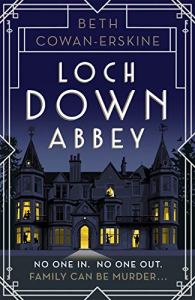
Loch Down Abbey by Beth Cowan-Erskine

Hodder & Stoughton| April 2021| 300 pages| ebook| Review copy| 4*

Description

It’s the 1930s and a mysterious illness is spreading over Scotland. But the noble and ancient family of Inverkillen, residents of Loch Down Abbey, are much more concerned with dwindling toilet roll supplies and who will look after the children now that Nanny has regretfully (and most inconveniently) departed this life.

Then Lord Inverkillen, Earl and head of the family, is found dead in mysterious circumstances. The inspector declares it an accident but Mrs MacBain, the head housekeeper, isn’t so convinced. As no one is allowed in or out because of the illness, the residents of the house – both upstairs and downstairs – are the only suspects. With the Earl’s own family too busy doing what can only be described as nothing, she decides to do some digging – in between chores, of course – and in doing so uncovers a whole host of long-hidden secrets, lies and betrayals that will alter the dynamics of the household for ever.

Loch Down Abbey is a light, quick and easy read that kept me entertained. The pun in the title suggested to me that it would be an amusing novel and the publishers describe it as a playful, humorous novel set in 1930s Scotland. I think it’s quite like a cross between a P G Wodehouse novel and a country house mystery, with elements of farce.

Loch Down Abbey, is a large rambling house with 125 rooms, not including the servants’ quarters, and 5 thousand acres of land on the shores of Loch Down. It has been the home of the Ogilvy-Sinclair Clan for six centuries. I found it quite bewildering at first as there are so many characters. I had to keep going back to the List of Characters to remind myself who they all were.

It’s partly a cozy, historical murder mystery, but mostly a family saga. Lord Hamish Inverkillen is found dead, and at first it looks like an accident, but the housekeeper Mrs MacBain thinks it could be murder. It becomes clear that the Abbey, as well as their whisky distillery is in debt, so much so that the only way they can survive is to sell the house, the distillery and land. There’s a mysterious illness known as Virulent Pernicious Mauvaise spreading around the country. Loch Down Abbey has to go into lockdown! Most of the servants catch the disease and have to be isolated away from the family, meaning that the family have to make their own breakfasts, light the fires in the bedrooms and make their own beds – unheard of for aristocrats! And as Nanny has died the children run wild causing all sorts of mayhem.

As Mrs MacBain and Inspector Jarvis investigate Hamish’s death, lots of secrets and scandals are revealed. I really liked the descriptions of the Abbey itself complete with secret passages, reminding me of Enid Blyton’s novels and I thought the ending, though a bit unbelievable, was inevitable.

My thanks to the publishers for a review copy via NetGalley.

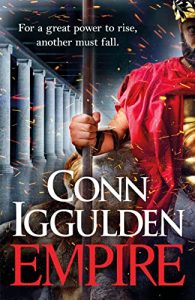
Empire by Conn Iggulden

Penguin| May 2023| 409 pages| ebook| Review Book| 5*

Pericles is more than a hero. He’s the leader of Athens. The empire’s beacon of light.

But even during times of peace, the threat of Sparta – Athens’s legendary rival – looms large on the horizon. When a sudden catastrophe brings Sparta to its knees, Pericles sees a golden opportunity to forever shift the balance of power in his city’s favour.

For sometimes, the only way to win lasting peace is to wage war. Sparta may be weak, but their power is far from extinguished. Soon a ruthless young boy steps forward to lead the Spartans back to greatness.

As the drums of battle draw closer, can Pericles rise once more?

Or will the world’s greatest empire fall under his watch?

My thoughts

Empire is the second in the Golden Age series, continuing the story told in Lion. Pericles is the main character, now the leader of Athens, appointed as a strategos (a military general). Iggulden brings the period to life as he details the continuing struggle for power between Athens and Sparta. The earthquake that struck around 464 BC destroyed most of the city of Sparta. After the Spartans rejected the Athenians’ offer of help Pericles realised that war between them was inevitable and he decided to rebuild the walls around the city to keep it safe. When the Spartans heard that the walls were rising they demanded they be taken down. The Athenians ignored this demand which, of course, led to war, with the Spartans laying siege to Athens.

Lion is an action packed and a gripping story. Iggulden tells the story, seamlessly incorporating his research into the narrative so that this doesn’t read like a textbook but as a fascinating and gripping epic tale of war and death between the states of Athens and Sparta. It’s an amazing tale of political intrigue and bloodthirsty battles. Equally as fascinating as the story is Iggulden’s Historical Note, in which he expands on the background and detail of the historical record. He also explains how he has compressed some of the years and has omitted some ‘actions, skirmishes, insults and general breakdown of good relations between the two states and their allies.’

I think it’s an entertaining and very readable book and I thoroughly enjoyed it.

My thanks to the publishers for a review copy via NetGalley.