Green Darkness by Anya Seton

I finished reading Green Darkness a couple of weeks ago and have been wondering what to write about it or whether to write anything at all. I thought I’d read the book years ago, not long after it came out, but as soon as I began what I thought was a re-read I realised that this was completely new to me – I just thought I’d read it because I’d visited Ightham Mote, a beautiful 14th century moated manor house in Kent where part of Green Darkness is set.

A brief synopsis from Goodreads:

This story of troubled love takes place simultaneously during two periods of time: today and 400 years ago. We meet Richard and Celia Marsdon, an attractive young couple, whose family traces its lineage back to medieval England. Richard’s growing depression creates a crisis in Celia, and she falls desperately ill. Lying unconscious and near death, Celia’s spirit journeys backward to a time four centuries earlier when another Celia loved another Marsdon.

I wasn’t enthralled by it and nearly abandoned it after the first few chapters set in 1968, because the characters didn’t come over as real and the writing in accents was awful. But once I got on to the historical part, set in the 16th century it was better, so I read on.

There are some books that are easy to write about – this isn’t one of them so this is a brief post. Green Darkness is written around the premise of reincarnation, so the characters/personalities feature in both time periods. I didn’t think this was successful, but seemed contrived. For me the book would have been better as straight historical fiction.

Reading Challenges: Color Coded Challenge – green (I don’t know why this book is called Green Darkness – if the book explains the title I missed it). What’s In a Name – a book with a colour in its title. Historical Fiction challenge – 16th century England. My Kind of Mystery Challenge.

Historical Fiction Reading Challenge 2015

I’ve been looking out for this challenge after Historical Tapestry announced that they were no longer running it and there is a new host this year – Amy at Passages to the Past. I hadn’t seen Amy’s blog before, but it looks very interesting, full of historical fiction reviews etc.

The challenge runs from January 1st to December 31st 2015 and there are six different levels to choose from:

20th century Reader – 2 books
Victorian Reader –  5 books
Renaissance Reader – 10 books
Medieval – 15 books
Ancient History – 25 books
Prehistoric [ 50+ books

Any type of historical fiction is accepted including sub-genres such as Historical Romance, Historical Mystery, Historical Fantasy and Young Adult.

Historical fiction is one of my favourite genres and last year I met my target level reading 26 books – just over the Ancient History level. I’m tempted to aim for the Prehistoric Level, but as I want to be more relaxed about challenges this year I’ll be aiming for the Ancient History level again, and if I read more then so much the better.

Portrait in Sepia by Isabel Allende

I picked up Portrait in Sepia up in a bookshop four years ago. As I knew nothing about it or the author it joined the other to-be-read books until just recently.

The opening pages of this historical novel grabbed my attention, about Aurora del Valle’s birth in 1880 in San Francisco in the Chinese quarter and referring to family secrets:

I have come to know the details of my birth rather late in life, but it would have been worse not to discover them at all, they could have been lost forever in the cracks and crannies of oblivion. There are so many secrets in my family that I may never have time to unveil them all: truth is short-lived, watered down by torrents of rain. (page 3)

Portrait in Sepia is part of a trilogy, with The House of the Spirits and Daughter of Fortune, and maybe it would have helped if I’d read the other two books, but I thought there was plenty of background history to the characters and I had no problem in following the story and distinguishing the characters.

Summary from the back cover:

After her mother dies in childbirth, Aurora del Valle is raised by her grandmother in San Francisco, but despite growing up in this rich and privileged environment, Aurora is unhappy. Haunted by terrible nightmares and the inexplicable absence of many of her childhood memories, and finding herself alone at the end of a love affair, she decides to travel to Chile to discover what it was, exactly, all those years ago, that had such a devastating effect on her young life. 

Aurora is the narrator and this the story of her family and after giving details of her birth, Aurora goes back to 1862 beginning her story with details about her grandparents. This is not a book you read quickly as there is a lot of detail, a lot of 19th century history of Chile, its mix of nationalities, politics and wars – at first I felt I was drowning in detail, but once I settled into the rhythm of the writing I began to appreciate Allende’s style. It takes you right into the characters, seeing them through Aurora’s eyes – her Chinese grandfather, Tao Chi’en, her uncle Severo and her two grandmothers, Paulina and Eliza, who both play a large role in her life. And there are many other colourful characters and momentous events in this book.

It’s a book about love, loss, identity, betrayal and about family relationships. It’s a portrayal of the strengths and weaknesses of the characters and their struggle to survive. Aurora tells her family’s story through looking at photographs, snapshots in time, through her own disjointed, incomplete and vague memories of her childhood and through conversations with her family members. Whilst she was still very young her two grandmothers decided her future, thinking that time would erase the memory of the traumatic events she had seen, never realising that the scenes would live forever in her nightmares.

Portrait in Sepia explores the nature of memory, how each moment of our lives is so transitory and how the past becomes confused as we try to recapture the moments we’ve lived through. Through photographs we can keep memories alive. As Aurora discovered:

Every instant disappears in a breath and immediately becomes the past; reality is ephemeral and changing, pure longing. With these photographs and pages I keep memories alive; they are my grasp on a truth that is fleeting , but truth none the less; they prove that these events happened and that these people passed through my destiny. Thanks to them I can revive my mother who died at my birth, my stalwart grandmothers, and my wise Chinese grandfather, my poor father, and other links in the long chain of my family, all of mixed and ardent blood. (pages 303-4)

Reading a book like this inevitably leads me on to yet more books, because now I want to read the other two books in the trilogy.
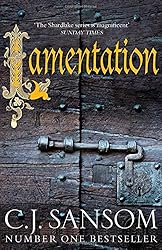
Lamentation by C J Sansom

Once again I am behind myself with writing about the books I’ve read! So here are just a few thoughts about C J Sansom’s historical novel, Lamentation, the sixth Matthew Shardlake book.

I have enjoyed the earlier books in the series so I had great expectations for Lamentation and I wasn’t disappointed. It’s set in 1546, the last year of Henry VIII’s life. Shardlake, a lawyer is asked by Queen Catherine (Parr) for help in discovering who has stolen her confessional book, Lamentation of a Sinner. What I like about these books is their historical setting and the Historical Notes giving yet more background to the period and emphasising that because the sources are ‘very thin’ that inevitably this is Sansom’s own interpretation of events and clarifying that Catherine Parr’s book was not, in the real world, stolen.

The book evokes the people, the sights, smells and atmosphere of Henry’s last year and at the same time it’s an ingenious crime mystery, full of suspense and tension. It begins as Shardlake is ordered to watch the burning at the stake of Anne Askew and other heretics (a real event). I’m not good at reading horrific scenes, but I managed this one without too much mental aversion of my eyes. Along with the mystery of the missing book, Shardlake is working on the Cotterstoke dispute between rival siblings, and has problems at home with his domestic servants.

I was also very taken with Shardlake’s introduction in Lamentation to William Cecil, Mary Tudor and a young Elizabeth I. I hope Sansom has more Shardlake books in mind.

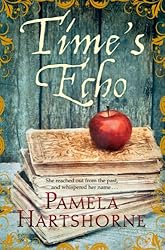
Time's Echo by Pamela Hartshorne


As I wrote in a First Chapter post  Time’s Echo mixes time as Grace Trewe is drawn into Hawise Aske’s life, four and a half centuries earlier in York, 1577. I saw this book in the library and although I hadn’t heard of Pamela Hartshorne I thought the title was interesting, and from the description on the back cover and the opening paragraphs, I thought it was worth borrowing.

It’s a good choice for Carl’s R.I.P. IX challenge, a time-slip story with an element of mystery and suspense in both time periods. Grace is staying in York to sort out the sale of her late godmother’s house when she experiences unnerving episodes in which she appears to be reliving the traumatic events in Hawise’s life beginning in 1577.  Grace likes to travel and although she survived the Boxing Day tsunami she is suppressing her memories of what happened. 

I think the suspense is somewhat diluted because right from the opening chapter it’s revealed that Hawise was drowned on All Hallows’ Eve, with her thumb tied to her toe – ie as a witch. But as Grace’s episodes continue she learns what happened in Hawise’s life to bring her to her dramatic death and this is interwoven with events in Grace’s life. It gets to the point where she dreads slipping out of current time into not only Hawise’s past but also into her own as what happened to her in the tsunami breaks through her mind.

What does add to the suspense is the unpredictability of the time-slips and the sense of malice and evil. So much so that the sceptic in me was unable to decide whether this was a question of whether Grace was suffering from post-traumatic stress disorder or was she really being “possessed” by Hawise, as she believed, feeling Hawise clamouring to be let into her mind. I found the historical sections more interesting than the modern story, which I think often happens when I read time-slip stories.

Pamela Hartshorne explains how she came to write this book in the Author’s Note at the end of the book. It grew out of her research on the wardmote-court returns of early modern York. These records dealt primarily with nuisances, things that affected the quality of life for the neighbourhood – such as noisy neighbours, blocked sewers. potholed streets etc (I note that local life hasn’t changed much over the centuries!). Some of the minor characters were real people, but this book is a work of fiction and Hartshorne is not intending this to be an accurate historical account, although she has tried to make it as convincing and as authentic as she could – I think she succeeded.

I thought the book was rather drawn out in parts, slowing the story down a bit too much for my liking. But, I like the fact that the book has a factual background, even though there are some liberties with the evidence – eg there was no plague in York in the 1570s or 1580s as featured in the book. So, on the whole I enjoyed Time’s Echo primarily because of its historical elements and I’ll look out for more books by Pamela Hartshorne. I see from her website that she has just published another time-slip book, The Memory of Midnight.

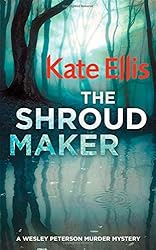
The Shroud Maker by Kate Ellis

When I saw The Shroud Maker by Kate Ellis in the mobile library I thought I’d seen reviews of her books on other blogs, so I borrowed it. It is the eighteenth Wesley Peterson Mystery, but I think it reads well without knowing the background to the main characters. Although I suppose if I went back in the series I’d find that I know things that maybe I shouldn’t.

Summary:

It’s the Palkin Festival in Tradmouth, a town in Devon, when the body of a strangled women is discovered floating out to sea in a dinghy. A year earlier Jenny Bercival had disappeared from the festival and her mother returns to look for her bringing with her anonymous letters claiming she is still alive. DI Wesley Peterson and his boss DCI Gerry Heffernan are investigating the two cases. Are they connected and is there a link to a fantasy website called ‘Shipworld’ which features the 14th century mayor and privateer of Tradmouth, Palkin as a supernatural hero with a sinister, faceless nemesis called the ‘Shroud Maker’?

 When Wesley’s friend, archaeologist Neil Watson finds a skeleton on the site of Palkin’s warehouse, the question is whether an ancient crime has been uncovered, or is it Jenny’s body?

My view:

I liked the way the historical mystery intertwines with the modern one, through the archaelogical evidence, and the extracts from a 19th century biography of John Palkin written by his descendant, Josiah Palkin-Wright and letters from Josiah’s wife to her sister, worried about her marriage and that her sister does not reply. Kate Ellis’s style of writing is deceptively simple, so much so that the locations and characters came to life in my mind, whether it was Tradmouth in the past or the present.

There is plenty of mystery in this novel. I really had to concentrate to keep all the characters, red-herrings, twists and turns, and sub-plots in my mind. I thought I’d followed it as I read it, but now I’m not sure that I can give a clear account of what happened and why. However, as I do like complex mysteries I think I’ll have to look out for the first books in the Wesley Peterson series.

A note on the title:

From the title I thought that the ‘Shroud Maker’ would be a person who makes shrouds ie cloths used to wrap a body for burial, but that is not so in this book. Instead the name of ‘Shroud Maker’ is taken from a rope maker, shrouds being the ropes that support a ship’s masts. He or she is a mysterious figure, who in the Shipworld website appears as a faceless monster, wearing what looks like a white ski mask, a malevolent dark force.

The Author’s Note:

It didn’t take me long reading this book to realise that ‘Tradmouth’ is an inversion of the name of Dartmouth in Devon and Kate Ellis’s note at the end of the book clarifies that. She refers to Geoffrey Chaucer, the author of The Canterbury Tales which features a character called the Shipman, a seaman from ‘Dertemouth’, who like her own invented character, was little better than a pirate. She writes that during the 19th century people were fascinated with the medieval period, perhaps as a reaction against industrialisation and her fictional writings of Josiah Palkin-Wright reflected that interest. And coming up to the present day she reflects that fantasy fiction is as popular today as it ever was, with the influence of J R R Tolkien’s works and fantasy fiction websites.

Reading Challenges: R.I.P. Challenge, the My Kind of Mystery Challenge, and the Historical Fiction Reading Challenge.