The Christmas Card Crime and Other Stories edited by Martin Edwards (British Library Crime Classics)

Here is another collection of short stories from the Golden Age of Murder edited by Martin Edwards: The Christmas Card Crime and Other Stories.
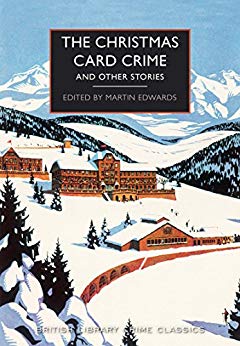
Christmas Card Crime

Poisoned Pen Press, in association with the British Library|1 October 2019|Print length 240 pages|e-book |Review copy|4*

There are eleven stories all set during the Christmas season in this collection and an introduction by Martin Edwards. In it he points out the differences between a short story and a novel. It’s not just the length, but it is also the fact that in a short story there is little space to develop the characters in depth or for lengthy descriptions, so ‘every word must be made to earn its keep‘. He has also prefaced each story with a biographical note, which I found useful as some of the authors were new to me.

The mysteries range in date of publication from 1909 up to 1965. I’ve read stories by some of the authors before, such as Baroness Orczy, John Dixon Carr, Ronald Knox, E C R Lorac, John Bude and Julian Symons, but others were new to me. The ones I enjoyed the most are:

The Motive  Ronald Knox. This story first appeared in The London Illustrated News in November 1937 and is about an attempted murder in a smart hotel on the English Riviera, by a character named ‘Westmacott’ (a pen name used by Agatha Christie).. On Christmas Day after a party the guests decided to play a version of ‘blind man’s buff’ in the swimming pool, which didn’t go as planned.

Another version of ‘blind man’s buff‘, this time called ‘blind man’s bluff‘, is played in the next story also with disastrous consequences.

Blind Man’s Hood by John Dickson Carr writing as Carter Dickson. This first appeared in the Christmas edition of The Sketch in 1937 and is a story inspired by the unsolved Peasonhall murder case of 1902. It is a strange tale about a young couple arriving to spend Christmas with friends, only to find the house empty – except that is for a young woman carrying a white bag, who tells them about a game of ‘Blind Man’s Bluff’ that went very wrong, years ago. It’s a variation on a locked room mystery, with a touch of the supernatural.

Crime at Lark Cottage by John Bingham – this first appeared in the 1954 Christmas Number of The London Illustrated News. Bingham was the 7th Earl of Clanmorris, a journalist who was recruited into MI5, where he worked with David Cornwell, who later wrote spy novels under the name of John Le Carré. This story and the next are my two favourites in the book. It is the story of an escaped convict and an isolated country cottage occupied by a young woman and her little daughter one snowy Christmas. Very atmospheric and tense with an unexpected ending. I’d like to read more of John Bingham’s work.

‘Twixt the Cup and the Lip by Julian Symons – this first appeared in Ellery Queen’s Mystery Magazine in January 1965). Longer than the other stories in this collection it is the tale of Mr Rossiter Payne, a meticulous bookseller who plans a perfect robbery – to steal the jewels, that had once belonged to the Russian royal family, on display in a London department store at Christmas. But Mr Payne had made an uncharacteristic error …

Overall, I enjoyed reading this collection, with a mix of excellent short stories and some that I thought  were too short and had disappointing or predictable endings.

My thanks to the publishers for my review copy via NetGalley.
Two Crime Fiction Titles

I’m behind with reviewing the books I’ve read, so here are short reviews of two crime fiction novels I’ve read recently:

Broken ground

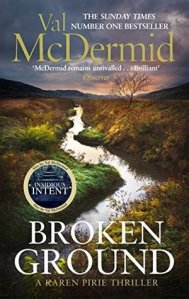
Broken Ground by Val McDermid, the 5th Karen Pirie book. 4*

This begins in 1944 when two men bury a couple of wooden crates in a peat bog in Wester Ross in the Scottish Highlands. Seventy four years later Alice and her husband Will are on a treasure hunt, following a map Alice’s grandfather had left her. But they are astonished when discover the body of a man in the peat bog together with one of the crates. Perfectly preserved it appeared at first that this was a case for Karen’s friend Dr River Wilde, the forensic anthropologist. But the fact that the man was wearing a pair of Nikes, dating the body back to the 1990s ruled out that idea, which made it a case for Karen Pirie and her Historic Cases Unit.

This is a very readable book, moving swiftly along, that I really enjoyed. Karen has to cope with the unwelcome addition to her team of DS Gerry Mcartney. The ACC, Ann Markle and Karen just don’t get on and Karen suspects Markle is using McCartney to keep tabs on her and find a way to close the Unit down. It is a complicated case as attention switches back to events in 1944, the 1990s and the present day, although the actual murder mystery isn’t that difficult to work out.

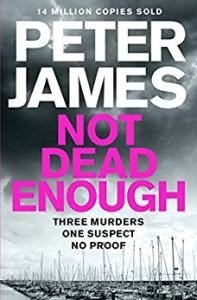
Not Dead EnoughNot Dead Enough by Peter James, the 3rd Detective Superintendent Roy Grace book. 4*

It’s set in Brighton and begins with the murder of Katie Bishop. The immediate suspect is her husband Brian, but it appears that he couldn’t be the murderer unless he could have been in two places at once. Then Sophie Harrington is killed. She had been having an affair with Brian thus intensifying the police investigation into his movements and background.

Grace’s wife, Sandy, had disappeared nine years earlier and he is still wondering what happened to her even though he is now involved with Cleo Morey, the Chief Mortician and he takes a quick trip over to Munich when his friends tell him they had seen her there.

This is a re-read. I first read it in January 2014 and it was only when I reached the part about Sandy that I realised I had read it before. I think that this is because the two murders are particularly gruesome and either I’d scan read them before or had blocked them out of my mind. Apart from the gruesome murders I enjoyed this book and intend to carry on reading the Roy Grace books.

A Lovely Way to Burn by Louise Welsh: Mini Review

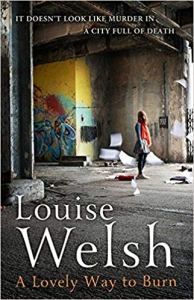
A Lovely Way to Burn

John Murray|2004|358 pages|Hardback| Library book|4*

I’ve read a few of Louise Welsh’s books and enjoyed each one so when I saw this on the library shelves I borrowed it. I agree with Val McDermid’s description of it on the back cover: ‘a terrifying journey into the possible, this is dystopia for today. Feral, frightening and fascinating, A Lovely Way to Burn gripped and chilled me in equal measure.

Once I started reading I just didn’t want to stop. I was gripped as Stevie Flint, a presenter on a TV show, Shop TV, finds her boyfriend, surgeon Simon Sharkey, lying dead in his apartment. At first it appeared that he had died of natural causes and then that he had killed himself. But he had left a hidden note for her with instructions to deliver his laptop to Malcolm Rhea, a colleague at St Thomas’s Hospital. Under no circumstances was she to take it to the police or to entrust it anyone except Rhea. Stevie is determined to find out what happened to him. Her search takes her into the most dangerous situations.

It is a horrifying vision of what could happen when a new and unidentified virus, known as ‘the sweats’ sweeps the globe. London quickly descends into chaos – supermarkets are looted, roads are gridlocked as people try to flee the infection, then society just crumbles as people look out only for themselves, rioting and eventually succumbing to the mysterious illness and dying. 

After quite a leisurely start the pace picks up, and the tension rises rapidly before reaching a nightmare scenario as decay and disintegration set in. It’s a mix of murder mystery and a surreal and frightening story of a plague. This is the first in Louise Welsh’s Plague Trilogy, but it is complete in itself. I have the second book, Death is a Welcome Guest and it looks as though it has a new set of characters – I’m looking forward to reading it!

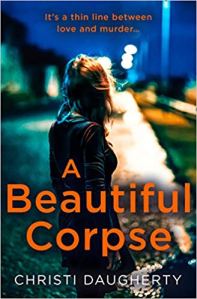
A Beautiful Corpse by Christi Daugherty

a beautiful corpse

Harper Collins|March 2019|384 pages|e-book via NetGalley|Review copy|5*

I saw A Beautiful Corpse by Christi Daugherty on NetGalley and thought I would like it from the description, but not expecting to enjoy it as much as I did. I didn’t realise that it’s the 2nd in the Harper McClain series but I think it works very well as a standalone.

I liked a lot about it – it is well written, has a fast-paced plot, but not at the expense of the characters, and it’s set in Savannah, with its historic buildings, parks and ancient oak trees covered in Spanish moss.

Harper McLain is a crime reporter with the Savannah Daily News. The book begins late one evening as she is playing pool in the Library Bar with her friend and bartender, Bonnie. The crime photographer rings her, telling her about a murder on downtown River Street, a narrow cobblestoned lane between the old wharves and warehouses and the Savannah River. And she is shocked to discover that the young woman sprawled on the uneven cobbles is Naomi, a law student, who had worked with Bonnie at the Library Bar. She had been shot dead.

There are three men who are all suspects, but her current boyfriend Wilson Shepherd is the prime suspect. The Library Bar owner, Fitz, is also a suspect especially as no one has seen him after the shooting. And then there is her ex-boyfriend Peyton Anderson, the powerful DA’s son. The police are convinced that Wilson is the killer, but after Harper talked to him, she just can’t believe that it was him. There were no witnesses to the shooting and when Harper talks to Jerrod, Naomi’s father, she realises that Peyton’s alibi may not be as solid as the police maintain it to be. 

This a story of obsession and jealousy and the tension rises as the killer’s focus shifts on to Harper herself. She is a strong determined character, determined to find out the truth. But as well as the murder investigation Harper has her own personal problems to contend with. Her job as a reporter is under threat, someone is breaking into her apartment and her personal relationship with Detective Luke Walker seems about to be revived, but she is wary where it will end. On top of all that she is desperate to find out who had killed her mother twelve years earlier. 

I loved it and it has made me eager to read the first book, The Echo Killing, to find out more about Harper and her background and also to read the next book in the series – Revolver Road due to be published in March next year – to find out what happens next.

WWW Wednesday: 27 November 2019

IMG_1384-0

WWW Wednesday is run by Taking on a World of Words.

The Three Ws are:

What are you currently reading?
What did you recently finish reading?
What do you think you’ll read next?

a beautiful corpse

Currently I’m reading A Beautiful Corpse, crime fiction by Christi Daugherty, set in Savannah, Georgia. A beautiful law student has been killed and three men close to the victim are questioned. All of them claim to love her. All of them say they are innocent of her murder.  As journalist Harper McClain unravels a tangled story of obsession and jealousy, the killer turns his focus onto her. I’ve read over half the book and it is growing on me – I’m enjoying it more and more as I read on.
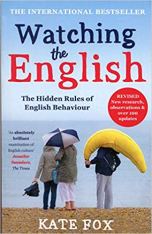
Watching the EnglishI’m also reading Watching the English by Kate Fox, a nonfiction book about the ‘Hidden Rules of English Behaviour’. I’ve only just started reading and so far it is really interesting as the author sets out her parameters and defines what she considers to be  ‘Englishness’ and why it is different from ‘Britishness’, which I think is a very tricky question and one that I have been puzzling over for years.

She refers in some instances to Jeremy Paxman (and I see from the index there are several references to him in this book) and she lists his book The English: A Portrait of a People, which I read about 5 years ago. I decided from reading his book that I didn’t really feel any clearer about what is is to be ‘English’ and it seemed there really is no such thing as ‘the English’ – we’re a mixture of all sorts, or as Paxman puts it, The English are a mongrel race‘. (page 59)

Furious hours

I’ve recently finished Furious Hours: Murder, Fraud, and the Last Trial of Harper Lee by Casey Cep, a nonfiction book about Willie Maxwell, an Alabama serial killer and the true-crime book that Harper Lee worked on obsessively in the years after To Kill a Mockingbird. I found this a fascinating book and posted my review yesterday

As for my next book I don’t know right now. I’m torn between wanting to read several, including A Pinch of Snuff by Reginald Hill, the 5th Dalziel and Pascoe novel, A Lovely Way to Burn by Louise Welsh, the 1st in her Plague Trilogy, Go Set A Watchman by Harper Lee and In Cold Blood by Truman Capote (the last two as I’ve just finished reading Furious Hours).

Have you read any of these books?  Do any of them tempt you? 

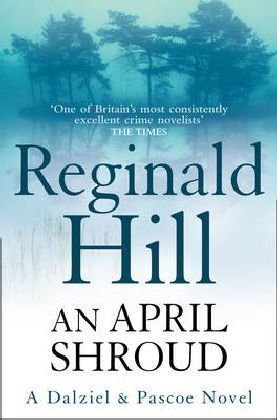
An April Shroud by Reginald Hill

April Shroud

HarperCollins|2011|326 pages|Paperback|my own copy| 3* 

An April Shroud is Reginald Hill’s fourth Dalziel and Pascoe novel, first published in 1975, in which Dalziel is on holiday and Pascoe is on his honeymoon.

From the back cover:

Inspector Pascoe may take holidays but Death never does – and neither, it seems, does Superintendent Dalziel. A watery accident on a solitary country holiday leads to the Fat Man drying off in Lake House, a nearby mansion well past its prime.

The same cannot be said for its owner, the fulsome Mrs Fielding. She has only recently buried her husband, but seems more concerned with her future. Dalziel’s curiosity is aroused – purely professionally of course – and by the time Pascoe’s honeymoon is over, there have been several more deaths and Dalziel might have compromised himself beyond redemption …

Whereas in the previous book, Ruling Passion Dalziel’s character was more of a caricature, on An April Shroud Hill develops his character more fully, in fact I think the book is primarily a superb character study of Dalziel.  He is rude, coarse and insensitive, but his capacity for getting to the bottom of a mystery is shown to be immense.

Although on holiday he cannot help but ferret out what really happened to Conrad Fielding, when he meets the Fielding family on their way back home after Conrad’s funeral. He was rescued by them when his journey south was brought to an abrupt end by floods. The police had decided that Conrad’s death had been an accident – he had fallen off a ladder onto the drill he had been using and it had pierced his heart. Mrs Fielding invites Dalziel to stay at their home, Lake House, where it soon becomes apparent to him that the family have plenty of secrets they would rather he didn’t discover.

I couldn’t easily distinguish who was who in the family, except to realise that they were all rather odd. The plot seemed over complicated and in parts I thought I was reading a farce as more bodies turned up dead. I had little idea who was guilty and the identity of the culprits took me by surprise. Dalziel’s ‘interlude’ with the widow, Bonny Fielding, was entertaining as well as revealing about Dalziel’s personal life – he is sensitive and vulnerable beneath his boorish exterior. 

Overall, I enjoyed the book, although for me it was far from Hill’s best Dalziel and Pascoe book and I’m looking forward to reading book 5, A Pinch of Snuff, as I know that the later books are much better. Reginald Hill wrote 24 Dalziel and Pascoe novels. I’ve read some of them and currently I’m reading my way through the rest.

These are the Dalziel and Pascoe books I’ve read so far:

1. A Clubbable Woman (1970) 
2. An Advancement of Learning (1971)
3. Ruling Passion (1973)
4. An April Shroud (1975) 
8. Exit Lines (1984)
11. Bones and Silence (1990) 
14. Pictures of Perfection (1993) – read, no post
17.On Beulah Height (1998) 
20. Death’s Jest Book (2002) 
21. The Death of Dalziel (2007)

Reading Challenges: Mount TBR 2019 (a book I’ve owned for four years) and the Calendar of Crime 2019 challenge (for the month of April – a book with the month in the title).