The Classics Club Spin Result

The spin number in The Classics Club Spin is number …

which for me is Moll Flanders by Daniel Defoe. The rules of the Spin are that this is the book for me to read by 29th January 2023.

Synopsis

I grew as impudent a Thief, and as dexterous as ever Moll Cut-Purse was’

Born and abandoned in Newgate Prison, Moll Flanders is forced to make her own way in life. She duly embarks on a career that includes husband-hunting, incest, bigamy, prostitution and pick-pocketing, until her crimes eventually catch up with her. One of the earliest and most vivid female narrators in the history of the English novel, Moll recounts her adventures with irresistible wit and candour—and enough guile that the reader is left uncertain whether she is ultimately a redeemed sinner or a successful opportunist. 

I hesitated before adding this book to my Classics Club list and now I’m not sure that I do want to read it. I’m hoping that at least I’ll like it. If you have read it I’d love to know what you thought of it.

Did you take part in the Classics Spin? What will you be reading?

White Rose, Black Forest by Eoin Dempsey

Rating: 3 out of 5.

This is the second of several short posts as I try to catch up with writing reviews of books I read earlier this year.

White Forest, Black Rose by Eoin Dempsey is a World War 2 novel which is different from other books set during the War that I’ve read before, told from the perspective of a German who opposed the Nazis. It is set in the Black Forest, Germany in 1943, where Franka Gerber is living alone in an isolated cabin, having returned to her home town of Freiburg after serving a prison sentence for anti-Nazi activities.

It is December and the Forest is blanketed in deep snow when she discovers an unconscious airman lying in the snow wearing a Luftwaffe uniform, his parachute flapping in the wind. Taking him back to the cabin she saves his life, but whilst he is unconscious she hears him speak in English and so it seems that he is not who she first thought he was. Both his legs are broken and, having been a nurse, Franka is able to set the bones, and tries to discover his true identity. Trapped in the cabin they both gradually reveal details of their past lives and learn to trust each other.

It is a tense, claustrophobic novel and as soon as he is able to walk they decide to leave the cabin and so begins a race against time, as they are hunted by the Gestapo. Can they trust each other enough to join forces on a mission that could change the face of the war and their own lives forever?

White Rose, Black Forest is a novel inspired by true events, although the author doesn’t clarify what is fact and what is fiction. I enjoyed it, especially the historical aspects. The White Rose movement in Germany was a non-violent intellectual resistance group in Nazi Germany, who conducted an anonymous leaflet and graffiti campaign that called for active opposition to the Nazi regime.

It slots into the Forest box in the Wanderlust Bingo card and is also one of my TBRs, a book I’ve owned since 2018.

State of Wonder by Ann Patchett

Once more I’m behind with reviews of some of the books I’ve read in June, July and August, so this is the first of several short posts as I try to catch up with writing reviews.

Rating: 5 out of 5.

I loved State of Wonder by Ann Patchett!

After a slow start I began to realise that this was a book I was really going to enjoy. In some ways it is similar to Heart of Darkness by Graham Greene, but set in the Brazilian jungle along the Rio Negro instead of the Belgian Congo in Africa. It slots into the River box in the Wanderlust Bingo card. It is also one of my TBRs, a book I’ve owned since 2015 and so qualifies for the Mount TBR Challenge.

Dr. Annick Swenson, a research scientist, is developing a drug that could alter the lives of women forever. But she refuses to report on her progress, especially to her investors, whose patience is fast running out. Anders Eckman, a lab researcher, is sent to investigate. When Dr. Swenson reported that Anders had died of a fever in a remote part of the jungle, Dr. Marina Singh, a former student of Dr. Swenson, is sent to find out what has happened to him.

From that point onwards it gets more and more complicated. First of all it’s very difficult for her to meet Dr. Swenson, and when she does eventually reach her there are all the dangers of the rain forest to deal with, including deadly snakes, hundreds of insects, mysterious natives and exotic diseases plus the intense heat. There are also secrets and lies that are only gradually revealed.

The novel raises questions about the morality and ethics of research into the use of extreme fertility treatments and drug studies in general, along with the exploitation of native populations. It is wonderfully descriptive and I could easily imagine that I was there in the jungle, experiencing the oppressive heat and humidity. I found it all fascinating and I was totally absorbed in the story.

Throwback Thursday: The Remorseful Day by Colin Dexter

Today I’m looking back at my post on The Remorseful Day by Colin Dexter, the last Inspector Morse book. I first reviewed it on August 2, 2015.

My review begins:

Chief Inspector Morse is one of my favourite fictional detectives (maybe even the favourite). I first ‘met’ him years ago in the ITV series Inspector Morse and so, just as Joan Hickson is forever in my mind as Miss Marple and David Suchet is Poirot, John Thaw is Morse. The series was first broadcast in 1987, but I don’t intend to write about the books versus the TV adaptations – I’ve enjoyed both. This post is just about the last book in the series – The Remorseful Day.

Click here to read my full review

~~~

The next Throwback Thursday post is scheduled for September 29, 2022.

The Night Hawks by Elly Griffiths

Quercus| 4 February 2021|e-book| Print Length 321 pages| My own copy| 4*

Synopsis:

Dr Ruth Galloway returns to the moody and beautiful landscape of North Norfolk to confront another killer. A devastating new case for our favourite forensic archaeologist in this acclaimed and bestselling crime series.

The Night Hawks, a group of metal detectorists, are searching for buried treasure when they find a body on the beach in North Norfolk. At first Nelson thinks that the dead man might be an asylum seeker but he turns out to be a local boy, Jem Taylor, recently released from prison. Ruth is more interested in the treasure, a hoard of Bronze Age weapons. Nelson at first thinks that Taylor’s death is accidental drowning, but a second death suggests murder.

Nelson is called to an apparent murder-suicide of a couple at the isolated Black Dog Farm. Local legend talks of the Black Shuck, a spectral hound that appears to people before they die. Nelson ignores this, even when the owner’s suicide note includes the line, ‘He’s buried in the garden.’ Ruth excavates and finds the body of a giant dog.

All roads lead back to this farm in the middle of nowhere, but the place spells serious danger for anyone who goes near. Ruth doesn’t scare easily. Not until she finds herself at Black Dog Farm …

My thoughts:

The Night Hawks is the 13th book in the Dr Ruth Galloway books. I’ve enjoyed the earlier books, despite the fact that they are written in the present tense. But it’s been a while since I last read one, 5 years to be precise and I’ve missed a few of them as the last one I read was the 9th book, The Chalk Pit.

So, Ruth’s life has moved on the three books I haven’t read! There is a Who’s Who of the main characters at the end of the book giving their backstories which helps if you haven’t read the earlier books, and reminded me of who they all are and their relationships.

Ruth, the central character, is now Head of the Department of Archaeology at her old university, the fictional University of North Norfolk, having been promoted after the retirement of her old boss, Phil Trent. Her replacement as the archaeology lecturer is David Brown, who Ruth finds annoying. She doesn’t really know why as they have the same academic speciality, the prehistoric era, particularly as that is partly why she employed him to teach the courses that she used to teach. She is also a special advisor to the north Norfolk police.

Her complicated relationship with Detective Chief Inspector Nelson, the father of her daughter, Kate, now ten years old, continues in this book. Nelson thinks of himself as an old-fashioned policeman. But Superintendent Jo Archer is keen to bring the force into the twenty-first century and wants him to retire. He dismisses that idea, maintaining that the police force needs his experience and know-how. He has no plans to retire and avoids talking to her whenever he can.

A body is found on the beach at Blakeney Point, a young man who Nelson guesses is an illegal immigrant, an asylum seeker, and then a skeleton, buried in a mound of what appears to be Bronze Age weapons, discovered by the group known as the Night Hawks when they were searching for buried treasure.

The police are also investigating what at first appears to be a case of murder-suicide at Black Dog Farm, an isolated farm said to be haunted by the Black Shuck. Shuck is the name given to an East Anglian ghostly black dog that is said to roam the coastline and countryside of East Anglia, a large, shaggy dog said to be an omen of death. And there had been quite a few sightings of such a dog near Black Dog Farm.

I was thoroughly entertained by this mystery, glad to get re-acquainted with Ruth, her family and her friends and colleagues. There is a really strong sense of place, so much so that I could easily visualise the scenes and gain a sense of what it’s like to be there at the beach, with the shingle and the sand dunes at Blakeney Point and the north Norfolk countryside.

I hope to read books I’ve missed, namely The Dark Angel, The Stone Circle and The Lantern Men, before too long, and then the 14th in the series, The Locked Room.

Book Beginnings & The Friday 56: All Among the Barley by Melissa Harrison

Every Friday Book Beginnings on Friday is hosted by Gillion at Rose City Reader where you can share the first sentence (or so) of the book you are reading. You can also share from a book you want to highlight just because it caught your fancy.

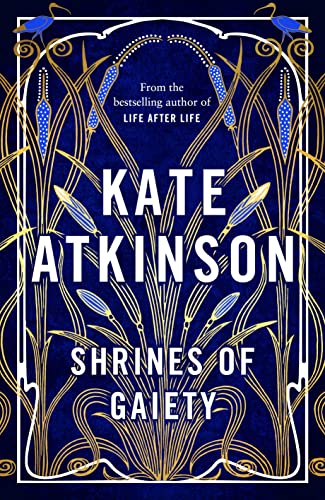
Yesterday I finished reading Shrines of Gaiety, Kate Atkinson’s new book which will be published in September. I’ll write about it in a later post. Although I’m still reading The Return of the King and The Island, I wondered what I’d like to read next. I was thinking of reading  Lion by Conn Iggulden, the first in a new series ‘The Golden Age’, set in Ancient Greece in the 5th century BC. But, today I wasn’t in the mood for ancient historical fiction and fancied something more rural and more modern – and spotted All Among the Barley in a pile of books waiting to be read. It’s set on a farm in Suffolk just before the Second World War.

Prologue

Last night I lay awake again, remembering the day the Hunt ran me down in Hulver Wood when I was just a girl.

And then Chapter 1:

My name is Edith June Mather and I was born after the end of the Great War. My father, George Mather, had sixty acres of arable land known as Wych Farm; it is somewhere not far from here, I believe. Before him my grandfather Albert farmed the same fields, and his father before him, who ploughed with a team of oxen and sowed by hand.

Also every Friday there is The Friday 56, hosted by Freda at Freda’s Voice, where you grab a book and turn to page 56 (or 56% of an eBook), find one or more interesting sentences (no spoilers), and post them.

Page 56:

Unlike Doble, whose family had been tied to ours for generations, John was what we in the village called a ‘furriner’, having been born sixty miles or more north of us, where our clay gave way to flat, rich peat.

Synopsis from Amazon:

WINNER OF THE EU PRIZE FOR LITERATURE

‘BOOK OF THE YEAR’ NEW STATESMAN, OBSERVER, IRISH TIMES, BBC HISTORY MAGAZINE

The fields were eternal, our life the only way of things, and I would do whatever was required of me to protect it.


The autumn of 1933 is the most beautiful Edie Mather can remember, though the Great War still casts a shadow over the cornfields of her beloved home, Wych Farm.

When charismatic, outspoken Constance FitzAllen arrives from London to write about fading rural traditions, she takes an interest in fourteen-year-old Edie, showing her a kindness she has never known before. But the older woman isn’t quite what she seems.

As harvest time approaches and pressures mount on the whole community, Edie must find a way to trust her instincts and save herself from disaster.

I chose this book because earlier this year I enjoyed Melissa Harrison’s novella, Rain: Four Walks in English Weather, which is about four rain showers, in four seasons, across Wicken Fen, Shropshire, the Darent Valley and Dartmoor. I like the way she writes about the natural world and All Among the Barley looks as though it will bring to life a world governed by the old rural traditions, in an evocation of place and a lost way of life.

What do you think? Have you read this book ?