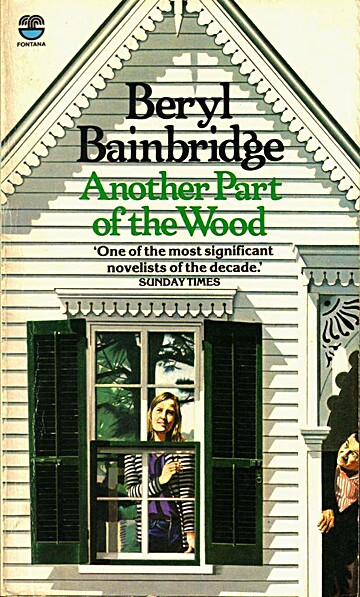
Another Part of the Wood by Beryl Bainbridge

Rating: 4 out of 5.

Synopsis from Amazon:

Joseph decides to take his mistress and son, together with a few friends, to stay in a cabin in deepest Wales for the weekend – with absolutely disastrous results. Beryl Bainbridge’s gift for deadpan dialogue and spare narrative, and her darkly comic vision of the world, are all in evidence in this early novel.

I read Another Part of the Wood because I’ve enjoyed other books by Beryl Bainbridge. It’s a novella, really, as it’s only 159 pages. I love her style, dark humour with clear, concise prose, and fully realised characters. It was her second book, first published in 1968. She revised the book and reissued it in 1979. My copy is a Fontana edition published in 1980. I read it at this time because it’s the novel that came up for me to read for the latest Classics Club Spin. It’s also one of my TBRs, a book that I’ve owned since 2016.

Like all of Beryl Bainbridge’s books that I’ve read it is well written and makes compulsive reading, with individual, mainly unlikable, characters who are mostly at odds with each other. I enjoyed the oddness, never really knowing what would happen next. The title has a theatrical feeling, pointing out the different scenes in the book as the action switches from one part of the wood to another, with one or more of the characters taking centre stage.

It’s set in Flintshire, Wales, in a holiday camp, which consists of huts in a wood at the foot of a mountain. There is George, the owner of the land, and Balfour who works in a factory during the week and helps him at the weekends. George, is obsessed with the Holocaust and Balfour, a shy, quiet man suffers from some sort of illness – he gets sick very suddenly with a high temperature and the shivers as though he’s turned to ice. All he can do is hide away and sleep it off.

The book begins as George’s friend, Joseph, a selfish, insensitive man, arrives for the weekend from London, with his young son, Roland, his girlfriend Dotty, and Kidney, a fat teenager who apparently has learning disabilities and a health problem (never explained), dependent on his pills. In addition Joseph has invited another couple to join them, Lionel and his wife, May, an unhappy couple with a dysfunctional and argumentative relationship. They are all townies, like fish out of water in the countryside and find the huts claustrophobic and too basic – May refuses to use either the chemical toilet or the bushes.

The atmosphere is tense right from the start and rises throughout the book as their relationships become increasingly fractious. Having promised Roland that he would take him for a walk up the mountain, Joseph leaves him to his own devices. He withholds Kidney’s pills and argues with Dotty. Dotty and Balfour walk off to the village where she buys a coat of many colours and Balfour falls ill. The wood, as in fairy tales, is not a safe place.

The world was a deep deceptive forest, full of promises and little glades and clearings, and in the dark depths roamed the wolves, savage, snapping their great teeth, waiting to spring on those who wandered from the path. (page 73)

There’s a sense of foreboding, the sense that something terrible is about to happen … but what, and who is in danger? I felt that more than one of these characters could come to a sticky end. And I was unsure, fearing the worst for one particular character – and sadly I was right. It was inevitable.
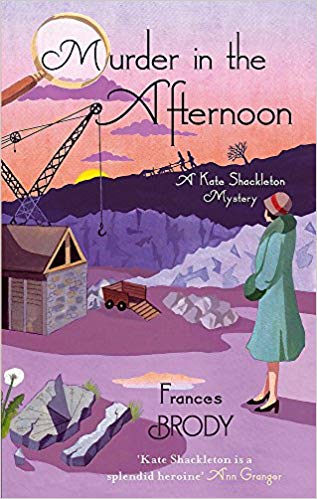
Book Beginnings & The Friday 56: Murder in the Afternoon by Frances Brody

Every Friday Book Beginnings on Friday is hosted by Gillion at Rose City Reader where you can share the first sentence (or so) of the book you are reading. You can also share from a book you want to highlight just because it caught your fancy.

Today I’m featuring one of my TBRs books Murder in the Afternoon by Frances Brody, the third Kate Shackleton Mystery set in the Yorkshire Dales in 1923.

My Book Beginning

Harriet held the cloth-covered basin in her thin hands, feeling the warmth. She and Austin trod the well-eorn path from their long strip of back garden on Nether End,

Mam wasn’t home. She’d hurried off to Town Street, to buy the Woodbines that Harriet accidentally on purpose forgot when she and Austin went to do the Saturday shop. Mam wanted a new house. She was sick to death of living in the back of beyond.

Also every Friday there is The Friday 56, hosted by Freda at Freda’s Voice, where you grab a book and turn to page 56 (or 56% of an eBook), find one or more interesting sentences (no spoilers), and post them.

Page 56:

‘Won’t you at least cordon off the mason’s hut, in case this does turn out to be a murder enquiry?’

His small eyes narrowed. I had overplayed my hand.

‘No, Mrs Shackleton, I will not.’

Synopsis:

Dead One Minute: Young Harriet and her brother, Austin, have always been scared of the quarry where their stonemason father works. So when they find him dead on the cold ground, they scarper quick smart and look for some help.

Alive the Next?: When help arrives, however, the quarry is deserted, and there is no sign of the body. Were the children mistaken? Is their father not dead? Did he simply get up and run away?

A Sinister Disappearing Act: It seems like another unusual case requiring the expertise of Kate Shackleton. But for Kate this is one case where surprising family ties makes it her most dangerous – and delicate – yet….

What do you think? Would you read it?

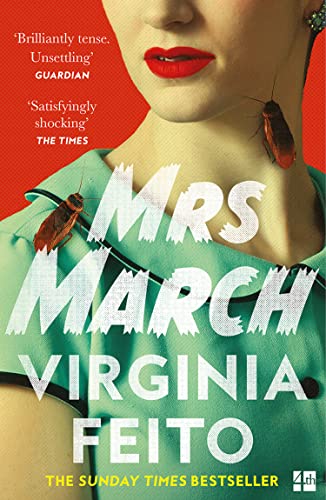
Mrs March by Virginia Feito

4th Estate| May 2022| 305 pages| Review Copy| 3*

I was invited to read Mrs March by the publishers 4th Estate publishers via NetGalley on the publication of the paperback edition in May 2022. It was first published in August 2021.

Publishers’ summary:

George March’s latest novel is a smash hit. None could be prouder than Mrs. March, his dutiful wife, who revels in his accolades and relishes the lifestyle and status his success brings.

A creature of routine and decorum, Mrs. March lives an exquisitely controlled existence on the Upper East Side. Every morning begins the same way, with a visit to her favourite patisserie to buy a loaf of
olive bread, but her latest trip proves to be her last when she suffers an indignity from which she may never recover: an assumption by the shopkeeper that the protagonist in George March’s new book –
a pathetic sex worker, more a figure of derision than desire – is based on Mrs. March.

One casual remark robs Mrs. March not only of her beloved olive bread but of the belief that she knew everything about her husband – and herself – sending her on an increasingly paranoid journey, one
that starts within the pages of a book but may very well uncover both a killer and the long-buried secrets of Mrs. March’s past.

A razor-sharp exploration of the fragility of identity and the smothering weight of expectations, Mrs. March heralds the arrival of a wicked and wonderful new voice.

My thoughts:

I liked the synopsis which is why I read Mrs March. I thought it sounded like a book I would enjoy. But I am in two minds about this book, because although I can see why it has received such a lot of praise and 5 star reviews I really did not enjoy reading it. It is a remarkable character study, taking the reader right inside Mrs March’s head as she descends into paranoia and madness. The whole book is seen solely from her perspective, which makes it the most uncomfortable experience – but that is down to the brilliance of Feito’s writing.

It begins well and I was immediately reminded of Mrs Dalloway and also of the unnamed wife in Rebecca and I wondered if her real name would be revealed. Throughout the book she is called ‘Mrs March’ even when referring to her as a child. It’s as if she is only a person identified by her marital status. Her life seems to have no meaning other than being married to Mr March. There really is very little evidence for Mrs March’s belief that her husband has based the character of a prostitute in his book on her. But her conviction that this is how he sees her is devastating to her. It’s as though her whole existence is threatened.

It’s been a while since I finished reading it as I’ve been wondering what to write about it. There is so much in it to take in and whilst my reading is mostly for enjoyment I don’t think I can dismiss a book simply because I didn’t ‘enjoy’ it. But neither can I ignore that fact. How can you ‘like’ the portrayal of the breakdown of a personality, or a person? It’s beautifully written, but so tragic. I couldn’t like any of the characters, but they got under my skin as I read and I wanted it to end differently – of course, it couldn’t.

My thanks to the publishers for a review copy via NetGalley.

Book Beginnings & The Friday 56: Whispers Under Ground by Ben Aaronovitch

Every Friday Book Beginnings on Friday is hosted by Gillion at Rose City Reader where you can share the first sentence (or so) of the book you are reading. You can also share from a book you want to highlight just because it caught your fancy.

Today I’m featuring one of the books I’m currently reading, Whispers Under Ground by Ben Aaronovitch, the third book in his Rivers of London series, police procedurals of a very different kind – urban fantasy, set in the real world of London, a mix of reality and the supernatural.

My Book Beginning

Back in the summer I’d made the mistake of telling my mother what I did for a living. Not the police bit, which of course she already knew about having been at my graduation from Hendon, but the stuff about me working for the branch of the Met that dealt with the supernatural.

Also every Friday there is The Friday 56, hosted by Freda at Freda’s Voice, where you grab a book and turn to page 56 (or 56% of an eBook), find one or more interesting sentences (no spoilers), and post them.

Page 56:

I was carrying my magic bowl with both hands and stepping carefully on the frost-slippery cobbles.

Ben Aaronovitch is an English author and screenwriter. He is the author of the Rivers of London series of novels. He worked as a scriptwriter for Doctor Who and Casualty before the inspiration for his own series of books struck him whilst working as a bookseller in Waterstones Covent Garden. His unique novels are the culmination of his experience of writing about the emergency services and the supernatural. 

The series is to be adapted for television, bringing together all nine of the novels, plus the accompanying short stories, novellas and graphic novels, for the screen. The TV adaptation will be co-produced by Pure Fiction Television, See-Saw Films and Aaronovitch’s own production company Unnecessary Logo.

Synopsis:

Peter Grant is learning magic fast. And it’s just as well – he’s already had run-ins with the deadly supernatural children of the Thames and a terrifying killer in Soho. Progression in the Police Force is less easy. Especially when you work in a department of two. A department that doesn’t even officially exist. A department that if you did describe it to most people would get you laughed at. And then there’s his love life. The last person he fell for ended up seriously dead. It wasn’t his fault, but still.

Now something horrible is happening in the labyrinth of tunnels that make up the tube system that honeycombs the ancient foundations of London. And delays on the Northern line is the very least of it. Time to call in the Met’s Economic and Specialist Crime Unit 9, aka ‘The Folly’. Time to call in PC Peter Grant, Britain’s Last Wizard.

What do you think? Would you read it?

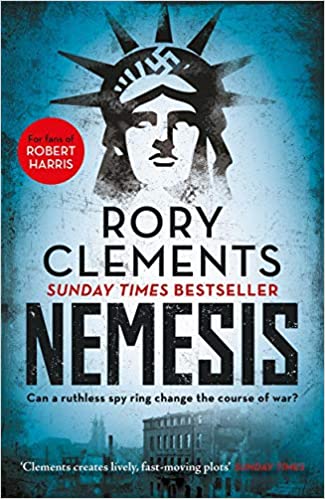
Book Beginnings & The Friday 56: Nemesis by Rory Clements

Every Friday Book Beginnings on Friday is hosted by Gillion at Rose City Reader where you can share the first sentence (or so) of the book you are reading. You can also share from a book you want to highlight just because it caught your fancy.

Today I’m featuring Nemesis by Rory Clements, the third book in his Tom Wilde series, historical fiction set in the Second World War. I’ve read books 1, 2, 4 and 5. It’s probably better to read them in sequence, but I’ve found they read well as standalone books. I am about to start this one.

This was the best day of his life, watching his beloved boy, here in this ancient chamber of light.

Also every Friday there is The Friday 56, hosted by Freda at Freda’s Voice, where you grab a book and turn to page 56 (or 56% of an eBook), find one or more interesting sentences (no spoilers), and post them.

Page 56:

Why was the door open?

He stood on the front doorstep, as his eyes adjusted to the gloom. Across the road, beside the fenced-off garden at the centre of the square, he thought he saw shadowy movement. At first he dismissed it, but then, he heard voices too.

RORY CLEMENTS is a Sunday Times bestselling author. He won the CWA Ellis Peters Historical Award for his second novel, Revenger, and a TV series of the John Shakespeare novels is currently in development. 

Synopsis from Amazon:

In a great English house, a young woman offers herself to one of the most powerful and influential figures in the land – but this is no ordinary seduction. She plans to ensure his death . . .

On holiday in France, Professor Tom Wilde discovers his brilliant student Marcus Marfield, who disappeared two years earlier to join the International Brigades in Spain, in the Le Vernet concentration camp in the foothills of the Pyrenees. Wilde secures his release just as German tanks roll into Poland.

Meanwhile, a U-boat sinks the liner Athenia in the Atlantic with many casualties, including Americans, onboard. Goebbels claims Churchill put a bomb in the ship to blame Germany and to lure America into the war.

As the various strands of an international conspiracy begin to unwind, Tom Wilde will find himself in great personal danger. For just who is Marcus Marfield? And where does his loyalty lie?

A brilliantly intelligent, gripping WW2 spy thriller from the Sunday Times bestselling author of Corpus and Hitler’s Secret.

What do you think? Would you read it?

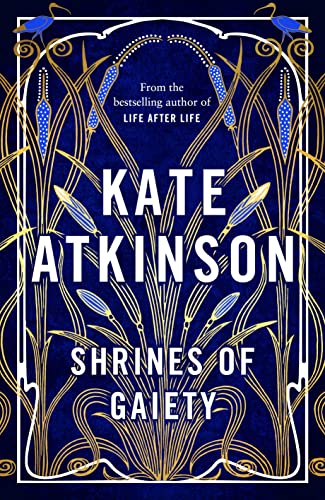
Shrines of Gaiety by Kate Atkinson

Random House UK| 27 September 2022| 440 pages| e-book Review Copy| 2.5*

Synopsis from Amazon

1926, and in a country still recovering from the Great War, London has become the focus for a delirious new nightlife. In the clubs of Soho, peers of the realm rub shoulders with starlets, foreign dignitaries with gangsters, and girls sell dances for a shilling a time.

At the heart of this glittering world is notorious Nellie Coker, ruthless but also ambitious to advance her six children, including the enigmatic eldest, Niven whose character has been forged in the crucible of the Somme. But success breeds enemies, and Nellie’s empire faces threats from without and within. For beneath the dazzle of Soho’s gaiety, there is a dark underbelly, a world in which it is all too easy to become lost.

With her unique Dickensian flair, Kate Atkinson brings together a glittering cast of characters in a truly mesmeric novel that captures the uncertainty and mutability of life; of a world in which nothing is quite as it seems.

My thoughts:

Kate Atkinson is one of my favourite authors, so I was expecting to enjoy Shrines of Gaiety. But it took me a while to settle into this book and for quite a while I wasn’t at all sure that I wanted to carry on reading. But I persevered and finished it, because I wanted to find out what happened.

The novel begins just before the General Strike in May 1926. What I liked about it is that it does give a good idea of life in the 1920s, the atmosphere and attitudes after the First World War. There’s the nightlife, the new nightclubs, gangsters, corrupt police, and missing girls, drugs, drinking, crime and murder. The ‘dark belly’ of Soho’s underworld was very dark indeed and the gaiety superficial.

However, my problem with it was I found it confusing, with several plot lines and lots of characters, in lots of different locations, and at different times, and the narration jumps around between all of them. I had to keep backtracking to work out who was who and how they interacted. It was hard work! And some of it was boring, with quite a lot of padding, making the book as a whole far too long. It’s a sprawling story that could probably have been better spread between two or even three books.

In her Author’s Note Atkinson explains that inspiration for her novel came from the life and times of Kate Meyrick, who for many years was the queen of Soho’s clubland. Many of the details for the novel are taken from her autobiography, Secrets of the 43 Club and Atkinson also cites Barbara Cartland’s autobiography, We Danced All Night and several other works as sources for the novel. But although based on fact and including real people this is very much a work of fiction and she lists several details that she has invented.

Shrines of Gaiety has all the ingredients I love in a novel, but for me it didn’t hold my interest. Sometimes timing is everything and this may be just a case of the wrong book at the wrong time for me.

My thanks to Random House for an ARC via NetGalley.