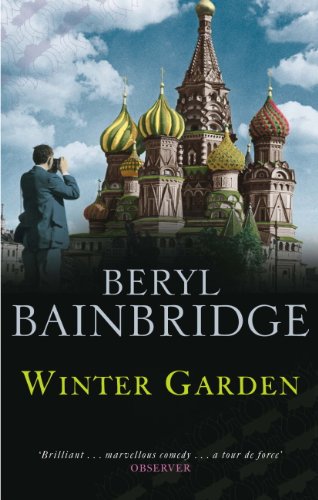
Book Beginnings & The Friday 56: Winter Garden by Beryl Bainbridge

Every Friday Book Beginnings on Friday is hosted by Gillion at Rose City Reader where you can share the first sentence (or so) of the book you are reading. You can also share from a book you want to highlight just because it caught your fancy.

One of the books I’m currently reading is Winter Garden by Beryl Bainbridge. I’ve enjoyed some of her other books so I’m hopingto enjoy this one too.

My Book Beginning:

One morning early in October, a man called Ashburner, tightly buttoned into a black overcoat and holding a suitcase, tried to leave his bedroom on the second floor of a house in Beaufort Street.

Also every Friday there is The Friday 56, hosted by Freda at Freda’s Voice, where you grab a book and turn to page 56 (or 56% of an eBook), find one or more interesting sentences (no spoilers), and post them.

Page 56:

Only last week there had been a report in the Guardian about an innocent bystander from Manchester who had gone to some meeting or other behind the Iron Curtain and disappeared for three days.

Synopsis

Quiet and reliable, Douglas Ashburner has never been much of a womaniser. So when he begins an extra-marital affair with Nina, a bossy, temperamental artist with a penchant for risky sex, he finds adultery a terrible strain.

He tells his wife that he needs a rest, so she happily packs him off for a fishing holiday in the Highlands. Only, unknown to her, Douglas is actually flying off to Moscow with Nina, as a guest of the Soviet Artists’ Union. It is then that things begin to get very complicated indeed…

What do you think? What are you currently reading?

The Night of the Mi’raj by Zoë Ferraris

Abacus| 16 August 2012 | 360 pages| e-book edition| My own copy| 4*

The Night of the Mi’raj (published as Finding Nouf in the USA) is the first book in Zoë Ferraris’  Katya Hijazi series, set in modern day Saudi Arabia, featuring Nayir al-Sharqi, a desert guide and a laboratory technician Katya Hijazi. When sixteen year old Nouf ash-Shrawi disappears from her home in Jeddah, just before her arranged marriage, her brother, Othman, asks his friend, Nayir to find her. After searching the desert for ten days, Nayir fails to find her, but then Nouf’s body is found in a desert wadi. It appears that her death was an accident and that she died by drowning in the wadi after a sudden storm.

Nayir is puzzled. Why did Nouf run away to the desert, leaving behind her fiance and a luxurious life with her wealthy family? He’d never failed before to find a lost traveller and he assumed if she had run away it was because she didn’t want to be found. Her family accept the verdict of accidental death, but when Katya tells Nayir she has found evidence that Nouf was murdered he feels compelled to uncover the truth about her death. The more the two of them discover the more problems and challenges arise.

What is most fascinating in this book for me is not the mystery, but the developing relationship between Nayir and Katya and the description of life in Saudi Arabia. Nayir is not a Bedouin or a Saudi, he’s a Palestinian. But the Bedouin had taught him about the desert:

From here he had a sprawling view of the desert valley, crisp and flat, surrounded by low dunes that undulated in the golden colour of sunset. … The wind picked up and stroked the desert floor, begging a few grains of sand the better to flaunt its elegance, while the earth shed its skin with a ripple and seemed to take flight. The bodies of the dunes changed endlessly with the winds. They rose to peaks or slithered like snake trails. The Bedouin had taught him how to interpret the shapes to determine the chance of a sandstorm or the direction of tomorrow’s wind. Some Bedouin believed that the forms held prophetic meanings too. Right now, the land directly ahead of him formed a series of crescents, graceful half-moons that rolled towards the horizon. Crescents meant change was in the air.

I was puzzled by the title of the UK publication – The Night of the Mi’raj, so I was pleased that Zoë Ferraris explained why she chose it in her Author’s Note. The mi’raj is both a physical journey and a spiritual climax, a moment of revelation for Mohammed. She states that; ‘In this book Nayir’s journey to learning the truth behind Nouf’s death is, for him, both a physical and a spiritual discovery too.’

There are two more books in the Katya Hijazi series: City of Veils and Kingdom of Strangers.

Book Beginnings & The Friday 56: A Heart Full of Headstones by Ian Rankin

Every Friday Book Beginnings on Friday is hosted by Gillion at Rose City Reader where you can share the first sentence (or so) of the book you are reading. You can also share from a book you want to highlight just because it caught your fancy.

One of the books I’m currently reading is Ian Rankin’s latest and 24th Rebus novel, A Heart Full of Headstones. I’ve read all the earlier books.

The first Rebus book I read was Set in Darkness, the 11th book in the series. It was obvious that this featured characters that had been in the earlier books but I didn’t find it difficult to follow who was who and their relationships. Even so I decided I needed to start at the beginning and read them in sequence. And I think, for me at least, that works best, in order to fully understand the background and how the characters interact and evolve.

My Book Beginning:

John Rebus had been in court plenty of times, but this was his first time in the dock.

Also every Friday there is The Friday 56, hosted by Freda at Freda’s Voice, where you grab a book and turn to page 56 (or 56% of an eBook), find one or more interesting sentences (no spoilers), and post them.

Page 56:

Rebus had just finished eating an early dinner of microwaved haggis when he heard the doorbell. Brillo trotted with him to the door. Siobhan was standing on the step.

‘Well, well,’ Rebus said, while Brillo’s welcome was more effusive, ‘In you come then.’

Synopsis:

John Rebus had been in court plenty of times, but this was his first time in the dock…

John Rebus stands accused: on trial for a crime that could put him behind bars for the rest of his life. Although it’s not the first time the legendary detective has taken the law into his own hands, it might be the last.

What drove a good man to cross the line? Or have times changed, and the rules with them?

Detective Inspector Siobhan Clarke faces Edinburgh’s most explosive case in years, as a corrupt cop goes missing after claiming to harbour secrets that could sink the city’s police force.

But in this investigation, it seems all roads lead to Rebus – and Clarke’s twin loyalties to the public and the police will be tested to their limit.

A reckoning is coming – and John Rebus may be hearing the call for last orders…

Oh, my goodness – the call for last orders? How will this book end? I just have to read it!

What do you think? Have you read it, or are you going to read it?

Throwback Thursday: The Last Enchantment by Mary Stewart

Today I’m linking up with Davida @ The Chocolate Lady’s Book Review Blog for Throwback Thursday. It takes place on the Thursday before the first Saturday of every month (i.e., the Thursday before the monthly #6Degrees post). The idea is to highlight one of your previously published book reviews and then link back to Davida’s blog.

The Last Enchantment by Mary Stewart is the third book of the Arthurian Saga, a book of myth and legend and about the conflict between good and evil. I first reviewed it on April 5, 2014.

My review begins:

I love books that take me away to another time and place – The Last Enchantment (1979) by Mary Stewart is just such a book, magically whisking me back to the time of King Arthur and Merlin. This is not a book to read quickly, but a book to savour both for the story and for Mary Stewart’s descriptive writing.

Click here to read my full review

The next ThrowbackThursday post is scheduled for January 4, 2023.

Two Novellas in Now and Forever by Ray Bradbury:#NovNov22

HarperVoyager| 25 June 2012| 240 page| e-book| 4*

Now and Forever is the first book by Ray Bradbury that I’ve read. It contains two novellas – Somewhere a Band is Playing, in which a young writer discovers that all is not as it seems in a nostalgic community, and Leviathan ’99, a retelling of Moby Dick set in space. Two very different stories, each one fascinating, and both with a long history, as Bradbury wrote each one over several decades. They contrast both in style and content. I enjoyed both, but Leviathan ’99 is my favourite.

In the first, Somewhere a Band is Playing, (102 pages) a reporter James Cardiff arrives in Summerton, a small town in the middle of Arizona, a town which seems perfect, a quiet peaceful place. He can hear in the air the quiet sound of a band playing. But the more he explores the more mysterious Summerton becomes. For one thing there are no children and no hospitals or doctors because no one gets ill and even stranger the graves in the cemetery are empty. The story has a nostalgic feel, a sense of melancholy and myth as James, under the guidance of a beautiful young woman, Nefertiti, discovers the truth about Summerton.

Bradbury’s introduction to Somewhere a Band is Playing explains that he begun writing a screenplay and short story about a small town somewhere in the desert and how he had kept encountering Katharine Hepburn either in person or on the screen and was attracted by the fact that she remained youthful throughout the years. Then in 1956 she had made the film Summertime and this had led him to put her at the centre of a story and so Somewhere a Band is Playing slowly evolved. Another element of the story came when he saw the film, The Wind and the Lion and was so taken with the score that he wrote a long poem based on the enchanting music. He then put these elements together to produce this novella, which he dedicated to Anne Hardin, who had encouraged his work and to Katharine Hepburn.

Leviathan ’99’ (101 pages) is dedicated to Herman Melville because after spending a year writing the screenplay for John Huston’s Moby Dick he’d fallen under the spell of Melville and his ‘leviathan whale’. Bradbury then wrote his first script of Leviathan ’99’, which was eventually produced by BBC Radio in London, then as a longer version as a play in 1972. Finally thirty years later he finished writing it as a novella as his ‘final effort to focus and revitalize what began as a radio dream.’

I haven’t read Moby Dick, but I enjoyed this story about spaceships instead of sailing ships, mad astronaut captains instead of seafaring captains and the blind white comet instead of the great white whale. It’s set in 2099 and begins as Ishmael, an astronaut joins the Cetus 7, the largest interstellar ship ever built. The spaceship is on a mission, travelling beyond the stars. His cubicle roommate is Quell, a seven feet tall, green spider who is a telepath. The captain is mad, obsessed with finding the comet, Leviathan, the largest comet in history that had blinded him thirty years earlier. As Quell described it ‘the universe set off a light-year of immensity of photographic flash. God blinked and bleached the captain to this colour of sleeplessness and terror.’

It is an incredible achievement transposing Melville’s 19th century epic into a hundred page novella set in the future.

Two Novellas by Claire Keegan #NovNov22

Week 4 in Novellas in November is Contemporary novellas (post 1980). It was only this year that I ‘discovered’ Claire Keegan’s work when her novella, Small Things Like These was shortlisted for the 2022 Booker Prize. I liked the description, so I was eager to read it and I thoroughly enjoyed it. So wanting to read more of her books I read Foster, another novella, which is the buddy read during the Novellas in November event.

Small Things Like These by Claire Keegan (73 pages) 5*

It is 1985, in an Irish town. During the weeks leading up to Christmas, Bill Furlong, a coal and timber merchant, faces into his busiest season. As he does the rounds, he feels the past rising up to meet him – and encounters the complicit silences of a people controlled by the Church.

It won the 2022 Orwell Prize for Political Fiction, an award for outstanding novels and collections of short stories, first published in the UK or Ireland, that illuminate major social and political themes, present or past, through the art of narrative. It also won the Kerry Group Irish Novel of the Year 2022.

Claire Keegan’s style of writing is a refreshing change from so many of the long and complicated books I so often read. It is precise, focused, and beautifully written bringing her characters to life – these are real, ordinary people, living ordinary lives in 1980s Ireland. And the detail is there too in all the particulars of everyday life – it packs a lot into its pages. Bill Furlong is happily married with five young daughters, but he still remembers his own childhood. He never knew who his father was, brought up by his mother and the widow for whom she worked. Life was hard then and his own childhood Christmases were not like his daughters’, and it is this, I think, that makes him such a kind and compassionate man. As he does his rounds delivering coal and wood, he goes to the local convent and is confronted with the cruelty meted out to the young girls living there.

Set in the weeks leading up to Christmas it contrasts the season of hope and joy at the birth of a child with the treatment of unmarried mothers received in the homes known as the Magdalen laundries – and at the end of the story Claire Keegan explains the history of those institutions that were run by the Roman Catholic Church and the Irish State until they were closed down in 1996. Small Things Like These demonstrates the courage and compassion needed to stand up to the power of the church and state.

Foster by Claire Keegan (101 pages) 5*

A small girl is sent to live with foster parents on a farm in rural Ireland, without knowing when she will return home. In the strangers’ house, she finds a warmth and affection she has not known before and slowly begins to blossom in their care. And then a secret is revealed and suddenly, she realizes how fragile her idyll is.

I was amazed at the emotional depth Claire Keegan has instilled into such a few pages. She writes such clear sentences filled with poetic beauty. She shows how a young girl from an overcrowded and poverty stricken family blossomed whilst living with relatives of her mother, the Kinsellas, as her mother is about to give birth to yet another baby.

Yet it is not that straight forward. There is an undercurrent that hints of something that is not right, something that has happened that is never put into words. There is a sadness that pervades the story, along with kindness, caring and compassion. The girl knows she’ll return to her family, but she doesn’t know when, so the story is always told as it is happening. It’s in the present tense, which I never realised until I came to the ending. This is one of the rare instances for me that the use of the present tense seemed just right. The ending too could only happen the way it does. I absolutely loved Foster.