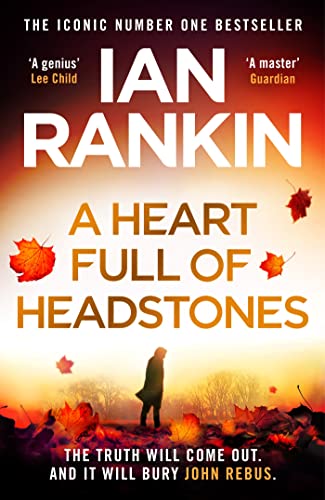
Book Beginnings & The Friday 56: A Heart Full of Headstones by Ian Rankin

Every Friday Book Beginnings on Friday is hosted by Gillion at Rose City Reader where you can share the first sentence (or so) of the book you are reading. You can also share from a book you want to highlight just because it caught your fancy.

One of the books I’m currently reading is Ian Rankin’s latest and 24th Rebus novel, A Heart Full of Headstones. I’ve read all the earlier books.

The first Rebus book I read was Set in Darkness, the 11th book in the series. It was obvious that this featured characters that had been in the earlier books but I didn’t find it difficult to follow who was who and their relationships. Even so I decided I needed to start at the beginning and read them in sequence. And I think, for me at least, that works best, in order to fully understand the background and how the characters interact and evolve.
My Book Beginning:

John Rebus had been in court plenty of times, but this was his first time in the dock.
Also every Friday there is The Friday 56, hosted by Freda at Freda’s Voice, where you grab a book and turn to page 56 (or 56% of an eBook), find one or more interesting sentences (no spoilers), and post them.

Page 56:

Rebus had just finished eating an early dinner of microwaved haggis when he heard the doorbell. Brillo trotted with him to the door. Siobhan was standing on the step.

‘Well, well,’ Rebus said, while Brillo’s welcome was more effusive, ‘In you come then.’

Synopsis:

John Rebus had been in court plenty of times, but this was his first time in the dock…

John Rebus stands accused: on trial for a crime that could put him behind bars for the rest of his life. Although it’s not the first time the legendary detective has taken the law into his own hands, it might be the last.

What drove a good man to cross the line? Or have times changed, and the rules with them?

Detective Inspector Siobhan Clarke faces Edinburgh’s most explosive case in years, as a corrupt cop goes missing after claiming to harbour secrets that could sink the city’s police force.

But in this investigation, it seems all roads lead to Rebus – and Clarke’s twin loyalties to the public and the police will be tested to their limit.

A reckoning is coming – and John Rebus may be hearing the call for last orders…

Oh, my goodness – the call for last orders? How will this book end? I just have to read it!

What do you think? Have you read it, or are you going to read it?

Throwback Thursday: The Last Enchantment by Mary Stewart

Today I’m linking up with Davida @ The Chocolate Lady’s Book Review Blog for Throwback Thursday. It takes place on the Thursday before the first Saturday of every month (i.e., the Thursday before the monthly #6Degrees post). The idea is to highlight one of your previously published book reviews and then link back to Davida’s blog.

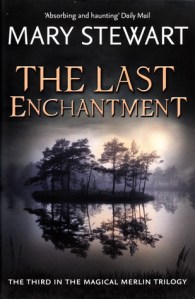
The Last Enchantment by Mary Stewart is the third book of the Arthurian Saga, a book of myth and legend and about the conflict between good and evil. I first reviewed it on April 5, 2014.

My review begins:

I love books that take me away to another time and place – The Last Enchantment (1979) by Mary Stewart is just such a book, magically whisking me back to the time of King Arthur and Merlin. This is not a book to read quickly, but a book to savour both for the story and for Mary Stewart’s descriptive writing.

Click here to read my full review

The next ThrowbackThursday post is scheduled for January 4, 2023.

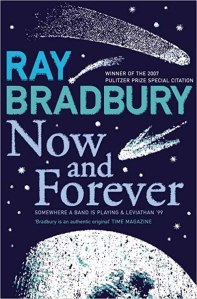
Two Novellas in Now and Forever by Ray Bradbury:#NovNov22

HarperVoyager| 25 June 2012| 240 page| e-book| 4*

Now and Forever is the first book by Ray Bradbury that I’ve read. It contains two novellas – Somewhere a Band is Playing, in which a young writer discovers that all is not as it seems in a nostalgic community, and Leviathan ’99, a retelling of Moby Dick set in space. Two very different stories, each one fascinating, and both with a long history, as Bradbury wrote each one over several decades. They contrast both in style and content. I enjoyed both, but Leviathan ’99 is my favourite.

In the first, Somewhere a Band is Playing, (102 pages) a reporter James Cardiff arrives in Summerton, a small town in the middle of Arizona, a town which seems perfect, a quiet peaceful place. He can hear in the air the quiet sound of a band playing. But the more he explores the more mysterious Summerton becomes. For one thing there are no children and no hospitals or doctors because no one gets ill and even stranger the graves in the cemetery are empty. The story has a nostalgic feel, a sense of melancholy and myth as James, under the guidance of a beautiful young woman, Nefertiti, discovers the truth about Summerton.

Bradbury’s introduction to Somewhere a Band is Playing explains that he begun writing a screenplay and short story about a small town somewhere in the desert and how he had kept encountering Katharine Hepburn either in person or on the screen and was attracted by the fact that she remained youthful throughout the years. Then in 1956 she had made the film Summertime and this had led him to put her at the centre of a story and so Somewhere a Band is Playing slowly evolved. Another element of the story came when he saw the film, The Wind and the Lion and was so taken with the score that he wrote a long poem based on the enchanting music. He then put these elements together to produce this novella, which he dedicated to Anne Hardin, who had encouraged his work and to Katharine Hepburn.

Leviathan ’99’ (101 pages) is dedicated to Herman Melville because after spending a year writing the screenplay for John Huston’s Moby Dick he’d fallen under the spell of Melville and his ‘leviathan whale’. Bradbury then wrote his first script of Leviathan ’99’, which was eventually produced by BBC Radio in London, then as a longer version as a play in 1972. Finally thirty years later he finished writing it as a novella as his ‘final effort to focus and revitalize what began as a radio dream.’

I haven’t read Moby Dick, but I enjoyed this story about spaceships instead of sailing ships, mad astronaut captains instead of seafaring captains and the blind white comet instead of the great white whale. It’s set in 2099 and begins as Ishmael, an astronaut joins the Cetus 7, the largest interstellar ship ever built. The spaceship is on a mission, travelling beyond the stars. His cubicle roommate is Quell, a seven feet tall, green spider who is a telepath. The captain is mad, obsessed with finding the comet, Leviathan, the largest comet in history that had blinded him thirty years earlier. As Quell described it ‘the universe set off a light-year of immensity of photographic flash. God blinked and bleached the captain to this colour of sleeplessness and terror.’

It is an incredible achievement transposing Melville’s 19th century epic into a hundred page novella set in the future.

Two Novellas by Claire Keegan #NovNov22

Week 4 in Novellas in November is Contemporary novellas (post 1980). It was only this year that I ‘discovered’ Claire Keegan’s work when her novella, Small Things Like These was shortlisted for the 2022 Booker Prize. I liked the description, so I was eager to read it and I thoroughly enjoyed it. So wanting to read more of her books I read Foster, another novella, which is the buddy read during the Novellas in November event.

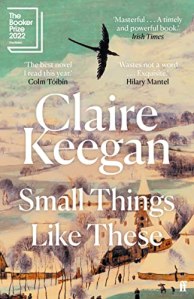
Small Things Like These by Claire Keegan (73 pages) 5*

It is 1985, in an Irish town. During the weeks leading up to Christmas, Bill Furlong, a coal and timber merchant, faces into his busiest season. As he does the rounds, he feels the past rising up to meet him – and encounters the complicit silences of a people controlled by the Church.

It won the 2022 Orwell Prize for Political Fiction, an award for outstanding novels and collections of short stories, first published in the UK or Ireland, that illuminate major social and political themes, present or past, through the art of narrative. It also won the Kerry Group Irish Novel of the Year 2022.

Claire Keegan’s style of writing is a refreshing change from so many of the long and complicated books I so often read. It is precise, focused, and beautifully written bringing her characters to life – these are real, ordinary people, living ordinary lives in 1980s Ireland. And the detail is there too in all the particulars of everyday life – it packs a lot into its pages. Bill Furlong is happily married with five young daughters, but he still remembers his own childhood. He never knew who his father was, brought up by his mother and the widow for whom she worked. Life was hard then and his own childhood Christmases were not like his daughters’, and it is this, I think, that makes him such a kind and compassionate man. As he does his rounds delivering coal and wood, he goes to the local convent and is confronted with the cruelty meted out to the young girls living there.

Set in the weeks leading up to Christmas it contrasts the season of hope and joy at the birth of a child with the treatment of unmarried mothers received in the homes known as the Magdalen laundries – and at the end of the story Claire Keegan explains the history of those institutions that were run by the Roman Catholic Church and the Irish State until they were closed down in 1996. Small Things Like These demonstrates the courage and compassion needed to stand up to the power of the church and state.

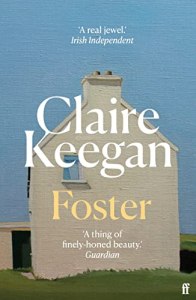
Foster by Claire Keegan (101 pages) 5*

A small girl is sent to live with foster parents on a farm in rural Ireland, without knowing when she will return home. In the strangers’ house, she finds a warmth and affection she has not known before and slowly begins to blossom in their care. And then a secret is revealed and suddenly, she realizes how fragile her idyll is.

I was amazed at the emotional depth Claire Keegan has instilled into such a few pages. She writes such clear sentences filled with poetic beauty. She shows how a young girl from an overcrowded and poverty stricken family blossomed whilst living with relatives of her mother, the Kinsellas, as her mother is about to give birth to yet another baby.

Yet it is not that straight forward. There is an undercurrent that hints of something that is not right, something that has happened that is never put into words. There is a sadness that pervades the story, along with kindness, caring and compassion. The girl knows she’ll return to her family, but she doesn’t know when, so the story is always told as it is happening. It’s in the present tense, which I never realised until I came to the ending. This is one of the rare instances for me that the use of the present tense seemed just right. The ending too could only happen the way it does. I absolutely loved Foster.

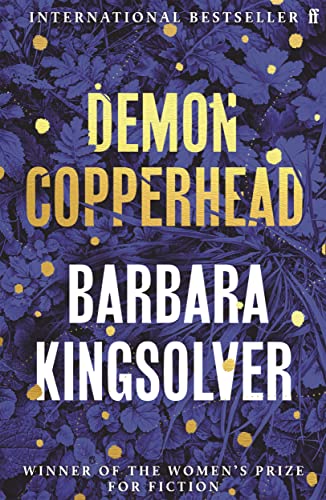
Book Beginnings & The Friday 56: Demon Copperhead by Barbara Kingsolver

Every Friday Book Beginnings on Friday is hosted by Gillion at Rose City Reader where you can share the first sentence (or so) of the book you are reading. You can also share from a book you want to highlight just because it caught your fancy.

I’ve borrowed Demon Copperhead from the library and I’ve started reading it – even though I’m currently in the middle of two other books. As it’s had such good reviews, I’m a bit worried that it won’t live up to all the hype for me. It’s a retelling of David Copperfield, which I read earlier this year.

My Book Beginning:

First, I got myself born. A decent crowd was on hand to watch, and they’ve always given me that much: the worst of the job was up to me, my mother being let’s just say out of it.

Also every Friday there is The Friday 56, hosted by Freda at Freda’s Voice, where you grab a book and turn to page 56 (or 56% of an eBook), find one or more interesting sentences (no spoilers), and post them.

Page 56:

Finally Miss Barks turned round with her elbow on the back of the seat and said let’s talk about where we are going. I’d be staying with a gentleman named Mr Crickson that took kids for short-term only. He had boys there now. The Cricksons had been regular fosters until his wife passed away, and now he just took in the odd hardship case.

So, I’m guessing Miss Barks and Mr Crickson are the equivalent characters of Mr Barkis and Mr Creakle in David Copperfield. I have a feeling I should not approach this book as a retelling of David Copperfield, or I’ll be forever comparing the two and not really reading it as a book in its own right, as it were.

Synopsis:

Demon’s story begins with his traumatic birth to a single mother in a single-wide trailer, looking ‘like a little blue prizefighter.’ For the life ahead of him he would need all of that fighting spirit, along with buckets of charm, a quick wit, and some unexpected talents, legal and otherwise.

In the southern Appalachian Mountains of Virginia, poverty isn’t an idea, it’s as natural as the grass grows. For a generation growing up in this world, at the heart of the modern opioid crisis, addiction isn’t an abstraction, it’s neighbours, parents, and friends. ‘Family’ could mean love, or reluctant foster care. For Demon, born on the wrong side of luck, the affection and safety he craves is as remote as the ocean he dreams of seeing one day. The wonder is in how far he’s willing to travel to try and get there.

Suffused with truth, anger and compassion, Demon Copperhead is an epic tale of love, loss and everything in between.

~~~

What do you think? Have you read it, or are you going to read it? Do you like books that retell classics?
The Black Mountain by Kate Mosse #NovNov22

Week 4 in Novellas in November is Contemporary novellas (post 1980)

The Black Mountain by Kate Mosse (136 pages) 3*

This is a Quick Reads publication – a series of short books by bestselling authors and celebrities. They are designed to encourage adults who do not read often, or find reading difficult, to discover the joy of books. I like the long novels Kate Mosse writes, so I wondered what this short novel would be like.

It is historical fiction set in May 1706 on the northern part of the island of Tenerife, where Ana and her family live in the shadow of a volcano, known locally as the Black Mountain. It’s also a murder mystery – Ana’s father Tomas had apparently committed suicide, but Anna just can’t accept that and reading the letter he’d left she is convinced it was murder. She is determined to find out the truth.

Legend says the mountain has the devil living inside it and when the devil was angry he sent fire and rocks up into the sky. However, there has been no eruption for thousands of years and no one believes it is a threat. Sometimes the earth trembled and shook but the sky never turned red. Until, that is two days after Tomas’ death. He had seen the signs that the mountain was about to erupt and had tried to warn people – but they didn’t want to know. When more tremors occur, and grey ash starts falling Ana realises the danger signs are increasing and she needs to warn people that they must flee before the volcano erupts and destroys their world.

I enjoyed this novella, reading it quickly, feeling almost as though I was also in danger as the Black Mountain threatens to erupt and wondering if Ana would discover the truth about her father’s death in time for her to escape.

The Black Mountain is based on a real historical event. The town of Garachio erupted from May 4 to 5, 1706, which was disastrous not only for the town but also for the entire archipelago. Its port concentrated a large part of the international trade that linked the island with Europe, Africa and America.

~~~

I’ve read a few of the Quick Reads. Here’s a list of all the available titles.