Every Friday Book Beginnings on Friday is hosted by Gillion at Rose City Readerwhere you can share the first sentence (or so) of the book you are reading. You can also share from a book you want to highlight just because it caught your fancy.
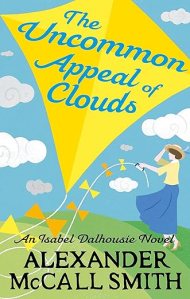
I’m featuring The Uncommon Appeal of Clouds by Alexander McCall Smith, an Isabel Dalhousie book, that I’ve borrowed from my local lbrary.
ChapterOne:
‘Mozart’ said, Isabel Dalhousie. And then she added, Stinivasa Ramamjan .
Also every Friday there is The Friday 56, hosted by Freda at Freda’s Voice, but she is taking a break and Anne at My Head is Full of Books has taken on hosting duties in her absence. You grab a book and turn to page 56 (or 56% of an eBook), find one or more interesting sentences (no spoilers), and post them.
But then, we can misjudge each other so easily, she thought; so easily.
Description from Amazon:
As a mother, wife, employer and editor of the Review of Applied Ethics, Isabel Dalhousie is aware that to be human is to be responsible. So when a neighbour brings her a new and potentially dangerous puzzle to solve, once again Isabel feels she has no option but to shoulder the burden.
A masterpiece painting has been stolen from Duncan Munrowe, old-fashioned philanthropist, father to two discontented children, and a very wealthy man. As Isabel enters into negotiations with the shadowy figures who are in search of a ransom, a case where heroes and villains should be clearly defined turns murky: the list of those who desire the painting – or the money – lengthens, and hasty judgement must be avoided at all cost. Morals, it turns out, are like Scottish clouds: complex, changeable and tricky to get a firm grip on; they require a sharp observational eye, a philosophical mindset, and the habit of kindness. Fortunately for those around her, Isabel Dalhousie is in possession of all three.
I’ve read some of his other Isabel Dalhousie books and enjoyed them. So I’m hoping to enjoy this one too. I really like the gentle pace of these books and what I find so fascinating is that whilst not a lot actually happens, a lot goes on in Isabel’s head.
What do you think, does this book appeal to you? What are you currently reading?
Every Friday Book Beginnings on Friday is hosted by Gillion at Rose City Readerwhere you can share the first sentence (or so) of the book you are reading. You can also share from a book you want to highlight just because it caught your fancy.
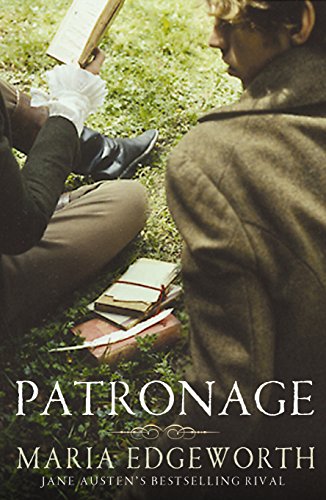
I’m featuring Patronage by Maria Edgeworth. This is one of my TBRs and I meant to include it in my Top Ten Tuesday post this week. Maria Edgeworth (1768 – 1849) was a contemporary of Jane Austen, publishing novels at the same time – Patronage was published just 5 months before Mansfield Park in 1814.
From the back cover:
Patronage was one of the most eagerly anticipated novels of Jane Austen’s day. It sold out within hours of publication.… an adventurous soap opera about the trials and fortunes of two neighbouring families in Regency England, both of which had sons and daughters setting out in the world. … a bright and mischievous critique of the way young men gained careers and young women gained husbands.
It begins:
‘How the wind is rising!’ said Rosamond. ‘God help the poor people at sea tonight!’
Also every Friday there is The Friday 56, hosted by Freda at Freda’s Voice, but she is taking a break and Anne at My Head is Full of Books has taken on hosting duties in her absence. You grab a book and turn to page 56 (or 56% of an eBook), find one or more interesting sentences (no spoilers), and post them.
‘I hope, with all my heart, I hope,’ continued Rosamond, that Buckhurst will have some sense and steadfastness to refuse, but I heard his father supporting that foolish Colonel Hauton’s persuasions and urging his poor son to go with those people to Cheltenham.
Description from the publisher:
Meet the Percys and Falconers, neighbouring families, each with three sons and two daughters to launch into Regency society. The hardworking, independently minded and dutiful Percys are happy to work their way up in the world but are undermined by their scheming rivals who use Patronage to grab at instant fame and fortune. With their sons eased into lucrative but ill-suited diplomatic and clerical jobs, and their daughters bankrupting themselves to scale the heights of fashion, the Falconers are heading for a tumble; while the moral steadiness and strong family ties of the Percys allow them to attain both the heights of their chosen professions and a glittering match.
Throughout the month of November, bloggers Liz, Frances, Heather, Rebekah and Deb invite you to celebrate Nonfiction November with us.
Week 3 (11/11-11/15) Book Pairings: This week, pair up a nonfiction book with a fiction title. Maybe it’s a historical novel and the real history in a nonfiction version, or a memoir and a novel, or a fiction book you’ve read and you would like recommendations for background reading. Or two books on two different areas have chimed and have a link. You can be as creative as you like! (Liz)
Liz further clarifies in her Pairings post: ‘I offer a mix of fiction/nonfiction pairs, fiction/nonfiction/memoir sets and nonfiction/nonfiction.’
After the Hamas-led attack on Israel on October 7, 2023 I decided I needed to know more about what had led up to it. And I found lots of books, including these:
Nonfiction/Fiction – I’m aiming to write more about these books in due course.
This is an extremely detailed chronological account of events in this conflict from the years from 1882 preceding the Balfour Declaration in 1917 to 2017. Ian Black was a British journalist who worked for The Guardian holding the posts of diplomatic editor and Europe editor as well as Middle East editor. I’m quoting from his obituary in January 2023: ‘he embodied the correspondent’s duty to show fairness to both parties. That refusal to reinforce the narrative of one side alone informed his writing on the Israel-Palestine conflict from the start.’ So I thought this could be a good place to start. And as far as I can tell it is an unbiased and factual account,with many references to Black’s sources, and it took me a long time to read it. In the Preface Black states:
It tries to tell the story of, and from both sides, and of the fateful interactions between them. … This book is intended for the general reader … It is based on a synthesis of existing scholarship and secondary sources: primary research covering the entire 135-year history is far beyond the capability of any one author. Specialised publications like the Journal of Palestine Studies, Israel Studies, and the Jerusalem Quarterly are vital resources.
I learnt a lot that I hadn’t known before, but I decided I still needed to know more and next I bought:
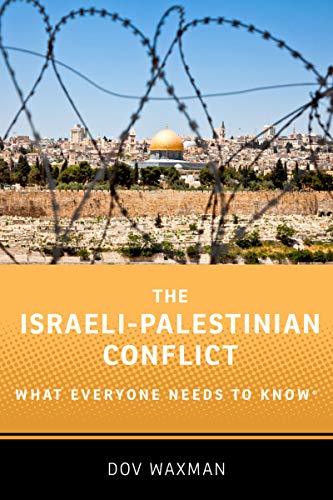
Dov Waxman is the Rosalinde and Arthur Gilbert Foundation Chair of Israel Studies at the University of California Los Angeles (UCLA) and the director of the UCLA Y&S Nazarian Center for Israel Studies. His research focuses on the conflict over Israel-Palestine, Israeli politics and foreign policy, U.S.-Israel relations, American Jewry’s relationship with Israel, Jewish politics, and contemporary antisemitism. He frequently gives media interviews and public talks on these topics. (Taken from his website).
This book is more readable than Black’s and is written as a series of questions and answers covering the conflict from its nineteenth-century origins up to the present day (2019). It explains the key events, examines the core issues, and presents the competing claims and narratives of both sides. In the Preface Waxman states he has tried
to present the different perspectives and narratives of Israelis and Palestinians and avoid ‘playing the blame game’. … Neither side is wholly innocent or completely guilty, and both have legitimate rights and needs.
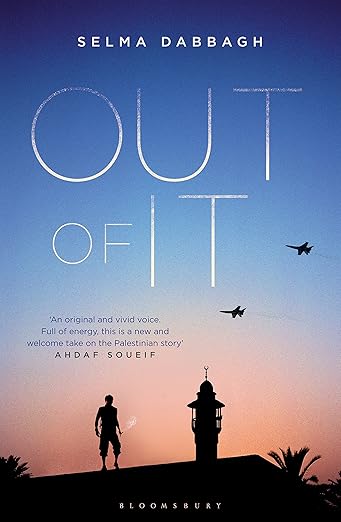
I haven’t read this. I saw it reviewed in The Guardian. It’s set in Gaza City during the Second Intifada in the 2000s. It’s about the Mujahed family, chronicling their hopes and dreams as well as their suffering.
Blurb from Amazon:
Gaza is being bombed. Rashid – an unemployed twenty-seven year
old who has stayed up smoking grass watching it happen – wakes to hear that he’s got the escape route he’s been waiting for: a scholarship to London. His twin sister, Iman – frustrated by the atrocities and inaction around her – has also been up all night, in a meeting that offers her nothing but more disappointment. Grabbing recklessly at an opportunity to make a difference, she finds herself being followed by an unknown fighter.
Meanwhile Sabri, the oldest brother of this disparate family, works on a history of Palestine from his wheelchair as their mother pickles vegetables and feuds with the neighbours.
Written with extraordinary humanity and humour, and moving between Gaza, London and the Gulf, Out of It is a tale that redefines Palestine and its people. It follows the lives of Rashid and Iman as they try to forge paths for themselves in the midst of occupation, religious fundamentalism and the divisions between Palestinian factions. It tells of family secrets, unlikely love stories and unburied tragedies as it captures the frustrations and energies of the modern Arab world.
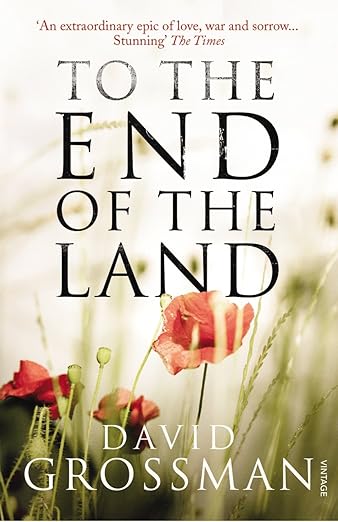
To the End of the Land by David Grossman, translated by Jessica Cohen (fiction) – another book I haven’t read.
David Grossman is one of the leading Israeli writers of his generation, and the author of numerous works of fiction, non-fiction, and children’s literature. His work has appeared in The New Yorker, and been translated into twenty-five languages around the world. He lives on the outskirts of Jerusalem.
Description from Fantastic Fiction:
Ora is about to celebrate her son Ofer’s release from Israeli army service when he voluntarily rejoins. In a fit of magical thinking, she takes off to hike in the Galilee, leaving no forwarding information for the ‘notifiers’ who might deliver the worst news a parent can hear. Recently estranged from her husband, she drags along an unlikely companion: their once best friend Avram, who was tortured as a POW during the Yom Kippur War and, in his brokenness, refused to ever know the boy or even to keep in touch with them.
Now, as they hike, Ora unfurls the story of her motherhood and initiates the lonely Avram in the drama of the human family – a telling that keeps Ofer alive for both his mother and the reader. Her story places the most hideous trials of war alongside the daily joys and anguish of raising children: never have we seen so clearly the reality and surreality of daily life in Israel, the currents of ambivalence about war within one household, the burdens that fall on each generation anew.
Grossman’s rich imagining of a family in love and crisis makes for one of the great antiwar novels of our time.
Top 5 Tuesday was created by Shanah at Bionic Book Worm, and it is now being hosted by Meeghan at Meeghan Reads. For details of all of the latest prompts for October to December, see Meeghan’s post here.
Do you have a pile of books on your TBR that you were “going to read soon” but now it’s been like 5 years and you don’t know how to start that book any more? Maybe it’s 600 pages long. Or maybe you’ve seen some not-so-great reviews that pushed it down a bit. What books on your TBR intimidate you?
These are books I want to read but each time that I look at them I think ‘not now’ because they are so long AND as these are all either hardbacks or paperbacks they’re heavy, unwieldy and in small print!
Nicholas Nickleby by Charles Dickens (860 pages) – Nicholas Nickleby, is left penniless after his father’s death and forced to make his own way in the world. There’s an extraordinary gallery of rogues and eccentrics: Wackford Squeers, the tyrannical headmaster of Dotheboys Hall; the tragic orphan Smike, rescued by Nicholas; and the gloriously theatrical Mr and Mrs Crummle and their daughter, the ‘infant phenomenon’. Nicholas Nickleby is characterized by Dickens’s outrage at social injustice, but it also reveals his comic genius at its most unerring.
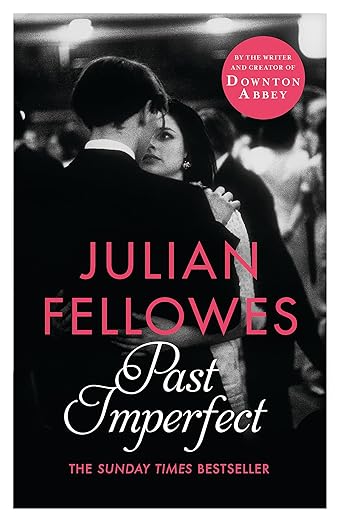
Past Imperfect by Julian Fellowship (528 pages) described on the back cover as a story that takes us back to the Debutante Season of 1968 – ‘Poignant, funny, fascinating and moving’ . Wishing to track down a past girlfriend who claims he had fathered her child, the rich and dying Damian Baxter contacts an old friend from his days at Cambridge. The search takes the narrator back to 1960s London, where everything is changing–just not always quite as expected.
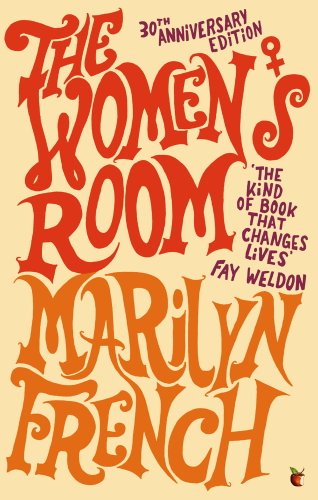
The Women’s Room by Marilyn French (544 pages), described as ‘one of the most influential novels of the modern feminist movement.’ It was first published in 1977 to a barrage of criticism. This is the story of Mira Ward, a wife of the Fifties who becomes a woman of the Seventies. From the shallow excitements of suburban cocktail parties and casual affairs through the varied nightmares of rape, madness and loneliness to the dawning awareness of the exhilaration of liberation, the experiences of Mira and her friends crystallize those of a generation of modern women.
The Wine of Angels by Phil Rickman (623 pages) – the first Merrily Watkins novel, in which the Rev Merrily Watkins tries to be accepted as the vicar (or priest-in-charge as she insists she ought to be called) in the country parish of Ledwardine in Herefordshire, steeped as it is in cider and secrets and echoes of the poet Thomas Traherne who was once based in the area.
This Thing of Darkness by Harry Thompson (750 pages) – In 1831 Charles Darwin set off in HMS Beagle under the command of Captain Robert Fitzroy on a voyage that would change the world. This is the story of a deep friendship between two men, and the twin obsessions that tear them apart, leading one to triumph, and the other to disaster.
Every Friday Book Beginnings on Friday is hosted by Gillion at Rose City Readerwhere you can share the first sentence (or so) of the book you are reading. You can also share from a book you want to highlight just because it caught your fancy.
I’m featuring The Stars Look Down by A J Cronin. It’s my current Classics Club Spin book – the rules of the Spin are that this is the book for me to read by 18th December, 2024. So, as it has 712 pages I thought I’d better start reading it now.
ChapterOne:
When Martha awoke it was still dark and bitter cold. The wind, pouring across the North Sea, struck freezingly through the cracks which old subsidences had opened in the two-roomed house. Waves pounded distantly. The rest was silence.
Also every Friday there is The Friday 56, hosted by Freda at Freda’s Voice, but she is taking a break and Anne at My Head is Full of Books has taken on hosting duties in her absence. You grab a book and turn to page 56 (or 56% of an eBook), find one or more interesting sentences (no spoilers), and post them.
‘It had come upon her then, while her husband was in prison, the last indignity. And before her grown sons. Inscrutable as the darkness which layabout her, she thought rapidly. She would not have Dr. Scott, nor Mrs Reedy, the midwife , either.
Description from Goodreads
The Stars Look Down was A. J. Cronin’s fourth novel, published in 1935, and this tale of a North country mining family was a great favourite with his readers. Robert Fenwick is a miner, and so are his three sons. His wife is proud that all her four men go down the mines. But David, the youngest, is determined that somehow he will educate himself and work to ameliorate the lives of his comrades who ruin their health to dig the nation’s coal. It is, perhaps, a typical tale of the era in which it was written – there were many novels about coal mining, but Cronin, a doctor turned author, had a gift for storytelling, and in his time wrote several very popular and successful novels.
In the magnificent narrative tradition of The Citadel, Hatter’s Castle and Cronin’s other novels, The Stars Look Down is deservedly remembered as a classic of its age.
What do you think, does this book appeal to you? What are you currently reading?
It’s time again for Six Degrees of Separation, a monthly link-up hosted by Kate atBooks Are My Favourite and Best. Each month a book is chosen as a starting point and linked to six other books to form a chain. A book doesn’t need to be connected to all the other books on the list, only to the one next to it in the chain.
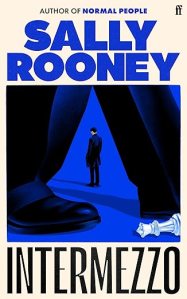
This month starts with Intermezzo by Sally Rooney. I haven’t read this book, so this is the description on Amazon UK:
Aside from the fact that they are brothers, Peter and Ivan Koubek seem to have little in common.
Peter is a Dublin lawyer in his thirties – successful, competent and apparently unassailable. But in the wake of their father’s death, he’s medicating himself to sleep and struggling to manage his relationships with two very different women – his enduring first love Sylvia, and Naomi, a college student for whom life is one long joke.
Ivan is a twenty-two-year-old competitive chess player. He has always seen himself as socially awkward, a loner, the antithesis of his glib elder brother. Now, in the early weeks of his bereavement, Ivan meets Margaret, an older woman emerging from her own turbulent past, and their lives become rapidly and intensely intertwined.
For two grieving brothers and the people they love, this is a new interlude – a period of desire, despair and possibility – a chance to find out how much one life might hold inside itself without breaking.
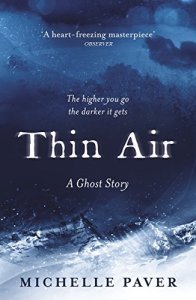
My first link is Thin Air, a novel by Michelle Paver also about two brothers. Kanchenjunga, the third highest mountain in the world, had claimed many lives and no one had reached the summit. Held to be a sacred mountain, it is one of the most dangerous mountains in the world – believed to be the haunt of demons and evil spirits. An unsuccessful attempt had been made in 1907, led by Edmund Lyell, when only two men had returned. The group in 1935, led by Major Cotterell, attempted to follow the 1907 route up the south-west face. Their story is narrated by medic, Dr. Stephen Pearce, accompanying his older brother, Kits. The brothers have always been rivals and this continues as they make their way up the mountain. Things start to go wrong almost straight away and Stephen is full of foreboding.
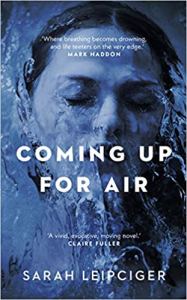
My second link is a book that also has ‘air’ in the title – Coming Up For Air, Sarah Leipciger’s second novel. It is a beautiful novel, a story of three people living in different countries and in different times. How their stories connect is gradually revealed as the novel progresses. As the author explains at the end of the novel it is a mix of fact and fiction and has its basis in truth. There is grief and loss and despair in each story, but above all, it is about love, and the desire to live. I think Sarah Leipciger is a great storyteller. It is an inspiring book, beautifully written, which emphasises the importance of the air we breathe and the desire to live. I read this book in June 2021.
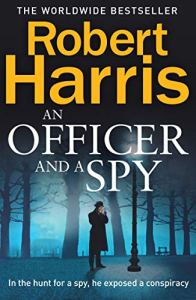
My third link is An Officer and a Spy, historical fiction by Robert Harris, another book I read in June 2021. It is a gripping book about the Dreyfus affair in 1890s France. Alfred Dreyfus, a young Jewish officer, was convicted of treason by passing secrets to the Germans in 1895 and sent to solitary confinement on Devil’s Island. It’s narrated by Colonel George Picquart, who became convinced that Dreyfus was innocent. Harris goes into meticulous detail in staying accurate to the actual events, but even so this is a gripping book and I was completely absorbed by it from start to finish.
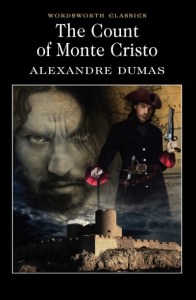
My fourth link is The Count of Monte Cristo, historical fiction by Alexandre Dumas, in which the main character is also wrongly imprisoned on an island. It begins in 1815 when Edmond Dantès, a sailor, having returned to Marseilles is wrongly accused of being a Bonapartist and imprisoned in the Chateau d’If on the Isle of Monte Cristo, for fourteen years. It’s a great story, action-packed, and full of high drama and emotion. Montecristo is a real island in the Tyrrhenian Sea, part of the Tuscan Archipelago, and administered by the municipality of Portoferraio in the province of Livorno.
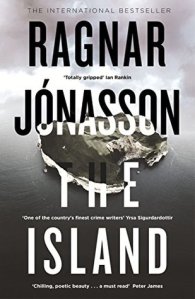
So My fifth link is also set on a real island, that of the isolated island of Elliðaey off the coast of Iceland in Ragnar Jónasson’s novel The Island, a murder mystery with elements of horror. Four friends visit the island ten years after the murder of a fifth friend, Katla, but only three of them return. One of them, Klara, fell to her death from a cliff – but did she jump or was she pushed? Detective Inspector Hulda Hermannsdóttir is sent to investigate. A suspect had been charged, but had committed suicide before the verdict was announced and the case had been closed. But are the two murders connected, even though they are ten years apart? This book is the second in Jónasson’s Hidden Iceland series.
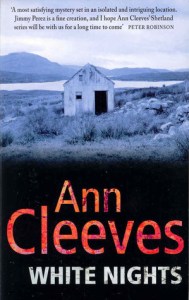
My final link is also the second book in a series, that is White Nights by Ann Cleeve, the second in her Shetland Quartet, featuring Detective Jimmy Perez. It’s set mainly in the village of Biddista, when Kenny Thomson finds a man’s body hanging in the hut where the boat owners of the village keep their lines and pots. At first it looks as though the man, his face covered by a clown’s mask, has committed suicide, but he’d been dead before he was strung up. As well as the mystery of who killed the man in the clown mask and why, there is also the disappearance 15 years earlier of Kenny’s older brother Lawrence. It was thought that he left the island after Bella had broken his heart. Kenny hadn’t heard from him since and at first thought the dead man could be him.
The books in my chain are mainly a mix of crime and historical fiction. And the chain has become a circle with the last book connecting to the starting book and the first book, all containing two brothers.
What is in your chain, I wonder?
Next month (December 7, 2024), we’ll start with a beach read – Sandwich by Catherine Newman.




 BooksPlease